


You've probably seen this already. The team produces a solid video, the agency puts spend behind it, the dashboard shows a pile of views, and nothing meaningful happens in the pipeline. No lift in lead quality. No sales conversation worth mentioning. Just a report full of activity.
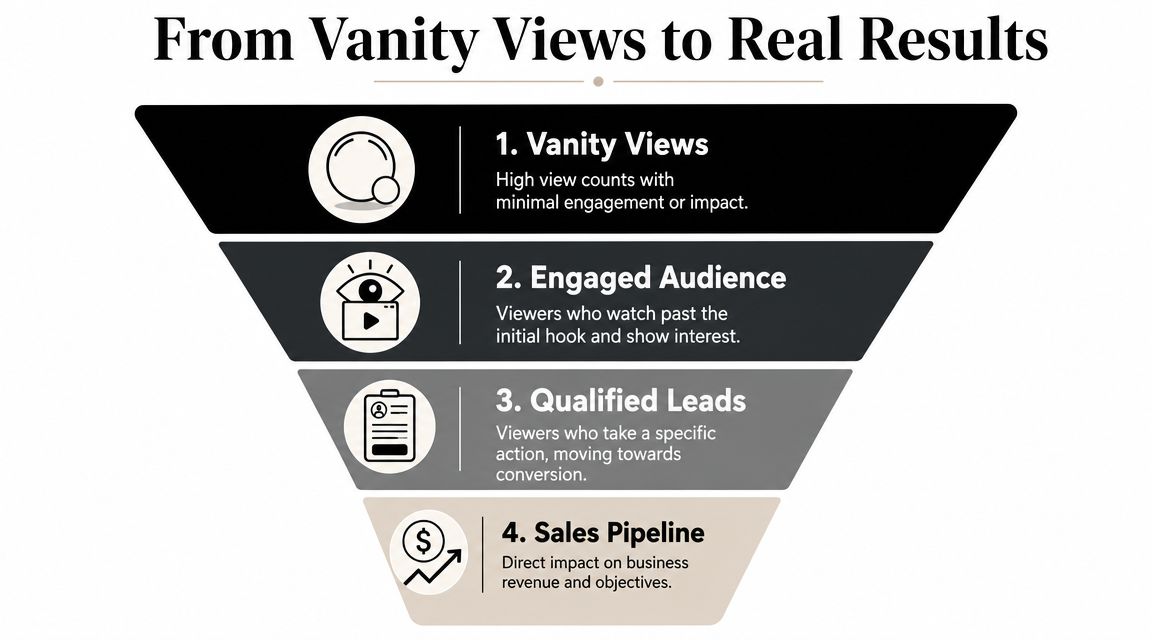
That's the problem with most advice about how to boost video views. It treats views as the finish line. They're not. They're just the first signal in a system that should produce engaged prospects, qualified leads, and revenue. If you're spending serious money on PPC, that distinction matters.
Large agencies usually split this work into silos. One team handles creative. Another handles YouTube SEO. Another launches paid campaigns. The result is predictable. Nobody owns the full path from impression to conversion. A specialist does. That's how you stop paying for attention that evaporates.
Table of Contents
Stop Chasing Vanity Views Start Driving Results - What qualified views actually look like
The Foundation Organic Optimization Before You Spend a Dime - Fix the discovery layer first - Build assets paid media can actually scale
Crafting Video Creative That Actually Holds Attention - The opening decides whether media spend survives - Authenticity beats formula when the promise is clear
Amplifying Reach with a Google Ads Video Campaign - Match the campaign objective to the business outcome - Use bidding and structure with intent
Precision Targeting and Smart Budget Allocation - Layer audiences instead of guessing - Budget by certainty not by hope
Measuring What Matters KPIs Beyond the View Count - Read performance in sequence - Build reporting for decision-making
Stop Chasing Vanity Views Start Driving Results
If you want to boost video views, stop obsessing over the view counter.
Most advice misses the underlying tradeoff. Bigger audience size sounds good until that audience is low intent and bounces fast. Platform algorithms reward watch time and retention, which means chasing more views can hurt you if those views come from the wrong people and drop early, as discussed in this YouTube analysis on retention and intent quality.
That's why “boosting” a post often disappoints senior marketers. It creates the appearance of traction without moving buyers any closer to action. Short-form distribution makes it easy to inflate top-of-funnel numbers. It does not make it easy to create demand from the right audience.
What qualified views actually look like
A qualified view isn't just a play. It's a view from someone who matches your market, stays engaged long enough to understand the offer, and has a logical next step after the video.
That changes how you package and promote everything:
Audience fit matters first: A mediocre view from your ideal buyer is worth more than a cheap play from someone who'll never buy.
Retention beats clickbait: If the title and thumbnail pull in the wrong people, the algorithm gets weak engagement signals.
Conversion path matters: Every video needs a next action. Visit a page. Watch the next asset. Fill out a form. Book a call.
Practical rule: Don't ask whether a video got views. Ask whether it attracted the kind of viewer your sales team actually wants.
If you want a useful outside perspective on why some videos spread while others stall, this creator's guide to video virality is worth reading. Not because virality is the goal for most brands, but because it sharpens your understanding of what earns attention versus what sustains it.
Brand demand matters here too. If people already recognize your brand category connection, your videos won't have to work as hard at the click stage. That's why I also look at broader visibility signals like share of search, not just platform-native video metrics.
The Foundation Organic Optimization Before You Spend a Dime
Most wasted video ad spend starts before the campaign launches.
The asset is weak, the metadata is lazy, the thumbnail is generic, and the channel gives Google almost no context. Then the agency flips the campaign live and blames the audience. That's backwards. Before you spend anything, the video needs to be discoverable, clickable, and aligned with the intent you want to buy.

A strong workflow starts with the discovery layer. Use keyword-rich titles and descriptions, publish an eye-catching thumbnail that accurately matches the video, and distribute across relevant channels. Those are repeatedly identified as key drivers of view growth in this video marketing measurement guide from Cronyx Digital.
Fix the discovery layer first
Your title should describe the actual problem solved by the video. Not your internal campaign name. Not a vague brand slogan. Use the language your buyer would type into YouTube or Google.
Descriptions should support that same intent. Write like a search strategist, not like a press release writer. Put the primary topic early. Clarify who the video is for. Reinforce the outcome. Then point viewers to the next action.
If your team needs a broader benchmark for how search behavior affects video discovery, these view video SEO insights from Keyword Kick are useful context.
Here's a simple checklist I use before any paid launch:
Title alignment: The title should reflect a real query or buyer pain point.
Description clarity: The first lines should explain the value fast and support search understanding.
Thumbnail honesty: It must earn the click without creating a promise the video can't keep.
Channel relevance: Your YouTube channel page should make it obvious what market you serve and what topics you cover.
A good keyword framework matters well before ad setup. If your team needs to tighten that process, review this breakdown of how to build a keyword list for SEO success.
Build assets paid media can actually scale
Paid media magnifies what's already there. If the metadata is sloppy, a paid campaign won't fix that. It will just buy more traffic into a weak setup.
That's one reason I prefer specialist-led execution over agency workflow. A specialist looks at the title, the thumbnail, the landing experience, the audience match, and the ad setup as one operating system. Agencies often separate those decisions across departments. Nobody catches the friction until money has already been spent.
This walkthrough is a useful refresher on the basics of video packaging and search visibility:
Clean packaging lowers friction. Lower friction gives the algorithm and your paid campaigns a better chance to find the right audience efficiently.
Crafting Video Creative That Actually Holds Attention
Most video campaigns don't fail in targeting. They fail in the opening.
You can buy distribution all day long, but if the creative loses people immediately, the campaign is dead on arrival. That's why creative is the biggest lever in any effort to boost video views profitably. Not louder bidding. Not broader targeting. The video itself.
Multiple expert sources recommend winning attention in the first 3 to 5 seconds by cutting slow intros, leading with the core value proposition, and keeping the video focused and concise. That early sequence is the retention hinge, according to this video marketing metrics guide from ReportDash.

The opening decides whether media spend survives
If your video starts with a long logo animation, a soft scene-setter, or generic brand language, you're burning budget.
Open with the outcome. Tell the viewer what they'll get. Show the pain point. Demonstrate the result. Ask the sharp question they're already thinking about. Do something that earns the next few seconds.
A practical structure works well:
Immediate relevance: State the problem or promised outcome.
Fast proof: Show the product, insight, result, or mechanism.
Controlled expansion: Add context only after attention is secured.
Clear CTA: Tell the viewer exactly what to do next.
Many polished brand teams encounter self-imposed obstacles. They want the piece to feel sophisticated. Buyers want it to feel useful.
If the viewer can't tell why they should keep watching almost immediately, the platform won't save you.
Authenticity beats formula when the promise is clear
There's a difference between optimization and obvious optimization. The internet is full of videos that look engineered for an algorithm first and a human second. Audiences notice.
The better play is natural delivery with sharp framing. Faster value. Less fluff. No fake suspense. No clickbait-style curiosity gap that gets the click and then destroys trust. That's especially true for brands selling considered purchases, services, or B2B offers where credibility matters as much as attention.
Your visual choices matter here too. Color, contrast, and scene composition all affect whether people keep processing the message. If your team needs to sharpen that side of creative, this resource on color psychology in advertising is useful.
Use this test before launching a video ad:
Mute test: Can someone understand the point from visuals and captions alone?
First-frame test: Does the opening screen look like content worth stopping for?
Trust test: Does the packaging accurately reflect the substance of the video?
CTA test: Is the next step obvious without sounding desperate?
That's the creative standard. Anything lower is just buying exits.
Amplifying Reach with a Google Ads Video Campaign
Once the asset is strong, paid amplification becomes useful. Google Ads can help you boost video views with control instead of guesswork.
Most underperforming accounts don't have a platform problem. They have a setup problem. The wrong objective. The wrong bid strategy. Weak ad group logic. Sloppy audience segmentation. Then somebody says video “doesn't work.”
Match the campaign objective to the business outcome
Start with the actual business goal.
If you need broad exposure for a new message, a view-focused setup can make sense. If you want pipeline impact, move closer to Leads or Sales objectives and make sure conversion tracking is in place before launch. Don't pick a campaign type because it's familiar. Pick it because it matches the role the video plays in the funnel.
The same discipline applies to ad format selection. Some videos should be used to create initial awareness. Others work better as remarketing assets after someone has already visited your site or engaged with a prior video. Treat every creative asset according to intent, not convenience.
If you want a more detailed walkthrough of platform mechanics, this guide on how advertisements on YouTube actually work gives useful context.
Use bidding and structure with intent
Bidding isn't a minor setting. It changes how the platform finds inventory and what kind of outcomes you're likely to get.
For broad reach and initial testing, Maximum CPV (cost per view) can help you learn which assets and audiences attract attention efficiently. For conversion-led campaigns, Target CPA (cost per acquisition) is often the better fit once you have reliable tracking and enough signal for the system to optimize toward action rather than cheap plays.
A clean account structure usually beats a complicated one. I'd rather see a disciplined campaign setup with clear audience separation than a bloated build full of overlapping ad groups nobody can interpret.
Use a structure like this:
One campaign for prospecting: New audiences, separated by audience type or theme.
One campaign for remarketing: Viewers, site visitors, and engaged users who already know you.
Distinct ad groups for creative testing: Separate videos so you can read performance cleanly.
Extension support where relevant: Add the supporting assets that improve visibility and click path.
Senior PPC management isn't about adding complexity. It's about removing ambiguity so budget decisions are obvious.
This is also where specialist management beats large agency process. A specialist can spot quickly whether the issue is creative fatigue, audience mismatch, weak conversion tracking, or a bid strategy that doesn't fit the campaign stage. Agencies often need two meetings and a spreadsheet before anyone touches the account.
Precision Targeting and Smart Budget Allocation
Targeting is where waste usually hides.
A lot of teams still run video like it's broad-reach display from years ago. They choose basic demographics, stack interests loosely, and hope the algorithm figures it out. That's lazy account management. If you're spending serious money each month, your targeting needs to reflect actual buyer signals.
Layer audiences instead of guessing
The best video targeting setups usually combine several signals rather than relying on one broad audience bucket.
Custom Segments are a strong starting point. Build them from the search terms your buyers use and the websites they visit while researching the category. This gives Google clearer context on who should see the ad.
Then layer in audience types based on campaign role:
In-Market audiences: Useful when buyers are actively researching a solution category.
Custom Segments: Better when you know the language and competitor environment well.
Remarketing pools: Often the most efficient traffic because the viewer already knows you.
Customer or lead-based audiences: Helpful for exclusions, upsell paths, or reactivation.
Don't stack everything into one ad group. Separate these audience types so you can see where intent is strongest.
Budget by certainty not by hope
Teams often overfund unproven prospecting and underfund remarketing because broad campaigns produce prettier dashboards.
That's backwards. Put enough budget into testing, but reserve meaningful spend for audiences that have already shown intent. The purpose of prospecting is to find future winners. The purpose of remarketing is to convert known interest.
Here's a practical model for a monthly video budget.
Campaign Type |
Audience |
Budget Allocation |
Primary KPI |
|---|---|---|---|
Prospecting |
Custom Segments based on search terms and competitor/category URLs |
$8,750 |
Qualified view rate |
Prospecting |
In-Market audiences aligned to product or service category |
$5,000 |
View-through rate |
Remarketing |
Site visitors and engaged video viewers |
$7,500 |
Conversions |
Creative testing |
New hooks, thumbnails, and audience-message combinations |
$3,750 |
Cost per qualified view |
That sample split keeps exploration alive without letting testing consume the whole budget.
A few allocation rules matter:
Protect remarketing spend: Don't let high-volume prospecting starve your warm audiences.
Cap experiments intentionally: Testing is necessary, but uncontrolled testing becomes drift.
Promote winners fast: Once an audience-creative pair proves it can hold attention and drive action, give it room.
Cut unclear ad groups: If you can't explain what an ad group is supposed to prove, it shouldn't exist.
This is exactly where senior oversight changes results. Junior account managers tend to spread spend evenly because it feels safe. It isn't. Strong PPC management concentrates budget where intent and performance are clearest.
Measuring What Matters KPIs Beyond the View Count
If your reporting ends at views and impressions, you don't have performance reporting. You have campaign theater.
Video is now a massive advertising environment. Global digital video advertising spending surpassed $191.4 billion in 2024, and short-form digital video spending is projected to reach $111 billion in 2025, a 12% year-on-year increase, according to this video marketing statistics roundup citing Statista. In a market that crowded, measurement has to be precise.
Read performance in sequence
I care about metrics in order, not in isolation.
Start with View-Through Rate (VTR) to judge whether the creative holds attention. Then look at Click-Through Rate (CTR) to see whether the audience wants the next step. After that, focus on conversion tracking. That's where business value shows up.
A useful internal metric is cost per qualified view. Define it clearly. For example, a qualified view might be a viewer who reaches a chosen watch threshold, visits the site, or proceeds to the next intended action. This gives you a better lens than raw CPV because it ties spend to meaningful engagement.
The best KPI stack tells you where performance broke. Creative, audience, click path, or conversion experience.
Build reporting for decision-making
Your report should help you decide what to change next. It should not just summarize what happened.
That means connecting platform metrics with downstream business outcomes. Which audiences produce engaged viewers? Which creative earns both retention and action? Which remarketing pools convert cleanly? Which landing pages hold up after the click?
If your team is improving how it communicates search and visibility performance more broadly, this guide for modern SEO reporting is a useful companion resource.
A strong reporting cadence should include:
Creative readouts: Which openings, formats, and CTAs hold attention best.
Audience comparison: Which segments produce qualified views instead of empty volume.
Conversion path analysis: Whether drop-off happens on-platform, after the click, or at the form stage.
Action list: What gets paused, scaled, rewritten, or retested next.
The point isn't to boost video views for bragging rights. It's to buy the right attention, hold it, and turn it into measurable business movement.
If you're tired of agency reporting that celebrates views but dodges revenue impact, Come Together Media LLC offers a better option. You work directly with a senior PPC specialist, get clear strategy instead of layers of account management, and see exactly how Google Ads decisions connect to pipeline and ROI.
