


You're probably living this already. Search is carrying the account, branded demand is doing its job, and then someone shows you the display report. It's full of impressions, vague placement summaries, and language about “awareness,” but when you push for pipeline, revenue, or even qualified assisted conversions, the room goes quiet.
That's not a display problem. It's a management problem.
Most high-spend accounts don't fail on display ad networks because the channel is broken. They fail because agencies hand display to junior staff, turn on broad automation, skip placement discipline, and then hide behind volume metrics. A serious advertiser needs more than access to inventory. You need control, measurement, and someone who knows how to stop waste before it compounds.
Table of Contents
Why Your Agency's Display Campaigns Are Failing - Where the waste starts - What a serious operator does differently
What Are Display Ad Networks Really - Think of it like a media marketplace - Why display networks exist - What this means for a CMO
The Three Network Types You Must Understand - Google Display Network - Programmatic ad exchanges - Native ad networks - Display network types compared for CMOs
How Display Ads Are Bought and Sold in Milliseconds - The process in plain English - The bidding models you actually need to care about - The lever most teams underuse
Measuring What Matters and Proving True ROI - Stop rewarding vanity metrics - Incrementality is the real test - What I'd ask in every display review
A Specialist's Playbook for Display Ad Optimization - The non-negotiables - How privacy changes the playbook - What specialists do that agencies usually don't
Your Pre-Launch Checklist for a Profitable First Campaign - The pre-flight check - One immediate audit step
Why Your Agency's Display Campaigns Are Failing
If your team is spending serious money on PPC, display shouldn't be treated like leftovers. That's what agencies do when they don't have senior oversight. Search gets the attention because it's easier to explain. Display gets the autopilot settings, a few generic banners, and a monthly deck full of numbers that sound busy but don't help you make decisions.
The usual pattern is ugly. Broad targeting. Weak exclusions. No audience separation between prospecting and remarketing. No real creative testing. Then the agency points to reach, clicks, or assisted conversion fluff while your actual acquisition costs drift in the wrong direction.
Where the waste starts
Display ad networks can absolutely support growth. But they punish lazy account structure.
Here's where agencies usually lose control:
They buy too wide, too early: Broad inventory without tight guardrails invites junk placements, accidental app traffic, and low-intent impressions.
They optimize to the wrong signals: CTR looks nice in a report. It doesn't pay for pipeline, subscriptions, leads, or sales.
They ignore placement quality: If nobody is reviewing where ads ran, you're not managing display. You're donating budget.
They blur funnel stages: Remarketing audiences and cold prospecting audiences need different bids, creatives, and expectations.
Most display failures come from weak operating discipline, not from the channel itself.
What a serious operator does differently
A specialist treats display as a strategic lever. That means connecting it to the rest of the account, forcing every campaign to justify its role, and cutting anything that can't prove value over time.
That's also why independent PPC specialists often outperform bloated agencies. You get direct communication, faster changes, and someone who owns the result instead of passing the account to a coordinator who learned display from a certification quiz.
What Are Display Ad Networks Really
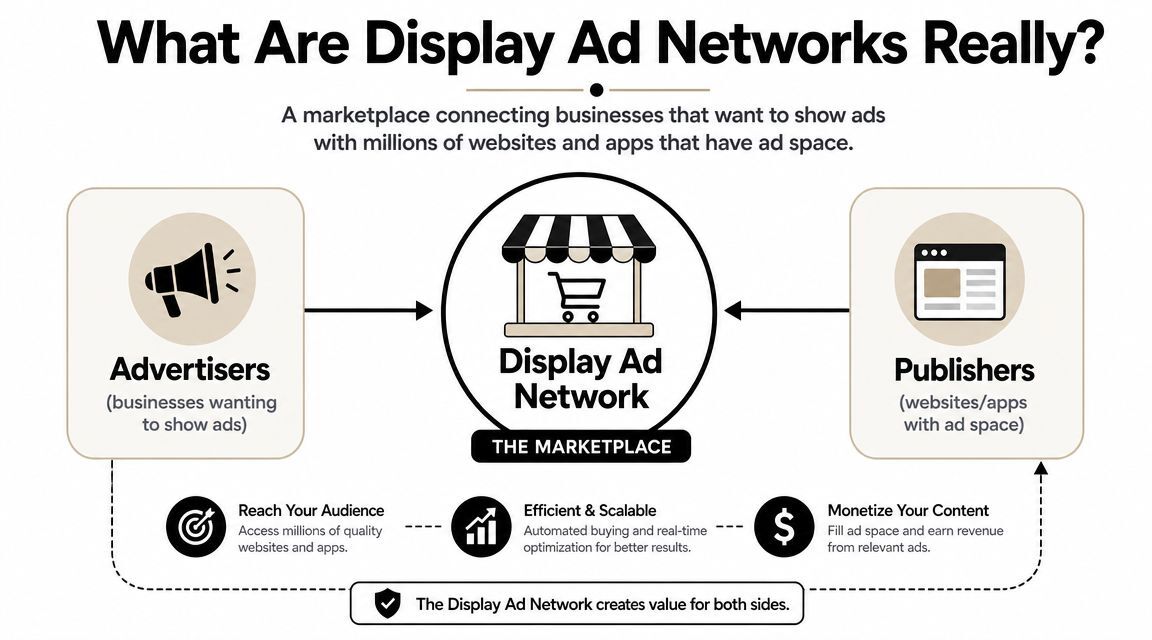
A display ad network is a marketplace. Advertisers want attention. Publishers have ad space. The network sits in the middle and makes the match at scale.
That's the simple version. The strategic version is more useful. Display ad networks let you buy access to a huge spread of websites, videos, and apps without negotiating one publisher at a time. That's what makes them practical for brands that need reach beyond search intent.
Think of it like a media marketplace
If direct media buying is buying one building, a display network is buying access to a city.
That scale is the point. One source notes that the Google Display Network is connected to over 2 million websites, videos, and apps through this overview of major display inventory sources. For advertisers, that matters because broad inventory gives you room to trade off reach versus control, then narrow delivery with placement, audience, and contextual filters.
The mistake is assuming scale alone creates value. It doesn't. Scale just gives you options. Value comes from how well you constrain and optimize those options.
Why display networks exist
No serious in-house team wants to negotiate thousands of separate deals just to test banner placements, remarketing audiences, or contextual buys. Display ad networks compress that complexity into one buying environment.
That gives you a few practical advantages:
Faster deployment: You can launch across broad inventory without publisher-by-publisher setup.
Centralized controls: Budget, targeting, exclusions, creative rotation, and bidding all sit in one place.
Better testing velocity: You can test audiences, messages, and placements without rebuilding the whole buying process each time.
Practical rule: Don't evaluate a display network by how much inventory it has. Evaluate it by how precisely your team can control that inventory.
What this means for a CMO
For a high-spend account, display ad networks aren't just a technical layer. They're a distribution system for brand recall, retargeting, assisted conversion, and selective prospecting.
Used well, they help you stay visible between search sessions, support branded demand, and bring back visitors who weren't ready the first time. Used badly, they become a giant container for cheap impressions and weak accountability.
That's why “what is a display network?” is the wrong question. The better question is whether your team is using the network as a precision tool or a budget hose.
The Three Network Types You Must Understand
Not all display ad networks solve the same problem. If your agency is lumping everything under “display,” they're flattening decisions that matter. You need to know which network type fits which objective.
Google Display Network
For broad reach and operational simplicity, Google Display Network is usually the first place teams start. That makes sense. It's tied closely to Google Ads workflows, audience lists, and campaign management habits your team already knows.
Its biggest strength is scale. As noted earlier in the article, GDN gives advertisers access to a massive inventory pool. That's useful when you want to expand beyond search and still keep campaign controls in a familiar platform.
GDN tends to fit best when you need:
Remarketing at scale: Especially when you want list-based audience segmentation inside Google Ads.
Top and mid-funnel reach: Good for keeping the brand present across broad web inventory.
Operational efficiency: One interface, one reporting environment, one workflow alongside Search and YouTube.
The downside is obvious. Easy access makes it easy to overspend if no one is policing placements, audience overlap, and creative quality.
Programmatic ad exchanges
Programmatic buying is where you go when control matters more than convenience.
This route is better for teams that want tighter inventory decisions, broader exchange access, and more flexibility around premium placements, audience combinations, or supply path choices. It's usually a stronger fit for mature advertisers that need to push beyond standard account setups.
Programmatic tends to work best when you care about:
Granular control: More ways to shape supply, frequency, and audience logic.
Premium inventory access: Better opportunities when brand environment matters.
Cross-channel sophistication: Useful if display is part of a broader media operation, not just a Google Ads add-on.
The catch is that complexity rises fast. If your team doesn't know what it's doing, “more control” turns into more expensive confusion.
Native ad networks
Native networks are different because the creative experience is different. These placements are designed to blend into surrounding content rather than scream “banner ad.”
That can be the right move when your goal is content-driven engagement, education, or softer prospecting. Native is often stronger than standard display when the buying cycle is longer and the audience needs context before they convert.
Use native when:
You're selling a considered purchase: The audience needs explanation before action.
Creative fatigue is high: Standard banners are getting ignored.
Content is part of the funnel: Guides, insights, and category education matter.
Native still needs discipline. Blending in is not the same as performing well.
Display network types compared for CMOs
Network Type |
Primary Use Case |
Key Advantage |
Watch Out For |
|---|---|---|---|
Google Display Network |
Reach, remarketing, integrated Google Ads execution |
Scale and easy alignment with existing Google Ads data |
Waste from loose placements and overreliance on automation |
Programmatic Ad Exchanges |
Advanced media buying and premium inventory access |
Stronger control over supply, targeting, and buying strategy |
Complexity, cost creep, and poor execution if unmanaged |
Native Ad Networks |
Content-led prospecting and softer user journeys |
Ads feel more natural in-content |
Weak creative-message fit can burn budget quietly |
If your team can't explain why they chose one network type over another, they didn't make a strategy decision. They made a default one.
How Display Ads Are Bought and Sold in Milliseconds
Marketers don't need a technical lecture on ad serving. They need to understand the buying levers well enough to stop bad decisions.
At the core, display ad networks run on an ad-server and matching layer that aggregates publisher inventory and assigns impressions using models like CPM, CPC, or CPA, as explained in Criteo's guide to how ad networks operate. That setup matters because performance improves when the system can shift spend toward placements that beat your efficiency targets.
The process in plain English
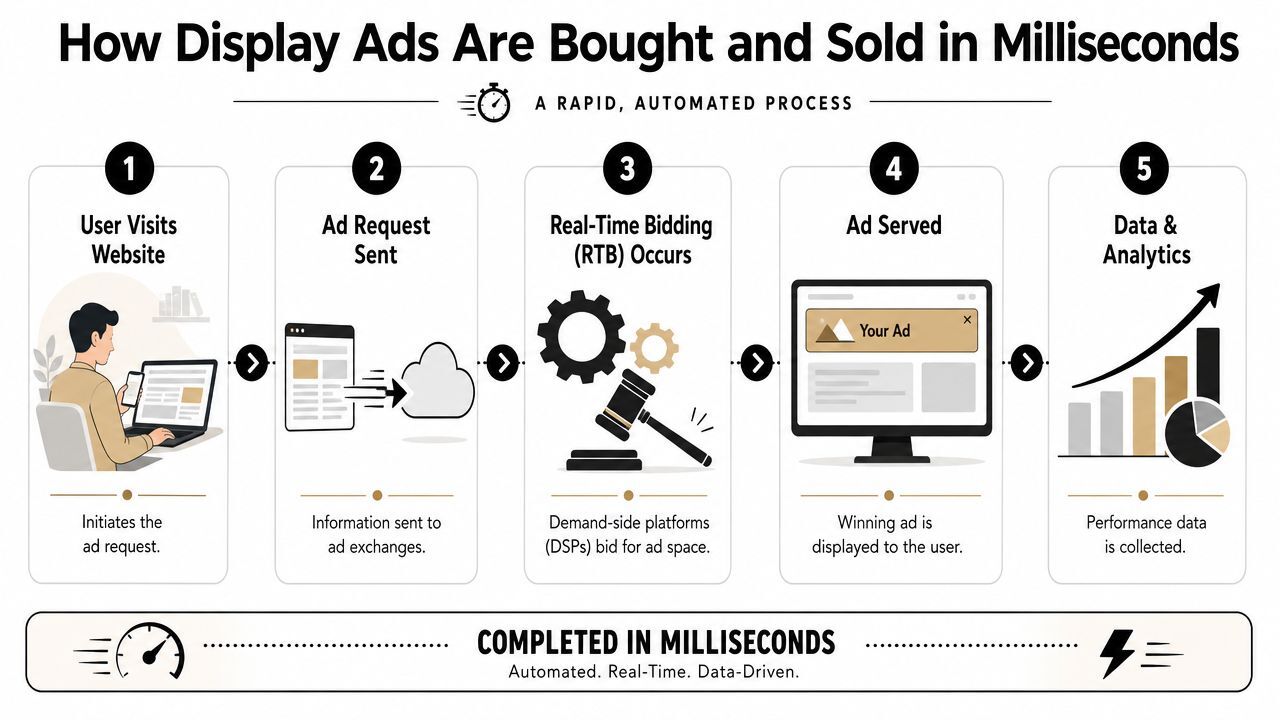
Here's what happens when someone loads a page with ad space:
A publisher makes inventory available. A website or app has an open slot.
The network evaluates the opportunity. It checks available signals tied to the user, page, device, and campaign rules.
Bidding logic kicks in. Advertisers compete based on targeting, bid strategy, and relevance.
A winner is selected. The ad server chooses what gets shown.
Performance data feeds back in. That data should shape future spend decisions.
This all happens fast, but the speed isn't the important part. The important part is that every one of those moments creates an optimization choice.
For a deeper explanation of the buying mechanics, this no-nonsense guide to programmatic ad buys is worth reviewing if your current reporting feels too abstract.
The bidding models you actually need to care about
Not every pricing model fits every goal.
CPM: Best when visibility and reach matter, but dangerous if traffic quality is poor.
CPC: Better when you need a click-based filter, though cheap clicks can still be worthless.
CPA: Useful when conversion data is strong enough to support outcome-based optimization.
A lot of teams choose the model first and ask questions later. That's backwards. Your conversion tracking quality should influence bidding choices, not the other way around.
Here's a short explainer before the video.
The lever most teams underuse
Targeting is where broad display becomes useful instead of reckless.
You're not trying to “reach everyone.” You're trying to tell the platform which impressions matter more. That can mean contextual alignment, audience intent, remarketing lists, or exclusion logic that removes obvious waste.
Good display managers don't just buy impressions. They shape the conditions under which an impression is worth buying.
Measuring What Matters and Proving True ROI
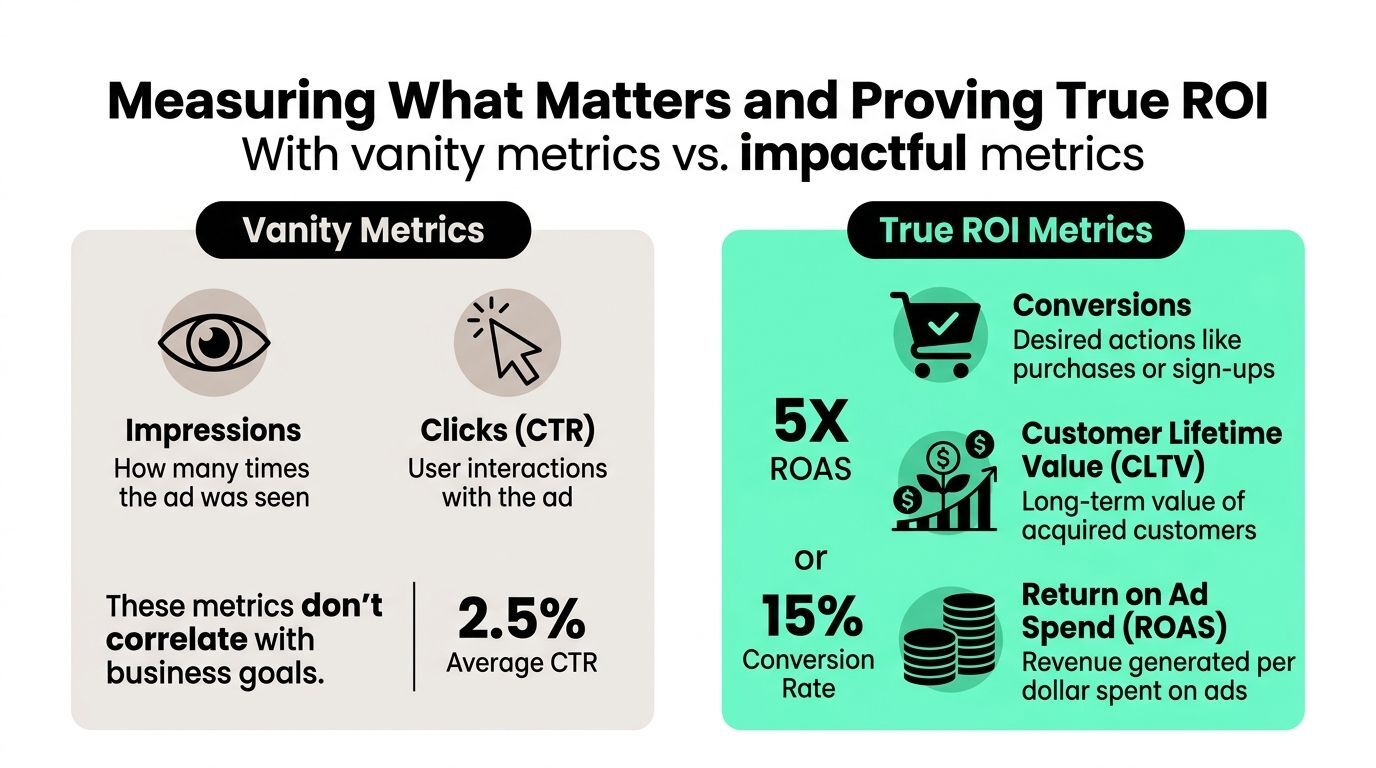
Most display reporting is designed to make mediocre work look active. Impressions. Reach. CTR. Viewability snapshots with no business context. None of that is enough.
A high-spend account needs a harder question answered. Did display create value you wouldn't have captured otherwise?
Stop rewarding vanity metrics
CTR has its place. So does viewability. But they are support metrics, not business outcomes.
If your agency celebrates cheap traffic while lead quality drops or revenue stalls, they're managing the spreadsheet, not the account.
The metrics that deserve executive attention are:
CPA: What it costs to generate the conversion you care about.
ROAS: How much revenue comes back relative to ad spend.
View-through conversions: Useful when interpreted carefully, not used as a dumping ground for inflated credit.
Incrementality: The hardest metric. Also the most important.
If your team hasn't built a serious view-through framework, this explanation of how view-through conversions should be interpreted in real PPC analysis is a useful benchmark.
Incrementality is the real test
Weak agencies often falter here. They'll happily tell you display “assisted” a sale. They're much less eager to prove whether the campaign generated net-new demand or merely attached itself to conversions that would have happened anyway.
That distinction matters more now because privacy changes have made user-level attribution less reliable. One market analysis argues that the value of display is shifting toward transparent reporting, predictable CPMs, clean supply paths, and AI-driven curation, and reports up to 38% higher CTRs and 27% stronger viewability for networks using AI-driven curation and dynamic creative optimization versus static networks in this 2026 analysis of modern display network performance. It's a projection-oriented market signal, not a shortcut to declaring success in your account.
What I'd ask in every display review
Use these questions in your next meeting:
Question |
Why it matters |
|---|---|
What business KPI is this campaign optimized to improve? |
Forces clarity beyond impressions |
Which placements or audience segments are creating qualified outcomes? |
Exposes waste hidden inside blended reporting |
Are view-through conversions being separated from click-through conversions? |
Prevents inflated attribution |
What evidence suggests the campaign is incremental? |
Tests whether display is actually adding value |
Bottom line: If a display campaign can't defend itself on CPA, ROAS, conversion quality, or credible assist value, cut it or rebuild it.
A Specialist's Playbook for Display Ad Optimization
Execution separates useful display from expensive noise. You don't need more dashboards. You need tighter control and faster decisions.
The first rule is simple. Build for precision, then expand only when the account earns it.
The non-negotiables
Here's the operating baseline I expect before any display campaign gets more budget:
Aggressive exclusions: Review placements early and often. Cut low-quality environments before they absorb spend.
Audience separation: Keep prospecting and remarketing in different campaigns. They need different bids, creatives, and performance expectations.
Creative variation: Test multiple headlines, images, and offers. Weak creative kills good targeting.
Landing page alignment: If the ad promises one thing and the page delivers another, performance falls apart after the click.
Many agency workflows break at this point. Junior managers don't have the time, authority, or experience to make constant adjustments at the level display requires.
How privacy changes the playbook
Cookie-restricted buying is forcing smarter strategy. According to Post Affiliate Pro's overview of ad network evolution, stronger display performance increasingly comes from combinations of automation, contextual relevance, and reporting transparency, with advertisers urged to prioritize partners that support AI optimization and contextual intelligence.
That changes campaign design in a few practical ways:
Lean harder on context: Page relevance matters more when behavioral tracking gets weaker.
Use first-party signals well: CRM audiences, customer lists, and site behavior still matter when governed properly.
Choose transparent partners: If reporting is vague, optimization will be vague too.
One useful way to keep this organized is to borrow a structured B2B marketing framework that forces your team to align channels, messaging, and measurement before spend ramps.
What specialists do that agencies usually don't
A specialist ties display back to the whole account. Search queries inform messaging. Remarketing pools reflect actual user behavior. Creative gets refreshed when frequency starts doing damage instead of good.
That's very different from turning on responsive assets and hoping machine learning sorts it out. Automation is useful. Surrender is not.
If you want a sharper contrast between disciplined execution and lazy account handling, this piece on display advertising best practices versus agency inefficiency makes the gap pretty obvious.
Your Pre-Launch Checklist for a Profitable First Campaign
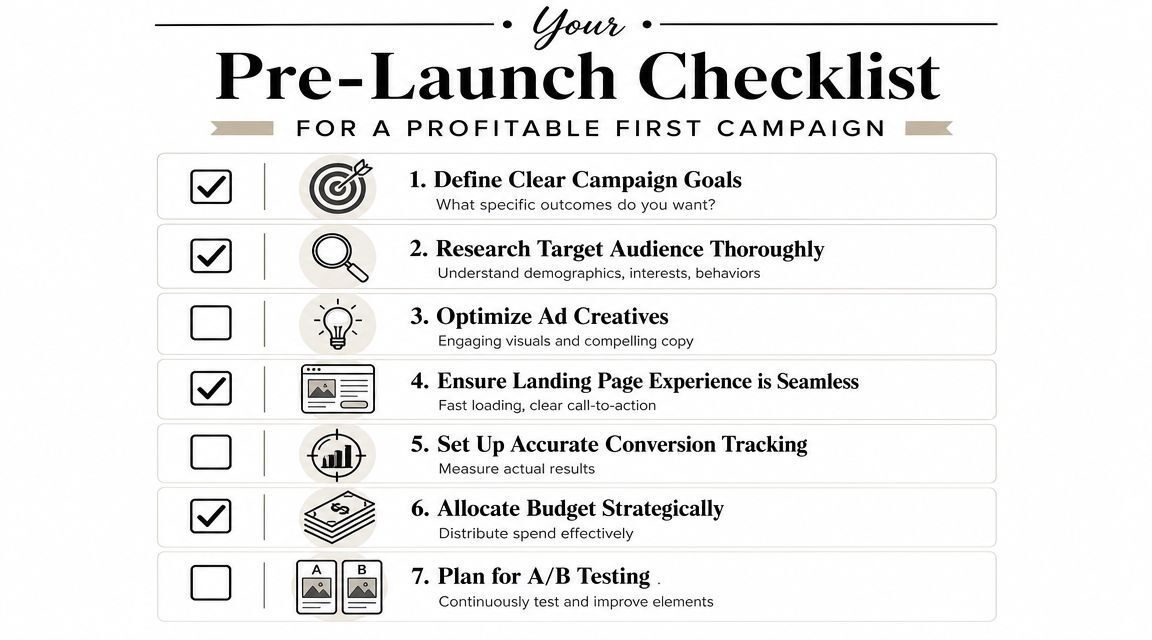
Before launch, I want discipline. Not enthusiasm. Discipline prevents stupid losses.
If your team can't answer the questions below clearly, the campaign isn't ready.
The pre-flight check
Define the goal: Is this campaign for prospecting, remarketing, awareness support, or direct response? One campaign should have one primary job.
Verify conversion tracking: If tracking is loose, every optimization decision after launch is compromised.
Separate audiences: Don't lump warm visitors and cold audiences together.
Review exclusions before launch: Placements, apps, and obvious junk inventory need guardrails from day one.
Match ad to landing page: Message, offer, and call to action should feel continuous.
Set a reporting cadence: Someone should review early placement quality and conversion behavior quickly, not at the end of the month.
Decide what success means in advance: CPA target, ROAS threshold, qualified lead quality, or assisted conversion role. Pick the standard before spend starts.
One immediate audit step
Open your current display campaign and look at where ads appeared. If that report looks messy, irrelevant, or suspiciously broad, you don't have a creative problem first. You have a placement control problem.
For teams rebuilding creative assets, this guide to display ad dimensions and practical production decisions helps tighten execution before the next launch.
If you're spending serious money on PPC and you're tired of display campaigns being managed like an afterthought, Come Together Media LLC offers the kind of direct, senior-level PPC support most agencies promise and rarely deliver. You work with a specialist, not a rotating cast of junior account managers, and you get clear strategy, transparent reporting, and faster execution built around ROI.
