


You're spending serious money on Google Ads. The dashboard says traffic is coming in. The agency says performance is stable. Sales says the leads are weak, slow to close, or never should've been sent over in the first place.
That disconnect is the core problem with most Google Ads for lead generation programs. The issue usually isn't that Google Ads can't work. It's that the account is built to generate activity, not revenue. Google Search can be powerful because it captures intent when people are actively searching, and Google reports that advertisers on Google Search typically see about $2 in revenue for every $1 spent, with some reporting returns as high as $8 for every $1 invested (Leverage Digital roundup citing Google Ads data). But that upside only matters if your system turns clicks into qualified opportunities.
Most large agencies don't fix that. They smooth it over with polished reporting, blended metrics, and junior account management. A specialist looks at the same account and asks a harder question. Are these leads helping the sales team close business?
Table of Contents
The Architectural Blueprint for Lead Generation - Why structure decides performance - Google Ads campaign types for lead generation goals - Build around intent, not internal org charts
Engineering Conversions with Landing Pages and Forms - Message match beats clever design - Forms should screen lightly, not interrogate
Flawless Conversion Tracking and Attribution - The minimum viable tracking stack - Offline conversion imports change what the account learns
The Specialist's Edge in Bidding and Lead Quality - Low CPL is often the wrong win - First-party data is now the leverage point
The C-Suite Dashboard for Meaningful Reporting - What leadership should see every week - What to remove from agency reports
Moving Past the Agency Model
If your account spends enough to matter, it deserves senior attention. That's where the agency model usually breaks down.
The problem isn't that agencies are always incompetent. The problem is incentive design. Agencies get paid to manage accounts across a roster. That pushes them toward repeatable processes, broad reporting templates, and safe optimization cycles. Your account becomes another line item in a workflow.
That's how you end up with reports full of impressions, clicks, and average CPC while your CRM fills with bad-fit leads.
The account isn't healthy because it generated more leads. It's healthy when sales wants more of those leads.
A specialist approaches Google Ads for lead generation differently. You don't need a team of layers. You need one person who can audit search intent, landing page friction, tracking quality, bidding signals, and CRM feedback without losing the thread. That's faster, clearer, and usually far more accountable.
If you also manage paid acquisition across retail or product-led offers, this practical guide on how to grow your e-commerce business with Google Ads is useful because it highlights the same core truth. Campaign success comes from matching intent, offer, and measurement rather than buying more clicks.
For a more direct look at why many businesses outgrow outsourced account management, compare that model with a specialist-led PPC ad agency alternative and the tradeoffs become obvious.
What usually goes wrong
Reporting is upside down: Agencies lead with traffic metrics instead of lead quality.
Optimization stays shallow: They adjust bids and ads, but ignore CRM outcomes.
Account ownership is fragmented: Strategy, execution, and reporting sit with different people.
The sales loop is broken: Nobody feeds back which leads were qualified, booked, or closed.
That's not a media buying issue. It's an operating model issue.
The Architectural Blueprint for Lead Generation
A bad account structure can't be rescued by better ad copy. If the architecture is sloppy, every later optimization is weaker than it should be.
Why structure decides performance
Most bloated accounts suffer from one of two problems. Either everything is crammed into a few campaigns with messy targeting, or the agency built an overcomplicated maze that no one wants to touch.
Neither works.
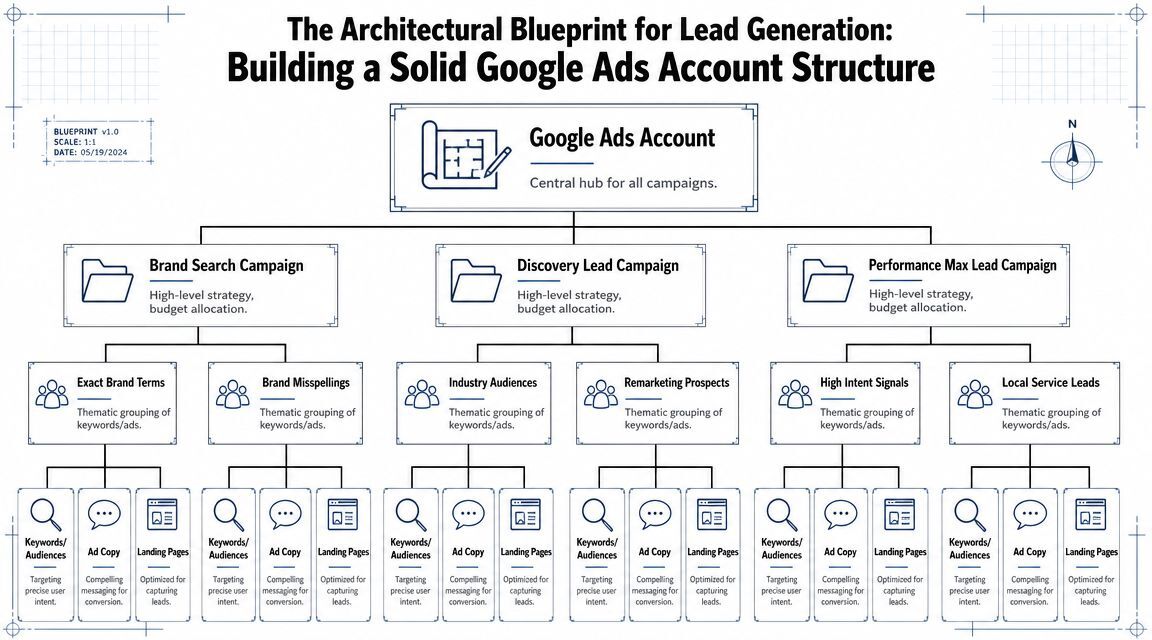
For lead generation, start with tightly themed Search campaigns built around high-intent keyword groups. That's the practical benchmark. Use exact and phrase match for the strongest commercial terms and hold back broad match until you've built a reliable smart bidding setup and a strong negative keyword list (Dynares guidance on Google Ads lead generation structure).
That advice matters because broad match can look efficient before you inspect the search terms and lead quality. It often widens reach faster than your qualification system can keep up.
A clean structure usually looks like this:
Brand Search: Protects branded demand and keeps competitor traffic from hijacking the easiest wins.
Core high-intent non-brand Search: Targets solution-aware searches with clear commercial intent.
Competitor or alternative campaigns: Useful when buyers are actively comparing options.
Performance Max or discovery-style support: Better used after tracking and lead feedback are stable.
Remarketing support: Re-engages visitors who clicked but didn't convert.
Google Ads campaign types for lead generation goals
Campaign Type |
Primary Use Case |
Best For |
|---|---|---|
Search |
Capturing active demand from users already looking |
High-intent leads, demo requests, quote requests |
Performance Max |
Expanding reach with automation and audience signals |
Mature accounts with strong conversion tracking |
Discovery |
Reaching users earlier in the decision process |
Offer-led lead magnets and assisted demand generation |
Brand Search |
Defending existing demand |
High-converting branded traffic |
Remarketing |
Re-engaging previous visitors |
Longer sales cycles and multi-touch journeys |
Build around intent, not internal org charts
I still see accounts structured around product teams, office politics, or agency convenience. That creates keyword overlap, weak ad relevance, and landing page mismatch.
Instead, group campaigns around what the buyer is trying to accomplish. A user searching for pricing, implementation help, emergency service, or a vendor comparison is signaling very different intent. Treat those searches differently.
Practical rule: If one campaign contains buyers at different stages of intent, your budget allocation is already distorted.
Your immediate action step is simple. Pull your current Search campaigns and check whether each campaign maps to one clear intent cluster. If not, rebuild before you spend more time tweaking bids.
Engineering Conversions with Landing Pages and Forms
Most lead gen failures don't happen on the keyword. They happen after the click.
Agencies love to say they're driving qualified traffic. Fine. But if the landing page is generic, slow, cluttered, or asks for too much too early, you're paying to create drop-off. That's not traffic quality. That's conversion negligence.
Message match beats clever design
The landing page should continue the conversation started by the ad. If the ad offers a quote, the page should open with the quote offer. If the ad speaks to emergency support, the page should confirm immediate help. Too many pages force the visitor to reinterpret what they just clicked.
That friction kills conversion momentum.
Use the rule of one. One audience. One core problem. One offer. One primary call to action. Navigation menus, mixed CTAs, and brand fluff often distract from the only thing the page needs to do, which is move the prospect into the next sales step.
If you want a deeper look at the mechanics, this guide on Google Ads landing page optimization is worth reviewing with whoever owns your conversion pages.
Forms should screen lightly, not interrogate
For lead generation, friction is a pricing decision. Every extra field asks the user to spend more effort and trust on your form. Industry guidance consistently points in the same direction. Keep forms frictionless and ask only for the minimum information needed to start the sales conversation.
That doesn't mean every form should be tiny. It means qualification should be intentional. If sales needs context, ask one smart question that improves routing. Don't dump your entire discovery checklist into the form.
A strong form usually follows these principles:
Minimum required fields: Name, work email, phone if needed, and one qualifying prompt.
Clear next step: Tell the user what happens after submission.
Visible trust signals: Reviews, client logos, certifications, or process clarity.
Mobile-first layout: Most forms break on mobile long before anyone notices in reporting.
There's a parallel here with conversational capture tools. If you're comparing web forms with automated qualification flows, this breakdown of understanding chatbot ROI for SMBs offers a useful lens on where conversational experiences can reduce friction and where they can add noise.
A landing page shouldn't prove your company is interesting. It should make it easy for the right buyer to act.
Flawless Conversion Tracking and Attribution
A CMO reviews the monthly report. Leads are up. Sales says pipeline quality is down. The agency points to lower CPL and calls it progress.
That account has a tracking problem, not a traffic problem.
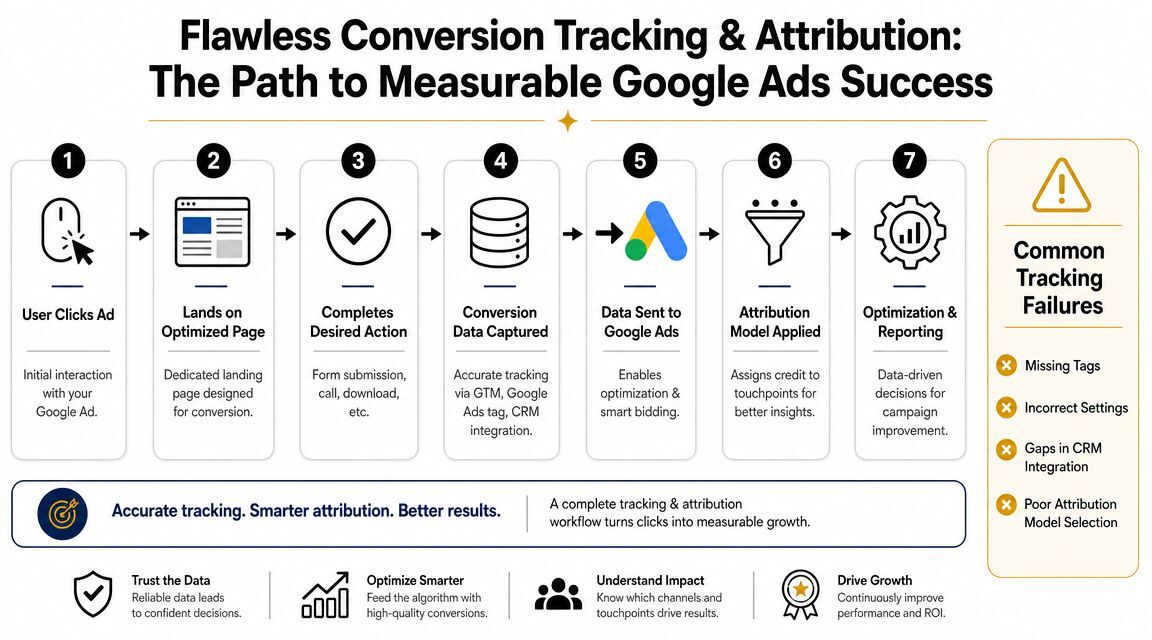
In high-spend lead gen, bad attribution does real damage. Google learns from the wrong signals, bidding shifts toward cheap form submissions, and reporting starts rewarding activity that revenue teams do not want more of. I see the same pattern in bloated agency accounts all the time. Duplicate tags. Primary conversions set on weak actions. Imported events that mean nothing to sales. No connection between CRM outcomes and ad platform optimization.
The minimum viable tracking stack
For lead generation, Google's own guidance is straightforward. Set one primary conversion action, install the Google tag correctly, add enhanced conversions where possible, and import offline conversion data so the system can learn from actual sales outcomes instead of basic form fills (Google's lead generation guidance).
That is the floor.
If your account spends serious money and still optimizes on every hand-raise equally, the machine is being trained badly. First-party data is now the key advantage. If you do not feed Google qualified outcomes, it will keep finding more of the wrong people at a price that looks efficient on paper.
My audit checklist is simple:
Primary conversion discipline: Count real lead actions as primary. Keep brochure downloads, page visits, and other weak signals as secondary.
Google tag accuracy: Verify the tag fires on the correct confirmation events and pages. "Installed" is not the same as "working."
Enhanced conversions: Use them to improve match quality where privacy limits browser-based tracking.
CRM source integrity: Pass campaign and click data into the CRM so lead records stay attributable after the form submit.
Offline conversion imports: Send back qualified lead, opportunity, or closed-won milestones when the sales process supports it.
If your team needs the technical setup details, use this guide on how to set up Google Ads conversion tracking.
A short visual explanation can help align marketing and ops teams before implementation:
Offline conversion imports change what the account learns
This is the work large agencies often avoid because it takes coordination across marketing, RevOps, and sales leadership. You need clear lead stage definitions, reliable CRM fields, and a process that sends downstream outcomes back into Google Ads.
Do it anyway.
If Google only sees submitted forms, it will optimize for submitted forms. If Google sees which leads became sales-qualified opportunities, it can start bidding toward revenue potential. That is the difference between vanity reporting and actual acquisition strategy.
Good tracking does not just measure results. It defines success for the bidding system.
This is also where specialist management beats volume-driven agency management. Generalist teams report what the platform gives them by default. A lead gen specialist configures tracking around sales acceptance, pipeline contribution, and closed revenue so the account improves lead quality instead of inflating lead counts.
The Specialist's Edge in Bidding and Lead Quality
Once the account structure and tracking are clean, bidding strategy starts to matter in the right way. Before that, most bid changes are just expensive noise.
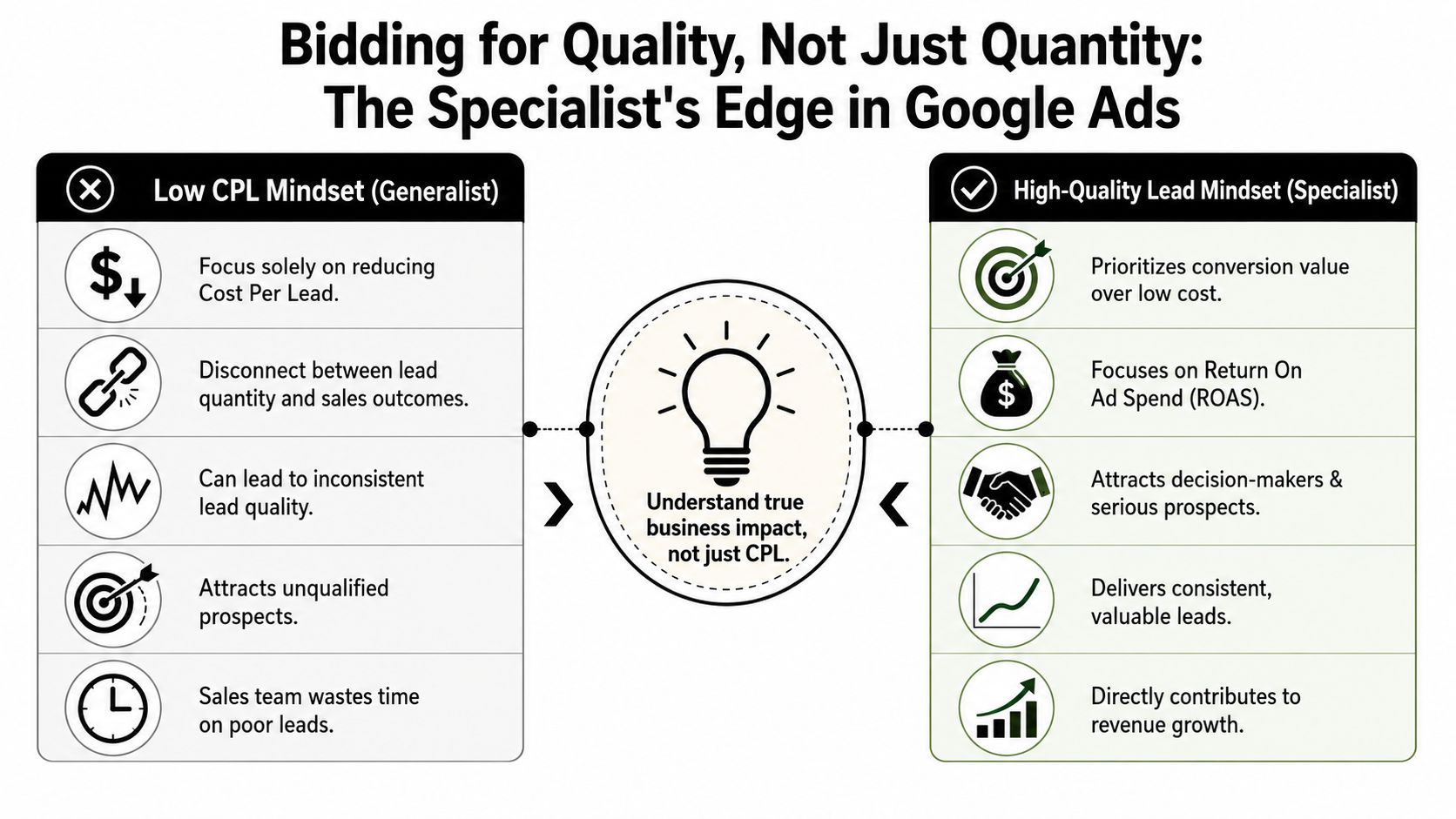
The biggest mistake I see is simple. Teams optimize for cost per lead even when lead quality is unstable. That creates a perverse incentive. The account starts fishing for cheaper conversions, not better prospects.
Low CPL is often the wrong win
This is the strategic gap in a lot of high-spend accounts. They celebrate lower CPL while sales gets flooded with weak inquiries.
That's backward.
A more advanced lead gen approach treats the account more like e-commerce in one key respect. You feed value back into the system. Independent guidance on lead generation strategy makes the point directly: the common gap is focusing on lead volume over lead quality, and the stronger approach uses value-based bidding and offline qualification data. A lower CPL is a false win if it increases unqualified leads. The better KPI is cost per qualified lead (Logical Position on lead quality and value-based bidding).
That changes how you bid.
Maximize Conversions: Useful when the account is still building signal density, but risky if primary conversions are weak.
Target CPA: Fine for tightly controlled lead definitions, less useful when lead values vary widely.
Maximize Conversion Value: Stronger when different lead types or downstream outcomes carry different business value.
Target ROAS: Best reserved for accounts with mature value inputs and reliable revenue feedback.
If your agency can't explain which business signal the bid strategy is optimizing toward, they're not running strategy. They're selecting settings.
For a plain-English reference on the mechanics behind these choices, review Google Ads bidding strategies explained.
First-party data is now the leverage point
The post-cookie environment has changed lead generation. Audience targeting is less about piling on more layers and more about feeding the platform better proprietary data.
That means using your CRM, customer lists, qualification labels, and sales-stage signals intelligently. Customer Match, audience signals, and remarketing lists are useful, but they only become powerful when they reflect real buyer quality.
Here's what specialist-led accounts do better:
They connect ad data to sales data: Not just platform metrics.
They build remarketing around buying stages: Not generic “all visitors” buckets.
They use first-party inputs for automation: Because rented targeting precision is weaker than it used to be.
They judge scale by lead quality stability: Not by whether Google can spend more.
A mature account doesn't ask, “How do we get more leads?” It asks, “How do we get more of the leads sales wants?”
The C-Suite Dashboard for Meaningful Reporting
Monday morning. The agency sends a 22-slide deck. Clicks are up, CPC is down, conversions increased, and your sales team is still complaining about junk leads.
That is a reporting failure.
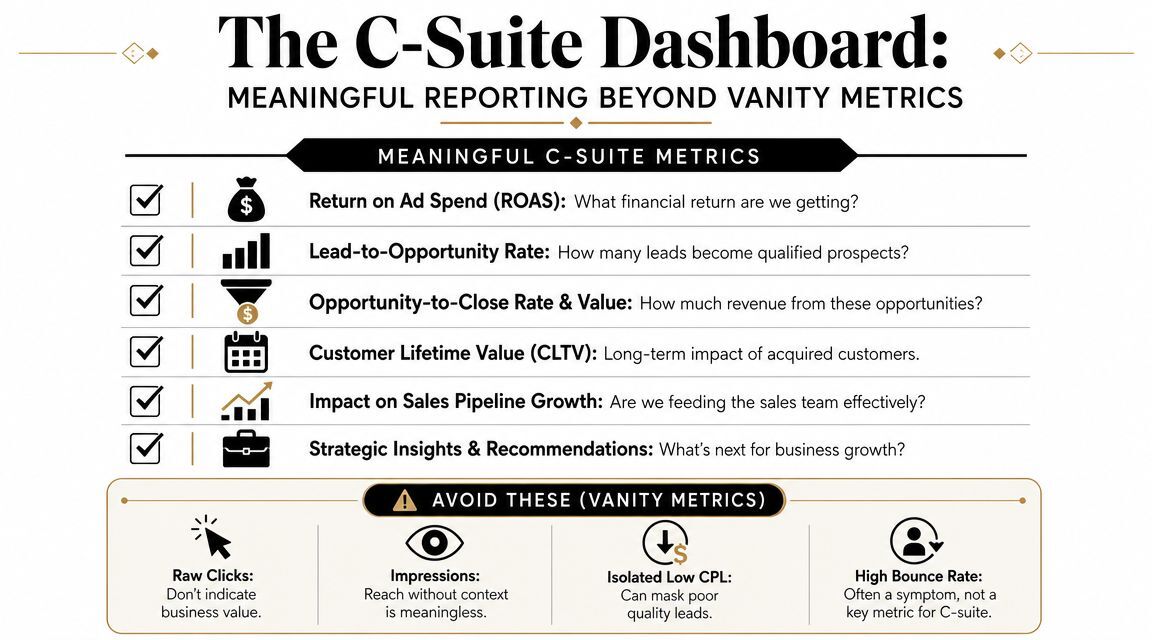
Leadership needs a dashboard built for allocation decisions. Keep spending. Cut waste. Fix qualification. Rebuild tracking. If a report cannot support one of those calls, it belongs in an analyst view, not a C-suite review.
What leadership should see every week
A useful executive dashboard is short, blunt, and tied to revenue quality. It should explain whether paid search is creating qualified pipeline, where lead quality is slipping, and what action the team is taking this week.
Include metrics that connect spend to business outcomes:
Cost per lead: Keep it as a top-of-funnel efficiency check.
Cost per qualified lead: This is the primary control metric for lead generation accounts.
Lead-to-opportunity rate: It shows whether form fills are turning into actual sales conversations.
Opportunity-to-close trend: It exposes problems in qualification, handoff, or sales follow-up.
Return on ad spend: Use it when revenue tracking is mature enough to trust.
Open issues blocking scale: Tracking gaps, slow lead routing, landing page friction, CRM breakdowns, or capped budget.
The commentary matters as much as the numbers. State what changed, why it changed, and what decision follows. Good reporting creates accountability. Weak reporting just archives activity.
What to remove from agency reports
Large agencies often protect weak strategy with busy reporting. They fill decks with platform output because platform output is easy to export.
Cut or demote these items unless they support a real business decision:
Impressions: Useful for diagnostics, rarely useful for executive review.
Raw clicks: Traffic volume does not tell you whether sales got better leads.
Average CPC in isolation: Cost means nothing without quality and close-rate context.
Blended conversion counts: They hide the difference between a high-intent lead and a soft action.
Platform-generated narratives: Automated summaries usually repeat movement without explaining cause.
The report should answer four questions. Should we scale, cut, fix, or hold?
One screen is enough for a weekly review. A monthly review should go further. It should show whether Google Ads for lead generation is producing sales-ready pipeline, which campaign themes are attracting the right buyers, and where operational issues are hurting ROI after the click.
If your current dashboard makes bad leads look like good performance, the account is being managed to satisfy the platform, not the business.
Come Together Media LLC offers specialist consulting for businesses that need senior-level PPC strategy without the usual agency layers. The focus is factual and narrow: cleaner tracking, tighter account structure, stronger lead-quality feedback, and reporting that ties spend to revenue instead of vanity metrics.
