

If you are spending serious money on Google Ads and your results feel flat, keyword research is where the waste starts.
Not bidding strategy. Not ad copy. Not some magical script your agency keeps promising to deploy next quarter.
Most underperforming PPC accounts are built on lazy keyword thinking. Someone exports a giant list from a tool, tosses broad terms into bloated ad groups, ignores negatives, and then wonders why lead quality collapses. That is not strategy. It is paid search by spreadsheet.
A specialist handles this differently. You do not start with volume. You start with commercial intent, business constraints, and account structure. That is how to do keyword research for PPC when the budget matters.
Stop Burning Cash on Bad PPC Keywords
High-spend accounts do not fail because Google Ads is broken. They fail because teams buy traffic they never should have invited into the account.
I see the same pattern constantly. A large agency hands the account to a junior manager. They run Keyword Planner, pull thousands of terms, sort by search volume, and call it research. Then they spread those terms across messy campaigns with weak negatives and generic ads.
The result is predictable. You pay for curiosity clicks, low-intent searches, and traffic that had no chance of becoming revenue.
What bad keyword research looks like
Bad PPC keyword research has a few obvious symptoms:
Volume over intent: Teams chase broad, impressive-looking terms instead of phrases that signal buying behavior.
No business filter: Keywords are selected without any reference to margin, sales cycle, close rate, or lead quality.
Loose match controls: Broad match runs wild without enough guardrails. If you need a quick way to sense-check match behavior before launch, a simple keyword match type tool can help your team avoid preventable mistakes.
Weak exclusions: Accounts skip foundational negatives, even though a strong negative keyword list is one of the easiest ways to stop waste fast.
What good keyword research does instead
Good research is narrower, sharper, and more commercial.
You are not trying to “cover the market.” You are trying to identify the searches most likely to produce profitable action. That means filtering every term through three questions:
Does this search reflect real purchase intent?
Can this click turn into profitable revenue?
Can we write a highly relevant ad and send traffic to a matching landing page?
Practical takeaway: If a keyword cannot be tied to a clear offer, a relevant ad, and a dedicated landing page, it probably does not belong in your account.
Big agencies sell process theater. More meetings, more dashboards, more slides. A specialist strips that away and focuses on the small set of decisions that move ROAS. Keyword research sits at the top of that list.
Aligning Keywords with Business Objectives
A CMO approves a healthy PPC budget, the dashboard shows rising clicks, and the sales team still says lead quality is weak. That failure starts before launch, at the keyword stage.
Keyword research has to begin with business economics. Open the tool too early and you get a list built on search volume, not profit. Large agencies do this all the time because giant keyword exports look like work. A specialist starts somewhere else. Revenue model first. Keyword list second.

Start with the economics
Set your acquisition target before you approve a single term.
Google Ads explains that Smart Bidding targets should reflect the actual value of a conversion, which means your keyword strategy has to respect the economics behind each lead or sale, not just the click price (Google Ads target CPA guidance). The point is simple. If your sales process cannot support expensive clicks, your keyword list cannot either.
Ask these questions first:
Business question |
Why it matters for PPC |
|---|---|
What action produces revenue? |
A demo request, phone call, quote form, and online purchase each require different keyword intent |
What acquisition cost can the business support? |
This sets your upper limit for CPC and determines how aggressive bidding can be |
What happens after the lead submits? |
Close rate, sales cycle length, and lead quality decide whether a higher CPC is justified |
Which offers have the best margin or LTV? |
Budget should follow profitable offers, not whichever service line gets internal attention |
If your team cannot answer those questions clearly, keyword research is still premature.
Map intent to revenue
A keyword is not valuable because it gets searched. It is valuable because it leads to profitable action.
That standard changes how you build the account. A SaaS company should pay more attention to comparison and solution-specific queries than broad educational searches. A local service brand should favor terms that signal urgency and location. A high-ticket medical advertiser should separate consultation intent from general condition research, because those two audiences behave differently and convert at very different rates. Such a situation often causes agency process to go sideways. The account gets padded with every loosely related term so the plan looks complete. The result is predictable. More traffic, weaker intent, lower close rates, and budget spread across searches that never had a fair shot at producing ROI.
Use a four-part intent filter
Review every keyword through four practical buckets:
Transactional: The search suggests the user wants to act now.
Commercial: The user is comparing options, pricing, vendors, or alternatives.
Navigational: The query is centered on a brand, including your own or a competitor's.
Informational: The user wants education, definitions, or general guidance.
High-spend accounts should put core budget behind transactional and commercial terms first. Informational queries can have a role, but only if they support a clear remarketing, audience-building, or assisted-conversion strategy. If you need a sharper framework for choosing PPC keywords that match high-impact ad goals, start there.
Key takeaway: High volume does not make a keyword strategic. Revenue alignment does.
Use customer language, not internal language
Boardroom terminology is useless in search.
The phrases that matter come from sales calls, CRM notes, support tickets, and on-site search behavior. That language tells you how prospects describe the problem, what outcome they want, and which words show up before a qualified opportunity is created. Those are the inputs worth trusting.
This is also where a dedicated PPC operator outperforms a large agency. The agency builds from category labels and tool suggestions because that is faster to scale across accounts. The specialist pulls language from actual buyers, ties it to funnel economics, and cuts anything that does not support qualified pipeline.
That is how you align keywords with business objectives. You choose terms the business can afford, the sales team can close, and the landing page can convert.
Building Your Foundational Keyword List
Most keyword lists are bloated before the campaign even launches.
You do not need a giant export to start. You need a tight seed list grounded in how your market talks, what your sales team hears, and what your offer solves.
A better starting point is a list of 10 to 20 seed keywords built from business intelligence, not software suggestions. That approach keeps your account focused and gives every expansion step a commercial anchor.
Mine the data you already own
Your best seed keywords are sitting inside the business already.
Start with these inputs:
Sales team notes: Pull recurring phrases from discovery calls, objections, and win reasons.
Support tickets: Look for repeated pain-point language and feature-specific questions.
On-site search queries: Visitors tell you exactly what they want if your site search is tracked properly.
Landing page copy: Product names, use cases, and outcome language can reveal obvious PPC themes.
If you skip this and go straight to tool output, you lose nuance fast. Tools can expand ideas. They cannot tell you which ideas map to qualified revenue.
Use four seed categories
I like to sort the first pass into four practical groups.
Product and service terms
These are the direct descriptions of what you sell.
Examples include a software category, a treatment type, or a core service line. These usually become the backbone of your highest-priority campaigns because the searcher already knows the category.
Problem and solution terms
These come from the pain points buyers are trying to fix.
A buyer may not search for your exact product name. They may search for the problem they want removed. This category is where the best non-branded opportunities show up.
Branded terms
Your own brand terms need active management. So do competitor brand terms, if you decide to pursue them.
Branded traffic is not always “free.” It can become messy if competitors bid aggressively or if your own account structure is weak.
Modifier-rich long-tail terms
Disciplined advertisers outperform broad, agency-built accounts here.
According to Search Engine Land, focusing on long-tail keywords in PPC research can lower CPCs by 20-50% while improving conversion rates because the searches are more specific and carry stronger intent.
That matters because long-tail phrases tell you more about what the buyer wants. A vague category term attracts browsers. A detailed phrase attracts someone ready to act.
If your team needs a sharper framework for that filtering step, this guide on choosing the right keywords for high-impact ads is worth reviewing alongside your seed build.
Practical rule: The longer and more specific the query, the more likely it reflects a real buying scenario instead of casual research.
What a usable starting list looks like
A solid seed list is not impressive because it is long. It is impressive because every term can justify its place.
Look for phrases that include signals like:
Category clarity: The user names the product, service, or treatment type.
Buyer modifiers: Words such as “best,” “review,” “pricing,” “near me,” or “alternatives.”
Use-case language: Searches tied to a job the buyer wants done.
Location intent: Essential for local and regional advertisers.
Brand comparison: Especially valuable when buyers are already evaluating options.
Avoid the three common traps
Many accounts go off track before expansion even begins.
Trap one is generic category obsession. The keyword may be relevant, but not profitable.
Trap two is internal naming. Your team may call the product one thing while the market uses another phrase.
Trap three is forcing scale too early. If the seed list is weak, expansion just multiplies bad assumptions.
A specialist does not start wide and hope to refine later. A specialist starts with the best terms available, proves commercial fit, and then expands from a strong base.
That is the difference between keyword research as admin work and keyword research as profit strategy.
Using PPC Tools to Uncover Profitable Terms
Tools do not find profitable keywords for you. They expose patterns. You still have to judge what deserves budget.
Many teams fail, mistaking data access for strategic thinking.
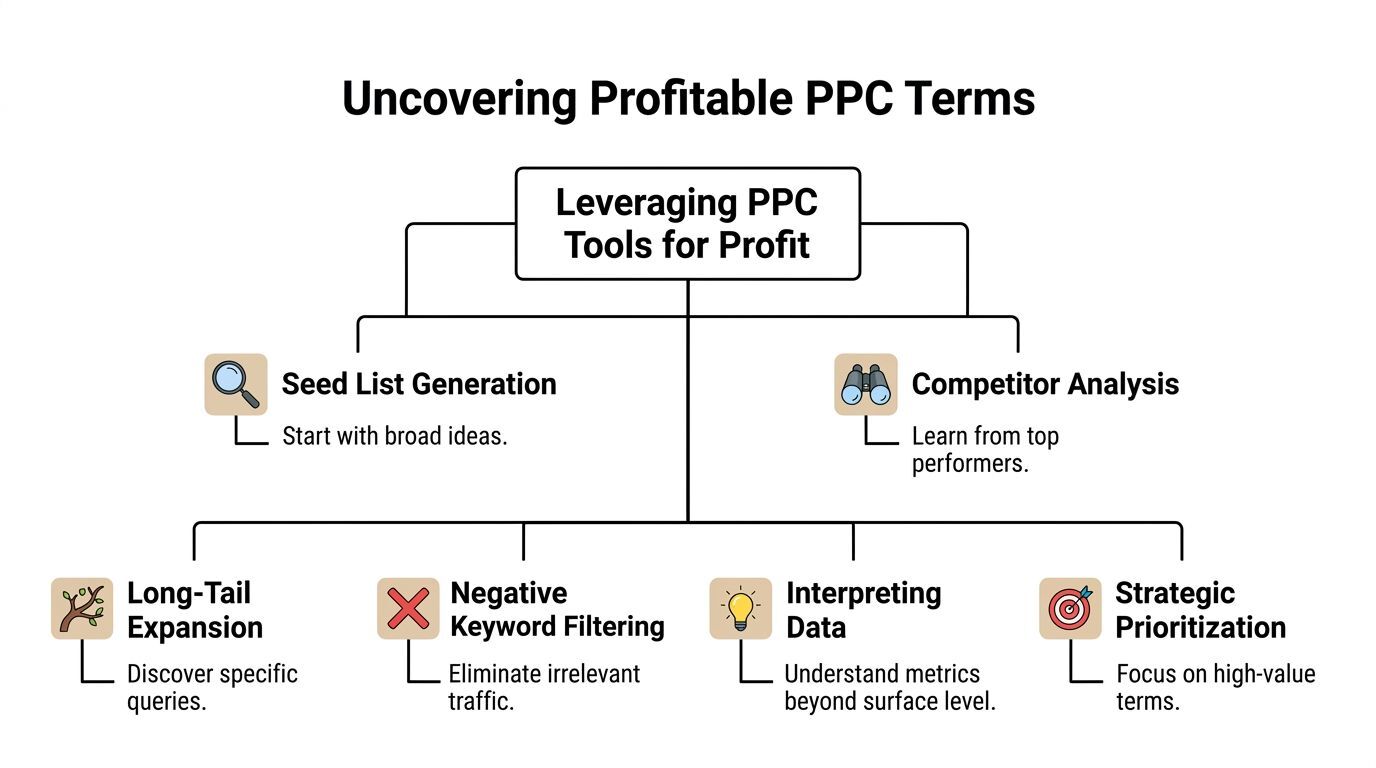
Google Keyword Planner, Semrush, Ahrefs, and SpyFu are useful because they help you evaluate demand, estimated CPC, and competitor behavior. But none of those platforms knows your margins, your close rate, or your sales quality thresholds.
Read the metrics in the right order
Many teams start by sorting for search volume. That is backwards.
Review terms in this order instead:
Metric |
What to ask |
|---|---|
Intent |
Does this search suggest the user wants to buy, compare, or solve a specific problem? |
CPC |
Can this keyword produce profitable traffic at the likely click cost? |
Relevance |
Can you match it with a specific ad and landing page? |
Volume |
Is there enough demand to matter once the first three checks are passed? |
A lower-volume keyword with sharp intent is worth far more than a broad head term that attracts weak clicks.
The better question is not “How many people search this?” It is “What kind of buyer makes this search?”
Know what the tools are really telling you
Google Keyword Planner is useful for directional volume, bid ranges, and discovering adjacent keyword ideas. Semrush and Ahrefs are stronger when you want broader databases and competitive visibility. SpyFu can be helpful for ad history and competitor patterns.
Use them differently:
Keyword Planner: Good for early expansion and rough commercial validation inside the Google ecosystem.
Semrush: Strong for gap analysis, theme discovery, and reviewing paid terms competitors appear to value.
Ahrefs: Useful for related ideas and question-based expansion.
SpyFu: Helpful when you want another view of competitor ad coverage over time.
Do not ask any tool for “the best keywords.” Ask it for evidence.
Here is a useful primer before you dig into rival campaigns: top PPC competitor analysis tools to outsmart bloated agencies.
Competitor research is not optional
If a competitor has been spending in your auction for a while, they have already paid to test messaging, offers, and themes.
You should learn from that.
According to PBJ Marketing, competitor deep-dives using tools like Semrush can help you capture 15-25% more market share by identifying underserved long-tail keywords where rivals underbid.
That does not mean copying their entire list. It means looking for:
Ignored subcategories
Uncovered use cases
Weaker brand comparison coverage
Long-tail commercial phrases with clear fit
Gaps between their ads and landing pages
Expert move: If competitors keep bidding on the same non-branded themes month after month, treat that as a signal worth investigating. Advertisers rarely keep paying for terms that never produce value.
A lot of agency teams skip this because real competitor research takes judgment. Exporting keyword suggestions is easier. It is also less useful.
Before you go further, this short walkthrough can help frame the research mindset:
Filter for profitable intent, not interesting language
Every keyword should fall into one of these decision buckets:
Bid now: Strong fit, clear intent, realistic economics.
Test carefully: Relevant but uncertain. Often better in phrase or exact first.
Observe only: Interesting language, but weak signal or unclear offer fit.
Exclude: Irrelevant intent, poor economics, or obvious mismatch.
Independent specialists beat big agencies in this aspect. The specialist has fewer accounts, more context, and direct access to decision-makers. That makes faster, cleaner judgment possible.
Use tool outputs to build hypotheses
The point of research is not to assemble a giant spreadsheet. It is to decide what to test first, what to isolate, and what to block.
If you want to know how to do keyword research for PPC at a high level, the answer is simple. Use tools to uncover demand. Use judgment to prioritize profit. Then validate everything in the live account.
Structuring Ad Groups for Maximum ROI
A $250,000 search account can bleed money with perfectly decent keywords if the structure is sloppy. I see it in audits constantly. One ad group holds dozens or hundreds of terms with different intent, the ads stay generic to cover everything, and traffic lands on pages that only partially match what the searcher wanted. CPC rises, click-through rate weakens, and sales teams start complaining about lead quality.
That failure starts after research. The list may be fine. The build is what broke.

Build ad groups around intent clusters
Use Single Theme Ad Groups. Keep each ad group focused on a narrow set of terms that share the same buyer intent, require the same ad promise, and deserve the same landing page.
That structure gives you control. It also exposes problems faster. If one theme underperforms, you can fix the ad, bid, landing page, or offer without guessing which keyword subgroup caused the issue.
WordStream has argued for tighter keyword grouping because relevance between keyword, ad copy, and landing page improves Quality Score and account efficiency; this core benefit is why experienced operators keep using this model instead of bloated builds that are easier for agencies to manage at scale. You can also sharpen this process by studying competitor keyword research tactics for outsmarting rivals and by understanding direct vs. indirect competitors before you decide which themes deserve their own budget and message.
What a disciplined structure looks like
A weak build shoves all of these into one ad group:
CRM software
sales CRM
CRM for startups
best CRM
free CRM
CRM pricing
HubSpot alternative
That setup guarantees mediocre relevance because those searches do not want the same thing.
A disciplined structure splits them by commercial intent:
Ad group theme |
Example keyword focus |
|---|---|
Core category |
CRM software, sales CRM |
Startup-specific |
CRM for startups |
Comparison |
HubSpot alternative |
Pricing intent |
CRM pricing |
Free-seeker traffic |
free CRM |
Each group gets its own ad angle, offer framing, and landing page path. That is how a specialist structures for signal clarity. Large agencies collapse these themes together because fewer ad groups are easier to maintain across too many client accounts. Easier for them is expensive for you.
Match types are budget controls
Match type decisions belong inside the structure, not as an afterthought.
Use exact match for proven commercial terms where you want precision. Use phrase match to expand within a controlled intent bucket. Use broad match only in accounts with clean conversion tracking, aggressive negative management, and someone reviewing search terms often enough to catch waste before it turns into a monthly habit.
Broad match is a tool. It becomes a liability in lazy account builds.
Negative keywords protect your structure
Without negatives, your themes bleed into each other and your reporting gets muddy. Then the wrong ad serves, the wrong page gets traffic, and you lose the ability to learn from results.
Build negatives in three layers:
Intent exclusions: free, jobs, training, definition, template, meaning
Cross-group exclusions: terms that belong in a different ad group, such as pricing, competitor, or startup modifiers
Offer exclusions: products, services, audiences, or locations you do not sell to
One practical rule matters here. If the search terms report keeps showing irrelevant clicks, stop blaming bids. The account lacks keyword controls.
Structure is what turns research into ROI
This is the dividing line between specialist management and agency sprawl. A specialist builds ad groups so performance data stays readable and actions stay obvious. A large agency builds for internal efficiency, which means fewer groups, blurrier intent, and slower decisions.
Tight structure takes more discipline upfront. It saves money every month after that. When the keyword, ad, and landing page all match the same buying intent, the account becomes easier to optimize, easier to scale, and much harder to waste.
Advanced Research for Regulated and Competitive Niches
Generic PPC advice breaks down fast in regulated or brutally competitive markets.
Healthcare is the obvious example. Cosmetic procedures, dermatology, med spas, and similar verticals cannot afford sloppy keyword strategy. The language is sensitive, policy restrictions are real, and clicks are expensive enough to punish every mistake.

Standard playbooks fail in regulated markets
General keyword guides assume you can bid broadly, test aggressively, and sort it out later. That is reckless in restricted industries.
According to The7Eagles, in regulated industries like healthcare, CPCs can be 3-5x higher than retail, and an estimated 40% of accounts face suspension for policy violations.
That changes the entire research process.
You cannot just chase high-intent phrasing if the wording itself pushes against policy. Terms that imply guarantees, exaggerated outcomes, or restricted claims can create account risk even if the search volume looks attractive.
Use compliant intent, not aggressive claims
For regulated accounts, build keyword sets around what is safe, local, and specific.
Better patterns include:
Consultation language
Location-based service terms
Procedure categories
Brand-safe informational modifiers
Navigational searches for providers, clinics, and treatments
What you want to avoid are phrases that drift into promises, absolutes, or language that can trigger policy trouble.
This matters outside healthcare too. Financial services, legal, addiction treatment, and other high-scrutiny categories all require more careful keyword selection than standard e-commerce accounts.
Competitive research needs nuance
In tough auctions, competitor research should go beyond “Who bids on my head terms?”
You need to separate direct competitors from adjacent players who compete for the same click in different ways. This overview on understanding direct vs. indirect competitors is a useful way to sharpen that thinking before you start conquest or gap analysis.
Then review competitors with a narrower lens:
Which themes do they dominate consistently?
Where are they absent?
Which landing page angles do they repeat?
Which branded comparison opportunities are available?
For a more tactical angle on competitor keyword discovery, this guide on unlocking AdWords competitor keywords is worth bookmarking.
Advanced move: In regulated niches, your safest profitable keyword is not the most aggressive phrase. It is the one that combines clear intent, policy safety, and local relevance.
Treat the Search Terms Report like a research engine
Many teams use the Search Terms Report only to add negatives.
That is too shallow.
The report also shows the actual language people use after Google expands your targeting. This provides three valuable things:
New compliant keyword ideas
Unexpected intent signals
Evidence of mismatch between your targeting and market behavior
In competitive and regulated accounts, that report should shape ongoing expansion. It helps you find safer, sharper variants that no keyword tool would prioritize properly on its own.
Specialist management pays off in this area. Advanced niches do not need more automation theater. They need tighter judgment, faster iteration, and someone who understands that one bad keyword choice can cost money, lead quality, and account stability at the same time.
Turn Your Research into a Repeatable Process
Keyword research is not a setup task. It is an operating system.
If your team only revisits keywords when performance collapses, you are already late. Strong accounts run a repeatable cycle. Research, launch, review, cut waste, expand winners, and restructure when needed.
That rhythm is what separates stable growth from expensive drift.
Use a simple operating cadence
You do not need an agency-sized workflow. You need discipline.
A practical process looks like this:
Set the commercial target first. Tie keyword decisions to acquisition economics and business priorities.
Build a focused seed list. Start with real customer language and high-fit service themes.
Expand with tools carefully. Pull ideas from Keyword Planner, Semrush, Ahrefs, and competitor research.
Prioritize by intent and fit. Not all relevant keywords deserve budget.
Structure tightly. Keep themes narrow enough to support relevant ads and landing pages.
Review search terms continuously. Add negatives, isolate winners, and find new themes.
Reallocate budget based on outcomes. Keep funding what produces profitable action.
This is not complicated. It is just work that has to be done consistently.
Track the signals that matter
Many teams drown in PPC metrics and still miss the obvious.
When reviewing keyword performance, keep your attention on a short list:
Signal |
Why it matters |
|---|---|
Conversion quality |
Not all leads deserve equal value |
Cost efficiency |
CPC alone means little without downstream performance |
Search term fit |
Reveals whether targeting logic is working |
Ad relevance |
Weak relevance points back to poor grouping |
Landing page alignment |
Good keywords still fail on bad destination experience |
A specialist can move faster here because there are fewer handoffs and less reporting theater. The person making the decisions is the person closest to the data.
Stop outsourcing judgment
This is a key issue with bloated agencies. They sell access to a team, but the account gets managed by layers of people who lack context and ownership.
Keyword strategy suffers first.
An independent PPC specialist works differently. Direct communication is faster. Decisions are cleaner. Testing gets implemented without getting trapped in internal process. Most important, the person shaping the keyword strategy understands the business goal behind it.
Final takeaway: The account improves when keyword research becomes a living process tied to profit, not a one-time export tied to activity.
If you were looking for how to do keyword research for PPC, the answer is not “use more tools.” It is “use a stricter filter.”
Choose keywords that fit the economics. Group them tightly. Control match types. Mine search terms. Keep refining. That is how serious advertisers stop wasting money and start building a paid search program that can scale.
If you want a second set of expert eyes on your Google Ads account, Come Together Media LLC offers exactly the kind of focused PPC support many high-spend businesses cannot get from a bloated agency. Chase McGowan works directly with clients on audits, account structure, keyword strategy, campaign setup, and ongoing optimization, without burying communication under account managers and internal layers. If your PPC spend is high and your results feel too inconsistent, start with a direct conversation and get clear, practical insight on where your keyword strategy is leaking money.