

You’re spending serious money on Google Ads, yet the account still feels slippery. Reports show clicks, impressions, and “activity,” but not enough clarity about what’s driving revenue and what’s draining budget.
In most underperforming accounts, the problem starts earlier than commonly assumed. It starts with the keyword in AdWords decision. Not the bid. Not the dashboard setting of the week. The keyword strategy.
A weak keyword strategy attracts the wrong searches, lowers relevance, inflates costs, and hides waste inside blended reporting. A strong one does the opposite. It filters for intent, shapes account structure, improves Quality Score, and gives you tighter control over ROI.
The difference between agency management and specialist strategy becomes obvious here. Agencies often “manage” keywords as inventory. A specialist treats them as financial levers.
Your Google Ads Budget Is Leaking and Keywords Are Why
If your Google Ads account spends heavily every month and still feels stuck, stop blaming the platform first. Google Ads usually isn’t the root issue. Fuzzy keyword strategy is.
Many agencies talk about keywords like they’re just a list of terms you need to show up for. That’s lazy. Keywords decide who can trigger your ads, how much ambiguity you allow into the account, and how much irrelevant traffic you’re willing to pay for.

What budget leakage looks like
You’ve probably seen some version of this:
Clicks are up: The agency celebrates traffic growth.
Lead quality is flat: Sales says the pipeline feels off.
Cost efficiency erodes: You’re paying more to learn less.
Reporting stays vague: The account gets described in aggregate, not at the search-query level.
That last point matters most. Waste usually hides in the gap between what you think you’re targeting and what users searched.
A keyword in AdWords is never just a targeting input. It’s a bet on intent. If the bet is too broad, too generic, or poorly grouped, Google fills the gaps with traffic that looks active in a report and weak in the CRM.
Practical rule: If your team can’t show the exact searches your budget bought, you don’t have keyword control. You have keyword exposure.
Why agencies miss this
Big agencies tend to optimize for process, not precision. That means junior account managers, templated buildouts, and broad recommendations that scale internally even when they don’t scale profitably for the client.
The result is predictable:
Agency habit |
What it does to your account |
|---|---|
Generic keyword lists |
Pulls in mixed intent |
Loose match types |
Expands irrelevant traffic |
Weak negative coverage |
Lets waste repeat |
Overblended reporting |
Hides where spend is leaking |
If you want a fast way to pressure-test your own account, use this PPC audit checklist. It’ll show you where keyword strategy is loose, where spend is getting diluted, and where reports may be masking the underlying problem.
Beyond the Search Bar What a Keyword in AdWords Is
A keyword is not the same thing as a customer’s Google search.
That distinction sounds basic, but it’s where many expensive mistakes begin.
Keywords are your instructions. Search terms are reality
In Google Ads, keywords are what advertisers bid on, while search terms are the queries users type. That distinction is fundamental, and it shapes how you evaluate performance in your actual account, not in a sanitized report from the agency layer (DataFeedWatch explains the difference here).
A simple way to conceptualize this:
Keyword: the bait you choose
Search term: the fish you catch
Pick vague bait, and you catch junk. Pick precise bait, and the traffic quality improves.
That’s why the phrase keyword in adwords can be misleading for less experienced advertisers. They assume the keyword is what the prospect typed. It isn’t. It’s the targeting instruction you gave Google.
Why this matters for spend control
Many accounts look acceptable at the keyword level and messy at the search-term level.
That happens because Google can match a keyword to related user queries. Some of those are useful. Some aren’t. If you only review keyword reports, you’re often looking at a blended result that hides weak search intent.
Here’s the practical impact:
A keyword can look productive on paper.
The search terms underneath it can include research queries, low-intent variants, or unrelated commercial intent.
Budget gets distributed across all of it unless someone actively trims the waste.
The Search Terms report is not optional. It’s where you find out what your budget bought.
If you want a sharper breakdown of that distinction, this guide on search terms vs keywords in Google Ads is worth reviewing.
New keywords don’t start equal
There’s another point many agencies barely explain to clients. New keywords don’t always get treated like proven keywords.
Historical account performance matters. According to DataFeedWatch, Google has historically served ads from new keywords less frequently until they accumulate performance data, and account track record affects initial delivery. The same source also notes a 58% CPC rise over five years as part of the broader account-history context that affects delivery and Quality Score signals.
That means keyword strategy isn’t just about adding more terms. It’s about adding the right terms into an account structure that already signals relevance and control.
Review search terms weekly in your highest-spend campaigns. Not monthly. Not when performance drops. Weekly.
What strong operators do differently
A specialist doesn’t ask, “What keywords are we bidding on?”
A specialist asks:
What queries are triggering spend?
Which of those queries align with purchase intent?
Which terms belong in their own ad groups or campaigns?
Which searches should be blocked immediately?
That’s how you move from keyword management to keyword strategy.
Mastering Keyword Match Types to Control Your Spend
Match types aren’t technical trivia. They are budget control settings.
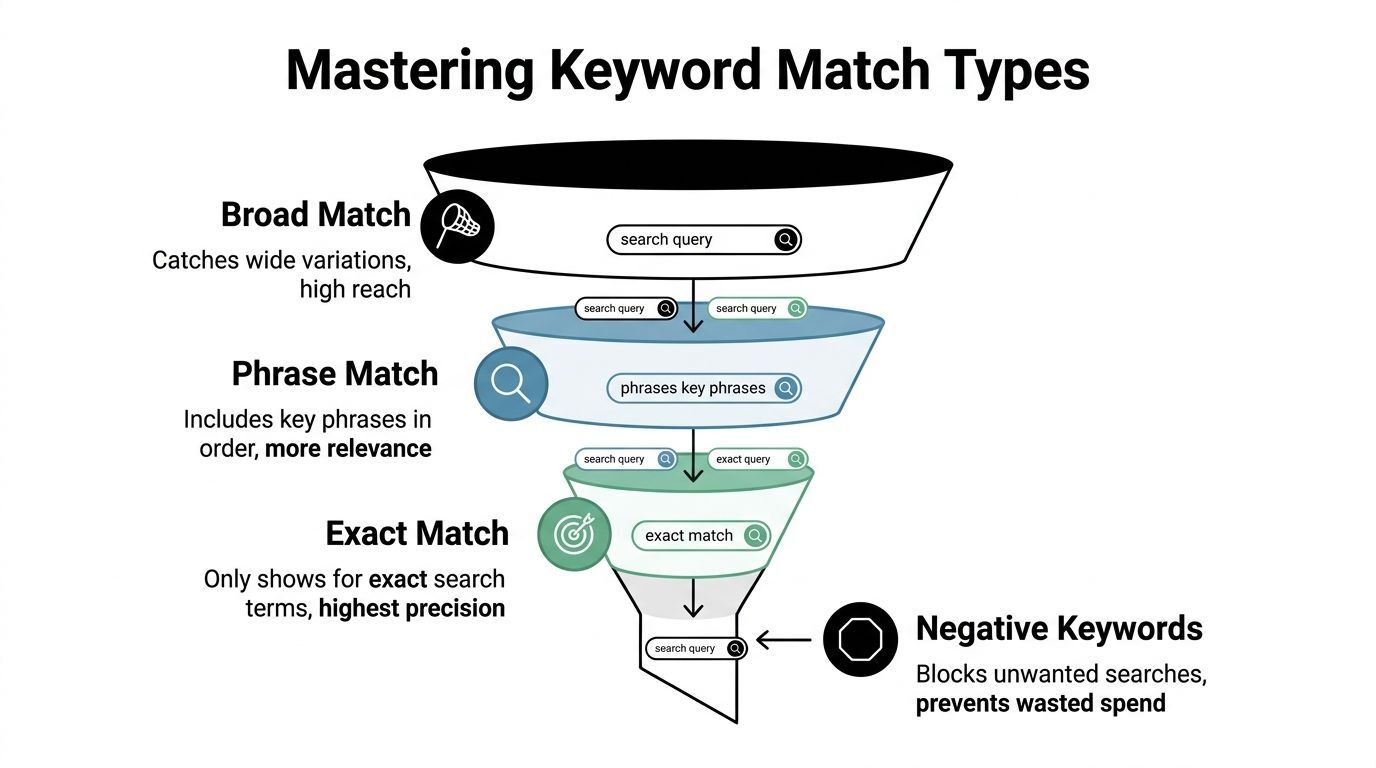
If the keyword is your instruction to Google, the match type tells Google how much freedom it gets when interpreting that instruction. Give Google too much room, and you buy traffic you didn’t mean to buy. Restrict it too aggressively, and you can choke off volume that would have converted.
The trade-off between volume and efficiency
There’s no universal best match type. There is only the right match type for the job.
Data shows the gap clearly. Broad match keywords generate 3-5x higher impressions than exact match but often have 40-60% lower conversion rates. Exact match can deliver 3-5x higher conversion rates (Google Groups source).
That’s the trade-off in plain English. Broad gives reach. Exact gives precision.
Broad match means more freedom and more risk
Broad match is useful when you need discovery. It helps surface new search behavior, new long-tail variants, and new pockets of demand.
It also creates the most room for waste.
Use it without discipline and you’ll see what many high-spend accounts suffer from:
Irrelevant intent drift: searches that are adjacent, not valuable
Mixed funnel traffic: research queries mixed with buyer queries
Budget dilution: strong terms lose spend to weaker variants
Broad match is not bad. Unsupervised broad match is bad.
Phrase match sits in the middle
Phrase match is often where mature accounts regain sanity.
It gives Google some flexibility while preserving more intent than broad match. For many advertisers, phrase match is where traffic gets large enough to matter and clean enough to scale.
That middle ground is why phrase often works well when you already understand your market and want controlled expansion, not blind expansion.
If you’re comparing these options in live campaigns, this consultant breakdown of broad match vs phrase match is a useful companion.
Exact match is where buying intent gets cleaner
Exact match is the closest thing to surgical targeting inside paid search.
It won’t generate the same volume. That’s not the point. It exists to protect budget around your most valuable, highest-intent terms.
Consider this analogy:
| Match type | Best use | Main risk | |---|---| | Broad | Discovery and reach | Waste from loose relevance | | Phrase | Controlled expansion | Can still pull mixed intent | | Exact | High-intent capture | Lower scale |
Use match types as a funnel, not a doctrine
A strong account doesn’t pick one match type and call it a strategy. It uses match types intentionally across the funnel.
A practical framework:
Top of funnel with broad: Find new search terms, but only if you’re reviewing actual query data and cutting waste.
Mid-funnel with phrase: Keep expansion under control and preserve stronger intent.
Bottom of funnel with exact: Protect the terms most closely tied to qualified conversions.
That structure gives you learning at the top and efficiency at the bottom.
Don’t ask which match type is best. Ask which match type deserves budget at this stage of intent.
What weak management looks like
The lazy version of account management is setting too much of the account to broad match, then reporting impression growth like it’s strategic progress.
It isn’t.
The specialist version is tighter. Match types get segmented by intent, negative keywords get layered in, and search terms dictate what gets promoted, isolated, or blocked. That’s how you stop paying for “activity” and start paying for qualified opportunity.
How Keywords Determine Your Ad Rank and Quality Score
Many advertisers think the Google Ads auction is simple. Bid more, rank higher.
That’s wrong, and it’s one reason frustrated CMOs keep increasing spend without getting cleaner efficiency back.
Your keyword choices affect Ad Rank because they affect relevance, expected click behavior, and landing page alignment. In other words, the auction is not just about how much you’re willing to pay. It’s about how credible your ad looks to Google for that search.

Quality Score is not cosmetic
Google Ads uses Quality Score on a 1-10 scale, built from expected click-through rate, ad relevance, and landing page experience. Each one-point improvement in Quality Score can reduce cost-per-click by 15-25% while improving ad rank (Semrush breakdown).
That’s why keyword strategy is financial strategy.
If the account is stuffed with loose keyword groupings, generic ads, and misaligned landing pages, you’re not just dealing with “messy structure.” You’re paying a premium for that mess.
If you want a deeper technical primer, review this guide on what Quality Score is and how to improve it.
Three components decide whether your keyword can compete
Expected click-through rate
This is Google’s estimate of how likely users are to click.
If this score is weak, Google is telling you the keyword and audience pairing isn’t convincing enough. That usually points to one of two issues:
the keyword is too loose for the offer
the message in the ad doesn’t line up with what the searcher wants
Specialists go back to search-term data at this point. Weak CTR is often a targeting problem before it’s a copy problem.
Ad relevance
Ad relevance measures how closely your keyword, ad copy, and user intent line up.
Here, lazy account structures get punished. If one ad group contains a pile of unrelated terms, the ad will feel generic to most of them. Generic ads lower relevance. Lower relevance hurts competitiveness.
Tight keyword grouping fixes this.
Landing page experience
A lot of agencies stop at the ad. That’s half the job.
Landing page experience covers technical performance, content relevance, and transparency. If the keyword says one thing and the page delivers another, Quality Score stalls.
A strong landing page for paid search doesn’t just look modern. It matches the query, answers the intent fast, and makes the next action obvious.
A bid can buy you into the auction. Relevance decides whether you deserve to stay competitive in it.
Why higher bids don’t solve structural weakness
When a competitor outranks you consistently, the answer isn’t always “they’re bidding more.” Sometimes they built a cleaner keyword-to-ad-to-page path.
That’s the advantage of specialist work. A specialist looks at the keyword as the first link in a chain:
Keyword selection
Ad-group structure
Ad copy relevance
Landing page alignment
Break one of those links, and the rest of the auction gets more expensive.
A short visual walkthrough helps if your team needs a refresher on how the auction logic works:
What this means for ROI
The practical takeaway is simple. Better keyword architecture often does more for profitability than another round of bid increases.
If your agency keeps talking about bid strategy without talking about keyword grouping, search intent, ad relevance, and landing page fit, they’re treating symptoms. Not cause.
Building a Profitable Keyword Architecture
Profitable accounts are built. They are not assembled.
When keyword architecture is strong, the account becomes easier to optimize because intent is separated cleanly. When it’s weak, the account turns into a junk drawer. Too many terms crammed together. Too many mismatched ads. Too many searches that don’t belong.
Start with intent, not volume
Many teams begin keyword research by sorting from highest search volume down. That’s a fast way to overpay for vague demand.
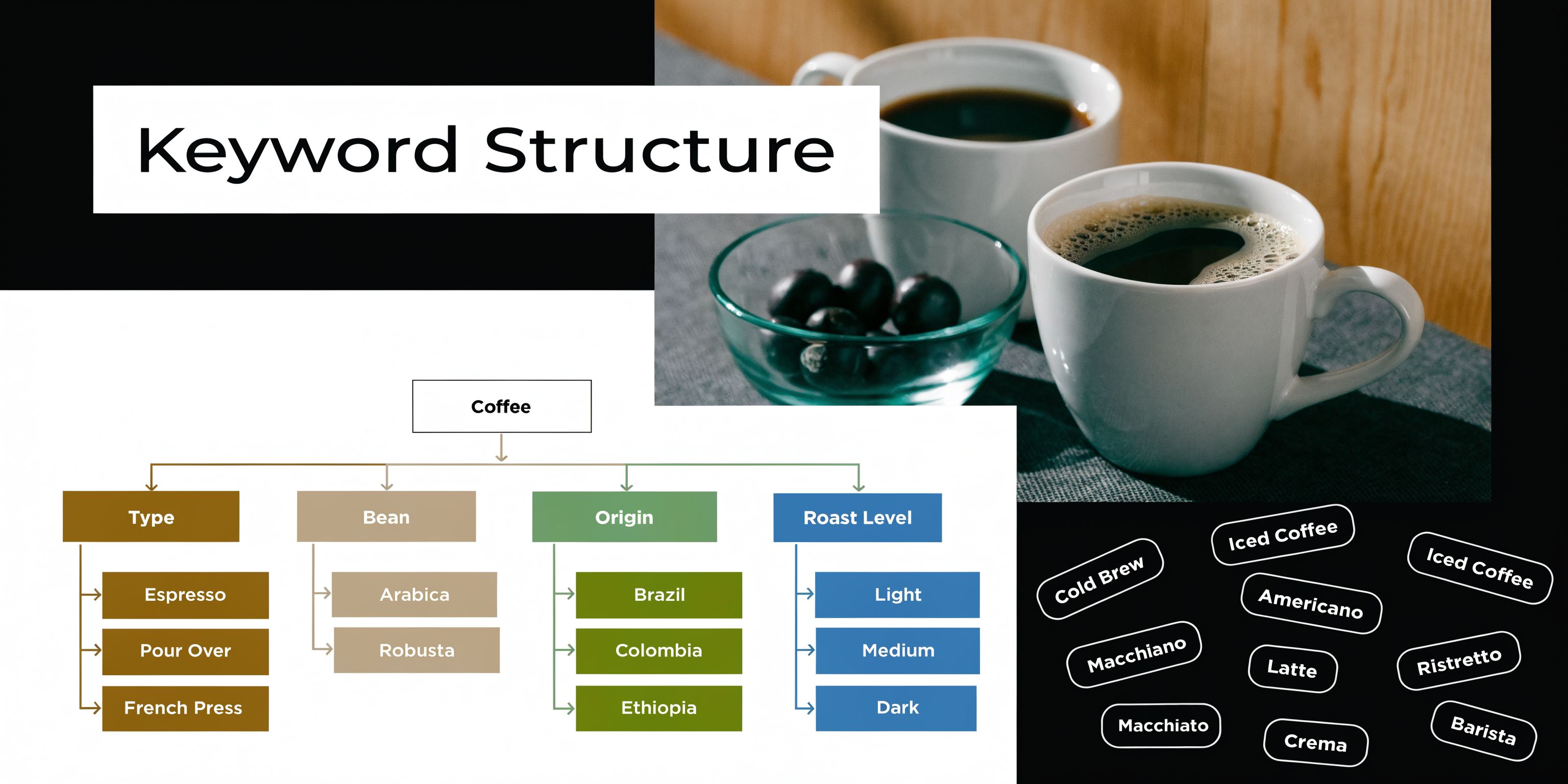
A better approach starts with intent buckets. Separate terms by what the searcher is likely trying to do.
For example:
Commercial evaluation: people comparing providers, features, or pricing
Transactional intent: people ready to book, buy, or request consultation
Low-intent research: people gathering information with no near-term buying signal
Search volume still matters, but only after relevance is established.
Google Keyword Planner helps here because it provides historical search volume data going back to 2016, which lets you see seasonality and trend movement instead of relying on a simple average. In one sample set of 119 keywords, search volume increased by 31% from 2018 to 2019, which shows why timing and trend direction matter as much as raw demand (Search Engine Watch coverage).
A term with attractive average volume can still be a bad investment if trend history shows declining interest or if the wrong season is approaching.
Build tight ad groups
The next step is grouping.
Many agencies cut corners here. They cluster too many related-but-different keywords into one ad group, then write ad copy that’s broad enough to speak to all of them and specific enough to satisfy none of them.
Tighter ad groups solve that.
A clean structure usually looks like this:
Account layer |
Good structure |
Bad structure |
|---|---|---|
Campaign |
One theme or business objective |
Mixed services and mixed intent |
Ad group |
Closely related keyword family |
Random variations bundled together |
Ad copy |
Mirrors search intent |
Generic brand copy |
Landing page |
Matches the query theme |
Sends everyone to one page |
That alignment matters because it supports better relevance all the way through the auction.
Long-tail keywords often outperform head terms
In large accounts, some of the best opportunities sit below the obvious category terms.
Long-tail keywords tend to reveal clearer intent. They often tell you what the buyer wants, what context they’re in, and how close they are to action.
That’s where specialists tend to find efficiency. Not by ignoring broader terms entirely, but by refusing to build the account around vanity demand.
Negative keywords are the shield
If positive keywords open the door, negative keywords close the wrong ones.
This is one of the most underused profit levers in Google Ads. Not because it’s obscure, but because it requires discipline. Someone has to review search terms, spot patterns, and keep adding exclusions.
A few practical examples of negative keyword use:
Informational blockers: “free,” “how to,” “DIY”
Job seeker filters: “salary,” “career,” “jobs”
Irrelevant geography: locations you don’t serve
Mismatched service intent: adjacent services that waste clicks
The fastest account improvement often comes from stopping bad traffic, not finding more traffic.
Architecture is maintenance, not setup
A profitable keyword architecture isn’t a one-time launch deliverable.
It requires ongoing decisions:
which search terms deserve promotion into exact or phrase
which terms need their own ad groups
which queries should be blocked
which seasonal trends justify budget shifts
That’s why specialist management outperforms bloated agency process here. Good architecture doesn’t survive on autopilot. Someone has to keep it clean.
Exposing Common Keyword Mismanagement and Agency Pitfalls
Most expensive Google Ads waste isn’t dramatic. It’s procedural.
It hides inside account habits that look normal in a status meeting and ugly inside the search-term data. After enough audits, the same keyword mistakes show up again and again.
Pitfall one overusing broad match to manufacture growth
This is common because it makes reports look busy.
Broad match can increase reach fast. That’s useful in the right hands. In the wrong hands, it fills campaigns with ambiguous traffic and lets agencies point to rising impressions and clicks as proof of momentum.
The client sees activity. The sales team sees weaker lead quality.
A specialist uses broad match selectively and watches query data closely. A weak operator uses it as a default because it scales management effort and buys more data without requiring better judgment.
Pitfall two ignoring the mechanics of negative match types
Negative keywords are often discussed in shallow terms, and that creates avoidable waste.
Google’s negative match types behave differently from positive keyword match types. One nuance matters a lot. A negative broad match for “running shoes” fails to block searches like “shoes for running,” and mishandling these nuances can account for 20-30% of wasted budget in improperly managed accounts. Proper negative implementation can also reduce CPC by 15-25% in competitive verticals (Google Ads help reference).
That means “we added negatives” is not enough. The match type and blocked behavior matter.
Pitfall three dumping too many keywords into the same ad group
This is classic agency buildout behavior. It saves time. It lowers performance.
When too many different keyword themes live inside one ad group, the ad copy becomes generic and the landing page fit gets weaker. Relevance falls. Performance gets harder to diagnose because everything is blended together.
A clean ad group should have a tight internal logic. If one ad can’t speak naturally to every keyword in the group, the group is too broad.
Pitfall four treating search-term reviews as occasional cleanup
Search-term review should be an operating rhythm, not an emergency response.
Accounts lose efficiency when irrelevant queries are allowed to keep matching for weeks. That’s especially costly in competitive categories where every wasted click crowds out budget that should have gone to stronger intent.
Here’s the difference in mindset:
Weak management |
Specialist management |
|---|---|
Reviews search terms sporadically |
Reviews them on a fixed cadence |
Adds generic negatives only |
Adds negatives based on recurring waste |
Leaves mixed-intent queries in place |
Segments winners and blocks losers |
Reports at campaign level |
Diagnoses at query level |
A few red flags worth checking right now
If you want to know whether your account has keyword mismanagement, look for these signs:
Too few negatives: Especially in high-spend campaigns.
Ad groups with broad themes: One ad group trying to cover multiple services, audiences, or intents.
No promotion path: Strong search terms never get isolated into tighter match types.
Agency reporting that avoids query detail: Lots of charts, little explanation of what people searched.
If an account spends heavily and nobody can explain the worst search terms it bought last week, the account is not under control.
Why independent specialists usually outperform here
The difference between an independent consultant and a bloated agency becomes obvious here.
A specialist usually has direct accountability to the account. No layers. No junior handoff. No incentive to preserve a messy structure because untangling it takes time. Keyword work gets done at the level where profitability changes, inside match types, negatives, ad groups, and search-term patterns.
That’s strategy. Not maintenance theater.
Take Back Control of Your Google Ads Performance
You don’t need to become a full-time media buyer to fix a weak account. You do need to understand where keyword choices affect money.
That means remembering three things:
Keywords are targeting instructions
Match types decide how tightly spend is controlled
Search terms reveal what you paid for
If your current agency keeps the conversation at the level of clicks, impressions, and broad campaign summaries, they’re keeping you far away from the decisions that shape ROI.
One action to take today
Go into Google Ads and open the Search Terms report for your highest-spend campaign over the last 30 days.
Then do this:
Sort by cost
Find the most expensive irrelevant query
Add it as a negative keyword
Check whether similar variants should also be blocked
That single move is often more useful than another round of reporting commentary.
Another smart angle to add
Keyword strategy also improves when you understand how competitors position themselves in the auction. If your team wants a practical outside resource, this guide on how to spy on competitor ads is a useful way to study ad patterns, offers, and messaging gaps without relying on guesswork.
What better management should feel like
Better PPC management is not mysterious.
It should feel like:
clearer targeting
cleaner search-term data
faster identification of waste
tighter connection between ad spend and qualified pipeline
That’s why many high-spend advertisers eventually leave big agencies. They get tired of paying for overhead, handoffs, and generic account care when what they need is direct strategic oversight from someone who understands how to turn keyword decisions into business outcomes.
If you’re frustrated with vague reporting and stagnant efficiency, start where the waste usually starts. Your keyword in adwords strategy.
If you want a direct, expert review of your Google Ads account, Come Together Media LLC offers personalized PPC consulting without the agency bloat. You get one-on-one strategic insight, transparent feedback, and a practical audit focused on keyword selection, account structure, wasted spend, and ROI opportunities.