


Most advice about PPC management is watered down to platform chores. Adjust bids. Test copy. Add keywords. Pull a report. That definition is useless once your ad spend is large enough to hurt.
If you're asking what PPC management is, the answer is simple. It's capital allocation under uncertainty. You're deciding where budget goes, what signals the platform can trust, what traffic deserves more investment, and what waste needs to be cut before it compounds. That is not junior account manager work. It's not a checklist you hand to an agency pod.
At higher spend levels, bad PPC management doesn't usually fail in dramatic ways. It fails insidiously. You get polished dashboards, vague commentary, and a slow decline in efficiency while no one takes real ownership. That's why many leaders end up rethinking the whole model and looking for a specialist who can treat paid media as a business system, not a production queue. If you're weighing paid search against other channels, this perspective also lines up with why PPC can outperform slower channels when speed and control matter.
Table of Contents
Stop Thinking About PPC Management Wrong - Why most accounts break
PPC Management Is a System Not a Task List - Why most accounts break - What a real operating cadence looks like
The Five Pillars of Expert PPC Management - Pillar one and two - Pillar three and four - Pillar five
Measuring What Matters True ROI and Business KPIs - Diagnostic metrics versus decision metrics - What good reporting actually answers
Choosing Your Growth Partner DIY vs Agency vs Consultant - PPC Management Model Comparison - Which model fits a high spend account
The Costly Mistakes That Quietly Burn Your Budget - Unchecked automation - Weak account hygiene - Broken measurement logic
Your Next Steps A Quick Audit and Specialist Advice - A five point audit you can do today - What to do with what you find
Stop Thinking About PPC Management Wrong
PPC management is often defined as campaign setup plus ongoing optimization. That's technically true and strategically empty.
For a business spending serious money, PPC management is the discipline of deciding where paid traffic should go, what level of risk is acceptable, and which signals deserve trust. The platforms execute. The manager decides the rules of the game. If those rules are weak, Google Ads will still spend your budget. It just won't spend it in a way your finance team will like.
The agency version of PPC management usually breaks because ownership is fragmented. One person handles reporting. Another writes ads. Someone else jumps in on bids. Nobody holds the full picture in their head, and nobody is close enough to the business to challenge bad assumptions. You don't need more activity. You need sharper judgment.
PPC management isn't the act of buying clicks. It's the act of controlling how money moves through a paid acquisition system.
That distinction matters because your ad account is not a media vending machine. It's a decision engine. Every change to conversion tracking, match types, audience exclusions, landing pages, budget splits, or bidding goals changes how that engine behaves.
If you're spending enough to care about efficiency, you should expect your PPC lead to think like an operator. They should understand margin pressure, sales quality, lead acceptance, geographic variation, and how platform automation reacts to bad data. A specialist consultant can usually do that faster than a layered agency because the strategy and execution sit with the same person.
Why most accounts break
Accounts rarely fail because no one touched them. They fail because the wrong things got attention.
Too much platform obedience: Teams accept Google recommendations without asking whether they support profit.
Too little business context: Campaigns optimize toward lead volume, not qualified revenue.
No accountability loop: Reports describe performance, but they don't drive decisions.
If you want the plain answer to what is PPC management, here it is. It's controlled, repeatable decision-making tied to business outcomes.
PPC Management Is a System Not a Task List
A strong PPC account works more like an investment portfolio than a to-do list. You don't throw money into assets because they're available. You allocate capital based on expected return, downside risk, and signal quality. Paid media should work the same way.

The account structure, bidding strategy, creative, audiences, search terms, landing pages, and tracking all feed each other. If one part is weak, the rest compensate badly. That's why task-based management underperforms. It treats symptoms in isolation instead of managing the machine.
Why most accounts break
High-performing accounts operate as a closed-loop optimization system. That means daily spend checks, weekly search term mining for negative keywords, and periodic adjustments to bids and creative so budget shifts toward queries with the highest conversion probability and away from waste, as outlined in Linear Design's guide to PPC management services.
That operating loop matters because Google's Smart Bidding doesn't work on faith. It needs valid conversion tracking, stable inputs, and enough clean feedback to learn from. If your data is noisy, delayed, duplicated, or misaligned with revenue quality, the algorithm doesn't become intelligent. It becomes confidently wrong.
A specialist sees this faster because they're not just checking tasks off in Google Ads. They're watching the relationship between signals and spend. They ask whether the account is learning from the right outcomes. Most agencies don't get that far. They're too busy showing movement.
Practical rule: If tracking is questionable, don't trust automated bidding to fix performance. Fix the measurement layer first.
What a real operating cadence looks like
A serious PPC management system runs on cadence. Not random bursts of optimization when a client asks hard questions.
Daily checks: Spend pacing, anomaly detection, disapproved ads, broken URLs, conversion drops.
Weekly reviews: Search term analysis, negative keyword additions, budget shifts, audience quality, device and geography trends.
Bi-weekly decisions: Ad testing direction, landing page friction, bid target changes, campaign prioritization.
Monthly review: Profitability by segment, strategic reallocations, channel role, and whether goals still match business reality.
The consultant model has an edge here because the person making decisions is the same person reading the account. Communication is shorter. Interpretation is better. Execution is faster.
If you want a useful definition of what PPC management means in practice, it's this. A disciplined control system that keeps spend aligned with intent, data, and profit.
The Five Pillars of Expert PPC Management
Weak accounts usually don't collapse from one giant mistake. They leak from five places at once. Fixing one while ignoring the others doesn't solve much.
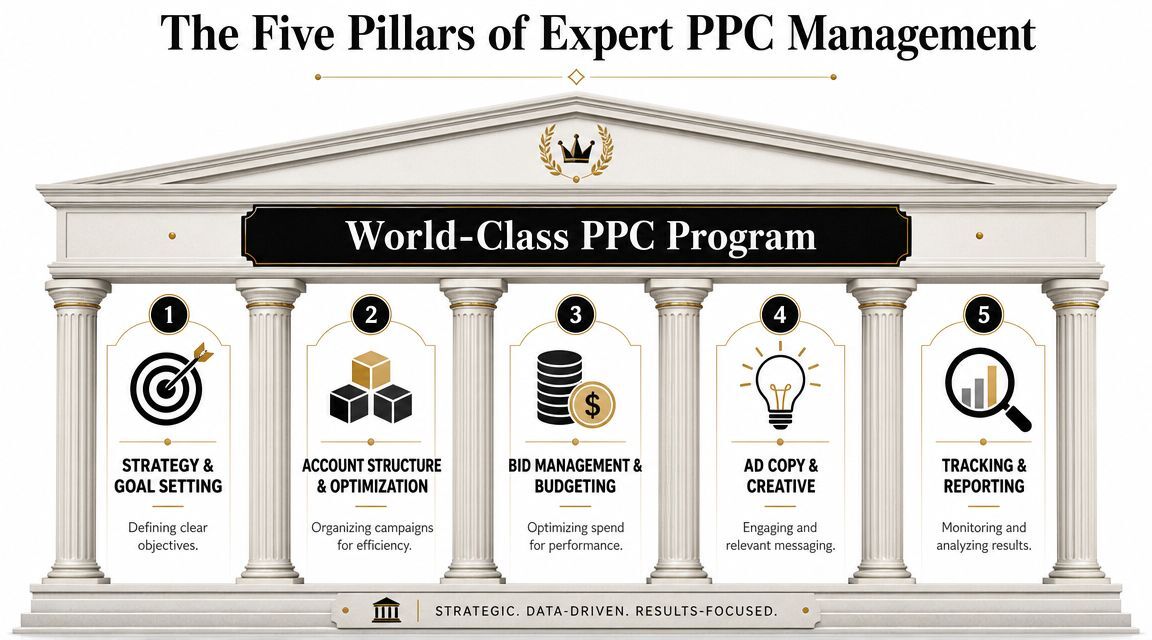
These are the five pillars I look at first in any audit. They tell you whether the account has a real architecture or just accumulated activity.
Pillar one and two
1. Strategic account structure
Good account structure mirrors the business. It separates priorities clearly enough that budget, bids, and reporting can follow real goals. That might mean splitting by product line, lead type, geography, brand versus non-brand intent, or new customer acquisition versus remarketing.
Agencies often accept whatever Google defaulted into place, then optimize inside a messy container. That's backwards. Structure decides what can be controlled later. If the account doesn't reflect how the business makes money, optimization becomes blunt and expensive.
2. Keyword and audience strategy
For intent to be sorted from noise, strong managers do more than just gather keywords. They decide which search behavior belongs in which campaign, what should be excluded, and where audience layering sharpens the signal.
Negative keywords are part of this architecture, not cleanup work. If your team isn't reviewing irrelevant queries regularly, you're paying tuition to Google. For a deeper look at that process, this negative keywords guide for Google Ads is worth keeping handy.
A quick gut check helps here:
High intent traffic: Searches that show a clear commercial need deserve tighter control and clearer budgets.
Exploratory traffic: Broader discovery terms can work, but only if you separate them and measure them accurately.
Irrelevant traffic: If you wouldn't want your sales team spending time on it, your ad budget shouldn't either.
After you've seen the account structure in action, this video gives a useful visual breakdown of how managers think through control and optimization.
Pillar three and four
3. Dynamic bidding and budget allocation
This is the financial core of PPC management. Budget should move toward segments that generate profitable outcomes, not just cheap clicks or attractive CTR. A strong manager sets bidding targets based on actual conversion economics and adjusts the allocation when demand quality shifts.
That means looking beyond campaign totals. Device, geography, audience, search term, and time pattern all matter. A campaign can look healthy in aggregate while one segment burns money underneath it.
4. Ad creative and landing page alignment
Great ad copy doesn't win by sounding clever. It wins by pre-qualifying the click and matching the next page. If your ad promises one thing and the landing page stalls, confuses, or buries the offer, the account pays for that disconnect.
Specialist oversight is essential. A consultant isn't writing copy in a vacuum. They understand which message attracts the right user, which offer screens out bad traffic, and which landing page friction lowers conversion rate. Agencies often split those responsibilities across teams, and the message gets diluted.
Better PPC creative doesn't attract everyone. It attracts the right people and repels the wrong ones.
Pillar five
5. Conversion tracking and measurement
This pillar is the most important because every automated system depends on it. If conversion actions are duplicated, mislabeled, too shallow, or disconnected from actual business value, the account starts optimizing toward the wrong outcome.
That is where many expensive retainers fall apart. Agencies talk about optimization while the measurement foundation is unstable. A specialist starts with the event logic, CRM handoff, primary conversion selection, attribution sanity, and reporting consistency.
A few signs the pillar is weak:
Inflated conversion counts: The platform says success. Sales says otherwise.
Wrong primary actions: The account optimizes for form fills when the business cares about qualified pipeline or completed purchases.
No value hierarchy: Every conversion gets treated the same even when the business value isn't remotely equal.
If you remember one thing from this section, remember this. What is PPC management? It's the coordinated control of structure, intent, spending, message, and measurement. Miss one pillar and the rest underperform.
Measuring What Matters True ROI and Business KPIs
Agencies love metrics that look active. Clicks, impressions, average CPC, CTR. Those numbers can help diagnose account behavior, but they don't tell you whether the spend is creating healthy growth.

In mature PPC management, profitability metrics outperform vanity metrics. CTR and CPC are useful diagnostics, but decision-making should center on CPA, ROAS, ACOS, and downstream value like LTV, because two campaigns with similar CTR can produce very different business outcomes when intent and customer value differ, as explained in Pepper Agency's PPC management guide.
Diagnostic metrics versus decision metrics
CTR tells you whether people are clicking. It does not tell you whether those clicks were worth buying.
CPC tells you what traffic costs. It does not tell you whether the traffic converts profitably.
CPA, or cost per acquisition, starts to get closer because it asks what you paid for a result. ROAS, or return on ad spend, goes further by tying spend to revenue. LTV matters because some customers are worth much more after the first transaction. Margin-adjusted return matters because revenue without margin can still be bad business.
That is why expert managers segment performance before making decisions. They look at search term, device, audience, and geography to find where profit comes from. They also resist acting on thin data. If the sample is too small, confidence is fake.
If reporting starts with clicks instead of business outcomes, you're looking at a dashboard built for justification, not management.
What good reporting actually answers
A useful report should answer questions a CMO or founder can act on.
Where should more budget go: Which campaigns, products, services, or audiences earn more investment right now.
Where should budget be cut: Which segments absorb spend without producing acceptable value.
What changed: Whether performance moved because of query mix, competition, creative, landing page behavior, or tracking.
What should happen next: The decision, not just the description.
This is also where a specialist tends to outperform a traditional agency. The reporting is tighter because it isn't being filtered through account management layers. The person interpreting the numbers is the person responsible for fixing the account.
If your current reports celebrate CTR gains while profit stalls, you're not getting PPC management. You're getting dashboard theater. A more grounded framework for measuring advertising effectiveness usually exposes that gap quickly.
Choosing Your Growth Partner DIY vs Agency vs Consultant
A bad management model can sink PPC before strategy has a chance to work. High spend does not forgive slow decisions, filtered communication, or generic account handling.
Reboot Online's PPC statistics summary shows why. As monthly spend increases, the team supporting PPC usually gets larger. Accounts spending $1 million to $3 million per month average 6.2 team members, versus 1.6 team members for accounts spending under $5,000. External management fees also commonly sit in the $1,001 to $3,000 range. The point is simple. Bigger budgets create more moving parts, more decision risk, and more room for waste if ownership is unclear.
That is why high-spend brands should choose a partner model based on decision quality, speed, and accountability. Price matters. Org design matters more.
PPC Management Model Comparison
Criteria |
DIY (In-House) |
PPC Agency |
Specialist Consultant |
|---|---|---|---|
Strategy depth |
Depends on internal experience |
Often inconsistent across teams and account tiers |
High when the consultant is senior and hands-on |
Execution speed |
Fast if the operator has time and authority |
Commonly slowed by approval chains and handoffs |
Fast because the same person sets direction and makes changes |
Communication |
Direct inside the company |
Usually filtered through account managers |
Direct with the person responsible for performance |
Cost structure |
Salary, tools, and management overhead |
Retainer plus agency overhead |
Focused on specialist time and fewer layers |
Accountability |
Shared across internal stakeholders |
Often split between sales, account, and delivery teams |
Clear ownership with one operator |
Best fit |
Lower-complexity accounts |
Brands that need broad channel coverage |
High-spend accounts that need depth and control |
Which model fits a high spend account
DIY works if you already have a strong operator in-house and the account is still manageable by one person. That window closes fast. Once spend rises, the job stops being campaign upkeep and turns into budget allocation, measurement design, creative testing discipline, and platform governance. If your internal team cannot protect time for that level of work, DIY becomes expensive in a quiet way.
Agencies solve staffing gaps, but they often create distance from the actual decisions that drive return. The standard model includes sales people, account managers, junior buyers, and reporting layers. That structure works for agency margins. It often works against account performance. By the time a problem reaches the person with enough context to fix it, the account has already paid for the delay.
Specialist consultants are the better fit for many high-spend advertisers because they compress that chain. Fewer layers. Faster judgment. Cleaner accountability. You are buying decision quality from someone close enough to the account to spot waste early and confident enough to challenge bad assumptions inside the business.
If you are weighing the tradeoffs, this comparison of PPC agency versus freelance consultant models gives a useful breakdown of where each setup tends to help or hurt.
Choose the model that keeps strategic control close to revenue, not the one with the nicest pitch deck. In PPC, structure drives outcomes.
The Costly Mistakes That Quietly Burn Your Budget
Most account waste doesn't arrive as a catastrophe. It shows up as tolerated inefficiency. A little irrelevant traffic here. A weak audience signal there. A bidding strategy learning from junk data for weeks because nobody challenged it.
Unchecked automation
Automation is useful. Blind trust in automation is expensive.
Platforms like Google Ads are designed to spend budget. They are not designed to protect your margin unless you feed them the right goals, exclusions, and value signals. When teams launch automated campaign types without tight oversight, spend drifts into low-intent pockets that look busy but don't help the business.
The fix isn't to reject automation. It's to govern it. Someone has to decide what the algorithm should optimize for and verify that it's doing the right job.
Weak account hygiene
A surprising amount of waste comes from simple neglect. Search queries go unreviewed. Negative keyword lists stay stale. Old ad copy keeps running long after the message stopped matching the market.
Discipline beats theory. An account can have smart strategy on paper and still underperform because nobody is cleaning the pipes.
Query review: Irrelevant traffic has to be excluded continuously.
Creative maintenance: Ads need fresh testing, but tests need a reason.
Budget hygiene: If one campaign keeps absorbing spend without producing value, stop feeding it.
Most wasted spend isn't hidden. It's ignored.
Broken measurement logic
A major gap in PPC management is measurement quality under privacy and platform changes. Attribution is degraded by cookie limits, modeled conversions, and cross-device behavior, so relying on last-click data is a critical error, as discussed in Webfor's look at modern PPC management.
Shallow management reveals its weaknesses. If your team still treats last-click reporting as ground truth, they're making decisions on an incomplete map. Expert management now means designing a measurement approach that acknowledges blind spots, reconciles platform data with business outcomes, and avoids overreacting to partial attribution.
That's why the old definition of PPC management falls short. It isn't just campaign mechanics anymore. It's decision-making under imperfect measurement, and that requires senior judgment.
Your Next Steps A Quick Audit and Specialist Advice
If your account is underperforming, you don't need another glossy report. You need a fast audit that tells you whether the fundamentals are intact.
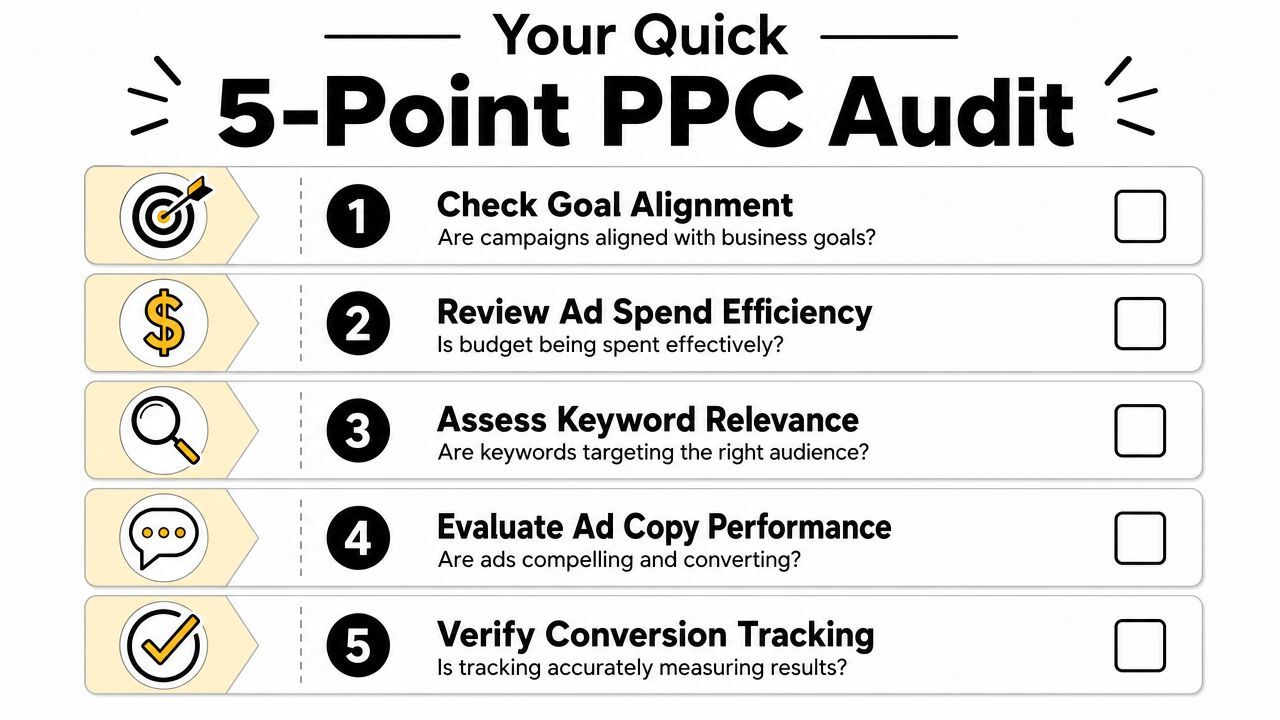
A five point audit you can do today
Use this quick review inside Google Ads and your analytics stack.
Check goal alignment Are campaigns organized around business priorities, or just around platform defaults? If your best products or services don't have clear budget control, the structure is wrong.
Review ad spend efficiency Find the campaigns that spend aggressively but don't contribute acceptable business value. Don't start by asking what's getting traffic. Ask what's earning more budget.
Assess keyword relevance Pull recent search terms and scan for obvious mismatch. If irrelevant intent is getting through, your targeting and exclusions need work.
Evaluate ad and landing page consistency Read the ad, click the page, and judge the handoff. If the promise is vague or the page makes the user work too hard, conversion rate will suffer.
Verify conversion tracking Confirm that the primary conversions in the account represent outcomes the business values. If the platform is optimizing for the wrong action, everything downstream gets distorted.
Start with tracking and query quality. Those two checks usually tell you whether the account is teachable or confused.
What to do with what you find
If the audit surfaces one isolated issue, fix it and monitor the account closely.
If it surfaces multiple issues, you're not dealing with a few loose ends. You're dealing with a management problem. That's when outside specialist review becomes valuable, especially for teams that need senior Google Ads oversight without hiring a full agency or building a larger in-house department.
For local businesses and SMBs, the priority is usually tighter efficiency and cleaner targeting. For healthcare and clinic advertisers, the bar is higher around trust, intent control, and careful measurement. For e-commerce teams, the focus is usually product-level allocation, feed quality, and margin-aware bidding logic.
If you want a second set of expert eyes on your account, Come Together Media LLC offers direct Google Ads consulting, audits, setup, and ongoing PPC optimization with one-on-one oversight. It's a practical fit for businesses that want clearer strategy, cleaner reporting, and a specialist partner instead of another agency layer.
