A Search Engine Marketing Strategy That Wins
- Sep 5, 2025
- 16 min read
A winning search engine marketing strategy isn't about having the biggest budget; it’s about having the sharpest mind managing it. The real goal is to get in front of high-intent customers the exact moment they’re looking for a solution and turn those clicks into measurable business growth.
Choosing A Specialist Over A Large Agency
When it's time to manage your SEM strategy, the choice between a solo consultant and a big agency can feel like a toss-up between a focused expert and the "safe bet." A lot of businesses just default to the big agency name, thinking bigger automatically means better.
But I've seen it time and time again—this is often where budgets go to die. They get eaten up by overhead, lost in layers of account managers, and shoehorned into standardized playbooks that don't fit the business.
What usually happens is your account gets handed off to a junior rep who's juggling a dozen other clients. Their job isn't to find the unique angles in your market; it's to fit your business into their agency's scalable, one-size-fits-all process. That approach almost always leads to wasted ad spend and completely missed opportunities.
The core difference is simple: a bloated agency is built for scale, while an expert consultant is built for results. You're not just another account number; your success is my reputation.
The Advantage Of Dedicated Expertise
Working with a specialized Google Ads consultant flips that entire model on its head. Instead of a diluted, cookie-cutter plan from an over-priced agency, you get a direct line to a seasoned expert whose own success is tied directly to yours.
This personal investment shows up in a few critical ways:
Deep Platform Knowledge: A specialist lives and breathes Google Ads. We're on top of every algorithm update and new feature, while bloated agencies might take months to catch up and train their junior teams.
Personalized Attention: Your strategy is built from the ground up by me, personally. It’s based on a real understanding of your business goals, your customers, and what your competitors are doing.
Rapid Adaptation: When the market shifts or a campaign isn't performing, a consultant can pivot instantly. There’s no waiting for internal meetings or chain-of-command approvals common in a large, slow-moving agency.
The image below breaks down the fundamental differences between paid and organic search, which really highlights why having an expert manage your paid strategy is so critical to your bottom line.
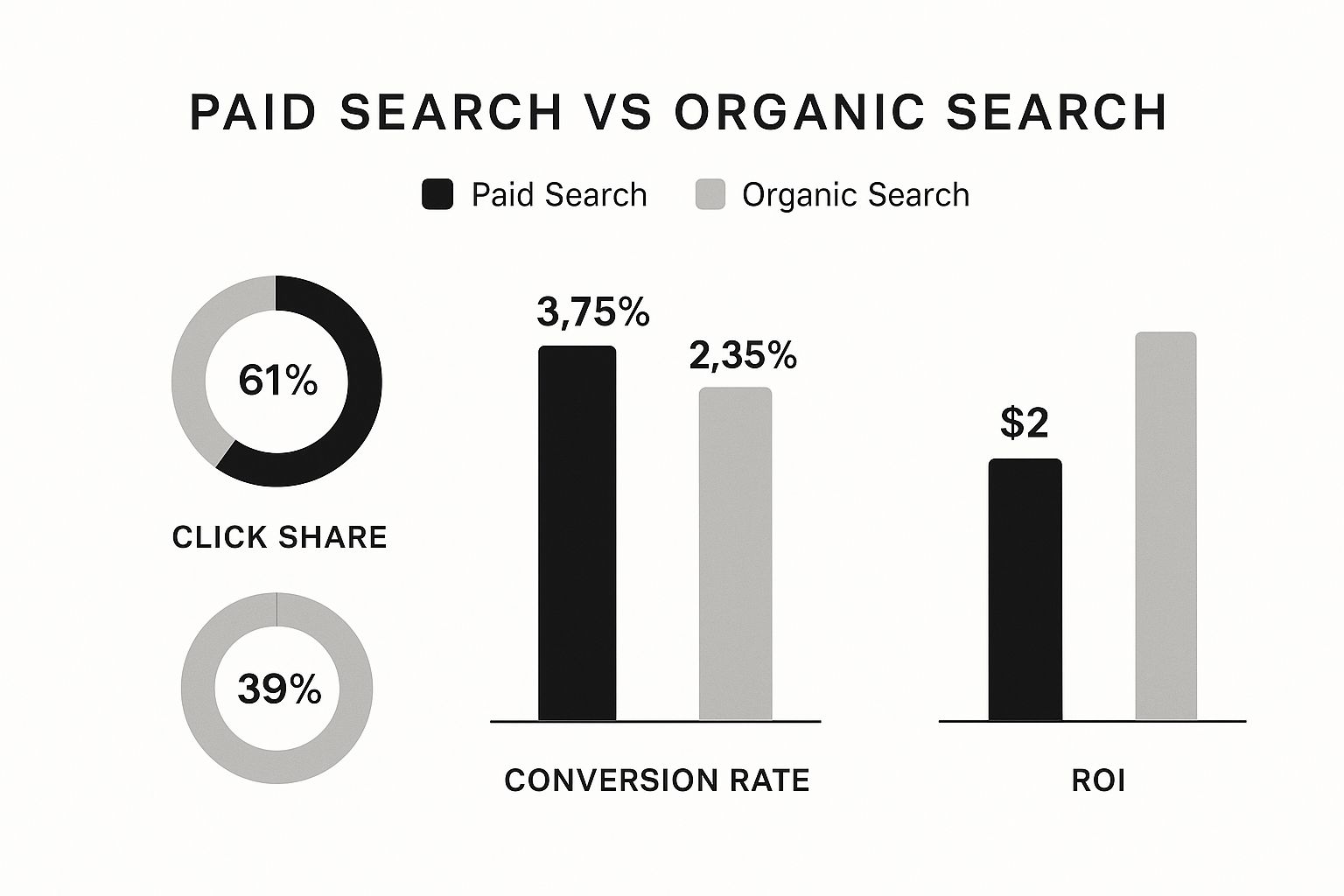
This data shows that while paid search often grabs more clicks and converts at a higher rate, a solid organic strategy can deliver a much stronger ROI over the long haul. This is why you need an expert managing both sides of the coin.
For a deeper dive, check out my guide on why hiring a senior Google Ads consultant beats working with a bloated PPC agency.
Individual Consultant Vs. Large Agency Approach
The day-to-day experience and, more importantly, the results you get can be worlds apart. Here’s a quick breakdown of what you can typically expect from each.
Factor | Individual Consultant | Large Agency |
|---|---|---|
Point of Contact | Direct access to the senior expert running your campaigns. | An account manager, often with limited hands-on experience. |
Strategy | Custom-built for your specific business goals and market. | Standardized playbook applied across many clients. |
Agility | Can make strategic changes and optimizations in real-time. | Slow to react due to internal process and bureaucracy. |
Accountability | Direct responsibility; my reputation is on the line. | Diffused responsibility across a team; easy to pass the buck. |
Cost | You pay for expertise and results, not office overhead. | Fees are inflated by overhead, sales teams, and management layers. |
Ultimately, choosing a specialist is about making a direct investment in a partner who is 100% focused on eliminating waste and maximizing your return on ad spend. It’s about doing what actually drives revenue for your business—not just what’s convenient for an agency's workflow.
Building a Bulletproof Google Ads Foundation
Real success with any search engine marketing strategy doesn't come from guesswork. It's built on a rock-solid foundation, and frankly, this is where having a dedicated specialist gives you a massive edge over the competition.
Too many large agencies rush right through this critical planning phase. They slap on a generic template, desperate to get campaigns live and start the billing clock. This "launch now, fix later" approach is just a fast way to burn through your budget with nothing to show for it.
An experienced consultant knows the real work happens before a single ad ever goes live. This foundational stage is the most important part of the entire process. It ensures every dollar you invest has a purpose and is fully accountable from day one.
Performing a Deep-Dive Competitor Analysis
Your competitors are already spending money on Google Ads, which means they're handing you a treasure trove of data—if you know where to look. A specialist goes way beyond a quick glance at their ad copy. We dig deep to find their strategic weak spots.
This means identifying the high-intent keywords they're dominating, but more importantly, the ones they're completely ignoring. It involves tearing down their ad schedules, messaging angles, and landing page experiences to find the gaps you can exploit for a quick win.
The goal isn't just to copy what your competitors are doing. It's to understand their playbook so well that you can surgically dismantle it and capture the market share they've overlooked. Over-priced agencies rarely have the time or specialized focus for this level of granular analysis.
Defining Goals That Actually Matter
So many campaigns fail because their goals are just too vague. An agency might report on vanity metrics like clicks or impressions because they're easy to track and look good on a PowerPoint slide. But let's be real—clicks don't pay the bills. Revenue does.
A specialist works with you to lock in sharp, business-focused goals right from the start. Instead of just aiming for "more traffic," we define success with outcomes that hit your bottom line.
Here are a few examples of goals that actually measure growth:
Achieving a specific Cost Per Acquisition (CPA) for a qualified lead.
Generating a target Return On Ad Spend (ROAS) of 4:1 or higher.
Increasing the Customer Lifetime Value (LTV) from paid search by 15% in six months.
Setting these clear Key Performance Indicators (KPIs) from the get-go makes sure our entire strategy is tied to your profitability, not just pointless activity.
Implementing Flawless Conversion Tracking
Without accurate conversion tracking, you are flying blind. It's the single most critical technical piece of any Google Ads account, yet it’s an area where bloated agencies often cut corners, leading to misattributed sales and terrible optimization decisions.
Getting this right is non-negotiable. For an e-commerce store, this means tracking not just the purchase but the specific revenue attached to every single transaction. For a B2B service, it might mean tracking form submissions, phone calls, and PDF downloads—each with its own assigned value.
This meticulous setup is what allows us to know, with absolute certainty, which keywords, ads, and audiences are driving real business results. This data-first approach is what turns your search engine marketing strategy from a cost center into a predictable, scalable growth engine. It's the blueprint for making sure your ad budget works as hard as you do.
Mastering Keywords and Audience Targeting

This is where a focused, expert-led search engine marketing strategy really separates itself from the rest of the field. Big agencies often lean on automated tools to generate generic keyword lists, but a specialist knows this is a craft. It’s where deep customer insight turns a cash-burning campaign into a winning one.
Throwing money at generic, broad keywords is the fastest way to drain your ad budget. You end up with a flood of low-quality clicks from people who are just browsing, not buying. I see this all the time in accounts managed by junior agency staff—they grab the most obvious terms to save time, and you end up paying for traffic that never had a prayer of converting.
A real expert, on the other hand, is obsessed with intent. We dig deeper. The goal is to unearth those high-intent keywords that signal a user is ready to pull the trigger, thinking exactly like your ideal customer to find the specific, long-tail phrases they use when they're serious about finding a solution.
Unearthing High-Intent Long-Tail Keywords
Long-tail keywords are longer, more specific search phrases. They don't have the massive search volume of broader terms, but they attract highly motivated buyers. The automated software a big agency relies on will almost always miss these gems because they aren't obvious.
Let's take a local plumbing company. An agency might just target the broad term "plumber." A specialist, however, will go after phrases your competitors are totally ignoring, like:
"emergency burst pipe repair Burlington"
"cost to install a tankless water heater"
"licensed plumber for bathroom remodel"
Each of these terms signals a specific, urgent need. The person searching is much further down the buying funnel. Capturing this traffic is how you generate leads that actually close, not just clicks that make reports look good.
This granular focus is what a specialist brings to the table, and it's a world away from the broad-stroke methods common in larger, slower organizations.
Want to go deeper on this? Check out our guide on how to choose the right keywords for high-impact ads.
Going Beyond Basic Demographic Targeting
Effective audience targeting is about so much more than just age, gender, and location. Those are just the starting points. A sophisticated SEM strategy uses Google's powerful audience layers to connect with users at the perfect moment—another area where a hands-on expert provides way more value than a set-it-and-forget-it agency.
A winning campaign isn't just about finding the right keywords; it's about matching them with the right person. Agencies often stop at the keyword, but a specialist knows the real magic happens when you connect that keyword to a highly qualified audience segment.
We can get incredibly specific. This ensures your ad budget is only spent on the people most likely to become your next customers. It's a multi-layered targeting approach that agencies frequently overlook because it's too complex or time-consuming for their model.
Here’s how a specialist creates a much sharper audience profile:
In-Market Segments: This lets us target users who Google's data shows are actively researching and comparing products or services like yours right now. For instance, we can target users "In-Market for Accounting Services" to ensure your ad shows up while they're actively looking to hire.
Custom Intent Audiences: We can build unique audiences from scratch based on the specific keywords people have searched or the URLs they've visited. This is powerful stuff—it lets us target users who have visited competitor websites or searched for very specific solution-oriented terms.
Strategic Remarketing Lists: This isn't just about spamming everyone who visited your site with the same ad. A real expert segments these lists based on behavior. We'll target users who abandoned a shopping cart completely differently than those who just read a blog post.
This expert-led approach puts your ads in front of the right people, with the right message, at the exact moment they’re ready to act. It’s a level of detail and strategic thinking that you just won't find in a bloated agency model, and it's what ultimately drives a superior return on your ad spend.
Crafting Ads That Convert
Your ad copy is the promise you make to a searcher. Your landing page is where you keep it.
This connection is the absolute core of any search campaign that actually makes money. It's also where the focused approach of an expert consultant completely blows the doors off the fragmented, siloed departments you find in most large agencies.
Think about it: in a bloated agency, the person writing your ads might have never even met the person designing your landing pages. This disconnect is a recipe for a jarring user experience, and it absolutely kills conversion rates while wasting your ad spend. As a dedicated specialist, I control both sides of this equation, ensuring a seamless journey from the first click to the final conversion.
Writing Ad Copy That Demands Action
Good ad copy is part psychology, part real estate. It has to instantly grab attention, speak directly to the user's problem, and give them a damn good reason to choose you over the other three ads staring them in the face. This isn't about mindlessly stuffing keywords into a template; it's about hitting emotional triggers and nailing your value proposition.
An experienced pro knows how to squeeze every drop of value out of the Google Ads toolbox to make your ads bigger, better, and more informative. We're talking about going way beyond just the headlines and descriptions.
Sitelink Extensions: Why hope they find your pricing page? Send them there directly. Use sitelinks to point users to high-intent pages like "Pricing," "Case Studies," or "Contact Us."
Callout Extensions: These are your quick-hit highlights. Think "Free Initial Consultation" or "15+ Years of Experience."
Structured Snippets: These add context by grouping features into categories, like "Services: PPC Audits, Campaign Management, Ad Copywriting."
When you use every relevant ad extension, your ad physically takes up more space on the results page. You dominate the screen. It's a small detail that has a huge impact, and it's the kind of thing overworked agency reps often skip.
Engineering Landing Pages for a Single Goal
A click means nothing if it doesn't convert. Nothing. The single biggest mistake I see businesses make—often on the advice of a generalist agency—is sending expensive paid traffic to their generic homepage. It’s a total conversion killer.
A specialist knows that every serious ad campaign deserves its own dedicated landing page. This isn't just another page on your site; it's a piece of machinery engineered for one single purpose—whether that's filling out a form, making a purchase, or booking a call. You strip away all the distractions and guide the user straight to the one action you want them to take.
The best landing pages are exercises in ruthless simplicity. They have a magnetic headline that mirrors the ad's promise, a crystal-clear call-to-action (CTA), and a frictionless mobile experience. If it doesn't serve the one conversion goal, it gets cut.
This tightly integrated ad-to-landing-page strategy is how you turn ad spend into actual revenue. It’s a hands-on, strategic process that just gets lost in the noise of a big, impersonal agency.
The Power of a Cohesive Strategy
This obsession with integrating ads and landing pages is what drives real results. Don't just take my word for it—visitors who land on a site from a PPC ad are about 50% more likely to convert than organic visitors. That stat alone shows you the power of a well-built paid strategy.
With global search ad spending projected to hit $132 billion in 2024, it’s obvious that businesses are pouring money into this channel. Why? Because when it's done right, it works. You can read more about these SEO and SEM statistics on smamarketing.net.
The key is making sure your investment is managed by someone who sees the whole picture—from the search query to the "thank you" page. This unified perspective is the natural advantage of working with a focused expert. It’s how you build a reliable system for turning clicks into customers.
Optimizing Your Campaigns for Peak Performance

Getting a Google Ads campaign live is just the starting gun. Honestly, any junior account rep at a big agency can do that. The real expertise—the kind that turns a so-so campaign into a money-printing machine—is in the relentless, day-to-day grind of optimization. It’s all about the data.
This is where a specialist’s value really shines. For a bloated agency, "optimization" often just means glancing at a few automated reports once a week. For an expert, it’s a constant process of tweaking, testing, and refining. It’s a series of calculated adjustments that agencies often skip because their assembly-line model just doesn't allow for that kind of granular attention.
This hands-on approach is what separates a "set it and forget it" campaign from a truly effective search engine marketing strategy. It's about treating your budget like it’s my own, squeezing every drop of efficiency out of it, and never, ever settling for "good enough."
Navigating Bidding Strategies with an Expert Hand
Google's smart bidding is powerful, no doubt. But it's not a magic button. I see it all the time: an agency just flips on "Maximize Conversions" and walks away. That’s a fast track to burning through your budget on junk clicks. A true specialist knows exactly when to let the algorithm do its thing and when to pull back the reins and take manual control.
For instance, putting a brand-new campaign on a Target CPA (Cost Per Acquisition) bid strategy is a rookie mistake. The algorithm has zero data to learn from, so it’s just going to make expensive guesses with your money. In that scenario, I’d start with something like Enhanced CPC or even full manual bidding to gather that crucial baseline data. Only then would I carefully transition to a more automated strategy. This kind of nuanced decision-making is something you’ll rarely get from a junior rep just following a playbook.
The Daily Grind That Agencies Skip
The biggest wins in performance come from the tedious, ongoing work that simply isn't profitable for a large agency's business model. These are the details a dedicated specialist lives and breathes.
Rigorous Search Query Analysis: I'm constantly digging through search query reports to see the actual phrases people typed to trigger your ads. This is where the gold is. It’s how I find all the irrelevant, money-wasting searches and build a bulletproof negative keyword list that protects your budget from tire-kickers.
Systematic A/B Testing: We don't guess. We test. We test headlines, descriptions, calls-to-action, landing page elements—everything. Small, incremental wins from constant testing add up to huge improvements in click-through rates and conversion rates over time.
Strategic Bid Adjustments: I’m analyzing performance data by device, location, and even time of day. If the data shows that mobile users in Chicago convert at a 20% higher rate between 9 AM and noon, you bet I'm adjusting bids to dominate that specific window of opportunity.
True optimization isn’t about making big, sweeping changes once a month. It’s about making hundreds of small, informed decisions every week that compound over time. This is the first thing that gets lost when your account is just another number on an overworked agency team’s spreadsheet.
Why This Matters for Your Bottom Line
This obsessive focus on the details has a direct and massive impact on your ROI. By constantly refining your campaigns, we make sure your ad spend is laser-focused only on the most profitable parts of your audience. For a deeper dive, check out our guide on how to [improve Google Ads performance and ROI](https://www.cometogether.media/single-post/improve-google-ads-performance-and-roi).
This is absolutely critical when you realize just how dominant the platform is. Projections show that by 2025, Google will command an 89.74% share of the global search market. With nearly nine out of ten of your potential customers on Google, you can see why having an expert meticulously managing your campaigns isn't a luxury—it's essential for survival and growth. As covered in this analysis of market dominance on proceedinnovative.com, this is the battleground. Your marketing dollars are won or lost here, and a dedicated expert is your best weapon.
Measuring Real Growth and Scaling Smartly
Data without insight is just noise. Any agency can throw a report at you that’s packed with charts and graphs, but a real expert knows which numbers actually tell the story of your business's growth.
This is the final, critical piece of any effective search engine marketing strategy: moving past vanity metrics and focusing on what truly drives your bottom line.
Too many bloated agencies will point to a rising click-through rate (CTR) or a higher impression share to justify their fees. Look, those metrics have their place, but they don't pay your bills. A dedicated specialist cuts through that clutter to concentrate on the numbers that actually matter.
Focusing on Profitability Metrics
Your entire ad spend has to be measured against real business outcomes. An expert's focus is relentlessly tied to profitability, which means we live and die by just a few key performance indicators.
Cost Per Acquisition (CPA): This is the ultimate measure of efficiency. We track exactly how much it costs to generate a qualified lead or a sale. This ensures every dollar spent is a profitable investment, not just a shot in the dark.
Return On Ad Spend (ROAS): It's a simple question: for every dollar you put into your campaigns, how many dollars do you get back? We don't just hope for a good return; we set a specific ROAS target that aligns directly with your profit margins.
Customer Lifetime Value (LTV): A true specialist thinks bigger. We look at how Google Ads contributes to the long-term value of a customer, not just that first sale. This is about building a sustainable business, not just getting a quick win.
Bloated agencies often lack the business acumen to connect ad metrics to your P&L. A consultant's value is in providing actionable intelligence from Google Ads and Analytics, not just a data dump that leaves you wondering, "So what?"
Knowing When and How to Scale
Scaling a campaign isn't just about throwing more money at it—that’s the classic agency approach, and frankly, it’s a recipe for disaster. Smart scaling is a strategic decision based on clear, data-driven signals. An expert knows precisely when to hit the accelerator.
We only scale when a campaign or ad group has demonstrated consistent, profitable performance over time. That means it's reliably hitting its target CPA and ROAS goals. Once we have that proof, we can methodically increase the budget or start exploring new growth channels.
This could mean strategically expanding into the Google Display Network with highly-targeted remarketing lists or testing the waters with YouTube Ads. This approach ensures you're building a predictable growth engine for your business, not just gambling with a bigger budget.
It’s the difference between guessing and growing.
Your SEM Strategy Questions Answered
It’s the classic dilemma: go with a big, well-known agency or partner with a solo expert? I get this question all the time, and it’s a fair one. The answer really boils down to one thing: who has more skin in the game?
Let's unpack the two most common questions I hear from businesses trying to make that call.
Why Not Just Hire a Big Agency?
This is probably the biggest misconception out there. People assume a large agency is the "safe" choice, but what usually happens is your account gets handed off to a junior-level manager who's juggling a dozen other clients. They're not incentivized to innovate; they're trained to follow a generic playbook.
The reality is, their goal is efficiency, not necessarily your profitability.
An independent consultant, on the other hand, lives and dies by their results. My reputation is built entirely on your success. There are no layers of management, no internal politics—just a direct, one-to-one partnership focused on making your business more money. My name is on the line with every dollar you spend.
When you hire a solo expert, you’re not paying for a fancy downtown office or a slick sales team. You’re paying for dedicated, hands-on expertise from the person who is actually doing the work and is personally invested in your return on ad spend.
How Does a Consultant Handle Complex Accounts?
Complexity isn't solved by adding more people to a project; it's solved by deep, focused knowledge. A true specialist lives and breathes the Google Ads platform every single day. We're on top of the algorithm changes and new features long before most agencies get around to implementing them.
This focus allows for a much more agile and responsive search engine marketing strategy.
Faster Pivots: When a campaign starts to underperform, I can spot it, analyze the data, and make changes immediately. There are no team meetings to schedule or approvals to wait for.
Deeper Analysis: I have the time to go granular. I dig into the messy search query reports and audience segments that big teams often skim over because they're stretched too thin.
This hands-on approach means your budget is always being optimized for what's working right now, not what worked for another client three months ago.
Ready to see what a dedicated, expert-led search engine marketing strategy can do for your business? Come Together Media LLC offers a free, no-obligation consultation to review your current campaigns and find immediate opportunities for growth.
Book your free consultation today at https://www.cometogether.media.


Comments