Expert Pay Per Click Audits to Maximize Your ROI
- Sep 1, 2025
- 16 min read
So, what exactly is a pay per click audit?
Think of it less like a routine check-up and more like a deep-dive forensic investigation into your ad account by a dedicated specialist. I’m peeling back the layers to find every dollar of wasted spend, pinpoint hidden growth opportunities, and ultimately, maximize your profitability. The entire point is to get a much better return on every single dollar you put into your campaigns, a level of focus that bloated agencies simply can't provide.
Why Your Agency's Audit Is Just Scratching the Surface

Let's be blunt. That "monthly audit" you get from your over-priced, bloated agency? It’s almost certainly a templated checklist run by a junior account manager who is juggling a dozen other clients. You're just another number on their spreadsheet.
Their review is built for speed, not depth. It’s designed to catch the most glaring, obvious mistakes, but it consistently misses the subtle, nuanced issues that are quietly bleeding your budget dry month after month.
This isn't necessarily because they're bad people. It's a fundamental flaw in the agency model itself. With bloated teams, high overhead, and layers of management, they have to rely on standardized processes and automated software just to keep up. The real strategic thinking—the kind of specialized expertise you get from an individual consultant—gets lost in a sea of vanity metrics and pre-generated reports.
The Pitfalls of a Cookie-Cutter Agency Checkup
The standard agency "audit" often feels more like a report card than a strategic plan. It’s great at telling you what happened, but it rarely uncovers why it happened or how an expert could fix the problem at its root.
Here’s where those checkups usually fall flat:
Chasing Vanity Metrics: They’ll celebrate a high click-through rate (CTR) while completely ignoring that the clicks are coming from irrelevant search terms that never convert.
Missing the Strategic Nuance: An automated tool doesn't understand your business goals. A junior employee won't question if your budget is split correctly between top-of-funnel awareness and bottom-of-funnel lead generation. An expert consultant lives for this stuff.
Ignoring Broken Tracking: I've lost count of the agency-managed accounts I've seen with broken or double-counting conversion tracking. This makes all their performance data totally unreliable and their reports pure fiction.
Sticking to a "Set It and Forget It" Structure: Agencies often build accounts from a template and rarely go back to rethink the core structure, even as your business grows and changes. It's faster for them, but disastrous for you.
This hands-off approach gets more dangerous by the day. The average cost per click (CPC) on Google Search is already $2.69 across industries, and it's only going up. Considering businesses typically earn $2 for every $1 spent on PPC, you can't afford to let agency waste chip away at that ROI. A deep, meticulous audit from a specialist is the only way to protect it. Dig into more PPC statistics to see just how quickly these costs are climbing.
A dedicated consultant's audit isn't about running down a checklist. It's about applying years of specialized experience to ask the tough questions that an overworked, generalist agency team simply doesn't have the time or expertise to address.
The Expert Consultant Difference
As an independent consultant, my entire reputation is built on going deeper. My name is on every report, and I’m not trying to manage a massive client roster to cover expensive office space and a bloated payroll. This gives me the freedom to conduct a pay per click audit that is truly investigative.
I've put together a quick table to show you what I mean.
Agency Audit vs. Expert Consultant Audit: A Quick Comparison
This table breaks down the core differences between the quick check-up you're getting from your bloated agency and the deep-dive analysis an individual expert provides.
Audit Aspect | Typical Agency Approach | Expert Consultant Approach |
|---|---|---|
Depth of Analysis | Surface-level check based on a standardized template. | In-depth, forensic investigation of every campaign element. |
Reporting Focus | Highlights vanity metrics (CTR, impressions) from automated software. | Focuses on bottom-line business metrics (ROAS, CPA, lead quality). |
Strategic Insight | Identifies obvious errors but rarely questions the core strategy. | Challenges the foundational strategy, structure, and budget allocation. |
Conversion Tracking | Assumes tracking is correct; may miss subtle implementation errors. | Pressure-tests the entire conversion path and validates data accuracy. |
Outcome | A report of what happened, with generic "best practice" tips. | An actionable, prioritized roadmap for plugging leaks and scaling growth. |
Who Does the Work | Often a junior account manager juggling multiple clients. | A senior-level expert with years of direct, hands-on experience. |
The difference is clear: one is a routine task designed to justify a monthly retainer, the other is a strategic investment in your profitability.
Instead of a template, I use a diagnostic methodology I've honed over years of turning around underperforming accounts. I don't just glance at the data; I dissect the strategy behind it. That means painstakingly reviewing your account structure for logical flow, manually analyzing search term reports to understand true user intent, and pressure-testing the entire journey from the ad click to the landing page.
This hands-on, meticulous approach is how you uncover the hidden problems that automated tools and junior staff always miss. We’re talking about the subtle keyword mismatches, the flawed bidding strategies, and the broken conversion funnels that are collectively hemorrhaging your budget. It’s this deep, specialized focus that transforms an ad account from a cost center into a predictable engine for growth.
Deconstructing Your Account Structure for Real Efficiency
Your Google Ads account structure is everything. It's the foundation. Get it right, and you have a logical, intuitive machine for making money. Get it wrong, and you're constantly fighting a losing battle, just trying to plug leaks in a sinking ship.
This is exactly where most big, bloated agencies drop the ball right from the start.
They lean on standardized, cookie-cutter templates that are designed for their workflow, not your actual business goals. An e-commerce brand with 500 different products gets jammed into the same basic setup as a local plumber. The result? A chaotic mess of mismatched keywords, irrelevant ad groups, and money down the drain. As a specialist consultant, the very first thing I do in a pay per click audit is pull this entire architecture apart, piece by piece.
Beyond Just Campaigns and Ad Groups
A real audit goes way deeper than just looking at campaign names. I'm dissecting the logic—or the complete lack of it—that ties everything together. The goal is to see if the account tells a clear story, from the highest campaign level all the way down to a single keyword.
I’ve lost count of how many agency-built accounts look organized on the surface but are fundamentally broken underneath. I recently audited an account for a SaaS company that had one single campaign for all its different software products. Inside were ad groups like "Product A - Broad Match" and "Product B - Exact Match." They were mixing products and match types into a confusing soup that made it impossible to control the budget or write ad copy that spoke to anyone. This is pure agency laziness.
A well-structured account isn’t about being tidy; it’s a strategic weapon. It ensures the right ad shows up for the right person at the right time. That’s how you lower your CPC and boost your Quality Score—it’s that simple.
The Granularity Test
A dead giveaway of a lazy, agency-built account is the total lack of granularity. They love to cram dozens, sometimes hundreds, of keywords into one ad group because it's easy and fast for their overworked staff. But that laziness means your ad copy can never be truly relevant to what someone is actually searching for.
Here's a classic example I see all the time:
Agency Ad Group: "Men's Running Shoes"
Keywords: "nike running shoes for men," "best marathon running shoes," "brooks trail running shoes," "cheap running sneakers"
Ad Copy: "Shop Men's Running Shoes - Free Shipping"
That ad is painfully generic. Someone looking for "brooks trail running shoes" has a very specific intent that this ad completely ignores.
Now, here’s how a specialist who cares about results would build it:
Ad Group 1: "Brooks Trail Running Shoes" * Ad Copy: "Durable Brooks Trail Shoes - Conquer Any Terrain"
Ad Group 2: "Nike Marathon Shoes" * Ad Copy: "Lightweight Nike Marathon Shoes - Set Your New PR"
This tight, thematic structure creates massive relevance, which leads to a better user experience and a much higher click-through rate. Yes, it takes more work to set up. That’s precisely why bloated agencies avoid it. But it’s the absolute foundation for any long-term success.
Naming Conventions and Settings That Bleed Money
Sloppy naming conventions aren't just a pet peeve of mine; they're a red flag for a much bigger strategic problem. When I see campaigns named "Campaign #1 - Search," I know instantly that this account is being managed on autopilot by a junior employee.
A clean system like isn't for show. It makes analysis and reporting fast and clear.
But it goes beyond names. I immediately dive into the campaign settings, because that's where the hidden costs are lurking. Agencies are notorious for leaving critical settings on their defaults, which—surprise, surprise—almost always benefit Google more than you. I'm checking for things like:
Search Partners Network: Is it even on? If it is, is it actually converting, or is it just a firehose of cheap, worthless clicks?
Location Targeting: Is it set to the default "Presence or interest"? This pulls in people interested in your location, not just people in it. For most businesses, switching this to "Presence" is a must.
Ad Rotation: Did they let Google "Optimize" the ads before collecting enough data to make a statistically sound decision? This often kills a potential winner before it ever has a chance.
These "small" details add up to a ton of wasted money over time. With global PPC ad spending projected to hit $351.5 billion, a solid account structure is the only way to manage that investment without setting it on fire. You can dig into more PPC ad spending trends to see why this is more critical than ever. A meticulous, expert-led audit makes sure your foundation is built to protect every single dollar you spend.
Uncovering Wasted Spend with Keyword Intent Analysis
One of the biggest money pits in any Google Ads account is a fundamental misunderstanding of keyword intent. It's the silent budget killer.
A bloated agency might hand you a slick report showing a long list of keywords they're bidding on. But what they almost always miss is the meaning behind those searches. When I conduct a pay per click audit, I go way beyond just looking at keyword lists. I get my hands dirty in your Search Terms Report to figure out what users are actually trying to do.
This is where the difference between a high-volume agency and a dedicated expert becomes painfully obvious. Agencies are driven by scale, so they lean on automated tools and broad match keywords to build campaigns fast. Sure, it casts a wide net, but it also drags in a ton of junk. My process is the complete opposite—it's manual and surgical. I’m not juggling 30 other clients; I’m focused on dissecting your account to see exactly where every single dollar is going.
This process directly impacts the core metrics that matter: Click-Through Rate, Conversion Rate, and Quality Score.
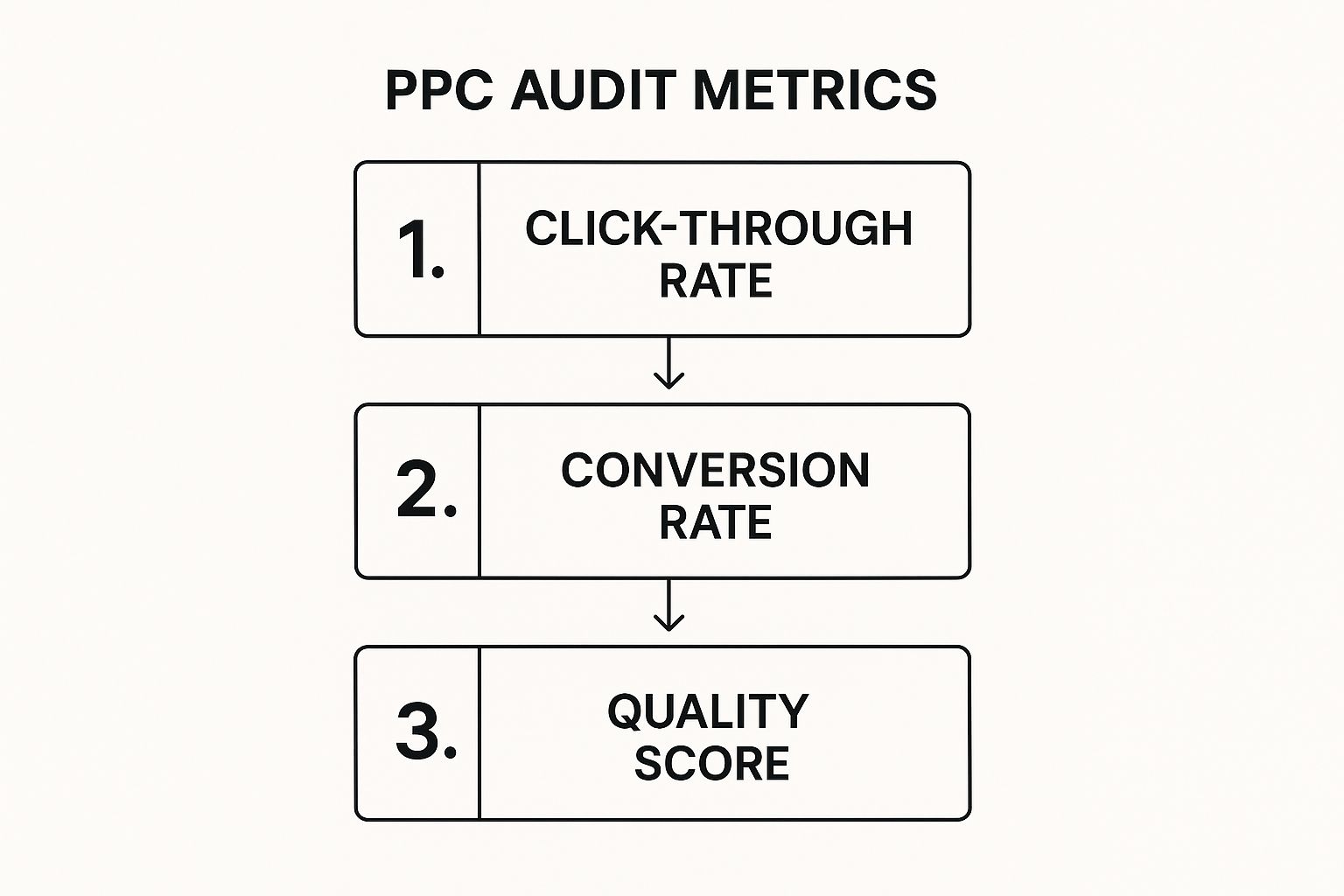
As you can see, everything is connected. A smart keyword strategy improves your Quality Score. That, in turn, boosts CTR, lowers your costs, and ultimately drives up your Conversion Rate.
The Meticulous Art of Negative Keyword Mining
The single most powerful tool for plugging budget leaks is a rock-solid negative keyword list. This is where I consistently find the most shocking agency waste.
Big agencies often just accept Google’s automated recommendations for negative keywords, which are notoriously bad and frequently suggest blocking terms that could actually make you money. They apply generic, pre-made lists that completely ignore the unique nuances of your business.
I do the polar opposite. I manually sift through your search term data, line by line, hunting for patterns of waste. It’s a painstaking process, but it’s the only way to get it right. I'm looking for the subtle differences in language that separate a buyer from a tire-kicker.
Here are the types of budget-killing search terms I find and eliminate all the time:
Informational & DIY Queries: Anything with words like "how to," "free," "template," "jobs," or "tutorial." These people want information, not your product.
Competitor & Brand Name Confusion: Clicks from users who were actually looking for a different, similarly named company. Total waste.
Irrelevant Product/Service Types: Imagine a company selling premium leather shoes getting clicks for "cheap rubber boots." It happens more than you'd think.
Discount & Low-Intent Shoppers: Terms like "clearance," "used," or "coupon" are poison if you're a premium brand that doesn't offer them.
An expert consultant doesn't just add negative keywords; we build a strategic defense for your budget. We identify the intent behind the search and preemptively block traffic that has zero chance of converting, protecting your spend before it's ever wasted.
Real-World Impact of Granular Focus
Let me give you a real, concrete example. I recently audited an account for a high-end software provider. Their agency had them bidding broadly on the term "project management software." Clicks were high, but their conversion rate was in the gutter.
After just one hour in their Search Terms Report, I discovered they were burning thousands of dollars on clicks from searches like:
"free project management software for students"
"project management software open source"
"asana project management jobs"
By adding just a few strategic negative keywords—"free," "students," "open source," "jobs"—we immediately plugged a massive leak. Their cost-per-acquisition (CPA) dropped by over 40% in the first month alone.
That's the power of an expert's granular focus. An overworked agency account manager, just glancing at a dashboard, would have completely missed it. For a deeper dive into this kind of detailed work, you can see how expert pay per click optimization can beat bloated agencies.
This meticulous process isn't just about finding keywords; it's about understanding the human behind the search. It’s this deep, manual analysis that separates a true consultant-led audit from a generic agency checklist—and it’s what turns a wasteful campaign into a profitable machine.
Getting the click is only half the battle.
So many businesses obsess over click-through rates and cost per click, but the second a user lands on their site, the experience falls apart. The real win isn’t the click; it’s the conversion that follows.
This is where a real pay per click audit has to go beyond the Google Ads interface. It's about digging into that critical—and often broken—connection between your ad copy and your landing page. This is a massive blind spot for large, siloed agencies. Their PPC team writes the ads, and a completely separate web team manages the landing pages. The two groups rarely talk, and you're the one footing the bill for their disconnect.
The Message Match Catastrophe
The most common and costly mistake I find is a total breakdown in message match. It's a simple concept, but incredibly powerful: your landing page has to directly reflect the promise you made in your ad. When it doesn't, you create instant distrust and confusion, and your bounce rate goes through the roof.
I’ve seen this play out a hundred times:
An ad shouts "20% Discount on All Orders," but the landing page is just a grid of full-priced items with zero mention of a sale.
The ad copy highlights "Free, Same-Day Shipping," but the fine print on the landing page says shipping is only free on orders over $100 and takes 5-7 business days.
An ad for something specific, like "Men's Waterproof Trail Runners," dumps users on a generic "Men's Shoes" category page, forcing them to start their search all over again.
This disconnect is a direct product of the agency model. The ad team hits their CTR target, the web team hits their deadlines, and neither is held accountable for the abysmal conversion rate that follows. As an independent consultant, I audit the entire journey because my success is tied directly to your profitability, not just superficial campaign metrics.
This holistic view is everything. I don't just look at ad performance; I look at the entire user experience, from the moment they type a search query to the second they see your thank you page.
More Than Just a Pretty Page
Beyond message match, the audit has to dive deep into the landing page's effectiveness as a conversion tool. A page can look slick and still fail miserably at converting. To create a user journey that actually works, every single element needs to be put under the microscope.
My audit process for the ad-to-landing-page path includes:
Ad Relevance and Scent: I confirm that the headline and core value proposition on the landing page mirror the ad copy that brought the user there. The "scent" of the original promise has to stay strong.
Call-to-Action (CTA) Clarity: Is the CTA button obvious, compelling, and unambiguous? Vague CTAs like "Submit" or "Learn More" almost always get crushed by specific, action-oriented text like "Get Your Free Quote Now" or "Download the Ebook."
Friction Point Removal: I hunt for anything that makes it harder for a user to convert. This could be a long, unnecessary form, a slow page load speed, or a distracting navigation menu that encourages users to wander off.
Strategic Use of Ad Extensions: Are sitelinks actually directing users to relevant sub-pages? Do price extensions match the pricing on the landing page? Are callouts reinforcing the key benefits mentioned on the page? Bloated agencies often just switch these on without a shred of strategy.
Closing these conversion-killing gaps is where you see a dramatic jump in campaign ROI. It's not just about tweaking bids or adding a few negative keywords; it’s about creating a seamless, trustworthy experience for your potential customers.
By improving this journey, you're not just making ads better; you're building a more efficient conversion machine. To go even further, check out these conversion rate optimization best practices for 2025 that you can apply directly to your landing pages. A consultant-led audit finds these gaps; an agency-led checkup often doesn't even know to look for them.
Getting Your Conversion Tracking and Attribution Right

This is it. This is the single most common, most catastrophic failure point I uncover in agency-managed accounts.
If your conversion tracking is broken, everything else is worthless. Every other part of a pay per click audit is a complete waste of time because the data you're using to make decisions is pure fiction.
You could have the most beautifully structured account and award-winning ad copy, but if the tracking is off, you're flying blind. You're just throwing money into a black box, guided by numbers that are fundamentally wrong.
This isn’t some rare, minor issue. I consistently find that a shocking number of businesses are making six- or seven-figure budget decisions based on bad data. It's often a direct result of the bloated agency model, where the PPC team is totally disconnected from the web dev team, leading to a waterfall of expensive implementation errors.
The Consultant's Hands-On Verification Process
An agency will glance at the "Conversions" column in Google Ads and just assume it’s correct. As an independent consultant, my first move is to assume it's wrong until I can prove otherwise. I don't trust dashboards. I get my hands dirty and manually verify the entire setup.
My audit checklist for your tracking is meticulous:
Tag Verification: I use tools like Google Tag Assistant to act like a user on your site. I'll fill out a form or complete a purchase to see if the conversion tags are actually firing on the "thank you" pages. You'd be amazed how often they don't.
Preventing Double-Counting: This is a classic agency mistake. A user refreshes a confirmation page, and boom—two conversions get recorded for a single sale. I dig into the tag setup to make sure it’s configured to fire only once per transaction.
Auditing "Micro-Conversions": Is your account tracking low-value actions like "viewed contact page" as a primary conversion? Agencies love doing this. It inflates their numbers and makes reports look great, but it completely distorts your actual performance. I make sure we're only measuring what truly matters: leads and sales.
This is the kind of detailed, hands-on work that just doesn't happen when your account is one of fifty being managed by a junior employee. They simply don't have the time or the specialized knowledge to dig this deep.
Bloated agencies report on the data they're given. An expert consultant validates that the data is trustworthy in the first place. This is the fundamental difference between a real audit and a superficial check-up.
Moving Beyond the Myth of Last-Click Attribution
Once we've confirmed the data is actually accurate, the next step is looking beyond the default "Last Click" attribution model that Google Ads forces on you. This model gives 100% of the credit for a sale to the very last ad a customer clicked.
It's a deeply flawed way to measure performance.
Imagine a customer's journey:
They first discover your brand by clicking a generic, top-of-funnel search ad for a problem they have.
A week later, they see one of your display ads and click through to browse products.
Finally, they search your brand name, click that branded ad, and make a purchase.
Under the default Last Click model, that final branded ad gets all the glory. The first two touchpoints—the ones that were essential for introducing and nurturing the customer—get zero credit. An agency relying on this model might tell you to cut spending on those "non-converting" top-of-funnel campaigns, which would completely cripple your sales pipeline.
As a dedicated consultant, my job is to see the full picture. I use different attribution models—like Linear, Time Decay, or Data-Driven—to understand how each ad and keyword actually contributes to the final sale. This paints a far more complete and accurate picture of what's truly driving growth. It lets us make smarter decisions, investing in the campaigns that find new customers, not just the ones that happen to close the deal.
This strategic analysis is how you unlock real, sustainable growth. For a deeper dive into connecting ad spend to actual profit, check out our consultant's guide to calculating return on ad spend. This level of insight is something you will never get from a standard agency report that just spits back default Google Ads data. It requires a specialist's focus on your actual business goals.
Answering Your Questions About Expert PPC Audits
After digging into the weeds of account structure, keyword intent, and conversion tracking, you probably have a few questions. It’s only natural. Let’s tackle the most common ones I hear from business owners who are tired of the agency runaround and just want a straight answer from a specialist.
This isn't about getting another generic report. It’s about getting clarity and an actionable plan from someone who is directly accountable for the quality of their work—me.
"My Agency Already Does Audits. Why Do I Need Another One?"
This is the big one, and it's the most important question to ask. The "audit" your agency gives you is almost always a quick, internal health check. It’s done by the same team managing the account, which means they have a built-in bias. They aren't exactly motivated to point out that their own strategy is flawed or that the initial setup was a mess.
An independent expert audit is different. It's a completely unbiased look under the hood. I come in with a fresh set of eyes, no attachment to past decisions, and no agenda.
I’m not just looking at what is happening in your account; I’m digging deep to uncover why. Think of it as a second opinion that identifies the systemic issues an agency might overlook or, frankly, be hesitant to admit exists.
My only loyalty is to your bottom line, not to defending past agency work. You won’t get a junior account manager running a template; you get my direct, senior-level expertise focused on one thing: finding every single dollar of wasted ad spend.
"How Long Does This Take and What Do I Actually Get?"
A quick agency check might take an hour. A real, consultant-led audit is a meticulous process. Depending on how big and complex your account is, it usually takes me 5-10 business days to do it right. The goal here isn't speed—it's depth.
When I’m done, you won't get some jargon-filled PDF designed to confuse you. You’ll receive a clear, actionable roadmap that includes:
A Prioritized List of Findings: We'll start with the most critical issues that are burning through your cash right now.
Step-by-Step Instructions: I won't just tell you what to change; I'll show you exactly how to implement the fixes.
A Strategy Debrief: We'll jump on a one-on-one call to walk through every recommendation so you understand precisely how it impacts your business goals.
"Is a One-Time Audit Really Enough?"
A single, deep-dive audit is incredibly powerful. It’s like a hard reset for your account, fixing those foundational problems and giving you an immediate performance boost. Many businesses see such a significant jump in ROI from these initial fixes that they realize the value of having an expert in their corner.
For many of my clients, we start with one comprehensive audit. Based on the results, they often decide to keep me on for quarterly check-ins or even ongoing monthly management. This makes sure the account stays optimized and adapts to new market changes. It prevents old, bad habits from creeping back in and keeps your campaigns running at peak performance.
But it all starts with that first, unbiased look.
Ready to uncover the hidden potential in your Google Ads account? At Come Together Media LLC, I provide the expert, one-on-one audit you need to stop wasting money and start maximizing your ROI. Get your free, no-commitment consultation today. Learn more at Come Together Media.


Comments