Google Ads Campaign Optimization That Actually Works
- Sep 14, 2025
- 13 min read
Getting your Google Ads optimization right is all about a relentless process of refining your campaigns so every dollar you spend is pulling its weight. Think of it as a constant cycle: monitor what’s happening, test new ideas, and adjust everything from the keywords you bid on and the ads you write to your bidding strategies and landing pages. This isn't a task for a junior account manager at a bloated agency; it's a craft that demands expert attention.
Why Your Agency's Optimization Isn't Working
Let's cut right to it. If your Google Ads account feels like a money pit, the generic, one-size-fits-all strategy from your over-priced agency is the problem. Too many businesses sign up with a big-name firm expecting personalized expertise, but what they get is a cookie-cutter approach from a junior manager juggling dozens of other clients, burning through your budget with zero accountability.
True Google Ads optimization is a craft, not a checklist.
The problem is baked into the bloated agency model. Your account, a critical investment for your business, gets handed off to an overworked employee whose real goal is just managing the account, not mastering it to drive your profits. This inevitably leads to the same old costly mistakes:
Wasted Spend on Broad Keywords: They'll target high-volume, generic keywords that rack up clicks but have almost no chance of converting into actual business, just to make reports look busy.
Template-Driven Management: Your campaign is forced into a pre-built formula that completely ignores what makes your business unique—your audience, your profit margins, your actual goals.
Lack of Proactive Strategy: "Optimization" becomes a reactive game of pausing what's clearly on fire instead of proactively hunting for new, untapped opportunities to grow your revenue. They're playing defense with your money, not offense.
The Expert vs. Agency Divide
As a dedicated expert consultant, I treat your budget like it’s my own money. The entire focus shifts from just "running ads" to systematically building a predictable revenue engine for your business. I use surgical precision, not the broad, clumsy strokes of an impersonal agency.
Now, many agencies have found that using the right Google Ads management software for agencies can help them get more efficient, especially when they're trying to scale. But even the best software can't replace the strategic eye of a seasoned specialist who is personally invested in seeing you win. An agency buys software; an expert provides strategy.
I recently took on a client who was burning through thousands a month with a big agency on search terms that were completely irrelevant to their high-end service. The agency report looked great—plenty of clicks, lots of impressions. The problem? The client wasn't getting any new business. I immediately cut the wasted spend, identified hyper-specific, high-intent keyword niches they'd completely missed, and restructured the entire account. Within a single month, their cost-per-lead dropped by 60%, and they closed more deals than in the entire previous quarter.
That’s the fundamental difference right there. An agency sells you a process managed by whoever is available; I deliver a personalized strategy built on expertise. While an agency is busy managing its portfolio, I am focused on managing your results and making sure every click has the potential to add directly to your bottom line.
Building a Bulletproof Campaign Foundation

The most profitable Google Ads campaigns are built long before you ever hit 'launch'. It's all in the foundational work—the strategic groundwork where an expert’s focus makes all the difference. This is also the exact phase that large, overworked agencies frequently rush through to get you "onboarded."
But let's be clear: true google ads campaign optimization begins here, not weeks after your budget is already lit on fire.
This whole process kicks off with a deep dive into your business, your audience, and what makes you unique. I’m not talking about a surface-level kickoff call. It's about me digging into your profit margins, pinpointing your most valuable customer segments, and mapping out the real-world problems your product actually solves. Agencies often skip this, opting for a generic template instead of a custom blueprint.
Uncovering Hidden Keyword Opportunities
Meticulous keyword research isn’t about finding the obvious terms; it's about finding the high-intent phrases your competition completely overlooks. Big agencies love to target broad, high-volume keywords because they're easy to find and manage, and they look impressive on a report. An expert, on the other hand, invests the time to unearth long-tail keywords that actually drive sales.
Think of it like this: an agency might target "running shoes." I'll dig deeper to find gems like "best trail running shoes for flat feet" or "lightweight marathon shoes under $150."
Sure, these have lower search volume, but their conversion rates are exponentially higher. This is how you find actual customers, not just empty clicks. It takes more work, which is why a bloated agency won't do it.
Building a campaign isn't just a technical setup; it's about translating your core business strategy into a predictable revenue engine. Every ad group, keyword, and ad should be a deliberate choice aimed at a specific business outcome, not just filling a campaign shell.
Structuring Campaigns with Surgical Precision
Once you have the right keywords, the campaign structure becomes absolutely critical. A classic agency mistake is lumping dozens of loosely related keywords into a single ad group. It's a lazy, time-saving approach that absolutely tanks your Quality Score and drives up costs because the ads can't possibly be relevant to every single search.
The right way to do it involves creating hyper-focused ad groups. Sometimes, I'll have just one keyword per ad group (Single Keyword Ad Groups, or SKAGs). This lets me craft ad copy and landing pages that perfectly match what the searcher is looking for.
When a user’s search, your ad, and your landing page are all in perfect alignment, Google rewards you. You get a higher Quality Score, which directly leads to:
Lower Cost-Per-Click (CPC): You pay less for each click than your competitors.
Better Ad Positions: Your ads show up higher on the page without having to bid more.
This meticulous structure ensures every part of your campaign is working together efficiently. Of course, none of this matters if your data is a mess. To get the most out of your campaigns from day one, it’s vital that you fix your Google Ads conversion tracking to ensure every lead and sale is properly attributed.
A solid foundation is what prevents wasted ad spend and sets the stage for scalable, long-term success. It's the difference between my expert approach and an agency's assembly line.
Mastering Bids and Budgets Like an Expert
This is where the real tactical skill separates a profitable campaign from a money pit. Managing bids and budgets isn't just about plugging in a daily spend limit and walking away. It’s an active, intelligent process that makes or breaks your performance.
It's also where an individual expert has the agility that a bloated, process-driven agency simply can’t match.
A big firm might just stick your account on a generic "Maximize Conversions" setting and call it a day. I, on the other hand, treat your budget with the respect it deserves, diving into Google’s complex bidding options to find the perfect fit for your specific business goals. This is a non-negotiable part of Google Ads campaign optimization.
The Expert Override: Knowing When to Trust the AI
Google's automated bidding strategies, like Target ROAS (Return on Ad Spend), can be incredibly powerful. No question. But the real secret weapon is the 'expert override'—knowing precisely when to trust the AI and, more importantly, when to step in and take the wheel.
Subtle market shifts, a competitor launching a new promo, or a slight dip in conversion data are all signals an algorithm might miss or react to slowly. As a hands-on consultant, I spot these trends immediately. This allows me to switch to Manual CPC bidding to regain critical control and protect your spend.
That’s a level of nuance that gets completely lost when an account manager at a large agency is juggling 50 other clients. They don't have the time or the incentive to provide that level of detailed oversight.
The heart of expert management is knowing that automation is a powerful tool, not a replacement for strategy. My job is to guide the AI, not just blindly accept its recommendations. This active oversight prevents costly errors and jumps on opportunities the machine can't see yet.
Dynamic Budget Allocation: A Nimble Strategy
Another massive advantage is dynamic budget allocation. A large agency often sets rigid monthly budgets for each campaign and rarely deviates. It's safe for them, but it's wildly inefficient for you. As a dedicated consultant, I’m in the account daily, monitoring performance and shifting funds in real-time.
If one campaign is crushing it—delivering high-quality leads at a fantastic cost—while another is sputtering, I don't wait for a month-end report to make a change. I immediately reallocate that budget from the underperformer to the proven winner.
This nimble approach maximizes your overall profitability day by day. It’s a strategy that’s almost impossible to execute within a rigid, bureaucratic agency structure. Understanding the different Google Ads bidding strategies available for 2025 is fundamental to making these quick, impactful decisions.
Maximizing Return on Ad Spend (ROAS) is the name of the game. Recent data shows that while advertisers earn an average of $2 for every $1 spent, top performers hit a 4:1 or even 5:1 ROAS. The gap often comes from relying on outdated manual methods or the unchecked automation common in large agencies. To truly master your bids and budgets, staying updated with the top AI marketing software can give you a significant edge.
Writing Ad Copy That Actually Converts
Let's be honest: high click-through rates are a vanity metric. I’ve seen countless agency reports brag about CTR while the client’s phone stays silent. A great CTR means absolutely nothing if those clicks don’t turn into actual customers.
This is where true Google Ads campaign optimization moves beyond technical tweaks and into the psychology of writing ad copy that sells—a skill that can't be automated or templated by a low-cost agency employee.
It's not about just jamming keywords into headlines. It’s about creating a direct line to your customer's problem and giving them a compelling reason to act. Think of it this way: your ad is a promise, and your landing page is where you deliver on it.
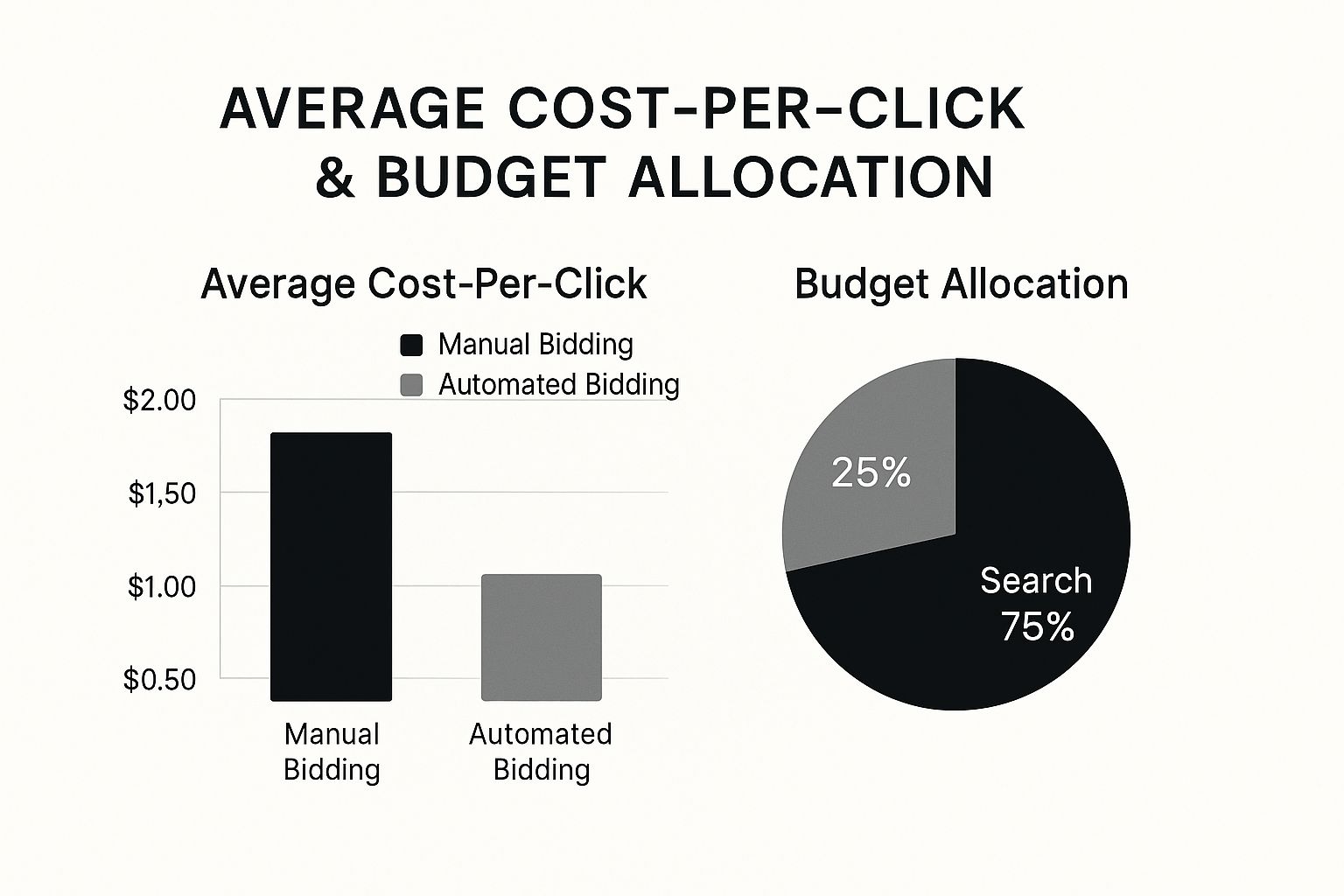
The image above highlights a critical point—while automated bidding can lower your CPC, it requires an expert hand to ensure those cheaper clicks are actually profitable. Without a cohesive ad-to-landing-page strategy, you're just paying less to lose money.
The Disconnected Agency Problem
This promise-and-delivery chain is precisely where big, bloated agencies drop the ball. Their ad copy team is almost always completely siloed from the team building the landing pages. The copywriter’s only goal is to get a click, and half the time, they’ve never even seen the page the user will land on.
This disconnect creates a jarring, confusing experience for the user. An ad screams "50% Off Spring Sale," but the landing page is a generic homepage with zero mention of the offer. The result? A lost visitor, a sky-high bounce rate, and another wasted ad click you paid for.
As a dedicated consultant, I manage that entire journey. I ensure the message is perfectly seamless from keyword to ad to landing page because I'm the single point of specialization and accountability.
A B2B software client came to me with a fantastic CTR but a conversion rate that was flatlining. The agency's ad promised an "Instant Demo," but the landing page cornered users into a long form for a callback. We made one tiny change: the headline became "Schedule a 15-Min Demo," and we updated the landing page to match. Conversions doubled overnight—all because we set and met the right expectation, a detail the agency had missed for months.
Dominating with Ad Extensions
Your core ad copy is just the start. Ad extensions are your secret weapon for dominating the search results page and taking up more screen real estate. Agencies often treat them as an afterthought, but I see them as a massive strategic advantage.
Well-crafted extensions don't just make your ad physically bigger; they give users valuable shortcuts.
Sitelink Extensions: Send people straight to high-value pages like pricing, case studies, or contact forms.
Callout Extensions: Shout out key benefits like "Free Shipping," "24/7 Support," or "No Contracts."
Structured Snippets: Neatly list your services, product types, or brands.
Properly using these tools is a game-changer. For a deeper dive, check out this guide on how to improve click-through rates in Google Ads.
This expert-level focus is reflected in how different ad components impact the bottom line. A generic agency might tick the boxes, but a specialist meticulously aligns every piece of the ad for maximum impact.
Ad Component Impact on Conversions
Ad Component | Generic Agency Focus | Expert Consultant Focus | Potential CVR Lift |
|---|---|---|---|
Headline 1 | Keyword stuffing for relevance score. | Hooks the user with a direct benefit or solution. | +15-20% |
Headline 2 & 3 | Generic features ("High Quality"). | Overcomes objections, adds social proof ("Trusted by 10k+"). | +10-15% |
Descriptions | Repeats headlines and features. | Expands on value, adds a clear, compelling call-to-action. | +5-10% |
Ad Extensions | Adds basic sitelinks. | Uses a full suite (sitelinks, callouts, snippets) to build trust. | +5-12% |
Message Match | Ad copy is loosely related to the landing page. | Ad copy promise is perfectly mirrored on the landing page. | +20-30% |
As the table shows, small, strategic improvements across the board lead to a significant cumulative lift in conversions. It's the difference between an agency just running ads and an expert running ads that actually grow a business. This detail-oriented approach is why some sectors are seeing conversion rates climb as high as 5.09%—they're finally connecting the dots between a great ad and a great user experience.
The Constant Cycle of Testing and Tuning
Here’s the single biggest—and most expensive—mistake that bloated, overworked agencies make: they treat Google Ads like a crockpot. They set it and forget it. But true, profitable Google Ads campaign optimization is never a one-and-done affair. It’s a disciplined, ongoing cycle of testing, tuning, and relentless refinement.
This constant process is what separates campaigns that consistently generate revenue from those that just burn cash. It’s about treating your account not as a static project, but as a living system that needs daily attention to perform at its peak. Agencies get stuck in monthly check-ins, which leaves a ton of money on the table. For a dedicated expert like me, this cycle is the entire job.
Surgically Removing Wasted Spend
First things first: you have to stop the bleeding. That means I dive deep into the Search Terms Report—a goldmine of data showing the exact queries people typed before clicking your ad. This is where a powerful negative keyword list is born.
An agency might add the obvious negatives like "free" or "jobs," but a specialist looks for the subtle, costly mismatches that bleed you dry. If you sell premium leather boots, a click for "cheap vegan boot repair" is pure waste. Adding "vegan" and "repair" as negatives seems small, but over thousands of clicks, it saves a fortune. This is the detail an agency overlooks.
A core tenet of my expert management is that the money you don't spend on irrelevant clicks is just as important as the money you spend on converting ones. This is the secret to protecting your budget and maximizing profitability.
Finding Gold in the Search Term Report
While I'm cutting out the junk, the Search Terms Report also reveals incredible new opportunities. This is where you'll often discover high-intent, long-tail keywords you hadn’t even thought of. These are absolute goldmines.
Let’s say a client sells ergonomic office chairs. They might discover people are searching for "best office chair for back pain under $500." This isn't just a new keyword; it's a direct signal of user intent and price sensitivity. I can immediately spin up a new, hyper-focused ad group just for that term, with ad copy and a landing page that speaks directly to that exact need. That’s the kind of nimble, proactive strategy that gets lost in rigid agency structures where such a change would require multiple meetings and approvals.
The Art of Relentless A/B Testing
Once the traffic is clean and targeted, the focus shifts to improving conversion rates through relentless A/B testing. This is as simple as running two ad variations against each other to see which one performs better. I’m constantly testing everything:
Headlines: Does a question ("Tired of Back Pain?") outperform a direct statement ("The #1 Ergonomic Chair")?
Descriptions: Does highlighting a feature ("Adjustable Lumbar Support") work better than a benefit ("Work Pain-Free All Day")?
Calls-to-Action: Is "Shop Now" more effective than "Find Your Perfect Chair"?
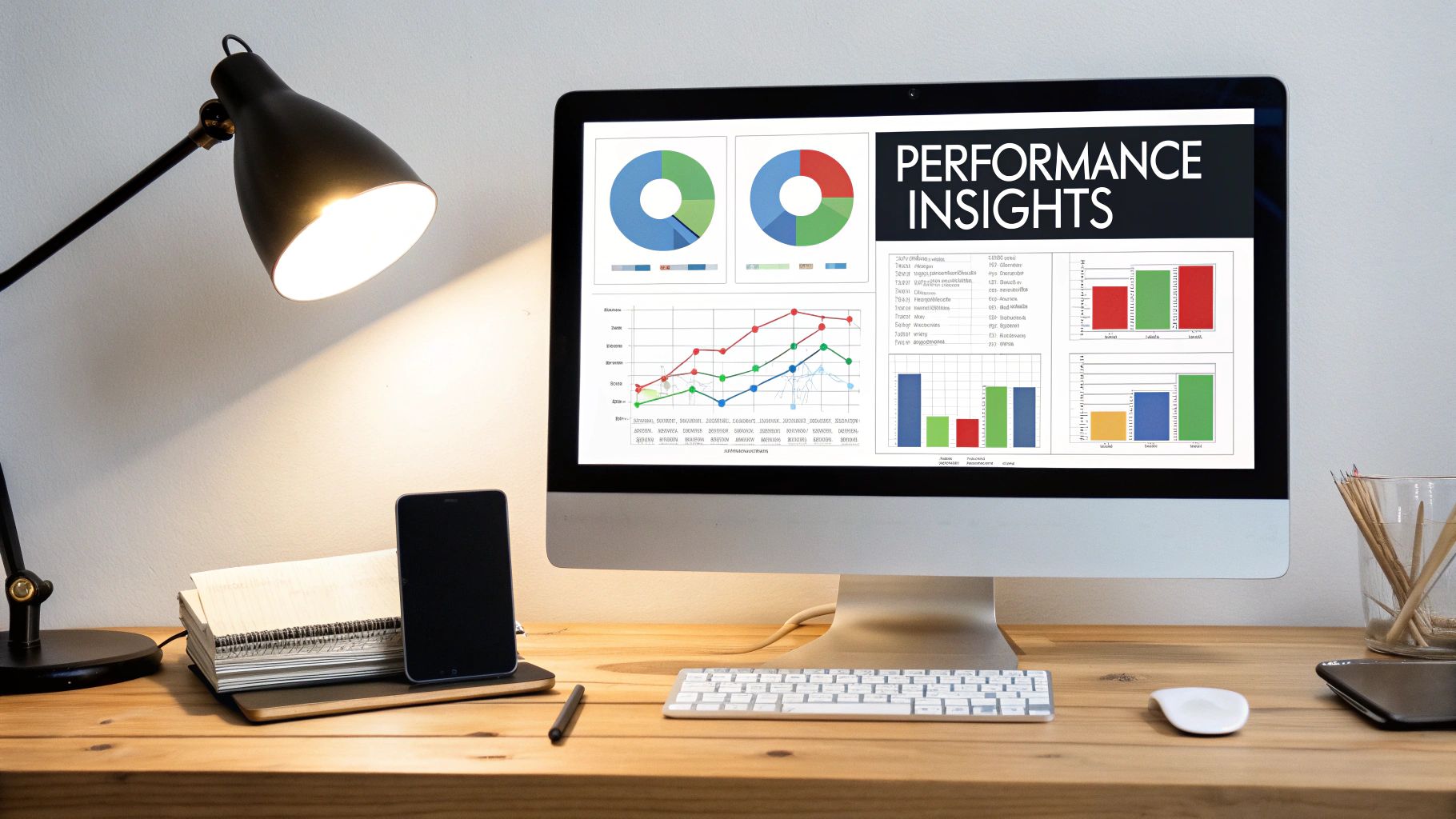
This data-driven approach removes all the guesswork. It allows me to consistently find the winning messages that resonate most with your audience. Of course, presenting this performance data clearly is critical for making these calls, and understanding data visualization best practices is a huge help here.
Ultimately, this cycle of tuning is what drives sustained, long-term growth. It's how you avoid wasted ad spend and boost ROI by consistently improving ad relevance. As competition gets tougher, a well-managed campaign can dramatically lower your cost-per-click while attracting users who are far more likely to actually convert.
Your Google Ads Questions, Answered
I get it. Diving into Google Ads can feel like trying to solve a puzzle with half the pieces missing. A lot of business owners I talk to have the same core questions, especially when they feel like their ad spend is just evaporating with nothing to show for it after hiring a big agency. Let's clear up a couple of the most common ones.
This is exactly where the difference between a real expert and a big, faceless agency becomes crystal clear. Those large shops often dish out cookie-cutter advice because it's scalable for them. A true consultant, on the other hand, digs into your specific business to find answers that actually fit.
"Why Are My Google Ads Not Converting?"
This is the classic "all smoke, no fire" problem: tons of clicks, but no sales or leads. It's almost always a sign of a major disconnect in your strategy, and it’s something I see all the time in accounts previously managed by bloated agencies.
The issue is rarely just one bad keyword or a poorly written ad. It's a breakdown in the customer's journey. Your ad makes a great promise—maybe it's "50% Off Today"—but when someone clicks, the landing page is confusing, slow, or doesn't even mention the offer. That's a dead end.
As a dedicated consultant, I don't just glance at your ad account; I audit the entire sales funnel. I hunt for the mismatches between the keywords people search, the ad they click, and the experience they have on your site. That's the kind of hands-on, detailed work a junior account manager juggling 30 other clients simply doesn't have the time or specialized experience to do.
The most common reason for poor conversions is a weak link between the ad and the landing page. An agency might blame the ad; an expert will fix the entire customer path to ensure a seamless, compelling experience from click to conversion.
"How Long Does Google Ads Optimization Take?"
Let's be clear: real Google Ads campaign optimization isn't a one-and-done task. It's a continuous process of refinement. You can absolutely see some quick wins in the first 30 days—like slashing the wasted spend on irrelevant keywords that a lazy agency let drain your budget.
But achieving sustainable, profitable growth? That takes time and a disciplined, expert approach.
An agency might sell you a "setup and launch" package and then move on. A true partner, an expert consultant, commits to a long-term cycle of testing, learning, and refining. We gather data, run A/B tests on ad copy, constantly adjust bids, and uncover new pockets of opportunity. This methodical process builds momentum over several months, creating a predictable revenue engine—something a "set it and forget it" agency model can never deliver.
Ready to see what a personalized, expert-led approach can do for your business? Come Together Media LLC offers one-on-one consulting to eliminate wasted spend and maximize your ROI. Get a free, no-commitment consultation today at https://www.cometogether.media to discover your campaign's true potential.


Comments