Google PPC Management Services: An Expert's Edge Over Bloated Agencies
- Aug 14, 2025
- 17 min read
It's a familiar, sinking feeling. You pour money into google ppc management services, crossing your fingers for a solid return, only to watch your budget evaporate with nothing to show for it. You’re left with weak results and the distinct impression that you’re just another account number on a massive agency’s to-do list.
This is the unfortunate reality for too many businesses that get stuck with over-priced, bloated agencies. I'm here to tell you there's a better way.
Why Generic PPC Management Fails Your Business
Think of your Google Ads account like a high-performance race car. It’s an incredible machine, engineered to get your business across the finish line faster than the competition. But it’s only as good as the driver behind the wheel.
Handing your account over to a big, impersonal agency is like giving the keys to a junior account manager who’s only read the training manual. They know the basic controls but have zero real-world experience navigating the hairpin turns of a competitive auction. They follow a checklist, but they don’t have the instinct or deep expertise to make the split-second adjustments that win the race.
This gets to the heart of the problem with bloated agencies: they’re built for volume, not for specialized, high-stakes performance. Your account becomes one of hundreds, managed by an overworked employee who applies the same tired template to every client, completely ignoring your unique industry, audience, or business goals.
The Specialist Advantage Over Bloated Agencies
The antidote to this cycle of frustration is to partner with a dedicated, expert Google Ads consultant like me. This isn't just about hiring a freelancer; it's about bringing on a strategic partner whose success is directly wired to yours. I am your dedicated driver—someone who knows every gear, every blind spot, and every opportunity in your specific race.
The core difference is simple: A bloated agency is incentivized to sign more clients and maintain the status quo. As a solo expert consultant, I am incentivized to get you the best possible results because my reputation and livelihood depend on it.
This focused approach unlocks a level of performance that large, layered teams just can't match. Forget standardized reports and slow-motion communication through layers of management. With me, you get direct access, a truly custom strategy, and a relentless focus on the metrics that actually matter to your bottom line. Suddenly, PPC management stops being a frustrating expense and becomes the powerful growth engine it was always meant to be.
Let's be clear: Google Pay-Per-Click (PPC) advertising is still one of the most powerful tools out there. On average, businesses make $2 for every $1 spent, and some dialed-in campaigns see returns as high as 800%. Here in the United States, where a staggering 98% of PPC marketers rely on Google's platform, getting this right is non-negotiable.
But without a specialist at the helm, most businesses never even come close to that potential. They leave a massive amount of money on the table. You can explore more about these industry benchmarks and what they mean for your campaigns.
Choosing the right partner for your google ppc management services is one of the most critical marketing decisions you'll make. It’s the difference between flying blind and having a clear flight path to sustainable, profitable growth.
Solo Expert vs Agency at a Glance
When you’re weighing your options, it’s easy to get lost in sales pitches and fancy presentations from big agencies. The table below cuts through the noise and lays out the fundamental differences between working with a dedicated expert like me and getting lost in their machine.
Attribute | Solo Expert Consultant (Me) | Large Bloated Agency |
|---|---|---|
Your Main Contact | The expert doing the work (me) | A junior account manager |
Strategy | 100% custom to your business | Templated, one-size-fits-all |
Speed of Action | Changes made in hours, not weeks | Weighed down by bureaucracy |
Incentive | Your performance and results | Sales quotas and client volume |
Cost Structure | Transparent, direct-to-expert | Inflated by overhead and staff layers |
Communication | Direct, clear, and proactive | Filtered through multiple people |
Ultimately, the choice comes down to what you value more: the false sense of security in a large corporate name, or the tangible results that come from true, dedicated expertise. For businesses serious about growth, the answer is always clear.
The Hidden Costs of a Bloated Agency

Ever felt like just another number on a massive agency’s spreadsheet? It’s a story I hear all the time. You sign up for professional google ppc management services, sold on a big promise from a senior executive, only to get lost in a maze of account managers and support tickets.
Your account—your business's growth engine—gets handed off. The senior expert who wowed you in the sales pitch vanishes, replaced by a junior account manager who is clearly spread thin across a dozen other clients. Suddenly, communication is slow, and your urgent questions disappear into a corporate black hole.
This isn't just bad luck; it’s a crack in the very foundation of the bloated agency model. Their business is built to scale, which means signing as many clients as possible to feed their massive overhead. Your success is a nice-to-have, but their own growth comes first.
The One-Size-Fits-All Trap
To manage hundreds of accounts, big agencies have to rely on standardized processes. They run on templates, checklists, and cookie-cutter playbooks. This means your business gets a "one-size-fits-all" strategy that completely ignores what makes you unique.
They might roll out the same keyword list they used for a similar client or write ad copy that has zero connection to your brand's actual voice. This assembly-line approach is efficient for them, but it can be devastating for you. It steamrolls right over your market position, your ideal customer, and the competitive edges you've worked hard to build.
The greatest hidden cost of a bloated agency isn't the high monthly fee. It's the missed opportunity from a strategy that was never actually designed for you.
You're paying for a custom-built race car but getting a generic family sedan. Your ad spend is being "managed," sure, but it's not being invested for maximum impact.
Who Is Actually Managing Your Account?
One of the most troubling parts of the large agency model is the bait-and-switch. You talk to a slick account director, but who is in the trenches every single day, adjusting your bids and analyzing your data?
More often than not, it's an entry-level employee who is learning the ropes with your money. That inexperience leads to classic, costly mistakes:
Bleeding Budget on Bad Keywords: They don't grasp the nuances of your industry, so they fail to implement a strong negative keyword strategy. Your money gets wasted on completely irrelevant searches.
Ignoring a Low Quality Score: They don't know how to improve ad relevance, so your cost-per-click creeps up. This is a silent budget killer that eats away at your ROI.
Focusing on Vanity Metrics: You get impressive-looking reports filled with clicks and impressions that mask the real story: your cost-per-acquisition is climbing and you're getting fewer results for your spend.
This entire structure is designed to protect the agency's bottom line, not yours. You end up paying a premium for junior-level work, while the real experts are kept out of reach. We break this down even further in our deep dive on why [expert Google Ads management services will always beat a bloated agency](https://www.cometogether.media/single-post/expert-google-ads-management-services-why-a-specialist-beats-a-bloated-agency).
Ultimately, the bloated agency is built on layers—layers of management, layers of process, and layers of fees. Each one adds cost and creates more distance between you and the person actually responsible for your results. This is an inefficiency that gets passed directly to you, showing up in both your invoice and your campaign performance.
The Solo Expert Advantage You Deserve

If you’ve ever dealt with the frustrations of a bloated agency, it's time for a different conversation. Imagine partnering with a Google PPC management expert who doesn't just clock in on your account but truly adopts your business goals as their own. This is the heart of my advantage.
When you hire me, you're not just buying a service; you're investing in a specialist whose reputation is on the line with every dollar you spend. There are no layers of junior account managers or bureaucratic red tape. I am the person who builds your strategy, the person in the trenches optimizing it daily, and the one who answers your call.
This creates a level of accountability that agencies just can't match. My success is a direct reflection of your results. This isn't just a job for me—it’s my craft.
Direct Access and Deeper Strategy
The fundamental problem with large agencies is that the real expertise is siloed. The seasoned strategist who actually understands market dynamics is almost never the person managing the day-to-day details of your account. With me, that gap vanishes.
You get a strategy I build from the ground up, based on a deep-dive into your specific business, your customers, and your competition. It's a bespoke approach that the one-size-fits-all agency model simply cannot replicate.
This direct partnership translates into real, tangible benefits:
Nimble Execution: When an opportunity pops up or a campaign starts to bleed money, I make changes immediately. There’s no waiting for internal meetings or a chain of approvals.
Proactive Communication: You get insights straight from me, the source, not watered down by a junior manager who may not grasp the strategic "why" behind the numbers.
Complete Transparency: You know exactly who is working on your account (me), what I am doing, and how it connects directly to your bottom-line goals.
My vested interest is the most powerful incentive in advertising. My reputation doesn't grow by signing more clients; it grows by delivering exceptional, undeniable results for the clients I have.
This creates a powerful alliance focused on one thing and one thing only: maximizing your return on ad spend.
Winning in a Complex Ad Environment
Let's be honest—the world of paid search gets more competitive and complicated by the day. The global market for paid search ad spend is projected to hit an incredible $351.5 billion. But with that growth comes sky-high costs-per-click and major privacy shifts that make tracking a nightmare. In this high-stakes environment, generic strategies don't just underperform; they fail. You can discover more insights about these PPC trends on DigitalSilk.com and see for yourself why expert management is no longer a luxury but a flat-out necessity.
Sustaining profitability requires a manager who can navigate these challenges with absolute precision. It demands someone who can optimize ad creative, master keyword bidding, and manage the entire conversion funnel with an expert hand. An agency generalist juggling a dozen different client types just doesn't have the deep, hands-on experience to win.
As an independent expert, I live and breathe Google Ads every single day. That specialized focus gives you a critical strategic edge. It's the difference between seeing a family doctor and a heart surgeon—when the stakes are this high, you want the specialist who has dedicated their entire career to that specific discipline. Your ad budget, and your business's growth, deserve nothing less.
An Expert-Led Google Ads Management Process
What does my Google PPC management process really look like day-to-day? It’s not about checking off boxes on a generic agency playbook. It's a craft—a specific blend of art, data science, and relentless attention to detail that large, bloated agencies simply can't replicate.
This is the fundamental difference between an agency’s standardized workflow and my method as an expert consultant. Agencies are built to manage volume; I am laser-focused on driving your profit. Let's pull back the curtain and walk through the five core stages of my process, designed for results, not just reports.
1. Deep-Dive Business Discovery
Before a single keyword is even considered, I start with a deep dive into your business. This isn’t a surface-level questionnaire. It's about me genuinely understanding the engine of your company—your unique value proposition, your ideal customer avatar, your actual profit margins, and where you stand against the competition.
An agency might ask, "What keywords do you want to target?" I ask, "What problem do you solve better than anyone else for a specific type of customer?" That shift in perspective is everything. It ensures the entire strategy is built on a foundation of business intelligence, not just search volume charts.
I dig into your customer's journey, their pain points, and the exact language they use. This is where the seeds of compelling ad copy are planted. A junior account manager at a big agency, juggling dozens of accounts, simply doesn't have the time or incentive for this level of immersion.
2. Strategic Campaign Architecture
With a deep understanding of your business in hand, the next step is designing the campaign architecture. Think of it like me drawing up the blueprint for a custom-built home. Agencies, on the other hand, often grab a pre-fabricated template and hope it fits. A robust architecture is built for profit, not just for clicks.
At the heart of this process are several key components that many agencies overlook.
To show how this hands-on approach differs from standard agency methods, here’s a breakdown of the core components I focus on.
Core Components of Expert-Led PPC Management
Service Component | My Expert Focus Area | Why It Matters More Than Agency Methods |
|---|---|---|
Account Structure | Segmenting campaigns by customer intent, product margin, and service lines—not just generic categories. | This allows for precise budget control and messaging that resonates, driving higher-quality leads. |
Keyword Grouping | Creating small, tightly-themed ad groups where every keyword is hyper-relevant to the ad copy. | This directly boosts your Quality Score, which lowers your cost-per-click and improves ad position. |
Conversion Tracking | Implementing and validating tracking for every valuable action—calls, forms, purchases, and even offline sales. | Without bulletproof data, optimization is pure guesswork. Agencies often set basic tracking and move on. |
Message Matching | Ensuring a seamless connection between the search term, the ad headline, and the landing page promise. | This builds immediate trust with the user and tells Google your ad is highly relevant, rewarding you for it. |
This architectural phase sets the stage for everything that follows. A weak foundation built by an inexperienced agency manager will eventually crumble under competitive pressure, wasting your ad spend month after month.
This simplified infographic shows the basic flow, but my real expertise lies in the nuanced execution of each step.
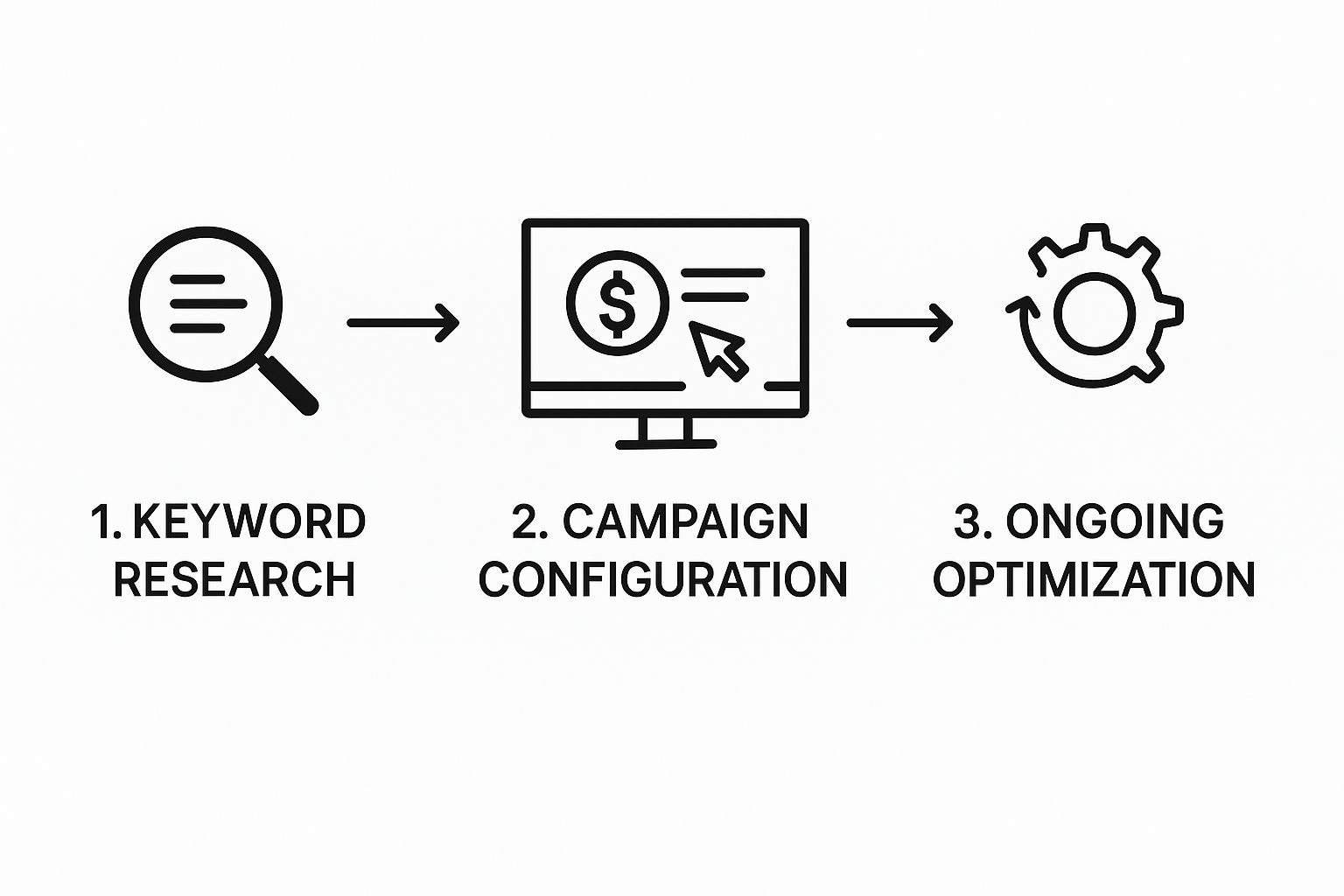
While the process of research, configuration, and optimization might look simple on a chart, my approach infuses each stage with deep strategic thinking that directly impacts your bottom line.
3. Compelling and Relevant Ad Creative
Once the structure is solid, it's time to write ads that actually get people to click and convert. Generic, boring ad copy is the hallmark of an overworked, uninspired agency. I use the insights from our discovery phase to craft messages that speak directly to your ideal customer’s problems and desires.
Your ad isn't just an ad; it's the start of a conversation with a potential customer. I ensure that conversation is relevant, persuasive, and directly answers the search query that brought them there.
I focus on creating a powerful "message match" between the keyword, the ad, and the landing page. This is absolutely crucial for a high Quality Score and a great user experience. It tells Google—and more importantly, your visitors—that you deliver exactly what you promise, building trust from the very first click.
4. Meticulous Daily Optimization
This is where the real growth happens and where my expert-led process truly shines. Google Ads is not a "set it and forget it" platform. It demands constant, meticulous attention—the kind a dedicated specialist like me provides, not a team juggling 30 other clients.
For a detailed look at how this works, you can read our expert's guide on [beating bloated agencies with superior pay-per-click optimization](https://www.cometogether.media/single-post/pay-per-click-optimization-an-expert-s-guide-to-beating-bloated-agencies).
My daily management isn't just about logging in. It's about:
Proactive Bid Management: Making strategic bid adjustments based on performance data from different devices, times of day, and audience signals.
Negative Keyword Mining: Actively hunting for and excluding irrelevant search terms that are silently eating your budget. This is a daily discipline for me.
Constant A/B Testing: Continuously testing ad copy, headlines, and landing page elements to find incremental gains that add up to big wins.
This is a hands-on, proactive process. An agency might glance at your account weekly; I am in it daily, making the small, consistent adjustments that compound into major performance gains over time.
5. Transparent Performance Reporting
Finally, I provide reporting that translates complex data into clear business intelligence. You won't get a standard-issue PDF from me filled with vanity metrics like impressions or clicks. You get a clear analysis of what actually matters to your business: your Return On Ad Spend (ROAS), your Cost Per Acquisition (CPA), and the overall profitability of your campaigns.
My goal is total transparency. You’ll understand not just what happened, but why it happened and what I'm doing next to improve. This creates a true partnership focused on shared goals—a stark contrast to the distant, report-forwarding relationship you get with a large agency.
Measuring Success Beyond Vanity Metrics

To really know if your Google PPC management services are working, you have to measure what actually matters. Far too often, bloated agencies hide behind "vanity metrics"—numbers that look impressive on a report but have zero connection to your business's health.
They'll brag about a huge spike in impressions or a mountain of new clicks. But what good are a million impressions if they don’t lead to a single sale? What's the point of a cheap click if that visitor just bounces? These metrics are agency catnip; they make it look like a lot is happening while your budget quietly drains away.
As an expert consultant, I'm accountable to your bottom line. My focus isn’t on looking busy; it’s on delivering tangible financial impact. This means we stop talking about superficial activity and start focusing on profit-driven Key Performance Indicators (KPIs).
KPIs That Actually Grow Your Business
The real story of your campaign’s success is told through metrics that connect ad spend directly to revenue and customer growth. These are the numbers that should be on every business owner’s dashboard.
Here are the core metrics I obsess over:
Cost Per Acquisition (CPA): This is the ultimate bottom-line number. It tells you exactly how much you're paying to land one new customer. An agency might celebrate a low cost-per-click, but a seasoned expert knows that a higher CPC that leads to a much lower CPA is always the smarter move. If you want to dive deeper, you can check out our guide on [what Cost Per Acquisition is and how to lower it](https://www.cometogether.media/single-post/what-is-cost-per-acquisition-how-to-lower-it).
Return On Ad Spend (ROAS): This simple ratio answers the most critical question: for every dollar I put into ads, how many dollars am I getting back? A 5:1 ROAS means you’re generating $5 for every $1 spent. This metric cuts through all the noise and measures profitability directly.
Conversion Value: Not all conversions are created equal. A true expert like me goes beyond just counting leads or sales by assigning a real monetary value to each conversion. This lets us optimize toward high-value customers, making sure your budget is chasing profits, not just transactions.
From Data Points to Business Decisions
Focusing on these KPIs changes the entire game. Instead of just reporting on clicks, I provide business intelligence.
A bloated agency reports on what happened. A dedicated expert consultant like me explains why it happened and uses that insight to make your campaigns more profitable next month. It’s the difference between being a scorekeeper and a strategist.
For example, by tracking Conversion Value, we might find that customers searching for "emergency plumbing repair" are twice as valuable as those searching for "plumbing cost estimates." I immediately use this insight to bid more aggressively on those "emergency" keywords, steering your budget toward the most profitable part of your market. An agency just following a template would miss this opportunity entirely.
This shift toward quality is reflected across the industry. While the average click-through rate for Google Ads has only inched up to 1.4%, conversion rates have jumped by 6.84%. This tells us that the traffic being captured is more qualified, and a skilled manager knows how to turn those clicks into customers. With the cross-industry average conversion rate at 7.52%, aiming for meaningful actions is everything.
Ultimately, measuring success the right way empowers you. It allows you to hold any advertising partner accountable for results that fuel your growth, not just fill up their monthly report.
How to Choose Your Ideal PPC Partner
Choosing the right partner for your Google PPC management is one of the most critical decisions you'll make for your business's growth. The difference between a true expert and a bloated agency isn't found in a slick sales pitch but in the answers to a few revealing questions.
Your goal is to cut through the fluff and find a partner who will treat your budget like it’s their own.
First, you need to find out who will actually be managing your account. This is the single most important question you can ask.
It's a classic bait-and-switch: a large agency puts a senior person on the sales call, only to hand your account off to a junior employee once you’ve signed the contract. You need to get a clear, direct answer to this. No ambiguity.
Uncovering True Expertise
When you're vetting a potential partner, you have to move beyond generic promises and demand specific proof of their strategic thinking. Any agency can brag about increasing clicks, but a real expert will talk about lowering your Cost Per Acquisition (CPA) or improving your Return on Ad Spend (ROAS). They talk about profit, not just traffic.
Here are the exact questions to ask to separate a strategist from a salesperson:
Who, specifically, will be working on my account every day? If they say "our team," press them for the name and experience level of the individual who will be in the driver's seat. With me, the answer is simple: I will.
Can you show me an example of a strategic win for a client similar to mine? Don't settle for "we increased their traffic." You want a story. Ask how they identified a key opportunity or solved a complex problem that led to more profit.
What is your communication and reporting style? An expert provides proactive insights and translates raw data into business intelligence. An agency, on the other hand, often just sends a templated report with little to no strategic analysis.
The right partner won't just manage your account; they become a vested part of your team. My success is tied directly to yours because my reputation depends entirely on delivering measurable results, not on hitting some internal sales quota.
The Litmus Test for a True Partner
Finally, ask about their process for handling a new account. This is where the difference becomes crystal clear.
A true expert like me will talk about a deep-dive discovery process—I'll want to understand your business, your margins, your customers, and your unique challenges. A bloated agency will just talk about their "standard onboarding checklist." The language they use reveals their entire approach.
When you choose a dedicated consultant, you're not paying for an agency’s fancy office, layers of management, or bloated overhead. You're paying for one thing: my expertise.
You get a direct line to the person making strategic decisions, ensuring your account gets the focused, daily attention it needs to thrive. That direct accountability is the ultimate advantage.
Your Questions About Expert PPC Management
It's smart to have questions when you're looking to hire someone to manage your ad spend. Let's cut through the noise and tackle the big concerns that come up when businesses compare a hands-on expert like me against a big, impersonal agency.
How Much Do Expert Google PPC Management Services Cost?
Think of my expert management as a direct investment in your bottom line, not just another monthly expense. Big agencies have a ton of overhead—we're talking fancy offices, large sales teams, and layers of management you never speak to. All of that gets baked into your fee.
As a solo consultant, I run a much leaner ship. This means your money goes directly into the strategic work that grows your business, not into subsidizing a bloated corporate structure.
Pricing usually comes in two flavors: a simple flat monthly retainer or a percentage of your ad spend. The real difference is that with an expert like me, you're paying for dedicated, senior-level strategy that’s focused on one thing: improving your ROI. You’re not just paying the salary of a junior account manager who's learning on your dime.
What's the Difference Between a PPC Consultant and a Freelancer?
This is a really important distinction, and it’s one that can make or break your results. While they both work independently, their roles are worlds apart. A freelancer is typically a task-doer; you hire them to execute specific jobs like setting up a new campaign or writing some ad copy. They are essentially a pair of hands.
A consultant, like me, is a strategic partner. I don't just "do tasks." I get into the weeds of your business model, your actual profit margins, and what your competitors are doing to build a comprehensive growth strategy from the ground up.
A freelancer is hired to do a job. I am brought on as a partner to solve a business problem and drive measurable financial results.
Choosing a consultant means you’re getting a strategist who is genuinely invested in your long-term success. The goal is to provide guidance that connects every dollar you spend on ads directly to your most critical business goals.
How Quickly Can I Expect to See Real Results?
Everyone wants instant wins, and don't get me wrong, they can definitely happen. But real, sustainable PPC success is a marathon, not a sprint. You'll see activity almost immediately—we can have traffic flowing within days—but the meaningful, profitable results are built over time through careful, data-driven optimization.
The first month is all about me gathering crucial data and making those initial strategic tweaks. It's by the 60-90 day mark that you'll really start to see significant performance improvements as Google’s algorithms learn and we double down on what’s working. Having a dedicated expert who is personally invested in your outcome is the best way to turn that initial data into lasting, profitable growth.


Comments