


You’re looking at another PPC report and feeling the same irritation you felt last month. Spend is up. Click volume looks healthy. The dashboard has enough green arrows to keep the agency comfortable. But your CPA isn’t improving, your ROAS is flat, and nobody can explain, in plain English, why a bigger budget isn’t producing a better outcome.
That’s the plateau high-spend accounts hit when management gets lazy.
At lower spend, mediocre PPC management can hide behind momentum. Brand demand carries part of the load. A few obvious keyword wins make the account look functional. But once you’re spending serious money, weak structure gets exposed fast. Bad tracking poisons decisions. Automation expands into junk traffic. Junior managers optimize what’s easy to change instead of what drives profit.
Most agencies create this problem themselves. They assign a six-figure account to someone with a checklist, not judgment. They recycle the same campaign template across wildly different businesses. They drown you in activity and starve you of strategy. Then they point at platform volatility as if Google Ads is the problem.
It usually isn’t.
PPC campaign optimization at your level is not about fiddling with bids twice a week. It’s about architecture, measurement, and disciplined budget control. If those three things are wrong, every tactical tweak sits on top of a broken foundation. If you need a clean reminder of what ROAS actually means in marketing, start there, then come back and look at your account like an operator, not a spectator.
Introduction You're Spending More But Getting Less
The ugly truth is simple. Most large PPC accounts don’t stall because they need more effort. They stall because they need better decisions.
Agencies love to talk about optimization cadence. Weekly checks. Monthly reports. Quarterly planning. Fine. None of that matters if the account is built on the wrong logic. More meetings won’t fix a campaign that mixes brand, competitor, and generic intent in the same bucket. A prettier dashboard won’t fix conversion actions that double-count leads. And no amount of “machine learning” will rescue an account that feeds the algorithm bad data.
Why high-spend accounts fail
There are a few repeat offenders.
Junior ownership of senior problems A lot of expensive accounts are run by account managers who know the interface but don’t understand the business. They can pause keywords. They can launch RSAs. They can’t tell you which product line deserves aggressive impression share and which one should be throttled.
Template strategy instead of commercial strategy Agencies often structure by keyword theme because it’s easy to build and easy to explain. That’s not the same as structuring by margin, sales cycle, or deal quality. If your account mirrors Google Ads navigation instead of your P&L, you already have a problem.
Unchecked automation Smart bidding and Performance Max can help. They can also burn cash quickly if you don’t control inputs, exclusions, creative quality, and conversion definitions. Automation is a force multiplier. It multiplies good systems and bad ones equally.
Reporting on platform metrics instead of business outcomes Click-through rate, top impression rate, and average CPC matter. They are not the point. The point is profitable customer acquisition.
Practical rule: If your agency can’t explain where the next dollar should go and why, they’re not optimizing your account. They’re maintaining it.
The businesses that break through the plateau usually make one shift. They stop buying “PPC management” and start demanding senior-level media judgment.
Stop Burning Cash Why Your $25k+ PPC Campaigns Are Stalling
Your team raises budget from $12,000 to $30,000 a month because the channel looks promising. Two months later, leads are up, sales is unhappy, cost per qualified opportunity is worse, and nobody can explain where the waste sits. That is how high-spend PPC accounts stall. They rarely collapse in one dramatic mistake. They erode through bad structure, weak data, and lazy decision-making.
Google still dominates search behavior. Google Ads also sits inside a search market tied to hundreds of billions in annual ad spend, as noted in SevenAtoms' PPC stats roundup. If your account is inefficient, the problem sits in the middle of your acquisition engine, not on the edges.
At this spend level, generic advice is useless. You need a senior operator’s diagnostic process. That means checking whether the account is built around profit, sales feedback, and clean signals, or around agency convenience.
Tracking failures poison every optimization decision
Start with conversion tracking.
If the account is feeding bad signals into bidding, every later decision gets worse. I see this constantly in six-figure annual accounts. The interface looks tidy, dashboards look active, and the data underneath is a mess.
Look for these red flags:
Primary conversions are inflated If form fills, phone clicks, page views, and imported pipeline stages all sit in the same primary conversion set, Google will optimize for activity instead of value.
Revenue and lead quality are disconnected If Google Ads reports strong return but sales says the leads are junk, trust sales first and investigate the setup.
Tag Manager has no governance Old tags, duplicate triggers, and abandoned conversion actions subtly corrupt bidding inputs.
A simple review table exposes this fast:
Audit item |
What to check |
What bad looks like |
|---|---|---|
Conversion actions |
Which actions are primary |
Soft actions included in bidding |
Attribution settings |
Whether they match the sales cycle |
Default settings used with no thought |
CRM imports |
Whether qualified leads feed back into Google Ads |
No offline signal at all |
GTM setup |
Trigger logic and duplicate tags |
Multiple fires for one user action |
If your team cannot answer those four points clearly, stop making bid changes and run a proper PPC audit checklist for tracking, structure, and conversion integrity.
Structural flaws create waste before bidding even starts
Plenty of accounts look organized in the UI and still fail at the business level. The test is simple. Does the structure help you allocate budget by margin, intent, geography, and sales quality?
In stalled accounts, the answer is usually no.
The common pattern is campaign cannibalization. Match types overlap. Search terms bleed across campaigns. High-intent queries get trapped in bloated ad groups or broad campaign settings. The result is predictable. Budget fragments, reporting gets muddy, and your best pockets of demand never get funded hard enough.
Check for these problems:
Brand and non-brand live in the same campaign That hides how much performance comes from existing demand.
High-margin and low-margin offers share one budget That forces the same bidding logic onto very different economics.
Geographies are grouped too broadly Strong markets carry weak ones and mask local inefficiency.
Landing pages serve mixed intent Conversion rates drop because the message does not match the query.
If your structure mirrors agency workflow better than your P&L, rebuild it.
Bid strategy gets blamed for problems caused upstream
Automated bidding is useful. It is also dangerous in accounts with weak segmentation and dirty conversion data.
The usual failure pattern is boring, which is why teams miss it. An agency turns on automated bidding across mixed-intent campaigns. Search terms expand. Conversion volume looks healthy in the platform. Sales quality slips. The agency keeps tweaking targets and budgets because that is easier than fixing architecture.
That is not sophistication. It is avoidance.
At $25,000 a month and above, bid strategy should follow account design, not compensate for its flaws. If conversion volume is low, the answer is usually tighter segmentation, stronger offline feedback, and better definitions of value. It is rarely another round of target CPA guesswork.
Agency warning signs get obvious fast
You can tell whether an account is under senior control in one meeting.
They describe tasks instead of tradeoffs
They report blended averages instead of segmented performance
They blame automation before checking conversion inputs
They cannot state which campaigns deserve more budget, which deserve less, and why
The disparity between agencies and consultants is evident. Agencies often protect process. A strong consultant protects budget. One is trying to show activity. The other is trying to show judgment.
Ask sharper questions. Ask which segment is overfunded, which one is underfunded, how lead quality differs by campaign, and what structural change would improve profit fastest. If the answers are vague, your campaigns are not stalling because PPC stopped working. They are stalling because nobody is making senior-level decisions.
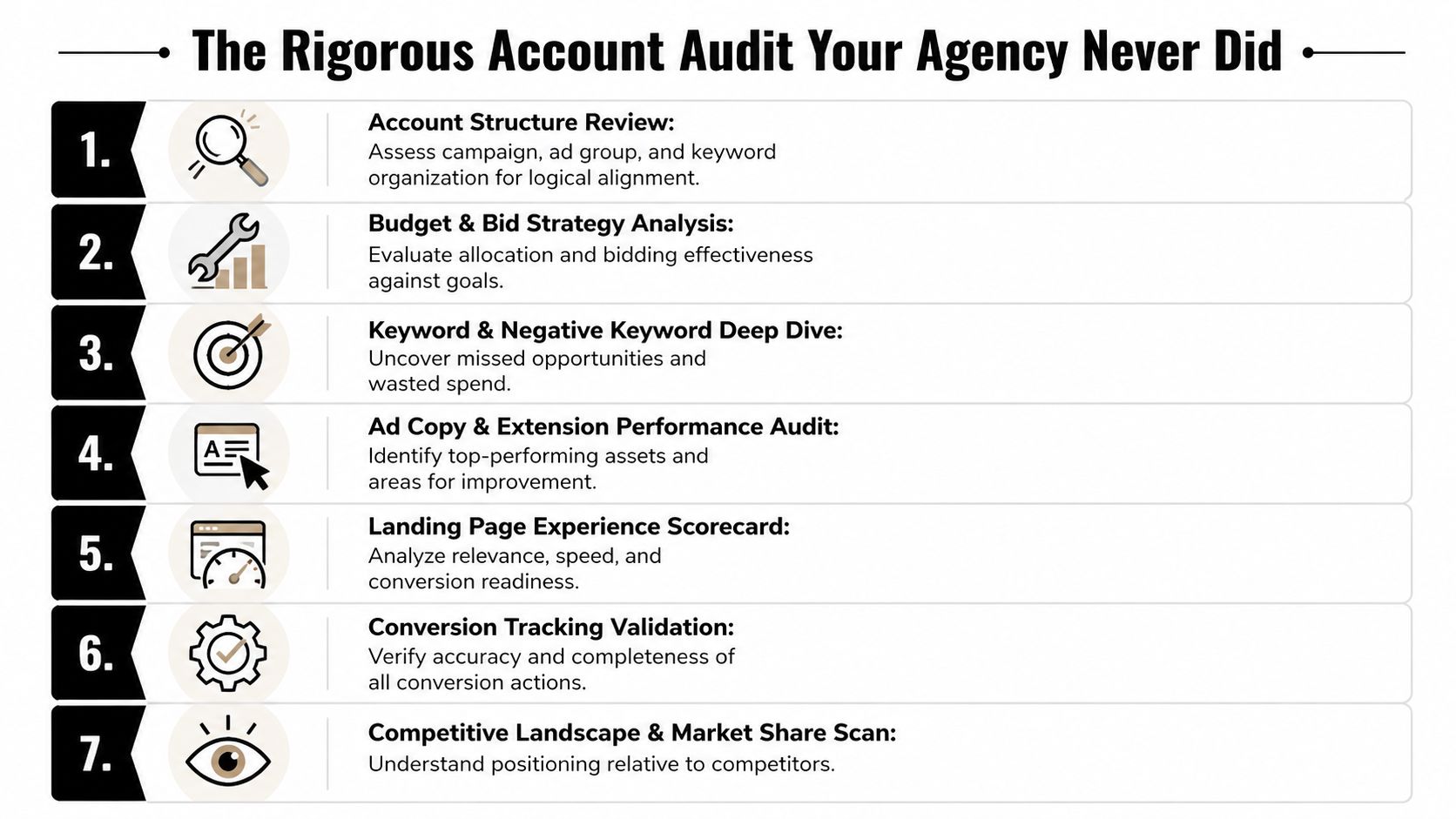
The Rigorous Account Audit Your Agency Never Did
A real PPC audit is not a surface-level review of keywords, ads, and spend pacing. It’s a forensic review of whether the account deserves more budget at all.
Most agencies skip this because it exposes too much. It reveals that the account structure was built for convenience. It reveals that conversion actions were never cleaned up. It reveals that bidding was changed before the business defined what a good lead or sale is.
That’s why the first serious move is always a deep audit.
The benchmark often quoted is the 7.17% average Google Ads conversion rate across industries, cited in Improvado's PPC analysis. Useful reference point, yes. But averages don’t fix accounts. Audits do. If you want a companion framework, this PPC audit checklist is a useful starting point.
Audit the truth before you audit performance
The first pass is about truth, not optimization.
Review these in order:
Conversion integrity Open Google Ads, Google Tag Manager, GA4, and your CRM side by side. Check whether the same event name means the same thing in each system. It often doesn’t.
Revenue or lead-value fidelity If you import offline conversions, verify stage definitions. If you sell online, reconcile transaction values. If there’s a mismatch, don’t optimize around bad totals.
Landing page continuity Search intent, ad copy, and landing page message need to line up. If a user searches for a specific service and lands on a broad homepage, that’s a management error, not a creative one.
Here’s the issue agencies miss. A keyword-level audit is useless if your conversion action is inflated. You can’t identify the best traffic if “best” is defined badly.
Audit account structure by profit path
Most agencies group by keyword similarity. That’s a platform-centric model.
A better model groups by profit path. In other words, the account should reflect how your business makes money. A dermatology practice shouldn’t bundle high-value surgical intent with lower-value informational or cosmetic queries just because the keywords sit in the same category. An e-commerce brand shouldn’t lump hero SKUs with low-margin accessories under one campaign because they share a product line.
Here’s the contrast:
Structure model |
Built around |
Typical result |
|---|---|---|
Keyword-group structure |
The ad platform interface |
Neat account, weak business control |
Profit-driven structure |
Margin, intent, sales value |
Better budget decisions |
A mini example makes this clear.
A healthcare advertiser might have one campaign for “services” with ad groups for treatment names. That looks tidy. But a better build separates urgent, high-intent consultation searches from exploratory condition research and from branded physician searches. Same business. Different economics. Different user psychology. Different bid logic.
Audit search terms and negatives with intent in mind
Most negative keyword work is reactive. That’s too slow.
You need to review search terms by commercial relevance, not just obvious irrelevance. Plenty of terms are technically related and still not worth funding. The question is not “Could this traffic convert?” The question is “Should I pay to acquire this traffic?”
Use this lens:
Keep aggressively when the query signals buying intent or clear service demand
Watch closely when the query is relevant but vague
Block when the query suggests education, jobs, free-seeking, DIY research, or mismatched service need
Audit mindset: Don’t ask whether a keyword belongs in the account. Ask whether it deserves budget priority.
Audit Quality Score where it matters
Quality Score is often treated as trivia. It isn’t. It becomes useful when you review it diagnostically instead of obsessively.
Look at components, not just the number:
Expected CTR tells you if the ad is compelling enough for the auction
Ad relevance reveals sloppy thematic grouping
Landing page experience exposes message mismatch and weak page design
If one ad group shows poor ad relevance, that usually points to structure. If landing page experience is weak, that points to UX or offer clarity. Treat it as a clue, not a score to game.
Audit bidding against business reality
The final step is where weak managers usually stop too early. They review bid strategy settings and call it done.
That’s shallow. You need to compare bidding behavior to actual business economics. If a campaign sells premium services with longer close cycles, the account should not be judged the same way as a fast-converting lower-ticket offer. If one segment produces better downstream quality, it may deserve budget even if front-end CPA looks worse.
That’s why audits done by specialists outperform template reviews. The specialist asks whether the account is aligned with how the business makes money. The template asks whether all the platform checkboxes are green.
Architecting Your Account for Profit Not Just Clicks
Good PPC managers optimize inside the account they inherited. Strong ones rebuild the account when the structure is wrong.
That’s the dividing line.
If your campaigns are still organized mainly by keyword buckets, you’re managing for administration. Not for profit. The account should reflect buying intent, commercial value, and decision stage. Anything less turns budget allocation into guesswork.

The pressure gets worse once customer journeys become messy. Research indicates 72% of marketers struggle with multi-touch attribution, which is exactly why simplistic final-click thinking creates bad budget decisions, as noted in this discussion of attribution complexity. If your account structure ignores the customer journey, your reporting will mislead you.
For a deeper companion read, this guide to Google Ads account structure lines up with the same principle.
Segment by intent first
Intent is the first structural decision because it shapes everything else. Ad copy, landing page selection, bid aggression, and budget priority all flow from it.
Use at least three intent layers:
Bottom-of-funnel Terms with clear buying or booking intent. These usually deserve the cleanest conversion path, the most direct copy, and the tightest negative keyword controls.
Mid-funnel Comparison, alternative, and problem-aware searches. These often need more proof, sharper differentiation, and stronger remarketing follow-up.
Top-of-funnel Awareness traffic can play a role, but it must be controlled. Don’t let awareness spend cannibalize decision-stage campaigns.
A lot of agencies blur these together because they want campaign volume. That’s lazy structure.
Separate campaigns by business value
Not all conversions are worth the same thing. Your account should acknowledge that directly.
If one service line is high-margin, higher-retention, or strategically important, build separate campaigns for it. Give it its own budget, landing pages, reporting view, and bid logic. Don’t bury it inside a catch-all campaign with lower-value offers.
A simple decision filter helps:
Segment |
Budget posture |
Bid posture |
Landing page approach |
|---|---|---|---|
High-value core offer |
Defend aggressively |
Prioritize qualified acquisition |
Dedicated page |
Mid-tier offer |
Fund selectively |
Balance scale and efficiency |
Intent-matched page |
Entry-level offer |
Control tightly |
Avoid overbidding |
Simpler conversion path |
Consultant-led management often outperforms the agency model. A specialist is more likely to ask, “What’s the most valuable customer action?” The average agency asks, “How do we increase total conversions?”
Those are not the same question.
Build attribution-aware campaign paths
If your buyers touch multiple campaigns before converting, don’t force every campaign to prove itself on last-click efficiency alone.
For example, a prospect might first search a symptom, later search treatment options, then return through brand or remarketing to convert. If the account is structured without any journey logic, upper-intent campaigns get underfunded and closing campaigns get too much credit.
Here’s the practical fix:
Map campaigns to the journey
Use consistent naming tied to stage and offer
Review assisted paths in your analytics stack
Judge support campaigns by their role, not just final-click volume
The account should make it easy to see what introduces demand, what nurtures it, and what closes it.
Use exclusions to protect good structure
Segmentation fails when campaigns bleed into each other.
If you build separate campaigns for branded, generic, competitor, and remarketing intent, you need exclusions to preserve that separation. Otherwise the reporting gets muddy and the best signals disappear into overlap.
This is one of the most underappreciated account design tasks. The point of structure is control. If campaigns compete for the same user or query with no guardrails, you don’t have structure. You have clutter.
Advanced Optimization Levers That Actually Move the Needle
A $40,000 account does not improve because someone changed three headlines and added a few negatives on Friday afternoon. It improves when the person running it knows which levers affect profit, which ones are noise, and which ones agencies use to look busy.
That distinction matters more as spend rises.

Stop treating split tests as the center of optimization
High-spend accounts with limited conversions do not need more testing theater. They need sharper judgment.
If you run PPC for a specialty clinic, enterprise B2B service, or high-consideration offer, you already know the problem. Conversion volume is often too thin for clean readouts on every ad, page, and audience change. Senior operators do not force fake precision into that environment. They rank changes by likely business impact and act.
Use this order of operations:
Search term quality first Cut irrelevant intent, review match type drift, and remove query themes that produce bad leads or wasted calls.
Offer and ad filtering second Write ads that repel poor-fit clicks. More clicks from the wrong people only makes the account look healthier than it is.
Landing page friction third Fix weak message match, unclear offers, and pages that bury the next step. You do not need a formal experiment to identify an obviously weak page.
Lead quality feedback fourth Pull patterns from sales calls, CRM notes, and intake teams. Then push those patterns back into targeting, exclusions, copy, and bidding priorities.
That is how experienced consultants optimize low-signal accounts without guessing.
Run search term analysis at the pattern level
One-by-one query reviews are too slow once spend gets serious. You need pattern detection.
Export search term reports and group recurring words, modifiers, and phrase clusters. Bad traffic usually repeats itself in predictable ways. Job seekers. DIY researchers. “Free” modifiers. Definitions. Low-intent comparison language. Irrelevant sub-services. Those patterns tell you where waste comes from and where account structure is too loose.
The rule is simple. Block the query pattern, not just the individual query.
That gives you cleaner traffic and cleaner data. Both matter.
Put guardrails around Performance Max
Performance Max can help. It can also swallow demand you should have kept in Search and hide the damage behind vague reporting.
Treat it like a controlled buying channel, not a magic box. Segment campaigns by product line, margin profile, or intent class. Keep conversion goals clean. Feed it creative tied to the offer, not generic branding. Watch search category data and asset signals closely. Protect your highest-intent search campaigns with budget separation and brand controls where available.
Agencies get lazy here because the interface makes laziness easy. A consultant should not.
Share bid learning only when the economics match
Portfolio bidding is useful when campaigns have the same conversion goal, similar lead quality, and similar auction dynamics. If those conditions are missing, shared bidding muddies the signal and weakens control.
Review your structure before you merge anything. Brand and non-brand should rarely learn together. Different service lines with different close rates should not share a target blindly. Campaigns with materially different CPA ceilings need their own bidding logic.
If your account is grouping campaigns just to reduce management time, fix that first. This guide to mastering your Google Ads bid strategy is a useful reference if your bidding setup has become too blunt.
A strong example of measurement discipline in action is how Nutrimuscle boosted customer acquisition. The lesson for CMOs is straightforward. Better measurement leads to better budget allocation, and better allocation usually beats endless micro-tests.
Automate maintenance. Keep judgment human.
Use scripts, rules, and alerts for pacing checks, broken URLs, budget anomalies, disapproval monitoring, and other repetitive account hygiene tasks. That saves time.
Do not hand strategic judgment to automation.
Machines can flag a spike in spend. They cannot tell you whether the leads from a new query cluster are worthless, whether a sales team is rejecting a service segment, or whether a campaign is winning the wrong kind of customer. That work still belongs to someone who understands business economics, account architecture, and intent.
That is the dividing line between button-pushing management and senior PPC optimization.
Here’s a short walkthrough that reinforces that mindset:
Optimizing When Data Is Scarce The Low-Volume Playbook
Your CMO asks why spend went up again while lead quality stayed flat. The agency answers with the usual script: give the algorithm more time, run more tests, broaden the audience, trust the machine.
That advice breaks low-volume accounts.
If your account produces only a small number of real buying signals each month, you cannot optimize it like a high-volume e-commerce program. You need tighter control, stricter filters, and a decision process built for uncertainty. This is the point where a senior consultant outperforms a bloated agency team. Fewer conversions demand better judgment, not more activity.
What to optimize when conversion data is thin
Start with the parts of the account that reveal commercial intent before the final conversion shows up in reporting.
Focus on four inputs:
Query intent Cut broad traffic that looks relevant in-platform but produces weak sales conversations. Protect exact match and high-intent phrase clusters tied to clear buying language.
Qualified pre-conversion actions Treat form starts, booked calls, pricing-page visits, and deep service-page engagement as directional signals if they correlate with closed business. Do not treat every click or page view as progress.
Lead quality feedback Pull in sales notes, call outcomes, and CRM disposition data. If a keyword theme keeps producing poor-fit leads, cut it even if the platform claims it converts.
Coverage on your best terms Sparse data accounts often have a simple problem. They are underfunded or poorly ranked on the few searches that actually matter. Fix that before you spend time on cosmetic ad tests.
This work is less about testing headlines and more about building a disciplined account that can survive limited signal density.
The operating cadence I use in low-volume accounts
Order matters. In low-data environments, the wrong sequence wastes months.
Fix tracking and define what counts as a qualified lead.
Review search terms and cut low-intent traffic aggressively.
Rewrite ads to screen out bad clicks and attract better ones.
Tighten landing pages so the offer, audience, and next step are unmistakable.
Expand only after lead quality is stable.
Agencies often reverse that order because expansion produces prettier dashboards. It rarely produces better economics.
Restraint wins here. Narrower targeting, cleaner intent, and stricter qualification usually beat endless experiments with no statistical backbone.
If you run a high-ticket service business, this is also where post-click discipline matters. Better page performance gives you more usable signal from limited traffic, which is why it helps to improve Shopify conversion rates and tighten the handoff between ad click and lead capture.
Stop accepting “test more” as a strategy. In low-volume PPC, the job is to make fewer, sharper decisions based on intent, qualification, and business reality. That is how mature accounts improve without wasting another quarter.
Take Control of Your PPC Performance
Strong ppc campaign optimization comes from discipline, not noise. Audit the account properly. Structure it around profit. Feed platforms cleaner signals. Stop accepting reports that explain motion instead of results.
If you manage e-commerce alongside paid search, it also helps to tighten the site-side economics. This practical guide on how to improve Shopify conversion rates is worth reading because better post-click performance makes every paid click work harder.
You don’t need a bigger agency. You need sharper judgment, cleaner data, and faster execution.
If you want that level of rigor, Come Together Media LLC offers specialist Google Ads consulting without the agency layers. You’ll work directly with an experienced PPC consultant, get a clear account review, and leave with actionable recommendations you can use immediately.
