
You’re spending serious money on paid media. The report lands in your inbox. It says the account is performing. The charts are clean, the clicks are up, and somebody highlighted a strong ROAS number in green.
Yet profit feels tighter, not stronger.
That gap is why so many leaders search for roas meaning marketing and still end up with answers that are too shallow to be useful. A definition alone won’t help you manage a real ad budget. You need to know what ROAS tells you, what it hides, and how agencies use it to make mediocre performance look respectable.
I’ve audited enough PPC accounts to say this plainly. ROAS is useful, but it’s also easy to manipulate with bad attribution, lazy reporting, and zero discussion of margin or lifetime value. If you’re a CMO, founder, or operator spending heavily on Google Ads, you need more than dashboard theater. You need a metric that leads to decisions, not excuses.
Your Agency Sent a Report What Does It Mean
You open the monthly report and see the usual suspects. Clicks. Impressions. CPC trends. Maybe a tidy line chart showing revenue going up. Then the headline number: ROAS.
It looks impressive. Your agency says the account is healthy. But cash flow doesn’t feel healthy, sales quality feels uneven, and you’re still wondering why ad spend keeps climbing without a clear profit story.

That’s not a reporting problem. It’s a leadership problem created by weak PPC management.
Most agency reports are built to reduce scrutiny, not increase clarity. They bury the one question that matters. Did the spend produce real business value, or did it just generate platform-friendly numbers? If your reporting doesn’t connect ad spend to accountable revenue and decision-making, it’s decoration.
Why polished reports still fail
ROAS can be a good starting metric, but only when the setup behind it is sound and the interpretation is honest. A report can show strong ad platform performance while hiding issues like poor lead quality, inflated attribution, branded search dependence, or spend being pushed into campaigns that look efficient on paper but don’t move the business.
Here’s the blunt version:
Clicks don’t pay you
Impressions don’t pay you
Even conversions can mislead you if tracking is broken or values are wrong
ROAS without context is a half-truth
A good PPC report should make budget decisions easier. If it leaves you more confused, somebody is protecting themselves.
If your current report feels vague, compare it to a better PPC report format that drives growth. You’ll quickly see the difference between activity reporting and management reporting.
What leaders should demand
Ask simple questions and keep asking until you get direct answers:
Question |
Why it matters |
|---|---|
Which campaigns are actually driving valuable revenue? |
You need budget clarity, not blended averages |
What attribution model is being used? |
Default settings can distort performance |
Are we measuring gross revenue or profit contribution? |
ROAS is not profit |
What should we cut, scale, or rebuild this month? |
Reporting should lead to action |
If your agency can’t answer those questions cleanly, you don’t have strategic PPC management. You have outsourced administration.
What ROAS Actually Means For Your Business
Your agency sends over a report showing a 5:1 ROAS, and everyone wants to call the month a win. Slow down. That number only tells you how much tracked revenue came in for each dollar spent on ads. It does not tell you whether the business made money.
ROAS means Return on Ad Spend. The formula is simple: revenue attributed to ads divided by ad spend.
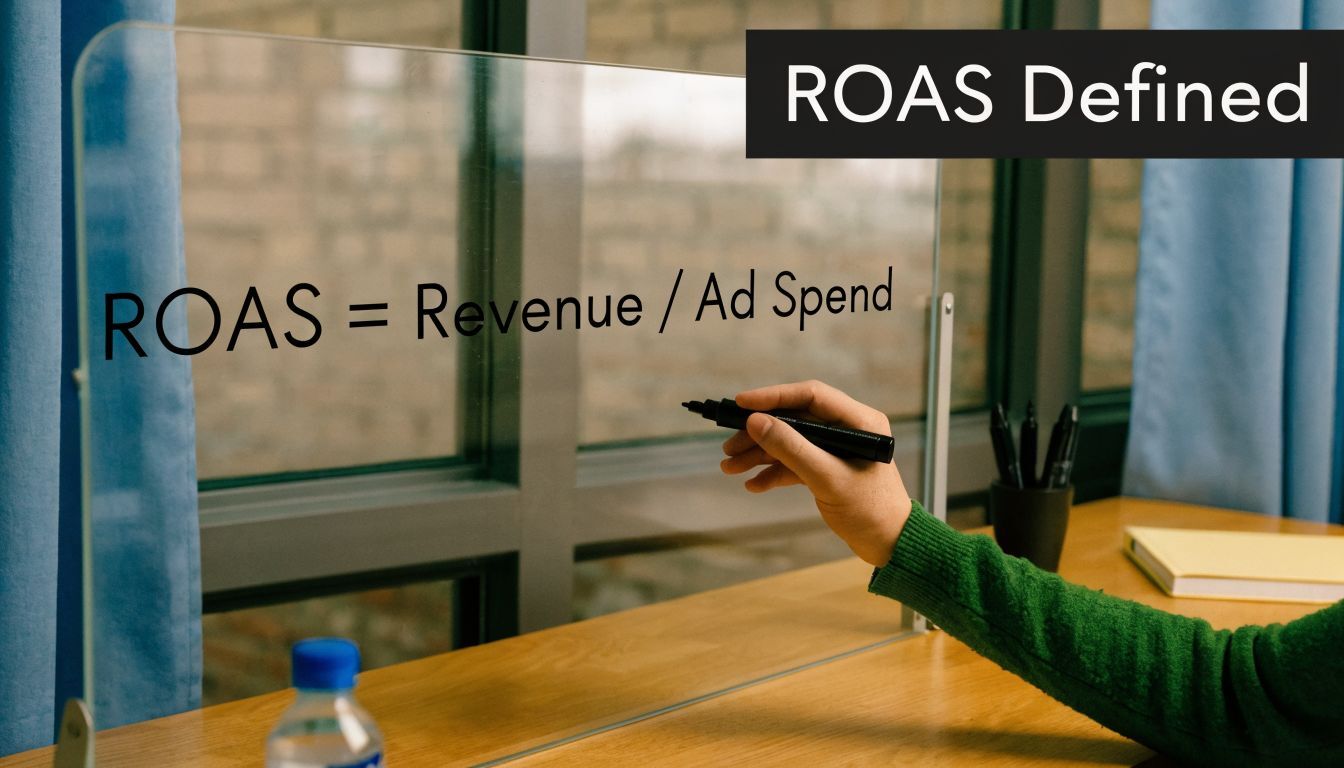
If you spend $2,000 and generate $10,000 in tracked revenue, your ROAS is 5, or 5:1. Clean math. Useful metric. Incomplete business answer.
That distinction matters. ROAS is an efficiency metric, not a profit metric. It helps you compare campaigns, channels, and bidding strategies quickly. It does not tell you whether those sales carried enough margin, whether the customers will buy again, or whether the account deserves more budget.
ROAS tells you how efficiently ads buy revenue
Used properly, ROAS answers one practical question: how much revenue did this spend produce?
That makes it useful for budget control. You can spot which campaigns are buying revenue cheaply, which ones are expensive, and which ones are being kept alive by bad judgment or soft reporting. If your tracking is clean, ROAS is one of the fastest ways to sort winners from passengers.
But stop treating benchmark ranges like strategy. Generic averages do not know your margins, sales cycle, or repeat purchase rate. A low-margin retailer, a high-ticket B2B firm, and a subscription brand should not chase the same ROAS target. Any agency quoting a universal “good ROAS” is selling convenience, not judgment.
ROAS gets distorted fast when nobody connects it to business economics
A 3:1 ROAS can be excellent. It can also be terrible.
If your gross margin is high, fulfillment is cheap, and customers reorder for the next 18 months, a lower ROAS may still print profit. If you sell a low-margin product with heavy service costs, even a strong-looking ROAS can lose money after costs hit the P&L.
That is why smart operators set ROAS targets backward from economics, not forward from ad platform screenshots. Start with contribution margin. Add customer lifetime value. Then define the minimum return required to scale with confidence. If your team needs to clean up the measurement side first, review these Google Analytics goals for better ROAS tracking.
ROAS is easy to manipulate in reporting
Agencies know ROAS looks good in a slide deck. That is why weak ones hide behind it.
They blend branded and non-branded performance. They count low-quality leads as revenue events. They ignore refund rates, discounting, or delayed churn. They celebrate platform-attributed revenue that never holds up in your CRM or finance system.
Here is the standard you should use instead:
ROAS view |
What it tells you |
What it hides |
|---|---|---|
Platform ROAS |
Reported revenue efficiency inside the ad platform |
Margin, lead quality, returns, and attribution inflation |
Business ROAS |
Revenue efficiency matched to real sales data |
Still misses full operating costs unless you add them |
Profit-based view |
Whether ad spend creates actual profit |
Requires stronger tracking and finance alignment |
That middle row is where serious advertisers operate. You need a number tied to real business outcomes, not just ad account math.
If you run e-commerce, this guide on how to boost your e-commerce ROAS is worth a look because it focuses on operational improvements instead of empty definitions.
A short explainer is helpful here if your team needs a visual refresher before discussing targets:
What ROAS should drive inside the business
Use ROAS to make decisions. Cut campaigns that cannot hit the required return. Protect campaigns that bring in profitable customers even if the headline number looks modest. Increase budget where volume can grow without wrecking efficiency.
One external summary of the metric from Improvado’s ROAS guide covers the standard definition well enough. The part that matters more is how you use it. Seasoned advertisers tie ROAS to profit thresholds, LTV, and budget allocation. Everyone else ends up admiring revenue while finance wonders where the margin went.
If someone gives you ROAS without profit context, customer value context, and attribution context, they are not helping you manage growth. They are dressing up ad spend.
Calculating Your True ROAS in Google Ads
Your agency sends a Google Ads report showing a 500 percent ROAS. Finance still asks why profit is flat. That gap usually comes from bad measurement, loose attribution, or conversion values that have nothing to do with real revenue.
In Google Ads, ROAS usually shows up as Conv. value / cost. Useful label. Dangerous metric if the setup is sloppy. If conversion actions are wrong, revenue values are missing, or GA4 and Google Ads are counting different outcomes, the number is just polished noise.
Start with revenue attribution, not the dashboard
True ROAS in Google Ads is attributed revenue divided by ad spend. The key word is attributed. Google Ads is not your accounting system, and it should never get the final word on performance without a tracking audit.
For ecommerce, pass transaction-level revenue. For lead gen, assign values based on qualified pipeline or import offline conversions tied to closed revenue. Counting every form fill the same is amateur hour. It inflates weak campaigns and trains bidding algorithms on junk signals.
If your team needs a quick reset on click-cost terminology before reviewing bid strategy, this ecommerce glossary entry on CPC covers the basics cleanly.
What to verify inside the account
Before you trust ROAS in Google Ads, check the machinery behind it:
Primary conversion actions are correct and included in optimization
Revenue values are dynamic rather than fixed placeholders
GA4 and Google Ads define conversions the same way
Duplicate purchases or leads are not inflating value
Brand search is separated so it does not hide weak prospecting performance
Lead values reflect sales quality instead of arbitrary spreadsheet guesses
Miss one of these and the account can look efficient while budget leaks into campaigns that never had a chance to pay back.
If you cannot trace conversion value to a real business outcome, you should not bid to ROAS.
For teams tightening setup discipline, this guide on mastering goals in Google Analytics for better ROAS is worth reviewing. A lot of accounts do not have a bidding problem. They have a measurement problem.
Attribution changes the answer
Google Ads, GA4, and your CRM will not match perfectly. Good. They measure different parts of the path with different attribution rules.
The mistake is pretending platform ROAS is the truth. It is one version of the truth. A competent operator compares all three sources, looks for directional consistency, and then adjusts budget with margin and close-rate data in mind. Agencies that skip that step love reporting meetings because no one asks hard questions.
A practical method for calculating true ROAS
Use a simple audit process:
Pull spend from Google Ads by campaign Account-level averages hide bad segments.
Identify where conversion value comes from Purchases, imported revenue, lead scores, and static values should not be blended without context.
Compare Google Ads against GA4 and CRM data You are looking for a sensible pattern, not a perfect match.
Segment the result Review ROAS by brand vs non-brand, campaign type, device, audience, and geography.
Pressure-test bidding targets If you use Target ROAS, make sure the target reflects break-even economics and customer value, not wishful thinking.
Here’s the audit table I use when I review accounts:
Audit item |
What bad looks like |
What good looks like |
|---|---|---|
Conversion value |
Same value for every lead |
Value tied to order data or qualified revenue stages |
Campaign reporting |
One blended ROAS number |
Segmented by campaign type and intent |
Attribution review |
Platform numbers accepted at face value |
Google Ads, GA4, and CRM compared side by side |
Bidding strategy |
tROAS running on weak or incomplete values |
tROAS used only after clean value data is in place |
Don’t let reporting defaults run the account
Google Ads can optimize hard and spend fast. If your inputs are wrong, it will scale bad decisions with impressive efficiency.
That is why serious ROAS work starts with tracking quality, then moves to profit, LTV, and budget allocation. Anyone can quote platform ROAS. The job is figuring out whether that return produces cash, buys valuable customers, and deserves more spend.
The ROAS Blunders Costing You Thousands
Your agency sends a report showing strong ROAS. Everyone relaxes. Then finance closes the month and profit is flat, cash is tight, and new customer growth barely moved.
That happens all the time because a clean ROAS number can hide bad business decisions.

Blunder one, treating ROAS like profit
ROAS measures revenue returned for ad spend. It does not measure margin, contribution profit, or cash left after fulfillment, discounts, sales labor, and overhead.
That distinction decides whether you should scale or cut.
I have seen campaigns post healthy platform ROAS and still lose money because the product mix was weak, shipping costs were ugly, or the sales team converted the leads badly. Agencies love to stop at revenue because revenue is flattering. Operators should not.
Ask better questions:
What ROAS clears break-even after real costs?
Which offers produce strong contribution margin, not just top-line sales?
Which campaigns bring in customers who buy again?
Which conversions would have happened without paid media?
If your team cannot answer those questions, they are reporting performance theater.
Blunder two, giving credit to demand you did not create
A lot of “great ROAS” is branded search, remarketing, or existing customer traffic taking a victory lap.
Incremental impact is the issue. Did ads create additional revenue, or did the platform attach itself to revenue that was already on the way? Those are very different outcomes, and bad agencies blur them on purpose.
A campaign that captures existing demand deserves a different budget decision than a campaign that creates new demand. Brand search often protects demand. Prospecting is supposed to create it. If both get rolled into one success story, leadership gets a distorted view of what is driving growth.
That distortion gets expensive fast.
Blunder three, hiding weak campaigns inside blended ROAS
Blended ROAS is a cover-up metric. Put branded campaigns, remarketing, and prospecting in one average and underperformance disappears.
You do not need one account-wide feel-good number. You need to know where money is working and where it is being burned.
Here’s where experienced advertisers break it out:
Segment |
Why it matters |
|---|---|
Brand vs non-brand |
Brand traffic usually inflates efficiency and masks acquisition problems |
Search vs display or video |
Intent, click quality, and conversion behavior are different |
New vs returning customers |
Returning buyers can make acquisition look better than it is |
Offer or product line |
Revenue quality changes by margin, close rate, and repeat purchase potential |
If your agency reports blended ROAS without these cuts, they are making it harder to manage budget properly.
Blunder four, optimizing on broken tracking
Bad tracking poisons every ROAS conversation. Duplicate purchases, missing call tracking, weak offline conversion imports, and inflated lead values will make weak campaigns look efficient.
Then everyone wastes time debating strategy when the actual problem is measurement.
If you need a starting point, review this guide on how to fix your Google Ads conversion tracking. Clean inputs come first. Until then, Target ROAS bidding is just automated confusion.
For ecommerce brands, conversion rate problems can also drag ROAS down even when traffic quality is decent. Landing pages, offer clarity, checkout friction, and mobile UX all matter. A practical primer on optimizing Shopify store conversions is worth reviewing if paid clicks are landing on a store that does not close the sale.
What experienced advertisers do differently
They use ROAS as one input, not the verdict.
The actual job is deciding which campaigns produce profitable revenue, which ones bring in valuable customers, and which ones deserve more budget. That means tying ROAS to margin, LTV, and incrementality instead of clapping for a top-line number in a slide deck.
That is how you stop paying for nice reports and start paying for growth.
Actionable Strategies to Improve Your ROAS Today
Improving ROAS doesn’t require motivational jargon. It requires discipline. Most accounts don’t need more complexity. They need tighter structure, cleaner traffic, stronger intent matching, and faster execution.
If your current team takes weeks to make obvious fixes, that’s not strategy. That’s drag.
Tighten campaign structure
Loose campaign structure creates vague data and vague decisions. If unrelated keywords, mismatched ads, and generic landing pages are all lumped together, Google has too much room to waste budget.
For search campaigns, use tightly themed ad groups. In some cases, a very narrow setup like a single-keyword ad group still makes sense. In others, small intent-based clusters are cleaner and easier to manage. The point is relevance. The search term, ad copy, and landing page need to line up.
When that alignment improves, your quality signals improve with it. Better relevance tends to produce cleaner clicks and more efficient spend.
Cut waste aggressively with negatives
A lot of bad ROAS comes from buying the wrong traffic, not from weak ads. Search term reports tell the truth fast if you bother to read them.
Build and maintain negative keyword lists constantly. Remove irrelevant intent. Remove research terms if you need buyers. Remove job seekers, support queries, and low-value modifiers. Don’t wait for waste to pile up.
Use this simple audit pattern:
Daily check for new junk queries in active spend-heavy campaigns
Weekly review by theme to identify recurring waste patterns
Shared negative lists for account-wide irrelevance
Landing page alignment check when high-intent queries bounce
That work isn’t glamorous. It’s where profit leaks get fixed.
Practical move: Open the search terms report today and find where you’re paying for curiosity instead of purchase intent.
Use bidding automation correctly
Google’s automation is powerful when the account has enough clean value data. It’s dangerous when it doesn’t.
If you’ve built solid conversion value tracking, Target ROAS can be effective because it lets Google bid using more auction-time context than a human can process manually. But don’t set fantasy targets and expect the system to obey economics. If your target is disconnected from actual account history, volume can collapse or traffic quality can deteriorate.
The right approach is boring and effective. Feed the system clean data. Set targets grounded in business reality. Monitor query quality, conversion quality, and volume together.
Fix the landing page before blaming the ad
A lot of teams obsess over headlines while sending paid traffic to pages that don’t close.
Your landing page should match the keyword intent and ad promise. If the ad offers a specific product, service, or outcome, the page should continue that exact message. Don’t make paid visitors hunt for it.
For e-commerce brands running Shopify, this guide on optimizing Shopify store conversions is a useful companion because it focuses on conversion friction where many paid campaigns fail.
Improve the account in the right order
Don’t chase every lever at once. Fix in sequence:
Priority |
Action |
Why it comes first |
|---|---|---|
First |
Tracking and conversion values |
Bad inputs ruin every decision |
Second |
Search term and audience cleanup |
Waste reduction improves efficiency fast |
Third |
Campaign and ad group structure |
Better data and relevance |
Fourth |
Bidding strategy |
Automation works better on clean foundations |
Fifth |
Landing page refinement |
Converts expensive traffic into revenue |
Most agencies reverse that order. They tweak ads first because it’s visible and easy to present in a meeting. Experienced PPC operators fix the plumbing before repainting the walls.
Beyond ROAS Using KPIs for Profitable Growth
Your agency reports a 5:1 ROAS and wants more budget. Fine. Before you approve another dollar, ask a better question. Did those campaigns produce profitable customers, or did they just generate attractive top-line revenue in a report?
ROAS is a useful efficiency metric. It is not a business model.
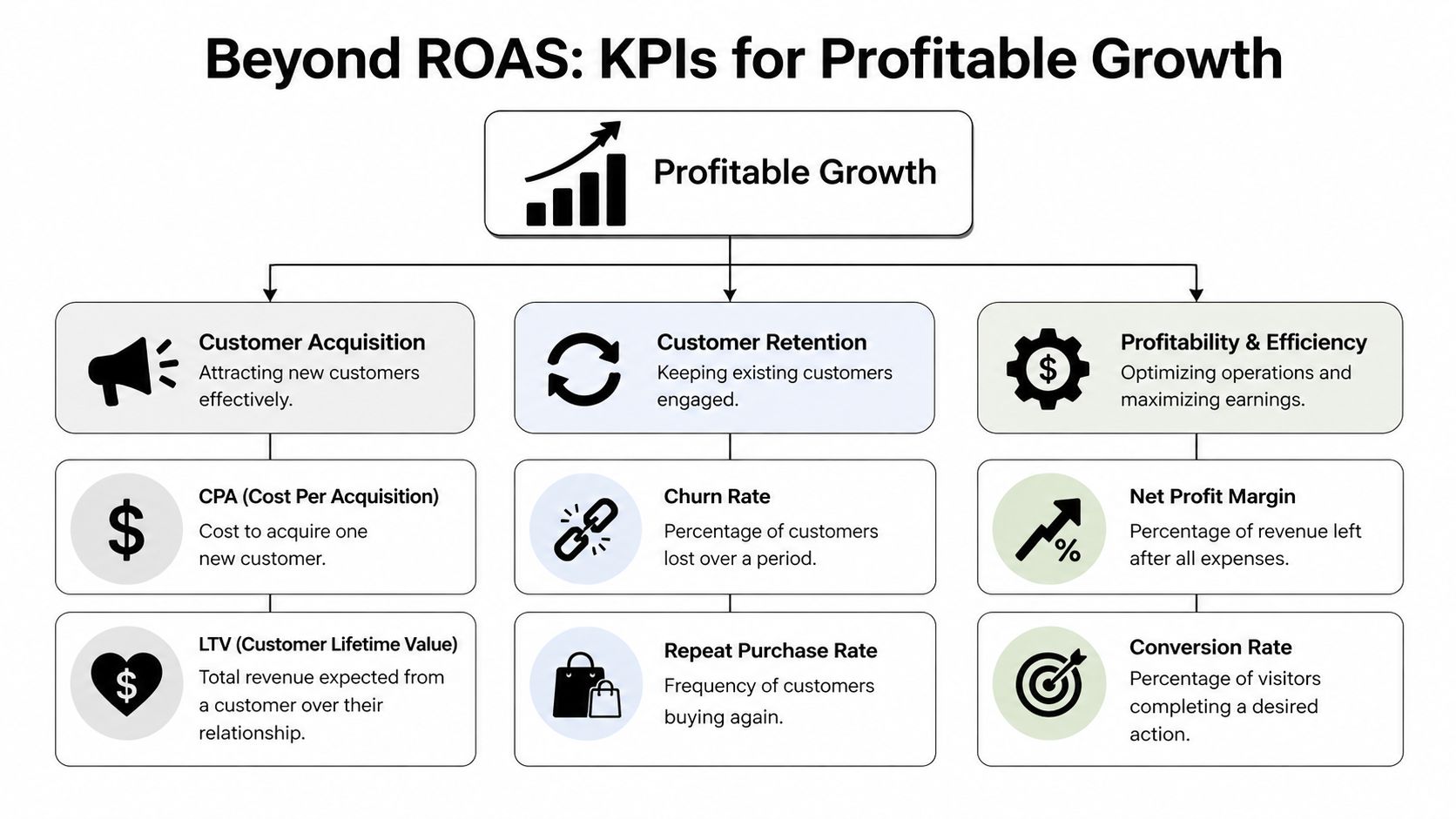
If you run paid media with any financial discipline, you judge ROAS next to the numbers that decide whether growth is worth funding. That means customer acquisition cost, lifetime value, conversion rate, retention, and margin.
Why immediate ROAS can mislead you
A campaign can look average on first purchase revenue and still be one of the best investments in the account. That happens when it brings in customers who buy again, stay longer, or produce better margins.
That is why short-term ROAS gets abused so often. Agencies love it because it is easy to present and easy to defend. The number looks clean. The business reality usually is not.
If your team shows a 2:1 or 3:1 ROAS without any context around repeat purchase behavior, refund rates, sales cycle quality, or contribution margin, they are giving you half the answer. Half an answer is how bad budget decisions get approved.
The KPI stack that actually matters
I do not want one headline metric. I want a stack that explains whether paid acquisition is producing durable profit.
Use this order:
ROAS for revenue efficiency
CAC or CPA for acquisition cost control
Conversion rate for traffic and offer quality
LTV for long-term customer value
Margin for actual business impact
Miss one of those and your reporting gets soft. Miss two and your budget process turns into theater.
How experienced operators make budget calls
Use ROAS to control bids and spending pace. Use LTV and margin to decide where the business should invest.
A branded search campaign can print a strong ROAS while adding very little new demand. A non-brand or upper-funnel campaign can look weaker on first purchase revenue while bringing in higher-value customers who stick. If you cut that second campaign too early, you protect the spreadsheet and hurt future profit.
The best campaign in the account is often the one a shallow dashboard undervalues.
That is why serious teams connect ad data to CRM data, repeat purchase behavior, and gross margin by customer segment. Anything less is just platform reporting with nicer formatting.
Build a decision framework, not a vanity dashboard
Your executive view should answer four questions:
Question |
KPI focus |
|---|---|
Are ads generating revenue efficiently? |
ROAS |
Are we buying customers at a sustainable cost? |
CAC or CPA |
Are those customers worth keeping? |
LTV and repeat behavior |
Does growth improve the business, not just top-line sales? |
Margin and profitability |
This framework fixes a common failure in paid media management. Teams scale whatever converts fastest. Smart operators scale what creates the most value over time.
That matters even more for subscription businesses, repeat-purchase e-commerce brands, healthcare groups, and high-consideration services. If you need a cleaner method for measuring long-term customer value, read this guide on how to calculate customer lifetime value accurately.
What expert PPC management looks like
It looks less impressive in a pitch deck and far better in the P&L.
It means reviewing search term quality, offline conversion feedback, lead-to-sale rates, value rules, and customer value by source. It means refusing to let branded search take credit for everything. It means judging campaigns by the quality of customers they create, not by whichever ratio looks best in the platform interface.
Plenty of agencies say they are data-driven. Then they report only default platform metrics and call it strategy.
That is not strategy. That is convenience.
The boardroom version of roas meaning marketing
In a real business, roas meaning marketing is not “how much revenue came back from ads.” It is how efficiently paid media contributes to profitable customer growth after you account for cost, retention, and margin.
That definition is less flattering to weak agencies. Good.
Once you treat ROAS that way, budget conversations improve fast. You stop rewarding campaigns for looking efficient in isolation. You start funding the channels, offers, and customer paths that produce real profit.
From Metric to Mandate Make Your Ad Spend Work for You
ROAS is a starting point. It tells you whether ad spend is producing revenue efficiently enough to earn further scrutiny. That’s valuable.
But that’s not the same as saying it tells you the truth about profit, incrementality, or long-term growth.
If your current PPC partner reports ROAS without explaining attribution, margin, campaign mix, and customer value, they’re giving you a partial answer and hoping you don’t notice. Plenty of agencies survive on that gap. They hide behind blended averages, overloaded dashboards, and junior account management that confuses activity with insight.
You don’t need more reporting theater. You need sharper accountability.
A serious paid media operator uses ROAS to make decisions. Which campaigns deserve more budget. Which keywords are draining efficiency. Which channels are harvesting existing demand instead of creating new demand. Which conversions are valuable enough to feed back into bidding. Which acquisition paths deserve patience because they produce stronger customers over time.
That’s the difference between managing ads and managing growth.
The practical takeaway is simple. Don’t ask your team for a better ROAS number. Ask them for a clearer profit story. Ask what’s incremental. Ask what’s repeatable. Ask what should be cut right now and what deserves more budget. If the answers come back vague, polished, or overloaded with platform jargon, you already know the account isn’t being led properly.
A specialist consultant has an advantage here. Direct communication. Faster changes. No committee. No junior handoff. No bloated retainer paying for overhead you didn’t ask for. Just focused PPC management tied to business outcomes.
That’s what your budget deserves.
If you want a straight answer on whether your Google Ads account is producing profitable growth, talk to Come Together Media LLC. Chase McGowan works as a specialist consultant, not a bloated agency middle layer, which means you get direct strategy, clean accountability, and PPC management built around real ROI instead of dashboard spin.