


If you're spending serious money on Google Ads, there's a good chance Dynamic Search Ads are already in your account. There's also a good chance they're under-managed, poorly targeted, and absorbing budget your agency can't explain.
That happens because most agencies treat dynamic search ads like a convenience feature. They launch them, point them at the whole site, add bland descriptions, and move on to the next client. You get automation without strategy, reporting without insight, and waste dressed up as innovation.
A specialist handles DSAs differently. The goal isn't to let Google run wild. The goal is to use Google's crawling and matching where it's strongest, then control everything else with ruthless precision.
Your Agency Is Wasting Your Money with Dynamic Search Ads
Agencies love to sell efficiency. DSAs give them an easy story. "Google will find new searches automatically." That's true. The problem is what they leave out.
Google will also match to pages you never wanted to advertise, write headlines based on weak page titles, and send paid traffic into parts of your site that have no business receiving expensive clicks. If nobody is checking query quality, landing page quality, and exclusions every week, the campaign turns into a leak.
The pattern is predictable. Your agency launches DSA because it's fast. They call it AI-powered. Then they spend their actual time on easier account tasks like ad copy refreshes, budget pacing, and presentation decks. Meanwhile, dynamic traffic drifts into irrelevant searches, soft landing pages, and low-intent sections of the site.
That's not smart automation. That's lazy account management.
What bad DSA management looks like
All webpages targeting: The campaign can hit almost anything Google crawls, including pages that don't belong in paid search.
No negative dynamic targets: Blog posts, careers pages, login screens, support content, and policy pages stay eligible.
No search term discipline: Queries pile up without exclusions, harvesting, or segmentation.
Weak descriptions: Agencies rely on auto-generated headlines but pair them with generic copy that doesn't sell.
No page title oversight: If your title tags are messy, your ad headlines will be messy too.
Practical rule: If your agency can't tell you which pages were excluded from DSA on purpose, they are not managing the campaign. They are observing it.
If that sounds familiar, start with a proper Google Ads optimization process and audit the DSA campaign before you raise budget. Most accounts don't need more automation. They need more control.
What Are Dynamic Search Ads and How Do They Really Work
Dynamic search ads aren't magic. They're a matching system.
Google launched Dynamic Search Ads in 2012 to automate ad creation from website content instead of manual keyword research. By 2025, campaigns that integrated DSAs with Smart Bidding saw an average 18% increase in unique converting search query categories and a 19% lift in total conversions, according to this breakdown of Google Dynamic Search Ads.
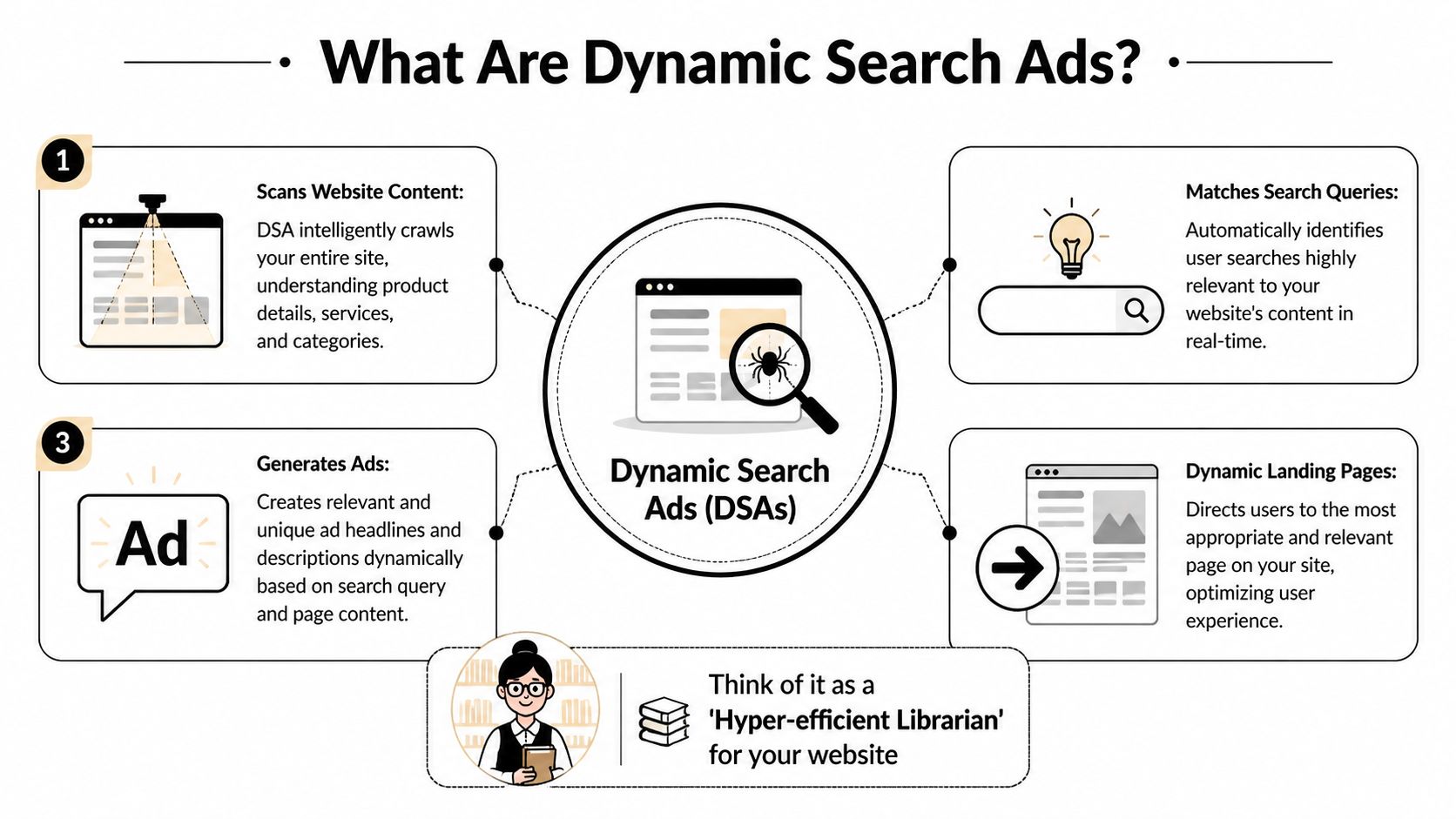
The easiest way to think about DSAs is this. Google acts like a hyper-efficient librarian for your website. It scans your pages, understands what those pages are about, and tries to match them to searches you didn't manually add as keywords.
The core mechanics
A standard search campaign starts with your keyword list. If the keyword isn't in the account, you usually won't show.
A DSA campaign starts with your website. Google crawls the site, reads the content, and decides which page is the best fit for a search. Then it dynamically generates the headline and sends the click to the matched landing page.
That difference matters because search behavior isn't stable anymore. People don't always search in neat, transactional phrases. They search in longer, more specific, more conversational language. Manual keyword builds miss a lot of that. DSAs are one of the few tools in Google Ads that can cover those gaps efficiently.
What Google actually builds
Dynamic search ads usually pull the headline from page-level information such as the title of the page. The final URL is the landing page Google thinks best matches the query. You still control the description lines, which means you still control the selling message.
That creates a simple but important reality. If your site structure is strong, DSAs can work extremely well. If your structure is sloppy, your ads inherit that sloppiness.
Here's the practical chain:
Google crawls the site
Google maps queries to relevant pages
Google generates the headline
Your description and assets help close the click
The landing page determines whether traffic converts
A DSA campaign is only as smart as the website it's allowed to use.
Why CMOs should care
Most high-spend accounts have blind spots in the long tail. Those are the specific, lower-volume searches that signal clear intent but don't always make it into a manual build. DSAs help you surface those searches without building endless keyword lists by hand.
That doesn't replace traditional search. It complements it. Manual campaigns give you control over your highest-priority terms. DSAs help you discover coverage gaps, new intent patterns, and landing page opportunities that a rigid keyword structure misses.
If you want a broader paid search foundation, this overview of how search advertising works is useful context. For another outside perspective on disciplined account management, I also like this piece on expert advice on PPC advertising, especially for teams that want clearer operator-level thinking instead of generic platform talk.
What DSAs are best at
DSA strength |
Why it matters |
|---|---|
Long-tail discovery |
Finds relevant searches you didn't manually target |
Coverage expansion |
Helps large sites advertise more of their inventory or service depth |
Speed |
Reduces the need for exhaustive keyword mapping |
Message relevance |
Dynamic headlines can align closely with nuanced search intent |
The mistake is treating those strengths like permission to stop managing the account. They aren't.
When to Unleash DSAs and When to Keep Them Caged
Dynamic search ads are not a default setting. They're a strategic tool. On the right site, they expand coverage and uncover revenue. On the wrong site, they burn budget with impressive-looking activity and mediocre business results.

The first question isn't "Should we test DSA?" The first question is "Does our website deserve DSA traffic?"
Use DSAs aggressively in these situations
Large ecommerce sites are the obvious fit. If you have deep catalog structure, strong product titles, useful category pages, and inventory that changes often, DSAs can cover search demand that manual keyword mapping won't catch fast enough.
They're also useful for service businesses with well-structured site architecture. If each service has its own high-quality page, the account can target those sections surgically. That matters for firms with broad service lines and many variations in how prospects search.
Good candidates usually have these traits:
Clear page intent: Product and service pages say exactly what they offer.
Strong structure: Categories, subcategories, and URLs are logically organized.
Searchable text: The page explains the offer in crawlable language.
Clean title tags: Headlines generated from the page have a chance to be compelling.
Keep them tightly controlled in service businesses
Service-based advertisers get into trouble when they let DSAs roam across the full domain. For healthcare and plastic surgery practices, broad "all webpages" targeting can lead to 30-50% wasted spend, and DSAs can underperform exact-match keywords by 25% in conversion rate when landing page matching is weak, according to this analysis of DSA performance for service businesses.
That doesn't mean service businesses should avoid DSAs. It means they should stop using them carelessly. The same source notes that a targeted approach can still boost CTR by 15-20% and capture 10-15% more traffic from relevant long-tail queries.
If you're in healthcare, legal, home services, or any other intent-sensitive category, "all webpages" isn't a shortcut. It's a mistake.
A simple decision filter
Use this framework before launch:
Question |
If yes |
If no |
|---|---|---|
Do your service pages match specific search intent? |
Target those sections directly |
Rebuild the landing pages first |
Are your title tags commercially useful? |
Let DSA test them |
Fix titles before spending |
Does the site contain lots of non-commercial content? |
Build exclusions immediately |
Proceed with tighter scope |
Do you already have strong exact-match winners? |
Use DSA for discovery around them |
Don't expect DSA to rescue weak fundamentals |
If you're running service-based PPC, your exclusions matter just as much as your targets. Start with a disciplined negative keyword strategy and pair it with page-level exclusions. That's how you keep DSAs caged where they should be and unleashed where they can help.
The Specialist Setup Versus The Agency Shortcut
There are two ways to launch dynamic search ads. One takes a few minutes and creates future cleanup work. The other takes real thinking and creates control from day one.
Most agencies pick speed. A specialist picks architecture.
The side-by-side reality
Agency shortcut |
Specialist setup |
|---|---|
Targets all webpages |
Targets controlled site sections, categories, or URL patterns |
Uses generic descriptions |
Writes descriptions that work with dynamic headlines and real buyer intent |
Adds few exclusions |
Excludes non-commercial pages before launch |
Waits for problems to appear |
Prevents obvious waste immediately |
Reports on clicks and conversions |
Audits page quality, query quality, and match quality |
The shortcut is easy to spot. The campaign uses broad website coverage, vague ad copy, and little segmentation. It looks efficient because setup was fast. It performs poorly because the strategy was thin.
What a proper DSA build looks like
Start with site structure, not campaign settings. Break the site into commercially meaningful groups. For ecommerce, that could be category and subcategory level. For lead generation, it could be service lines, treatment pages, or location-specific landing pages.
Then build dynamic ad groups around those themes. Don't dump everything into one bucket. If your account serves running shoes, dress shoes, and hiking boots, those shouldn't sit inside one generic DSA group. The same goes for a clinic advertising dermatology, cosmetic procedures, and skin cancer screening.
Your ad descriptions should do the selling work the dynamic headline can't do consistently. That means real value points, qualification, urgency, trust signals, and a clear next step.
Exclusions are not optional
In this context, agencies cut corners.
Before launch, exclude pages that shouldn't receive paid traffic. Common examples include:
Corporate pages: About, careers, press, investor, and team pages
Support areas: Help centers, policy pages, documentation, account access
Top-of-funnel content: Blog articles, glossaries, educational posts that aren't built to convert
Dead-end pages: Thin content, outdated offers, seasonal pages you don't want active
Operator note: A DSA campaign should never discover for you that your careers page can buy clicks.
One useful outside read on local provider selection is this piece on choosing a Bristol PPC agency. Not because you need an agency, but because it highlights a point many CMOs already know. The delivery model matters. When junior account managers handle setup, details like exclusions, page grouping, and intent mapping get skipped.
The launch checklist I’d use
Audit crawlable pages first Identify what Google can practically use.
Group pages by commercial intent Build around categories, service clusters, or URL patterns.
Write descriptions that can flex Dynamic headlines change. Your descriptions must still make sense.
Apply negative dynamic targets immediately Don't wait for waste to show up in reporting.
Protect your core manual campaigns Keep DSA in a discovery and coverage role, not a cannibalization role.
A specialist doesn't launch DSA because the feature exists. A specialist launches it because the website, campaign structure, and measurement setup can support it.
Advanced Optimization Your Agency Is Not Performing
Launching dynamic search ads is easy. Running them well is not.
The leverage comes from one place. The Search Terms report. Most agencies skim it. A real PPC operator uses it to decide which queries deserve budget, which landing pages deserve traffic, and which parts of the site should be cut off immediately.

In controlled tests, DSA campaigns achieved a 383 basis points higher click-through rate and a 42% lower cost-per-click than keyword-targeted campaigns. The same source notes that mature campaigns can improve ROAS by 20-30% by analyzing search terms and excluding pages with high spend and low conversions, as outlined in Gupta Media's DSA analysis.
That doesn't happen because the platform is magical. It happens because someone does the work.
Start with the three-way analysis
Don't review search terms in isolation. Review three things together:
The query
The landing page
The generated headline
That combination tells you why a click happened and whether it should happen again. A query may look relevant on its own, but if Google matched it to the wrong page, the click can still be low quality. Likewise, a page may be strong overall but produce weak headlines because the title tag is generic.
Build a pivot table and force clarity
Export the Search Terms report and build a pivot table in Excel or Google Sheets. Group by landing page first, then analyze performance by query volume, spend, clicks, conversions, and cost efficiency.
You're looking for patterns, not anecdotes.
What to flag immediately
High-spend pages with weak conversion performance These pages are absorbing budget without earning the right to keep it.
High-CTR, low-conversion combinations The ad match is good enough to win the click, but the page fails after the click.
Irrelevant query clusters These indicate missing negatives or overly broad dynamic targets.
Strong queries hiding inside DSA These are candidates for manual keyword harvesting.
The Search Terms report doesn't just show wasted queries. It shows weak pages, weak titles, and weak account structure.
Exclude pages, not just queries
Most accounts leave money on the table. They add negative keywords but keep feeding budget into poor landing pages.
If one page consistently attracts clicks that don't convert, exclude that page or section from DSA. The issue often isn't the user. It's the page. Maybe the title pulls in the wrong intent. Maybe the offer is soft. Maybe the page is informational when the campaign needs commercial intent.
That page-level sculpting is what turns DSA from broad coverage into controlled expansion.
A good working rhythm looks like this:
Pull search term data regularly
Sort by spend and conversion efficiency
Review page-level winners and losers
Add negative keywords where intent is wrong
Add negative dynamic targets where page quality is wrong
If you want a broader framework for tightening paid search performance, this Google Ads optimization checklist for 2025 is a useful companion.
Harvest winners into manual campaigns
One of the best uses of dynamic search ads is discovery. A DSA campaign finds search demand you didn't map in advance. Once a query proves it can convert, stop treating it like a discovery term.
Move it.
Create a dedicated manual search ad group for that query cluster. Give it specific ad copy, tighter bidding control, cleaner reporting, and its own landing page decisions. That's how advanced accounts use DSA. They mine it for intent, then promote winners into campaigns where they can scale with more precision.
What should be harvested
Signal |
Action |
|---|---|
Consistent converting query |
Build manual keyword coverage |
Commercial phrase with clear intent |
Write tailored ads around it |
Recurring theme across multiple searches |
Create a new ad group or campaign segment |
Strong query, weak page |
Consider a better landing page before scaling |
Fix the page title problem
Because DSA headlines are generated dynamically, page titles matter far more than many anticipate. If your title tag is vague, bloated, or written only for SEO vanity, your ad headline may be weak.
That creates a hidden drag on performance. The query might be good. The page might be relevant. But the headline underperforms because the source material is poor.
Review titles on pages receiving DSA traffic and tighten them around actual commercial intent. The best DSA managers don't treat the website and the ad account as separate worlds. They know that page metadata affects paid search output.
Compare DSA by efficiency, not ego
A lot of marketers obsess over whether DSA "beats" manual search. That's the wrong question.
The right question is whether DSA is finding profitable intent the rest of the account missed. If it can do that while maintaining efficient acquisition and surfacing new query themes, it earns budget. If it can't, cut it down.
Hard truth: Automation deserves budget only after it proves it can handle intent responsibly.
That's the difference between an agency that reports activity and a specialist who manages outcomes.
The Future Is Now The DSA Phase-Out Begins in 2026
Most dynamic search ads content is already outdated on the most important point. Google is phasing out Dynamic Search Ads in September 2026 and transitioning them to AI Max campaigns, according to this discussion of the DSA phase-out and migration issue.
If you're relying on DSA for long-tail coverage, this is not a footnote. It's a strategy problem that needs attention now.
Why this matters before 2026
The shift to AI Max means your current DSA structure won't remain static. Google is moving further toward automated targeting and bidding systems that make more decisions inside the black box. That doesn't mean results will automatically get worse. It does mean your current assumptions about control, reporting, and matching may change.
Accounts with messy DSA setups are especially exposed. If you already have weak exclusions, vague page targeting, and poor separation between discovery and core keyword campaigns, the migration could magnify those problems.
What smart advertisers should do now
Don't wait for a forced transition to begin cleanup. Use the remaining DSA window to document what works and isolate what shouldn't survive migration.
Focus on three things:
Map current dynamic targets Know which page groups, URL patterns, and site sections are driving value.
Preserve your exclusion logic Your non-commercial pages, weak sections, and soft-intent content should already be identified.
Separate discovery from scale Queries or themes that have proven themselves should not remain trapped in a dynamic campaign forever.
The accounts most at risk
Service businesses and ecommerce brands with sprawling sites have the most to lose from a sloppy transition. They tend to rely on DSA to capture edge-case searches and product or service variations. If migration happens before those accounts are cleaned up, the team will be diagnosing problems under pressure instead of entering the shift with a plan.
A capable PPC partner should already be preparing for this. That means auditing DSA targets, reviewing harvested queries, tightening exclusions, and deciding which campaign functions belong in automation versus manual control.
The advertisers who treat September 2026 like a calendar reminder will be late. The advertisers who treat it like a strategic deadline will be ready.
From Automated Guesswork to Intentional Growth
Dynamic search ads are useful. They're also dangerous in careless hands.
That's the core issue. Not the feature itself. Not Google's automation. The operator.
An overloaded agency generalist uses DSA to save time. A specialist uses DSA to capture intent that manual campaigns missed, test page-level demand, and expand coverage without surrendering control. Same tool. Completely different outcome.
If your account spends heavily on PPC, you don't need more noise, more dashboards, or more junior account management. You need someone who can look at a DSA campaign and answer the questions that matter. Which pages deserve traffic. Which queries should be blocked. Which search terms should graduate into manual campaigns. Which parts of the setup will break when AI Max replaces DSA.
That's where performance comes from. Not automated guesswork. Intentional growth, driven by someone who knows how to shape the machine instead of watching it spend.
If your Google Ads account is spending aggressively and your dynamic search ads aren't being managed with this level of precision, Come Together Media LLC is worth a look. Chase McGowan works as a dedicated Google Ads and PPC consultant, not a bloated agency middleman, which means direct communication, faster execution, and strategy built around your actual account instead of a templated process. If you want a second set of expert eyes on your DSA setup, exclusions, search term management, or 2026 migration planning, start with a conversation.
