
The most popular advice in paid search is wrong. Hiring a bigger agency is not the safe option for a serious Google Ads account. It’s usually the expensive option, the slower option, and the option most likely to bury your problems under polished reporting.
If you're spending significant money on PPC, you don't need more meetings, more layers, or more dashboards. You need tighter account structure, cleaner tracking, sharper judgment, and someone who can tell you when your campaign setup is wasting money. This is the core discussion around google adwords for agencies. Not how agencies pitch it, but how high-spend accounts succeed.
Stop Overpaying for Underwhelming Agency Results
Big agencies love to sell security. What they often deliver is distance.
You sign the contract because the logo looks credible. Then your account gets handed to a junior manager, your strategy gets watered down to something generic, and your monthly review turns into a slideshow about clicks, impressions, and “positive momentum.” None of that pays for your ad spend.

Google Ads is too important to manage like a commodity. 98% of PPC professionals use Google Ads, agencies allocate 80% to 85% of their PPC budgets to it, and the platform holds 69.04% of the PPC market, according to Google Ads usage and market share data. If your agency underperforms here, you're not missing a side channel. You're mismanaging the main one.
That’s why the standard agency model breaks down for ambitious brands. The more important the platform becomes, the less room there is for generic account management.
What most agencies actually sell
Most retainers buy you process, not performance.
Layered communication: The person selling the work usually isn't the person doing the work.
Template strategy: Your account gets dropped into the same naming conventions, the same reporting deck, and the same optimization checklist as everyone else.
Vanity metric protection: CTR, impressions, and conversion volume get highlighted because they’re easier to present than profit quality.
A specialist consultant works differently. You get direct access to the person making decisions. Strategy changes happen faster. Problems get spotted sooner. Waste gets challenged instead of normalized.
Agencies scale by delegation. High-performing Google Ads accounts scale by judgment.
If you're reviewing PPC pricing and service structures, don't just compare fees. Compare who is directly touching the account, how often they make structural changes, and whether they can explain how spend turns into margin.
My blunt recommendation
If your business spends enough for mistakes to hurt, stop buying agency theater. Buy accountability.
A dedicated Google Ads specialist has less incentive to protect internal hierarchy and more incentive to protect your budget. That's the better alignment. For CMOs and founders tired of bloated retainers, that matters more than agency size ever will.
The Foundational Framework Your Agency Skips
Most account problems aren't caused by bidding strategy. They start much earlier.
They start with weak onboarding, lazy campaign architecture, poor location logic, and search term reports nobody reviews with discipline. Once those mistakes sit in an account for months, every optimization is built on bad plumbing.
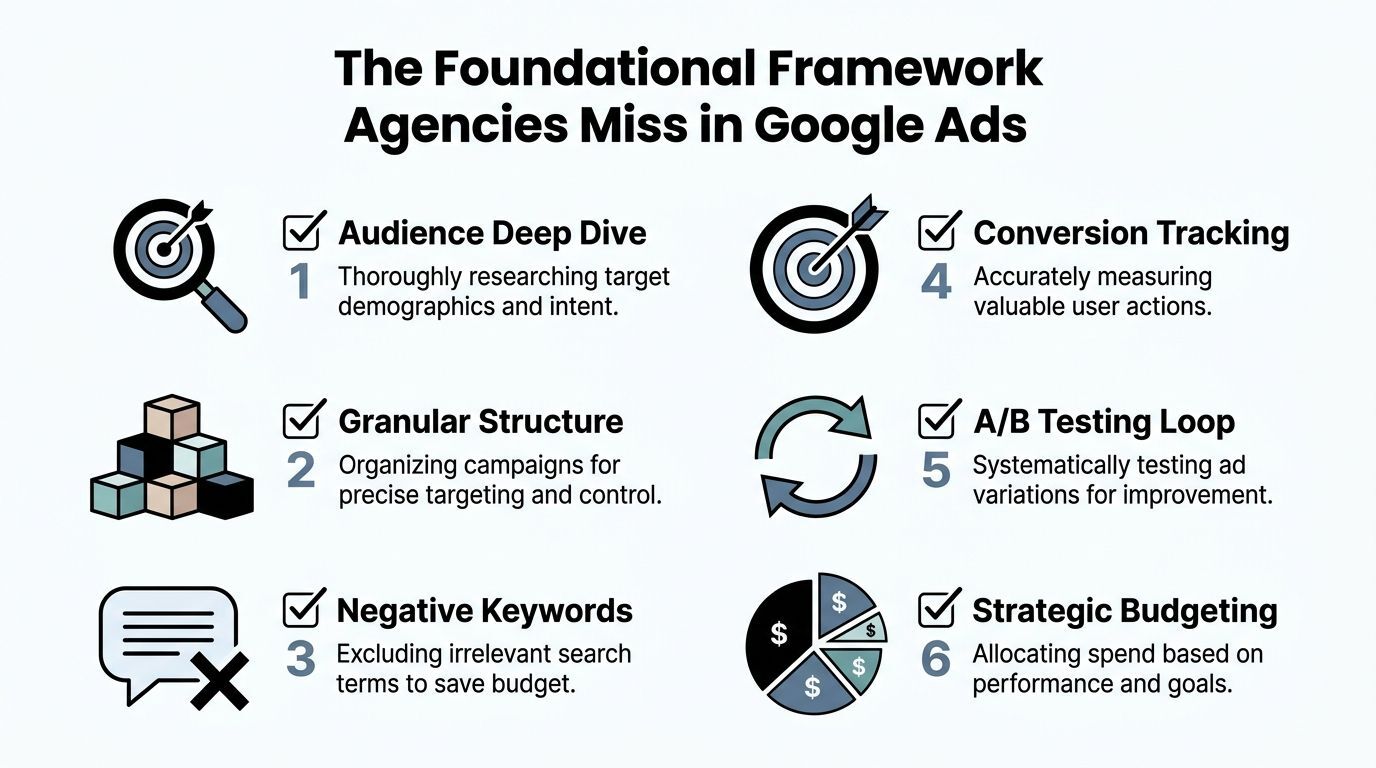
A common agency failure is structural. Agencies often chase surface metrics instead of auditing for hidden waste in search terms, segmentation, and location targeting, which is especially damaging in larger-spend accounts, as discussed in this agency account audit breakdown. That’s not a minor flaw. It’s the reason many accounts never become efficient.
Start with a real intake, not a kickoff call
A serious account setup begins before a single campaign goes live.
I want access to the ad account history, CRM stages, sales feedback, call outcomes, geo priorities, margin by service line, and the difference between a lead that looks good and a lead that closes. If an agency doesn’t ask those questions, they’re not building a growth system. They’re buying traffic.
For revenue leaders trying to clean up a fragmented stack before PPC gets judged unfairly, this martech guide for revenue leaders is useful context. Google Ads performance is often limited by what your systems can’t pass back cleanly.
The six checks I use before I trust any account
Some audits can be done in an hour. The good ones can’t.
Campaign intent alignment Branded, non-branded, competitor, remarketing, and local service intent should not live in a vague pile. Each serves a different job and needs different expectations.
Location integrity Multi-location businesses get wrecked here. If one campaign targets several cities or practice areas without local customization, relevance drops and spend leaks.
Search terms discipline In this discipline, hidden waste resides. Search term reports tell you what the platform matched, not what you hoped it matched.
Negative keyword depth Most accounts have a negative list. Very few have a hardened one. Those are not the same thing.
Conversion definition quality If the account is optimizing to junk actions, the machine will buy more junk actions.
Naming and management clarity If a CMO can’t understand campaign purpose at a glance, the structure is already working against you.
Practical rule: If your search terms report makes you uncomfortable, that's good. It means you're finally looking where the waste is.
The account structure mistake that keeps repeating
Healthcare groups, DSOs, legal firms, and home services brands all make the same structural mistake. They centralize too aggressively.
That sounds efficient on paper. In Google Ads, it often kills relevance. One broad regional campaign can't speak clearly to multiple locations, multiple services, and multiple patient or client intents at the same time.
A cleaner approach usually looks like this:
Account area |
Bad setup |
Better setup |
|---|---|---|
Geography |
One regional campaign |
Separate campaigns or clear segmentation by location |
Services |
Mixed services in one ad group cluster |
Dedicated campaigns or ad groups by service intent |
Lead quality |
Same target for all leads |
Separate tracking and valuation by lead type |
Search terms |
Occasional cleanup |
Scheduled review with clear exclusion rules |
If you need a stronger reference point for campaign hierarchy, this guide to Google Ads account structure is worth reviewing.
What to fix first when the account is messy
Don’t rebuild everything at once. That’s how people lose historical signal and create chaos.
Fix the pieces that most directly affect wasted spend first:
Tighten targeting: Remove broad geography settings that pull irrelevant traffic.
Break apart mixed intent: Separate campaigns that serve different user motives.
Review actual queries: Pull search terms and flag patterns, not just one-off bad matches.
Rebuild negatives: Add exclusions at the right level so they don't block useful intent elsewhere.
Pressure-test tracking: Make sure the conversions you're feeding Google are worth scaling.
This is the unglamorous work agencies skip because it’s hard to present on a slide. It’s also the work that usually produces the fastest improvement.
Building Campaigns Designed For Profit Not Just Clicks
A profitable account has a shape to it. You can see it in the campaign names, the segmentation, the bidding logic, and the search term flow. A weak account looks random. A strong account looks intentional.
That’s the standard I use when I audit google adwords for agencies. If I can’t tell what the account is trying to do by looking at the structure, I already know management has been reactive.
Naming conventions are not admin work
Most agencies treat naming conventions like housekeeping. That’s amateur thinking.
Naming conventions control decision speed. If a campaign name tells you network, geography, intent, service, and match type at a glance, you can diagnose performance faster and hand off cleaner insights to leadership. If every campaign is called something vague or auto-generated, you waste time deciphering your own account.
A naming system should make these questions obvious:
What market is this campaign serving?
Is this prospecting, branded defense, or remarketing?
What service line or offer is being promoted?
What match type strategy is active?
Is the campaign built for lead generation, sales, or another conversion class?
Segment by intent first, then by control need
Agencies often over-segment where it doesn’t matter and under-segment where it does. They’ll create cluttered ad group trees while blending completely different user motives into the same campaign.
That’s backward.
I prefer segmentation in this order:
Business objective New customer acquisition should not be mixed with brand protection.
Commercial intent High-intent service searches belong in a different control environment than exploratory searches.
Geography or branch logic If local relevance changes the offer, the campaign should reflect that.
Match type management Here, modern structure starts to outperform outdated “exact only” thinking.
Broad match is not the enemy. Lazy management is.
A lot of agencies still act like broad match is reckless by default. That advice is old.
Modern strategy often works better when you launch dedicated Broad Match campaigns to capture expanded query intent, then use Phrase Match variants as negatives to filter junk and isolate useful themes. When that’s paired with match-type segmentation, agencies have reported a 10% to 15% uplift in discovering new converting keyword themes, according to this modern Google Ads match type strategy analysis.
That doesn’t mean you dump broad match into a live account and hope for the best. It means you control it.
Broad match works when the account has strong negatives, clean conversion signals, and enough discipline to learn from search term data quickly.
Here’s the practical setup I like:
Broad campaigns for discovery: Let Google expand into adjacent intent and surface patterns you would have missed.
Phrase negatives to filter overlap: Stop broad campaigns from cannibalizing cleaner traffic.
Exact campaigns for control: Protect proven terms that justify more precision and budget confidence.
That mix gives you reach without giving up standards.
Bidding strategy should match data quality
Too many agencies choose bidding models because the interface suggests them. That’s not strategy.
If the account has weak tracking, poor CRM feedback, or mixed-quality conversions, aggressive automation can amplify mistakes. If the account has strong conversion definitions and enough clean signal, automated bidding can save time and improve efficiency.
Use automation when the account deserves it. Hold tighter control when it doesn’t.
A simple decision filter helps:
Situation |
Smarter move |
|---|---|
Weak or noisy conversion tracking |
Fix inputs before trusting automated bidding |
Clear lead quality and stable signal |
Test automated bidding with strict monitoring |
Mixed lead values across services |
Segment campaigns before setting one bid target |
New discovery campaigns |
Give them room to learn, but protect them with negatives |
This walkthrough is a useful visual primer on campaign strategy and setup:
The campaign build I trust most
I don’t trust auto-applied recommendations to shape account architecture. I trust disciplined structure.
That means every campaign answers a narrow question. Every ad group has a real semantic purpose. Every landing page has message alignment. Every search term review feeds back into exclusions, expansion, or segmentation.
That’s how campaigns become profit systems instead of click machines.
The Advanced Automation and Data Plays Agencies Fear
Most agencies talk about automation like it’s a switch. Turn on Smart Bidding. Add recommendations. Let the platform work. That’s not advanced management. That’s delegation.
A key edge comes from feeding Google better data than your competitors do, then using automation inside a controlled system. That's where performance starts to separate.

Automation is only as good as the input signal
If the platform can’t distinguish a qualified consultation from a junk form fill, it will optimize toward volume. You’ll think automation is helping because conversions go up. Then sales complains. They’re usually right.
This is why I push hard on server-side tracking and CRM feedback loops. Agencies that build a unified data layer with server-side Google Tag Manager and connect first-party CRM data have seen an average 14% observed conversion uplift, according to Google’s measurement and ROI data strategy guidance. Better input produces better optimization. That’s the whole game.
What the better setup actually looks like
Forget the buzzwords for a minute. Here’s the practical version.
Your ad account should know more than whether a form was submitted. It should know which leads progressed, which sales were closed, which calls were qualified, and which locations or service lines produce stronger downstream value.
That requires a tighter measurement stack:
Server-side GTM: Cleaner event handling and stronger data control.
CRM connection: So closed-loop outcomes can shape bidding decisions.
GA4 and first-party data alignment: Useful for identifying drop-off patterns and validating lead quality.
Ads Data Hub or warehouse logic: For larger accounts that need privacy-safe joins and deeper reporting.
The agency that says “Google’s AI will figure it out” usually hasn’t done the hard work required to make AI useful.
Scripts and automation should remove grunt work
I like automation for repetitive tasks. I don’t like it making strategic decisions in a blind account.
Use scripts and automated rules to handle things like anomaly checks, pacing alerts, disapproval monitoring, and repetitive reporting pulls. Keep humans responsible for offer strategy, segmentation decisions, landing page relevance, and conversion quality.
That division matters. The machine is fast. It is not accountable.
Pricing and market pressure belong in the data conversation
Many CMOs separate PPC data from pricing intelligence. That’s a mistake.
If your competitors shift offers, bundle differently, or reposition at the category level, your paid search performance changes even when campaign settings don’t. For teams that need a wider commercial lens, these Market Edge pricing insights help frame how pricing pressure affects demand capture and conversion quality.
Google Ads doesn’t operate in a vacuum. Your data strategy shouldn’t either.
Where specialist management beats agency process
An independent consultant can often move faster here because there’s less internal friction. No waiting for analytics, strategy, and account teams to agree on ownership. No handoff gap between CRM insight and bidding action.
That’s one reason I prefer specialist-led management for high-spend accounts. For example, Come Together Media’s automated bidding resource covers practical bidding considerations in a way that aligns with hands-on management rather than generic agency process.
A good automation setup should produce three outcomes:
Outcome |
What it means in practice |
|---|---|
Cleaner attribution |
You can trust what the platform is optimizing toward |
Faster decision cycles |
Waste gets caught earlier and scaling decisions happen with less guesswork |
Better lead economics |
Bidding improves because the account learns from actual business outcomes |
If your agency fears this level of integration, it’s usually because it exposes how weak the current measurement model is. Good. That weakness should be exposed.
Reporting That Speaks to the CFO Not Just the Intern
If your monthly PPC report starts with impressions, clicks, and CTR, you're looking at a comfort document.
Those metrics can be useful diagnostics. They are not the scorecard. A CMO trying to scale a service business does not need prettier charts. They need to know whether spend is creating profitable growth.
Stop reporting activity and start reporting economics
Top-tier consultants add value by measuring like a CFO, with MER, NCAC, LTV, and contribution margin instead of just lead volume or ROAS, especially in service businesses where customer value differs sharply by case type, treatment, or engagement quality, as argued in this profitability-focused Google Ads analysis.
That shift changes the entire conversation.
A legal lead is not a legal client. A booked consult is not a completed treatment plan. A form fill from the wrong geography or wrong income tier is not growth. If your reporting doesn’t separate those outcomes, your optimization logic is weak from the start.
The four numbers leadership actually needs
I don’t need a thirty-page report to judge account health. I need four business answers.
MER
Marketing Efficiency Ratio tells leadership how total revenue compares to total marketing spend. It forces channel managers to stop isolating themselves from broader business performance.
NCAC
New Customer Acquisition Cost matters more than blended lead cost when the company is trying to grow. If acquisition cost is rising while customer quality is falling, the account is not scaling well even if conversion volume looks healthy.
LTV
Lifetime Value keeps you from underbidding on high-value services and overbidding on low-value ones. Regarding this, most service businesses get PPC wrong. They treat every lead as equal because their agency reports every lead as equal.
Contribution margin
This is the number that makes the room quiet. Revenue without margin context can hide bad decisions. Contribution margin shows whether growth is worth pursuing.
A PPC report should help you decide whether to scale, cut, segment, or fix. If it only explains what happened, it’s late and incomplete.
Build reports around decision points
I prefer reports that answer operational questions, not just summarize platform output.
Use a structure like this:
What produced qualified demand
What produced low-quality demand
Which campaigns deserve more budget
Which campaigns need tighter control or segmentation
What changed in lead-to-sale quality
What the business should do next
That format forces accountability.
For operators in multi-unit or location-based businesses, tools that help estimate your franchise profitability can be useful as a planning layer. The principle is the same. Ad metrics only matter when they connect to economic reality.
One practical dashboard change to make now
Take “Conversions” out of the first row unless you’ve verified that all conversions represent meaningful business value.
Replace it with a simple table:
Report line |
What it should show |
|---|---|
Qualified leads |
Leads that passed an actual quality threshold |
Sales accepted leads |
Leads that the sales team would want more of |
New customer cost |
Spend divided by true new customer volume |
Revenue quality notes |
Short context on service mix, geography, or lead quality changes |
If you want a cleaner reporting model, this better PPC report format is a strong benchmark.
Most agencies keep reporting soft metrics because hard metrics expose weak management. That’s the part clients need to understand.
Choosing a Partnership Model That Aligns with Your Growth
Pricing models shape behavior. If you choose the wrong one, you can end up rewarding the exact habits you want your PPC partner to avoid.
That’s why I don’t treat management fees as a procurement exercise. I treat them as an incentive design problem.
The common models and what they encourage
Here’s the blunt version.
Model |
What it encourages |
Where it goes wrong |
|---|---|---|
Percentage of spend |
Budget growth |
Manager gets paid more when spend rises, even if efficiency doesn’t |
Flat retainer |
Stability and predictable scope |
Can become passive if scope is vague and accountability is weak |
Hourly or project-based |
Focused execution |
Can work well for audits and rebuilds, less ideal for ongoing performance ownership |
Performance-based |
Outcome orientation |
Often gets messy when attribution, lead quality, or sales follow-up are inconsistent |
No model is perfect on its own. What matters is whether the incentives match your business goals.
Why percentage-of-spend is often a bad fit
This model is common because it’s easy to explain. It’s also often misaligned.
If your manager earns more by spending more, they need unusual discipline to recommend budget restraint. Some have that discipline. Many don’t. The conflict is built into the model.
That doesn’t mean percentage-based pricing always fails. It means you should ask harder questions:
What happens if efficiency drops while spend rises?
Who defines success?
Is compensation tied to account complexity or just media volume?
Does the fee structure reward waste tolerance?
What I’d recommend for most high-spend advertisers
For brands spending serious money, I prefer one of two setups.
A flat retainer with clear performance expectations works well when the account needs strategic ownership, ongoing testing, and fast execution. It removes the incentive to inflate spend and keeps the relationship centered on results.
A hybrid model can also work. For example, a base fee for management plus a tightly defined performance component tied to qualified outcomes, not just front-end lead volume.
If your PPC partner can't explain how they're incentivized, assume the incentives favor them, not you.
What to ask before you sign
Don’t ask only what the fee is. Ask what the fee makes likely.
A good partnership conversation should cover:
Direct access: Will you talk to the strategist or an account relay?
Change velocity: How quickly can campaigns, budgets, and tracking be adjusted?
Scope clarity: What’s included in management, and what triggers extra fees?
Measurement ownership: Who is responsible for tracking quality and CRM feedback?
Decision transparency: Will recommendations be explained in business terms or platform jargon?
In these situations, specialist consultants usually beat large agencies. Fewer layers. Cleaner accountability. Faster execution. Better alignment.
If you’re frustrated with agency sprawl, don’t just switch vendors. Switch models.
Conclusion The Specialist Advantage
Google Ads doesn’t reward size. It rewards precision.
The accounts that perform best usually aren’t managed by the biggest team. They’re managed by the clearest thinker. Someone who audits structure instead of decorating reports. Someone who uses automation with discipline, not as a substitute for strategy. Someone who reports on profit, not just platform activity.
That’s the answer to google adwords for agencies in 2026. The old agency model is too bloated, too slow, and too comfortable hiding behind vanity metrics. High-spend accounts need tighter structure, stronger data, cleaner incentives, and direct accountability.
If your current agency can’t deliver that, stop waiting for them to become something they’re not. Get a specialist who already works that way.
If you want a direct, specialist-led review of your Google Ads account, Come Together Media LLC offers Google Ads consulting and PPC management with an emphasis on audits, transparent reporting, and hands-on optimization. That’s the right fit for businesses that want clear strategy, direct communication, and accountability tied to business outcomes instead of agency theater.