


Pay per click packages are often sold like off-the-rack suits. But when you're spending $25,000 or more a month on ads, a generic, one-size-fits-all approach isn't just a bad fit—it's a fundamentally broken model that stifles growth. You're not buying a commodity; you're investing in a strategic revenue driver. A pre-canned package simply cannot deliver the custom-tailored results your business demands.
The problem isn't your ad spend. It's the agency structure you're paying for.
Why Your Current Pay Per Click Package Is Broken

Let’s be direct. You're pouring significant capital into paid media, but your return on ad spend (ROAS) is flat, and you’re frustrated with impersonal service, boilerplate reports, and the nagging feeling your account is just running on autopilot.
You're right to feel that way.
The traditional agency model is built for volume, not value. Most pay per click packages are designed around an assembly-line framework that prioritizes the agency's efficiency far above your profitability. For a business operating at your level, this system is flawed by design.
The Agency Assembly Line
Big agencies hand your account to a junior manager who is simultaneously juggling 15, 20, or even more clients. Their primary job isn't to drive breakthrough growth for you; it's to keep you from canceling your contract. This structure inevitably leads to predictable failures:
No Deep Strategy: Your campaigns are managed with surface-level tactics—minor bid tweaks and recycled ad copy. There's no real strategy rooted in your business's unique unit economics or customer lifetime value.
Glacial Execution: Simple changes get stuck in endless layers of communication. A critical insight you share today can take weeks to implement as it travels from account executive to project manager and finally to the junior person actually clicking the buttons.
Zero Real Partnership: You talk to an account manager, not the actual strategist. The person with the real expertise is walled off, killing the direct, nimble collaboration required to jump on market opportunities.
Actionable Takeaway: Pull up your last three monthly PPC reports. Do they just dump clicks and impressions on you? Or do they tell a clear story connecting those metrics to your actual revenue and profit goals? A true partner explains the why behind the numbers, not just the what.
A dedicated PPC consultant operates on a completely different model. There are no layers. You work directly with me—the single expert accountable for your strategy, execution, and results. This direct line smashes bottlenecks and ensures every decision is made with an intimate understanding of your business objectives.
I’ve seen it time and again: a company moves from a bloated, high-overhead agency to a focused specialist and sees dramatically better outcomes, often for a more efficient fee. It’s time to stop paying for an agency’s ping-pong table and start investing in pure expertise.
If you're serious about performance, you need a partner, not another vendor. The first step is to get a clear picture of where the gaps are. Learn exactly what to look for with this comprehensive PPC audit checklist.
Anatomy Of A High-Value PPC Engagement
Let's cut through the noise you see in most pay per click packages. Vague promises of "optimization" and templated "monthly reports" are dead giveaways of an agency just going through the motions. When you're putting serious money on the table, you need a partner focused on actions that drive revenue, not just reports that show activity.
A real PPC engagement is a system, not a simple checklist. Each piece is built to connect your ad spend directly to your bottom line.
The Foundation: A Forensic Account Audit
A top-tier engagement never kicks off with, "So, what's your budget?" It starts with a deep, forensic-level audit of your account. This isn't a 15-minute skim; it’s a full dive into every campaign to see what's working, what's broken, and where the real opportunities are hiding.
This audit puts critical elements under the microscope:
Campaign Structure & Settings: Is your account a logical, scalable machine, or a tangled mess of old campaigns bleeding cash?
Keyword & Negative Keyword Lists: Are you bidding on terms that actually make you money, or are you just funding irrelevant searches and clicks from competitors?
Quality Score Components: We dissect your click-through rate (CTR), ad relevance, and landing page experience. These are the root causes of a poor Quality Score—a Google metric that directly impacts how much you pay per click.
This process instantly flags wasted spend and gives us the hard data needed for a strategy that fixes core problems, rather than just slapping on a bandage.
From Audit To Actionable Strategy
The audit findings become the bedrock of a custom strategy—one built around your specific business goals and unit economics. This is where a specialist’s approach demolishes the agency model. I don't pull a strategy off the shelf; I build one from your numbers.
A truly high-value PPC engagement is defined not just by clicks, but by tangible business growth. Understanding how to gauge this requires robust data analysis and a clear framework for measuring marketing campaign effectiveness, ensuring every dollar spent contributes to your bottom line.
A real strategy answers the tough questions upfront: What is a lead actually worth to your business? What ROAS (Return on Ad Spend) do we need to hit for this channel to be profitable? How will PPC efforts support your other marketing channels? Getting these answers right aligns the entire engagement with your financial reality from day one.
Relentless Execution And Transparent Reporting
With a solid strategy in hand, the focus shifts to meticulous, day-to-day execution. This isn't a "set and forget" operation; it's a constant cycle of building, testing, and refining.
Meticulous Campaign Builds: I structure campaigns logically by theme and intent. This gives us precise control over budgets and lets us match our message perfectly to the searcher.
Relentless A/B Testing: We are always testing ad copy, headlines, calls to action, and ad extensions (additional info in your ads like site links or phone numbers) to discover what truly moves your audience to act.
Sophisticated Bid Management: I don't rely on default settings. I actively manage bidding strategies to adapt to competitor moves, market shifts, and performance data, squeezing maximum value from every dollar.
Transparent Reporting: My reports aren't just data dumps. They're quick, actionable summaries that tell you what happened, what we tested, what we learned, and what the plan is for the next sprint.
This hands-on management is what separates winners from losers in a crowded market. With global PPC spending hitting $211.2 billion in 2026 and a staggering 72% of businesses not even checking their campaigns monthly, there's a huge opportunity for those willing to do the work.
A high-value engagement is a genuine partnership. If you're curious about the day-to-day work that goes into this process, check out our guide on how to manage PPC campaigns like a true expert.
Decoding PPC Management Pricing Models
Let’s pull back the curtain on how PPC management is priced. When you're looking at different pay per click packages, you need to know exactly what your money is buying. It's not just about the monthly fee; it’s about the value, expertise, and focused attention that fee secures for your business.
Most providers, especially big agencies, stick to one of a few core pricing models. Understanding how each one works is the first step in figuring out if you're getting a fair deal or just paying for an agency's overhead.
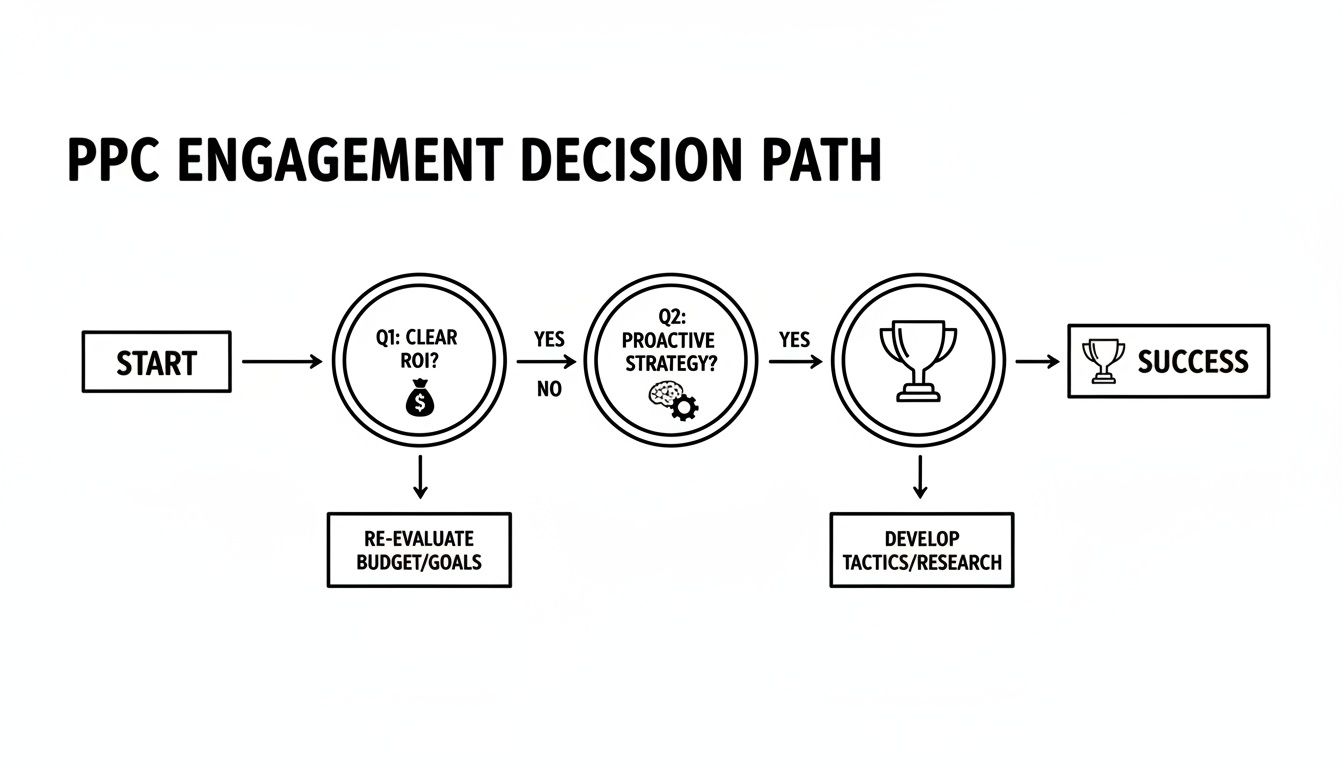
The real takeaway here is that success isn't about outspending the competition. It's about having a clear, strategic plan that directly ties every dollar you spend back to a measurable financial return.
The Percentage of Ad Spend Model
This is the most common model you'll run into, especially with larger agencies. The idea is simple: you pay them a percentage of what you spend on ads, usually between 10% to 20%.
The Supposed Pro: It scales with your budget. They'll tell you that as you spend more, their fee grows, which incentivizes them to grow your account.
The Glaring Con: This model creates a direct incentive to spend more, not to spend smarter. An agency can boost its own revenue by just telling you to increase your budget, even if that extra spend is inefficient and tanks your ROAS (Return on Ad Spend).
An agency focused on a percentage of spend might push for a $40,000 budget because it nets them a higher fee. A true specialist will tell you to start at $25,000, prove profitability, and scale intelligently from there.
My goal is to make every dollar work harder for you, not just to spend more of your dollars. This model almost always benefits the agency far more than the client.
The Flat-Fee Retainer Model
This is the structure I use and the one you’ll find most independent consultants and smaller, specialized shops using. You pay a fixed monthly fee for management, and it doesn't change based on your ad spend. The fee is set based on account complexity, scope of work, and the expertise needed.
The Pro: Our incentives are perfectly aligned. My only goal is to deliver the absolute best results possible within your budget, because my fee is tied to your satisfaction and retention—not how much you spend. This model rewards efficiency and strategic thinking.
The Con: The fee is fixed. If your account suddenly needs a massive increase in management complexity, we might need to discuss adjusting the scope. But this is rare and is always a conversation, not a surprise bill.
This model builds a real partnership. You get predictable costs, and I'm motivated to maximize your profit, not my commission. You're paying for my brain and experience, not just for someone to babysit a media budget.
Comparing PPC Management Models: Agency Vs. Specialist
To make it even clearer, here's a breakdown of how these different pricing structures typically play out when you're choosing between a large agency and a dedicated specialist.
Model Type |
Typical Agency Structure |
Dedicated Specialist Approach |
Best For |
|---|---|---|---|
Percentage of Spend |
15-20% of ad spend. Incentivizes higher budgets, not better results. Often managed by junior staff. |
Rarely used. I focus on efficiency, not just spending more of your money for my own gain. |
Large, slow-moving enterprises where budget is less of a concern than ticking a box. |
Flat-Fee Retainer |
Tiered packages with rigid deliverables. Less flexibility and often still pushes for upsells to higher tiers. |
A transparent, fixed fee based on the actual work and complexity. Incentives are aligned for performance and client retention. |
Businesses that want a true strategic partner focused on maximizing ROI and efficiency. |
Performance-Based |
Complex contracts with murky KPIs that can be easily manipulated. Often includes a base fee anyway. |
Can work for lead gen, but requires crystal-clear goals. My focus is on shared success, not just hitting a vanity metric. |
Niche situations with very simple, trackable conversion goals (e.g., form fills). Risky for e-commerce. |
The right model depends on your goals, but for most businesses serious about growth, the flat-fee structure with a specialist offers the most transparent and results-driven partnership.
Hybrid and Performance-Based Models
These models try to find a middle ground, often mixing a lower flat fee with a performance bonus tied to a specific KPI, like a target CPA (Cost Per Acquisition) or ROAS. In theory, they sound great—you only pay more when you get better results.
The reality? They can be a nightmare to structure fairly. What happens if market conditions shift? What if a new competitor drives up your click costs? It can easily lead to arguments and a misaligned focus on hitting short-term metrics that don't actually serve your long-term growth.
While they seem appealing on the surface, they often add a layer of complexity that a straightforward flat-fee partnership avoids entirely. For a deeper look at these structures and how to pick the right one, you might find our guide on decoding PPC management pricing for real results helpful.
Your ultimate goal should be to find a model that makes your PPC manager feel like a true extension of your team, not just another vendor on the payroll.
Red Flags Your PPC Partner Is Underperforming
It’s dangerously easy to get stuck in a bad PPC relationship. You're busy running your business, and you assume the invoice you pay for "management" means someone is diligently working behind the scenes. But that assumption can kill your growth.
You have to know the warning signs. When an agency is coasting, the red flags are never subtle—you just need to know where to look before their neglect does real damage to your bottom line.
The Revolving Door Of Account Managers
One month it’s Sarah, the next it's Tom. If your point of contact changes every few months, you don't have a partner. You're just a number in a high-turnover agency's queue.
Every time a new person takes over, your account's momentum resets to zero. You waste your time re-explaining your goals, your market, and what’s been tried before. Real growth requires a consistent, expert hand on the wheel—not a carousel of junior-level replacements. With me, you work with me. Period.
Reports Are Data Dumps, Not Strategic Insights
Does your monthly report look like someone just exported a few dashboards from the Google Ads interface? A PDF packed with charts showing clicks and impressions is a classic sign of autopilot management. It’s designed to look impressive while saying absolutely nothing.
A true partner’s report tells a story. It should clearly articulate: "We tested X against Y, which led to a 15% decrease in Cost Per Acquisition for this campaign. Based on this, our next step is to scale the winning ad copy into these two ad groups."
If your reports don't connect actions to outcomes and lay out a clear plan for the next 30 days, you're paying for reporting software, not strategy.
Your "Strategist" Can't Answer Deep Questions
Try this on your next call: ask your point of contact to explain the specific bidding strategy they're using and why it's a better fit than Target CPA or Maximize Conversion Value. Or ask them to walk you through their approach to attribution beyond a simple last-click model.
If you get a vague, jargon-filled non-answer, you’ve hit a massive red flag. It’s a dead giveaway that the person managing your account either lacks deep platform knowledge or isn't actually empowered to make strategic decisions. A true expert can go deep on the "why" behind every choice.
Resistance To Testing And New Ideas
The mark of a top-tier PPC manager is a relentless curiosity. I’m always asking "what if?" and pushing to test new campaigns, ad creative, landing pages, and audiences. A complacent agency, however, hates testing. It creates more work and introduces variables that might disrupt their comfortable, set-it-and-forget-it workflow.
If your ideas are met with friction or excuses, your partner is prioritizing their own operational ease over your growth. In PPC, standing still is the same as moving backward.
Actionable Takeaway: Challenge your current agency. Propose a small, controlled experiment—a new landing page, a different offer, or a new audience segment. Their reaction will tell you everything you need to know about their priorities.
The Specialist Advantage: Why I Outperform The Agency Model
You’ve seen the red flags and you know the pricing games agencies play. The alternative is clear. For any business serious about growth, choosing a true specialist over a big agency isn’t just a preference—it’s a strategic move with massive financial consequences.
The logic is simple. As an independent, senior-level consultant, I will almost always outperform a large agency bogged down by overhead and staffed with junior talent. This isn't a theory; it's a structural reality I've seen play out time and time again. It all boils down to direct accountability and pure, undiluted expertise.
Direct Access To The Strategist
When you hire a typical agency, you talk to an account manager. That person then relays your message to a project manager, who eventually briefs a junior employee to actually do the work. It’s a classic game of telephone, and it’s where your strategy goes to die.
Nuance gets lost. Urgency fades. Your account ends up in the hands of the least experienced person in the room.
Working with me cuts out every single middleman. You have a direct line to the person running your campaigns. The strategist, the analyst, and the executor are all the same expert: me.
Faster Decisions: We can jump on a call to discuss a market shift in the morning and have a new campaign live by the afternoon. No tickets, no project managers.
Deeper Insights: I’m in your account daily, living with the data. When you have a tough question about bidding, attribution, or performance, you get an immediate, informed answer—not a "let me circle back."
This direct access is the single biggest driver of agility and performance. It turns PPC management from a slow, bureaucratic process into a nimble, proactive partnership.
You're not just buying a set of deliverables from a menu of pay per click packages. You're securing a strategic partner who is just as obsessed with your bottom line as you are.
The pay-per-click world is a far cry from what it used to be. Back in 2005, you could get a click for an average of $0.38. Today, with the global average CPC sitting at $4.22—and skyrocketing in competitive niches like legal, where it can be $6.75 or more—every single click has to count. Getting into those top ad positions where click-through rates soar requires the kind of senior-level skill that most agencies keep locked away.
Superior Cost Efficiency And ROI
Let's be blunt about where your money goes when you hire a big agency. A massive slice of your fee pays for their fancy office, sales team commissions, administrative bloat, and multiple layers of management who never touch your account.
The actual portion that pays for an expert to work on your campaigns? It’s shockingly small.
When you work with a specialist, you cut out all that waste. Your money pays for one thing and one thing only: expertise.
This efficiency brings two major benefits:
More Value For Your Fee: A much larger percentage of your investment goes directly into strategic work that actually improves your results.
Better ROI: Because a seasoned expert is doing the work, the strategy is smarter, the execution is cleaner, and the ultimate return on your ad spend is significantly higher.
This isn't about finding the cheapest option. It’s about making the most intelligent investment in your growth. If you're ready to see what a true partnership looks like, our guide on the differences between in-house vs agency marketing highlights why a specialist wins.
A Mini-Case Study In Agility
I once took over an e-commerce account spending $50,000/month with a large, well-known agency. One morning, I saw news that their key competitor had a major supply chain breakdown. This created a massive—but very temporary—vacuum in the market.
I spotted the opportunity and the corresponding spike in search trends immediately. Within three hours, we had a call, agreed on a new strategy, reallocated the budget, and launched an aggressive campaign targeting keywords their competitor had owned for years.
The result? Over the next two weeks, they captured a 300% increase in market share for that product line, all while acquiring hundreds of new customers at a 50% lower Cost Per Acquisition.
An agency would have spent those two weeks just trying to get the right people into a meeting. That’s the specialist advantage in action.
Your Next Step Toward A Smarter PPC Strategy

Think of this guide as a diagnosis. If you’ve seen your own frustrations in the red flags and broken models we’ve covered, you already know the truth: your current PPC approach isn't working. The fix isn't a slightly cheaper package or a different agency with the same old playbook. It’s a fundamental shift in strategy.
The choice is clear. You can stick with generic pay per click packages that treat your business like an assembly-line product, or you can build a true strategic partnership. One is a commodity. The other is a competitive advantage that grows your bottom line.
Gain Clarity And Control
I invite you to book a free, no-strings-attached PPC account review. This isn't a high-pressure sales pitch. It’s the first step to finally getting the clarity and control over your ad spend you’ve been missing.
This is a one-on-one session where you and I—the actual expert—will dig into your account. We'll get an honest look at your current campaign structure, real performance, and where your money is being wasted. For an extra edge, we can even discuss leveraging an AI ad creative generator to speed up testing and find winning ads faster.
This audit is your chance to get immediate, actionable insights straight from a specialist. You’ll leave our call with a clear picture of your account's biggest opportunities and a handful of things you can do right now to stop bleeding cash.
My goal is to provide real value upfront. It’s the same direct accountability and expert attention you get when we work together, but it’s yours at no cost.
You've seen the pitfalls of the standard agency model. You know the difference between paying for a fancy office and investing in expertise. The next logical move is to see what a focused, specialist-led approach can do for your numbers.
Schedule your free account review today. It’s time to stop settling for mediocre and start building a smarter, more profitable PPC strategy.
Frequently Asked Questions About PPC Packages
When you're evaluating a PPC partner, you don't need to hear another textbook definition. You're past that. You need to know if they have what it takes to actually move the needle.
Let's cut through the usual agency song-and-dance and get straight to the questions that really matter—the ones I hear from smart founders and CMOs who are tired of mediocre results.
What Is a Realistic ROI From a Good PPC Package?
Anyone who gives you a flat ROI number without knowing your business is selling snake oil. A realistic Return on Ad Spend (ROAS) is completely tied to your industry, profit margins, and sales cycle.
A common agency benchmark is a 4:1 ROAS—$4 back for every $1 spent. Frankly, that's table stakes. For e-commerce brands, a 10:1 ROAS is often an achievable goal. For lead generation, the conversation shifts to Cost Per Acquisition (CPA) and, more critically, the quality of those leads and how many actually turn into customers.
A true expert doesn’t just throw out a generic ROI target. We work backward from your specific profit margins and customer lifetime value (LTV). We build custom targets that actually mean something to your bottom line. If a potential partner can’t have this conversation with you, they aren't building a real strategy.
How Much Should I Pay for High-Quality PPC Management?
When you're spending $25,000+ per month on ads, you'll typically see two pricing models. The first is a percentage of ad spend, usually 10-15%. Agencies love this model because it incentivizes them to spend more of your money, not necessarily to make you more money.
The second is a flat monthly retainer, which is what most senior consultants, including myself, prefer. These typically range from $2,500 to $7,500+. This model aligns our goals perfectly. My job is to maximize your profit, not inflate your ad budget to get a bigger fee.
It's about value, not cost. A $5,000/month specialist who adds $50,000 to your net profit is a far smarter investment than a $2,000/month agency that just keeps the lights on. You're paying for expertise that drives growth, not for an agency's ping-pong table.
How Quickly Can I See Results After Switching to a Consultant?
While transformative, business-level results usually take 60-90 days to fully mature, you will feel the impact of a real expert immediately. A dedicated consultant moves with urgency from day one.
Here’s what that looks like in practice:
First 30 Days: We start with a forensic audit to find and plug every source of wasted spend. I launch initial "quick win" campaigns to start generating momentum. You'll see immediate lifts in core health metrics like Click-Through Rate (CTR) and Quality Score.
First 60 Days: The new, custom-built campaigns are now live and gathering data. This is where you'll start to see a real, tangible drop in your Cost Per Acquisition (CPA) as the strategy finds its footing.
First 90 Days: The strategy hits its stride. We now have enough clean performance data to make aggressive, intelligent optimizations. This is when you see a significant and, more importantly, sustainable jump in conversion volume and ROAS.
If you're done with boilerplate answers and ready for a PPC partnership built on transparency and actual results, it’s time for a different kind of conversation.
At Come Together Media LLC, we skip the fluff and get right to building a strategy that drives your bottom line.
Book Your Free, No-Commitment Account Review Today
