


You're not looking for another polished agency pitch. You're looking at a paid media line item that's already large, already important, and still not producing the clarity it should.
If you're spending five figures a month on PPC, you should know exactly who's making changes in Google Ads, why budget is moving between campaigns, what's happening to ROAS (return on ad spend), and where your CAC (customer acquisition cost) is rising. Too many businesses don't. They get a monthly slide deck, a friendly account manager, and a vague sense that the machine is running. That's not management. That's distance.
I've audited enough agency accounts to know the pattern. The sales team closes the account. The strategist appears early. Then the day-to-day work gets pushed down the ladder. You end up speaking to someone competent enough to manage the relationship, but not always the person doing the hard thinking inside the account. That gap is where wasted spend lives.
The bigger issue is measurement. A lot of CMOs say they want leads, pipeline, and revenue, but they're still reviewing PPC through soft reporting. If your paid search is supposed to support demand generation, you also need a clean way to measure brand awareness for B2B alongside direct response metrics. Otherwise, upper-funnel spend and lower-funnel performance get blended into one fuzzy story, and nobody can tell what is working.
Before you change partners, run your account through a real PPC audit checklist. It will tell you more than your last three review calls combined.
You're Spending Five Figures a Month on Ads Are You Getting Your Money's Worth
Most businesses don't leave agencies because of one catastrophic mistake. They leave because the account slowly becomes generic.
The ad copy starts to look safe. Search terms go unchecked longer than they should. Conversion tracking gets messy after a website update. Performance Max runs with weak asset discipline. Budget shifts happen late. Nobody owns the ugly details, and the ugly details are where PPC accounts either print profit or bleed cash.
What frustration usually looks like
You probably know the signs:
Reporting sounds polished but thin. You get dashboards, but not sharp answers on why CAC climbed or why branded traffic is carrying the account.
Communication is buffered. You're talking to a point person, not the operator inside Google Ads Editor making decisions.
Testing is slower than market changes. Competitors launch offers, CPCs move, landing pages break, and your team hears about it after the damage.
Strategy gets diluted. The account serves the agency process instead of the business goal.
That's why the ppc agency vs freelance consultant decision matters more than most companies think. This isn't just a procurement choice. It's an operating model decision.
If your PPC partner can't tell you, in plain language, what's driving cost and what they changed this week to improve it, you're paying for theater.
What you should expect instead
At this spend level, you should expect direct accountability. You should know who owns search terms, bidding logic, audience exclusions, ad extensions, conversion actions, and landing page feedback. You should know whether your partner is protecting your budget or managing it.
A specialist consultant has one obvious advantage here. There's nowhere to hide. If the account underperforms, it lands on the consultant's desk. That pressure is healthy. It forces better decisions and faster action.
Understanding the Two Models Agency Overhead vs Specialist Focus
You are not buying PPC management in the abstract. You are buying a delivery model. That model decides how fast changes get made, who touches the account, how many meetings your budget pays for, and how much strategy gets watered down before it reaches the platform.
How the agency model makes money
An agency has to support a business around the work. Your retainer often helps pay for sales, account management, leadership, admin, reporting layers, internal reviews, and the time lost between handoffs. Some of that structure helps on large, messy accounts. A lot of it creates distance between your spend and the person making bid, budget, and targeting decisions.
That distance has a cost.
I see it in audits all the time. The strategy is broad enough to satisfy an internal process, but not sharp enough to lower CAC. The account manager owns the relationship. A junior buyer owns execution. A director appears in the quarterly review. Everyone is involved, yet no one is fully accountable for profit.
Agencies are built to scale service delivery across many clients. That usually means standard operating procedures, templated reporting, and approval chains. Those systems protect the agency. They do not always protect your margin.
How the consultant model stays lean
A specialist consultant cuts out the layers. You hire the person diagnosing search term waste, rebuilding campaign structure, fixing conversion tracking, and pushing landing page feedback back into the funnel. That matters more than a polished service wrapper.
The lean part is not just lower overhead. It is tighter decision-making.
If lead quality drops on Tuesday, the consultant can pull search terms, adjust match types, add exclusions, shift budget, and flag the CRM issue the same day. In many agencies, that sequence passes through an account manager, an internal chat, a queue, and a weekly call. Speed gets lost. So does context.
That is why businesses reviewing different pay per click packages should look past the monthly fee and ask a harder question. How many people stand between the ad spend and the operator with the authority to fix performance?
Why this affects ROAS and CAC
ROAS and CAC are not moved by org charts on their own. They are moved by execution quality, decision speed, and how much strategic clarity survives the delivery process.
In agencies, strategy often gets diluted because each layer has a different job. Sales wants retention. Account management wants client satisfaction. Media buyers want to stay inside process. Leadership wants utilization across the team. Those incentives are predictable. They just do not line up cleanly with ruthless account improvement.
A specialist consultant has fewer places to hide and fewer excuses. If performance slips, the problem is visible fast and ownership is obvious. That pressure produces better habits, cleaner testing, and faster corrections.
If you want a broader view of how service companies are changing under client pressure for efficiency and clearer ownership, this look at future agency business models is worth reading.
Agency overhead shows up in more than the invoice. It shows up in slower decisions, diluted strategy, and weaker accountability. A good consultant removes that drag.
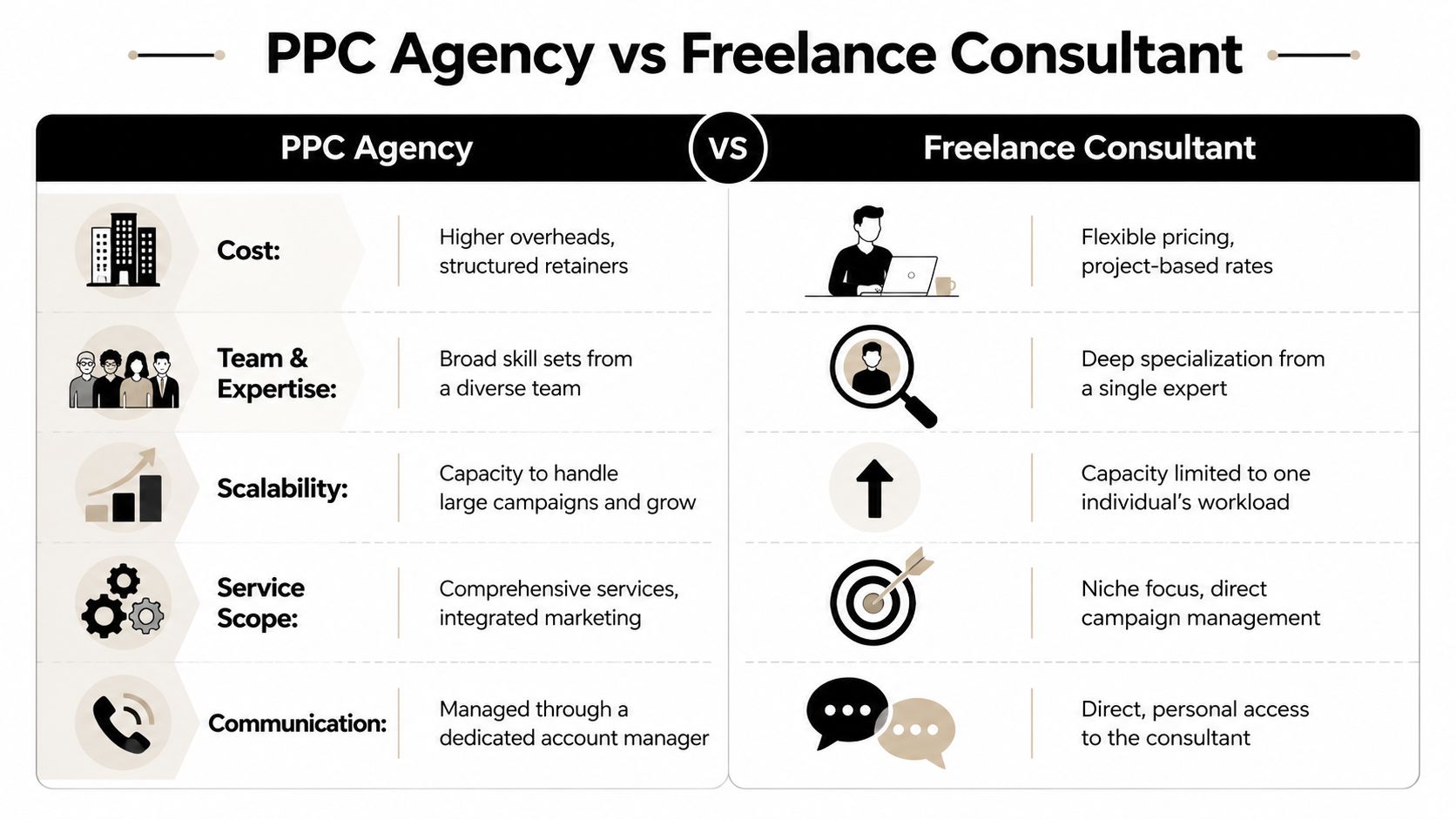
PPC Agency vs Freelance Consultant A Side-by-Side Breakdown
You can waste a lot of money choosing the cheaper-looking option or the bigger-looking option. The right choice is the one that protects margin, cuts wasted spend faster, and puts clear ownership on performance.
Here is the practical breakdown.
Factor |
PPC Agency |
Freelance Consultant |
|---|---|---|
Cost structure |
Higher overhead, layered fees, more non-delivery time built into the model |
Leaner fee structure, more of what you pay goes into actual account work |
Communication |
Usually filtered through account management |
Direct with the person doing the work |
Execution speed |
Slower when approvals, handoffs, and internal queues get involved |
Faster changes, faster testing, faster problem correction |
Expertise |
Broader bench, mixed seniority, uneven account ownership |
Narrower scope, deeper hands-on specialization |
Tools |
Often includes reporting and software access |
May require separate tool access or client-owned systems |
Scalability |
Better for complex multi-channel operations |
Better for focused performance management with tight accountability |
Onboarding |
Process-heavy and presentation-heavy |
Direct, practical, built around diagnosis and action |
Cost and fees
The invoice is only part of the cost.
With agencies, you are also paying for layers that do not directly improve bids, targeting, feed quality, search term control, or conversion tracking. You are funding sales overhead, management overhead, internal reporting time, and utilization targets. Some of that structure is useful. A lot of it is not.
A consultant usually gives you a cleaner value chain. Fewer people touch the account. Fewer hours get burned in internal syncs. More of the fee goes toward diagnosis, testing, and optimization. That is the fundamental comparison.
Tool access can narrow the gap. Some agencies include reporting systems, call tracking, creative workflows, and analytics support inside the engagement. Some consultants expect the client to already have those pieces in place. Before you decide, read this breakdown of what you're really paying for in PPC management. It explains where fees turn into results and where they disappear into overhead.
Communication and accountability
Agency accounts often break down here.
The person speaking to you is often not the person changing the account. That creates lag, weakens context, and gives everyone room to avoid responsibility when performance slips. I see it constantly in audits. A campaign underperforms for six weeks, and nobody can clearly explain who approved the structure, who reviewed search terms, or who let broken tracking sit untouched.
A specialist consultant has nowhere to hide. You ask a question and get an answer from the operator, not a messenger. That matters when lead quality drops, branded traffic starts masking real acquisition cost, or CPC inflation forces a fast shift in bidding and budget allocation.
Direct ownership usually produces cleaner work.
Strategy and execution speed
Agencies tend to slow down as they grow. That is not a moral failure. It is an operating model problem.
Every handoff strips some strategic sharpness out of the work. The brief gets softened. The nuance gets lost. The urgency gets buried under process. By the time the change reaches the platform, the opportunity is smaller or the damage is already done.
A good consultant works closer to the account and closer to the business goal. That means faster decisions on search query isolation, match type control, geo adjustments, offer testing, and budget reallocation. Speed alone is not the advantage. Speed with context is the advantage.
Slow optimization costs money every day it stays live.
Expertise
Agencies sell breadth. That can be useful if you need paid media, creative, analytics, CRO, and stakeholder management bundled together.
But breadth often comes with uneven depth. The senior strategist wins the pitch. The day-to-day work lands with a junior buyer or a stretched account team following a standard playbook. That is why so many agency accounts look fine from a reporting standpoint and weak inside the actual build. The naming conventions are tidy. The campaign logic is not.
A strong consultant is a narrower hire and often a better one when your core problem is account performance. You are buying judgment, not department coverage. For businesses also weighing leadership structure at the marketing level, this piece on finding fractional CMOs through Cemoh is useful because it frames the staffing decision around ownership and decision quality.
Tools and resources
Agencies do have a real advantage here. Many already have dashboards, QA systems, tracking support, and subscriptions to paid tools. If your internal setup is weak, that infrastructure can help.
Still, tools do not rescue bad management. A bloated dashboard does not fix poor search intent segmentation. Fancy reporting does not reduce CAC. Strong operators do.
If a consultant lacks the technical setup your business needs, that is a valid reason to choose an agency. If an agency has the tools but cannot translate them into account improvements, the stack does not matter.
Scalability
Agencies are built to absorb operational complexity. That matters if your business runs across markets, channels, business units, or large approval chains.
Consultants scale through focus. They work best when the main need is tighter control, faster action, and stronger accountability inside a defined scope. For many businesses spending serious money on Google Ads or paid social, that is enough. The bottleneck is not a lack of bodies. It is too many bodies between the problem and the person who can fix it.
Onboarding
Agency onboarding often looks polished because polish helps retention. You get kickoff decks, status calls, shared folders, timelines, and stakeholder workshops.
Consultant onboarding is usually less theatrical and more useful. Access review. Tracking audit. Waste check. Structural diagnosis. Priority fixes. Test plan.
If your account is already live and underperforming, that approach is usually better. You do not need another presentation. You need someone to find the leaks and stop them fast.
When a PPC Agency Makes Sense for Your Business
A good consultant should be honest about this. Sometimes an agency is the right choice.

High complexity changes the answer
The cleanest framework I've seen is campaign complexity. According to VA Masters' 2026 agency versus freelancer statistics, complexity ratings of 4 or below suit freelancer management, scores of 5 to 7 may work with either option, and complexity above 7 typically requires agency infrastructure and coordinated specialist teams.
That's useful because it forces a harder question than “can a freelancer do PPC?” Of course they can. The question is whether your account requires coordination across enough moving parts that one specialist becomes a bottleneck.
Cases where an agency is the smarter move
An agency usually makes sense when these conditions are true:
You need more than PPC. If your business needs paid search, paid social, landing page design, creative production, analytics engineering, and CRO all tied together, an agency may reduce coordination burden.
Your account has many stakeholders. Large internal teams often want scheduled reporting, formal process, documentation, and multiple points of contact.
Your campaigns are globally or operationally complex. Multi-market accounts, heavy product segmentation, or advanced creative throughput can justify more infrastructure.
You need redundancy. Agencies can cover holidays, turnover, and specialist handoffs more easily than a solo operator.
Cases where businesses choose an agency too early
A lot of companies move into agency relationships before they've earned the complexity.
They assume bigger spend automatically means they need a bigger service model. That's wrong. If your core issue is search structure, tracking integrity, landing page relevance, or weak query control, adding more people won't fix it. It may just make the account slower.
Don't buy infrastructure before you need infrastructure.
If your account still depends on basic fundamentals being done well, a specialist is usually the better fit. Agency scale only helps when scale itself is the problem.
The Case for a Dedicated PPC Consultant
You approve a five figure ad budget every month, ask for efficiency gains, and get another slide deck instead of lower CAC.
That is the point where a dedicated PPC consultant starts to make more sense than an agency.

What better management looks like
A strong consultant improves the account at the operating level first. That is where wasted spend hides.
Search campaigns get restructured so match types stop competing. Brand gets separated from prospecting. Conversion tracking gets audited against CRM outcomes instead of accepted at face value inside the ad platform. Bidding gets tied to qualified leads or revenue, not inflated platform conversions. Performance Max gets boxed in with clear inputs, exclusions, and reporting rules.
This work is not flashy. It is where margin comes from.
The difference is not just skill. It is focus. In an agency model, strategy is often diluted across account managers, media buyers, reporting layers, and internal approvals. Every handoff adds lag. Every lag creates more room for waste to stay live.
A mini account scenario I see all the time
A company leaves an agency after six months of flat results. The account is not broken. It is slow, padded, and full of tolerated inefficiency.
Search term reviews were too light. Broad match kept expanding without enough negatives. Conversion actions counted weak signals as wins. Budget stayed in campaigns that had already shown they could not hit target. The landing page promise drifted away from the ad copy. Nobody made one catastrophic mistake. The account lost money through a long chain of small, unchallenged decisions.
A consultant closes that gap faster because the same person diagnosing the issue is also inside the account making changes.
Here is what that usually improves:
Waste gets cut faster because search terms, placements, and exclusions are reviewed with urgency
Signal quality gets cleaner because tracking is tied back to sales reality
Budget moves to the right places instead of being spread evenly to keep reports tidy
Testing gets sharper because one operator sees the full path from keyword to landing page to conversion
Management drag drops because strategy and execution sit with the same person
Why direct access matters
Direct access changes the economics of the relationship.
If the person you speak to is the same person changing bids, fixing tracking, reviewing search terms, and deciding what gets paused, decisions happen faster and excuses disappear. That matters because PPC performance rarely collapses all at once. It slips through delayed reactions, weak follow-through, and unresolved account clutter.
A specialist Google Ads consultant model gives you that direct line. You are paying for judgment in the account, not layers around the account.
This short video gives a useful view of how specialist PPC thinking differs from broader agency packaging.
The accountability advantage
The strongest case for a consultant is cleaner accountability across the whole value chain.
With an agency, underperformance can hide inside process. Strategy gets separated from execution. Reporting gets separated from diagnosis. The person presenting results may not be the person who made the call that drove them. That structure protects the agency more than the client.
With a consultant, the line between decision and outcome is short. You know who set the strategy. You know who made the change. You know who owns the result.
Hire the person you want inside the account every week. That is the person who will affect ROI and CAC.
How to Choose Your Next PPC Partner
Don't choose your next PPC partner based on presentation quality. Choose based on operating fit.
A fast decision checklist
Run through these questions:
Do you need PPC only, or a wider service bundle? If you mainly need Google Ads expertise, account cleanup, testing, and lower CAC, a specialist is often enough.
Do you want direct access to the person making changes? If yes, that points strongly toward a consultant.
Is your account strategically complex or just poorly managed? Those are different problems. Don't buy a team to solve a discipline issue.
Do you already have working analytics and tracking infrastructure? If yes, a consultant can move faster. If no, ask who will fix tracking, not just report on it.
Do you need speed more than ceremony? Agencies are better at process. Consultants are usually better at fast action.
Will your internal team require formal reporting and multiple stakeholder calls? If yes, agency process may fit your environment better.
Questions to ask an agency
These questions cut through polished sales talk:
Who will manage the account day to day? Ask for the role and experience level, not just the team structure.
How often does the person inside Google Ads review search terms, bidding, and conversion tracking?
What happens when performance drops suddenly? Listen for response speed, not just escalation language.
How much of the fee supports strategy versus account management overhead?
Will I own the ad account, conversion history, and creative assets if we part ways?
Questions to ask a consultant
A consultant should handle direct scrutiny well.
What kinds of accounts do you manage best? You want clarity, not someone claiming to do everything.
How do you audit conversion tracking before making optimization decisions?
What's your process for budget reallocation when one campaign starts dragging overall CAC?
How do you balance automation with manual control in Google Ads?
What communication cadence should I expect when the account needs quick changes?
The right partner gives specific answers. The wrong one gives broad reassurance.
One practical move you can make this week
Pull the last 30 days of search terms, conversion actions, and campaign budget allocation. Then ask your current partner three questions: what should be excluded, what should be redefined, and what budget should move now. If the answers are slow or fuzzy, you have your answer.
Common Questions About PPC Partnerships
Can a hybrid model work
Yes. Sometimes the best setup is a consultant handling strategy, audits, account structure, and major optimization decisions while an internal marketer supports reporting or execution. Hybrid models work best when ownership is explicit. If nobody clearly owns performance, the model falls apart.
What if an agency says they also use freelancers
That can be fine. In some cases it's smart. The issue isn't whether freelancers are involved. The issue is whether you know who's responsible, who has authority, and whether the work gets better or just more fragmented.
What's best for a very small budget
If budget is small, don't buy complexity. You need clean targeting, disciplined conversion tracking, a tight offer, and quick feedback loops. A specialist usually fits that better than an agency service package.
How should a freelancer contract be structured
Keep it simple and specific. Define account ownership, access levels, deliverables, reporting cadence, communication expectations, and notice periods. State who owns historical data and ad assets. If those basics are vague, fix that before work starts.
Is the cheapest option usually the best one
No. Cheap PPC management is expensive when it produces weak decisions. Judge the partner on clarity, direct accountability, speed, and their ability to improve ROI and CAC. Fee matters. Decision quality matters more.
If you're spending meaningful money on Google Ads and want a direct expert relationship instead of another layered agency setup, Come Together Media LLC offers specialist PPC consulting built around one-on-one strategy, account audits, campaign setup, and ongoing optimization. It's a practical fit for businesses that want clearer accountability, faster execution, and tighter control over ad spend.
