


You’re spending serious money in Google Ads. The leads feel inconsistent, the reporting sounds polished, and your agency keeps saying the account is “learning.” Meanwhile, no one gives you a straight answer about why one bid strategy was chosen over another, what trade-offs come with it, or when it should be changed.
That’s the problem.
Bidding strategy isn’t a cosmetic setting. It decides how aggressively Google enters auctions, what kind of traffic you buy, and whether the platform is optimizing for clicks, leads, revenue, or visibility. If that choice is wrong, the rest of the account has to work uphill.
This is google ads bidding strategies explained the way a senior PPC consultant would explain it to a CMO or owner who’s tired of vague answers. No fluff. No agency-safe jargon. Just the practical decision criteria that separate efficient accounts from expensive messes.
Your Agency Is Probably Choosing the Wrong Bid Strategy
A lot of agencies pick bidding strategies for operational convenience, not business fit.
That usually looks like this. A junior account manager inherits the account, sees Google recommending automation, switches campaigns to a Smart Bidding option, and then leaves it there because changing it would require a real conversation about conversion quality, sales cycle length, tracking accuracy, and margin. Most clients never get that conversation.
The result is predictable. One business gets pushed into Maximize Conversions when it really needs cost control. Another gets forced into Target CPA before the account has enough reliable conversion history. A third stays on Manual CPC for months because no one fixed tracking, so the agency can’t trust automation.
That isn’t strategy. That’s avoidance.
The more you spend, the more expensive lazy bidding becomes. At higher budgets, small inefficiencies don’t stay small. They scale. If your account is buying the wrong type of clicks, overpaying for low-intent traffic, or optimizing around bad conversion signals, spend rises faster than profit.
What competent management looks like: bid strategy should match your business objective, your conversion data quality, and your account maturity. If those three don’t line up, performance drifts.
A specialist consultant usually handles this better than a bloated agency for one simple reason. There’s no incentive to hide behind templates. A consultant has to justify each strategic decision directly, explain the trade-offs plainly, and change course quickly when the data says the current setup isn’t working.
If your agency can’t explain why your bid strategy is the right one for your actual business model, they’re guessing with your money.
The Bidding Spectrum From Manual Control to AI Automation
A practice owner approves a larger Google Ads budget, lead volume goes up, and cost per lead looks acceptable. Then the front desk starts reporting weak enquiries, insurance mismatches, and bookings that never happen. In many accounts, that gap starts with bid strategy. The platform is optimizing for one outcome, while the business needs another.
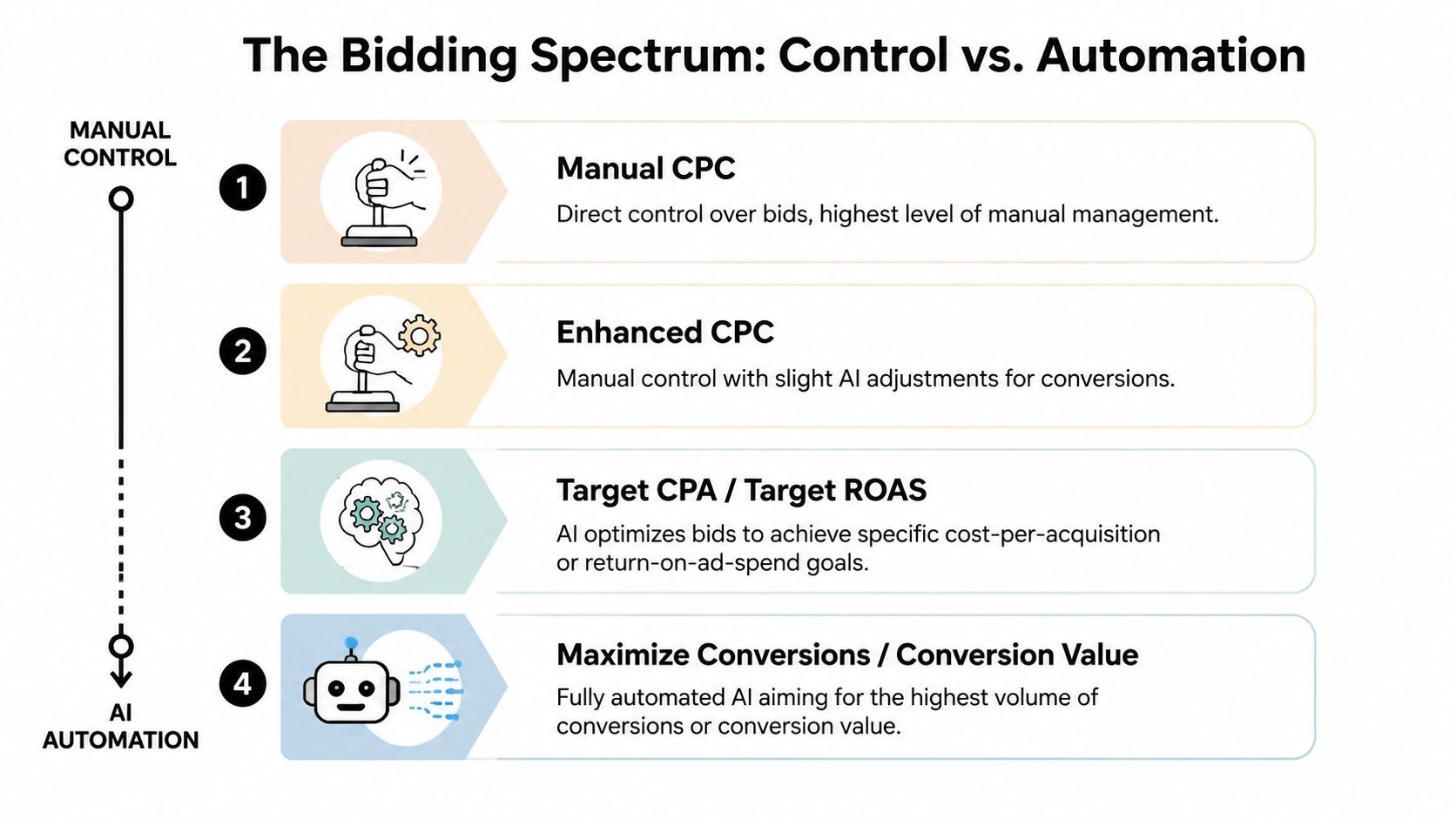
That is why bid strategy should be viewed as a spectrum of decision-making, not a menu of Google labels. At one end, you control bids directly. At the other, Google controls bids based on the goal you set. Between those points are options that share control.
If you need a refresher on auctions, impressions, clicks, and ad rank before adjusting bids, this breakdown of how Google Ads works is worth reviewing.
Manual means control, speed of learning, and more work
Manual CPC gives you direct control over keyword-level bids. That matters when an account is new, conversion tracking is questionable, or lead quality varies enough that you do not want Google making aggressive assumptions.
For high-spend SMBs, manual bidding is often less about staying old-school and more about getting clean feedback. You can see which searches attract useful clicks, where CPCs get inflated, and which parts of the account deserve more budget. In healthcare, that can be especially important because low lead volume, long booking cycles, and strict qualification criteria often leave automation with thin signals.
The trade-off is obvious. Manual CPC takes time, close supervision, and someone who can interpret search intent instead of exporting reports and calling it strategy.
Hybrid means partial control with auction-time help
Enhanced CPC (eCPC) sits in the middle. You set the base bids, and Google adjusts them up or down when it predicts a better or worse chance of conversion in a specific auction.
That can be useful when you want some machine assistance without handing over the entire steering wheel. Google can react to signals a person cannot process in real time, such as device, location, time, and contextual auction patterns. But eCPC still depends on decent conversion tracking and sensible campaign structure. If the account is sending mixed signals, hybrid bidding just applies those mistakes faster.
The practical question is not whether automation sounds good. The practical question is whether your account gives Google enough clean input to make smart decisions.
Full automation means you manage outcomes, not bids
At the far end are Google’s Smart Bidding strategies. Instead of setting individual keyword bids, you choose the result you want and let Google adjust bids auction by auction.
That usually means one of four goals:
More conversions
A target cost per acquisition
More conversion value
A target return on ad spend
Agencies often oversimplify the conversation surrounding Smart Bidding's inherent superiority. Smart Bidding is not “better” because it uses AI. It is better in accounts where the conversion goal is accurate, the volume is strong enough, and the business can tolerate a period of learning and fluctuation. It is a bad fit when lead quality is inconsistent, offline sales data never gets imported, or the target is set by finance with no connection to how the account performs.
For consultant-led accounts, that distinction matters. A consultant has to defend the choice in plain English. A bloated agency can hide behind Google’s recommendations tab and call it optimization.
The trade-off that actually matters
Here is the working view.
Position on spectrum |
Example strategies |
Main advantage |
Main risk |
|---|---|---|---|
Manual control |
Manual CPC |
Tight bid control and cleaner learning in weak-data accounts |
Slow, labor-intensive, misses auction-time signals |
Hybrid |
Enhanced CPC |
Keeps some control while adding Google’s real-time bid adjustments |
Depends on a solid setup and can amplify bad tracking |
Full automation |
Maximize Conversions, Target CPA, Maximize Conversion Value, Target ROAS |
Scales bidding decisions beyond human speed |
Poor targets and poor inputs waste budget fast |
For high-spend SMBs and healthcare advertisers, the right choice usually comes down to one question. Are you trying to control cost while you build reliable signals, or are you ready to let Google optimize toward a business outcome you consider trustworthy?
Foundational Strategies For Accounts With Limited Data
A private practice launches Google Ads, spends for three weeks, and gets six form fills. Two are spam. One is an existing patient. Two never answer the phone. The agency still flips the campaign to automated bidding because that is what the playbook says.
That is how low-data accounts burn money.
This section matters most for new campaigns, healthcare groups, seasonal businesses, and high-spend SMBs with uneven lead flow across locations or service lines. New Age’s guide on bidding without panic makes the same point from a different angle. Many bidding guides assume the account already has usable conversion history. In real accounts, that assumption fails all the time.

For these accounts, the first job is to create dependable signals. Start by fixing your Google Ads conversion tracking, separating primary from secondary actions, and removing conversions that should never drive bids. If the landing page is weak, bidding will not save it. Clean tracking and basic CRO strategies usually do more for early performance than switching to a flashier bid strategy.
Manual CPC when you need clean feedback
Manual CPC is still the best starting point in accounts where conversion data is thin, noisy, or politically unreliable.
Use it when:
A campaign is new and there is no meaningful conversion history yet
Keyword intent is still being tested
Healthcare or other high-consideration services generate few leads, and each lead needs human qualification
Budget control matters more than scale during the first phase
The main benefit is visibility. You can see where spend is going, which search terms deserve tighter control, and which ad groups are attracting curiosity instead of intent.
The trade-off is workload. Manual CPC only works if someone is reviewing search terms, location splits, devices, schedules, and landing page behavior often enough to act on what they find. A bloated agency can call manual bidding “hands-on” while barely touching the account. That is not management. That is drift.
Enhanced CPC when you have partial trust in the data
Enhanced CPC fits accounts that have some conversion signal but not enough consistency to hand over the budget completely.
That matters in healthcare and multi-location SMB accounts, where lead volume may be decent on paper but still messy in practice. One office answers calls quickly. Another misses half of them. One service line closes well. Another fills the CRM with low-intent inquiries. In that situation, full automation can scale the wrong behavior.
eCPC gives Google room to adjust bids in the auction while you keep tighter control over the structure and base bids. Used well, it is a transition tool, not a permanent resting place.
A disciplined rollout looks like this:
Start with a narrower keyword set than you would use in a mature account.
Confirm that tracked conversions represent real business value.
Watch query quality and lead quality together, not just platform conversions.
Shift to stronger automation only after the account produces patterns you trust.
If qualified lead review happens in a spreadsheet, by phone, or inside a practice management system, account strategy has to reflect that reality. Textbook advice usually ignores this. Consultants cannot afford to.
Maximize Clicks when the goal is information, not efficiency
Maximize Clicks is useful in a narrow set of situations. Early traffic gathering is one of them.
It can work for:
Search term discovery
Awareness or reach-focused campaigns
Filling the top of the funnel before conversion actions are ready
Market testing in a new geography or service category
The risk is obvious. Click volume is easy to buy and easy to misread. Cheap traffic can make reports look active while producing no revenue, no patient starts, and no sales pipeline value.
For high-spend SMBs, that means Maximize Clicks needs a stop condition. Set a time window, a budget cap, and a decision point. If the traffic does not produce useful search term insight or on-site engagement, cut it. Do not let an agency hide behind rising clicks while the business gets nothing from them.
A practical view of low-data bidding options
Strategy |
Best use case |
Main benefit |
Main risk |
|---|---|---|---|
Manual CPC |
New, volatile, or poorly tracked campaigns |
Clear spend control and cleaner feedback |
Time-intensive, slower to scale |
Enhanced CPC |
Accounts with early but imperfect conversion data |
Some auction-time help without giving up all control |
Can still amplify bad tracking or weak lead definitions |
Maximize Clicks |
Research, awareness, and early traffic collection |
Fast way to gather query and engagement data |
Can waste budget on low-intent traffic |
What usually works
For limited-data accounts, the right question is simple. Are you still learning what a qualified prospect looks like, or have you already defined it in a way Google can use?
If the answer is no, protect the budget first.
That usually means Manual CPC for weak tracking or unclear intent, Enhanced CPC for accounts with early signs of signal quality, and Maximize Clicks only when traffic collection has a specific purpose. The businesses that get this right do not chase automation for its own sake. They use foundational bid strategies to build an account that can support automation later without wasting six figures getting there.
Letting Google's AI Drive Performance With Smart Bidding
A healthcare group spends $40,000 a month on Google Ads. The agency switches everything to Smart Bidding, calls it “AI optimization,” and monthly lead volume rises. Three months later, half the leads are unqualified, call center time is wasted, and cost per booked patient is worse than before.
That is the Smart Bidding problem for high-spend SMBs. The setting is rarely the whole issue. The signal quality is.
Once an account has enough clean conversion history, manual bidding stops being the best use of attention. Google can adjust bids at auction time using context no human can process fast enough, including device, location, query intent, time, and prior behavior. Used well, Smart Bidding saves time and improves efficiency. Used on top of weak tracking, it scales the wrong behavior faster.

Maximize Conversions for lead volume
Maximize Conversions tells Google to spend toward the highest number of tracked conversions available within budget.
It fits accounts where volume matters, sales follow-up is strong, and the conversion action is close enough to real business value that more conversions usually means more revenue. That can work for straightforward ecommerce, high-capacity service businesses, or lead gen programs with disciplined intake.
It can also go wrong fast.
In healthcare and other high-consideration categories, not all leads deserve equal weight. A contact form from an out-of-area patient, a low-intent insurance question, and a consultation request for a profitable procedure should not be treated as the same signal. Yet many agencies still optimize them as if they were interchangeable because it makes reporting easier.
If lead quality is uneven, Maximize Conversions often finds the cheapest path to more noise.
Target CPA for controlled acquisition costs
Target CPA works best when the business knows what a qualified lead can cost and still produce acceptable margins.
That makes it a practical option for multi-location healthcare groups, legal, home services, and other high-spend SMBs that need tighter cost control than Maximize Conversions usually provides. Finance teams tend to prefer it for a reason. It gives a clearer operating range, even if total conversion volume comes down.
The trade-off is real. A conservative CPA target can limit reach, reduce impression share, and slow growth. An aggressive target can push the system into weak auctions just to maintain volume. Good management here is not about picking a “best” setting. It is about setting a target the business can support.
WordStream’s explanation of automated bidding does a decent job outlining that balance between efficiency and scale.
Maximize Conversion Value for accounts that know some leads are worth more
A lot of mature accounts should test Maximize Conversion Value earlier than they do.
If one product line, service, or procedure creates far more revenue than another, optimizing to conversion count leaves money on the table. The better instruction is value. For healthcare advertisers, that might mean weighting campaigns toward high-value service lines instead of treating every appointment request the same. For high-spend SMBs, it can mean importing offline value from the CRM so Google optimizes toward closed revenue, not cheap form fills.
This is usually where the agency versus consultant gap becomes obvious. Agencies often stop at platform conversions because deeper value mapping takes work across analytics, CRM, intake, and sales operations. A consultant who cares about actual ROI pushes further and asks whether the account is teaching Google what the business really wants.
If the answer is no, value-based bidding is premature.
Target ROAS for advertisers with mature revenue tracking
Target ROAS is the strictest financial instruction in standard Smart Bidding.
It is the right fit when revenue tracking is accurate, values are stable, and the business can tolerate some volume loss in exchange for stronger return discipline. Ecommerce accounts often get the clearest benefit, but some lead gen advertisers can use it too if they import reliable downstream revenue.
Poor inputs break this strategy quickly. Inflated conversion values, duplicated purchases, missing offline revenue, or wide swings in close rates will distort bidding. I see this often in healthcare and complex sales environments where the actual conversion happens after a call center review, insurance verification, or in-person consult. If Google only sees the top-of-funnel event, Target ROAS may optimize for activity that never becomes revenue.
What Smart Bidding needs before it deserves your trust
Smart Bidding does not rescue a messy account. It amplifies whatever signal you feed it.
The setup usually holds up when these conditions are true:
Primary conversions reflect business value. Not every form submit or phone call should be included.
Campaign intent is consistent. Mixed audiences and mixed goals confuse the system.
Budgets allow the strategy to learn. Starving a campaign while demanding efficiency usually produces volatility.
Landing pages do their job. Better page performance improves the signal going back into bidding. These CRO strategies can help tighten that side of the system.
Offline feedback exists when lead quality varies. Imported qualified lead data matters more than in-platform conversion totals for many SMB and healthcare accounts.
A deeper setup and troubleshooting reference is in this guide to Google Ads automated bidding.
Here’s a useful visual overview before you make changes inside the platform:
What works and what fails
Smart Bidding works best in accounts with clear goals, clean conversion design, and enough budget to let the system make meaningful decisions. One campaign objective is usually enough. One primary success metric is better.
It fails in the same predictable ways. Agencies lump soft and hard conversions together, import no CRM outcomes, mix brand and non-brand intent, then blame seasonality when lead quality falls. Google did what the account asked.
For high-spend SMBs, the decision is not whether AI bidding is good or bad. The decision is whether the account has earned the right to use it.
Using Specialized And Portfolio Bidding Strategies
A $40,000-a-month account can look well managed on the surface and still waste budget because the bid strategy is solving the wrong problem. I see this a lot in healthcare and high-spend SMB accounts. The agency picks one default strategy, applies it everywhere, and calls that consistency.
Specialized and portfolio strategies exist for the cases where standard campaign-level bidding starts to break down. They help when visibility matters, when campaign volume is uneven, or when business goals sit above a single campaign. They also create expensive mistakes when someone uses them without a clear reason.
Target Impression Share for visibility, not lead efficiency
Target Impression Share is a visibility tool. Use it when showing up in a specific position, on a specific page, for a specific query set has business value on its own.
That usually means:
Brand defense: protecting branded searches from competitors
Healthcare reputation terms: staying visible for physician, clinic, or treatment searches where trust starts before the click
Strategic market coverage: holding presence on a narrow set of terms that shape perception, even if they are not the cheapest path to a conversion
It is a poor fit for broad lead generation campaigns where every click needs to clear a profitability threshold. If your main KPI is qualified cost per lead, impression share can push bids higher without improving lead quality.
That trade-off gets ignored all the time. Agencies like clean dashboards, and visibility metrics look clean. Business owners need to ask a harder question. Is extra visibility producing revenue, better patient acquisition, stronger branded demand, or just a higher bill?
Portfolio bidding for accounts managed as a business, not a pile of campaigns
A portfolio bidding strategy lets multiple campaigns optimize toward one shared target. That matters when campaigns serve the same economic goal but do not each produce enough stable signal on their own.
For example, a healthcare group may split campaigns by location, service line, or physician. A regional home services company may split by metro area. If all of those campaigns ultimately feed the same margin target or acquisition model, managing them in isolation can be inefficient.
Portfolio bidding often helps in cases like these:
Situation |
Why a portfolio approach helps |
|---|---|
Several low-volume campaigns with the same CPA goal |
Google can use combined data instead of forcing each campaign to learn alone |
Multi-location healthcare accounts |
Locations can share signal when patient acquisition economics are similar |
Regional service campaigns with one revenue model |
Bidding aligns to the business outcome, not arbitrary campaign boundaries |
The fundamental difference between an agency and a consultant is clearly demonstrated. A generalist agency often keeps everything separated because it is easier to report on. A good consultant groups campaigns only when the underlying economics match. If one location closes leads at half the rate of another, forcing both into the same target can hide a performance problem instead of fixing it.
Portfolio strategies are useful, but they are not automatic upgrades. Shared bidding only works when the campaigns truly belong together.
If you are weighing efficiency targets inside acquisition campaigns, this guide on mastering target CPA for better ROI gives a practical view of how those controls work in practice.
The same logic applies outside Google Ads. If the business cannot define what profitable growth looks like, no bid strategy will fix that. Start with the economics, then optimize your marketing returns across channels with the same discipline.
Specialized strategies reward clear intent. They punish vague goals, mixed conversion actions, and lazy account structure.
A Consultant’s Framework For Choosing Your Strategy
The right bid strategy comes from asking the right questions in the right order.
Agencies often reverse that. They start with what Google recommends, then rationalize it afterward. A consultant should do the opposite. Start with business economics, then map that reality to the platform.
Research from Optmyzr’s analysis of PPC bidding strategy performance found that Smart Bidding strategies outperform manual bidding when sufficient conversion data exists, and that no account performing at less than 25 conversions demonstrated better results than accounts with 50+ conversions, regardless of budget allocation. That’s a useful anchor because it pushes the conversation away from spend level and toward data maturity.
Start with the business question, not the platform setting
Ask these questions first:
Is the primary goal volume, efficiency, revenue quality, or visibility? If you can’t answer that cleanly, no bid strategy will save you.
Is conversion tracking accurate enough to trust? If the account counts junk actions as success, automation will optimize junk faster.
Does the campaign generate enough stable conversion history? If not, control matters more than sophistication.
Are all conversions equal in value? If they aren’t, bidding on count alone may distort the whole account.
How long is the sales cycle? Long-cycle businesses need more discipline around what they treat as a primary optimization signal.
The decision matrix
Strategy |
Primary Goal |
Best For |
Data Requirement |
Level of Control |
|---|---|---|---|---|
Manual CPC |
Controlled testing and spend management |
New campaigns, volatile lead quality, limited-data accounts |
Low |
High |
Enhanced CPC |
Gradual move toward automation |
Accounts with some conversion signal but not full maturity |
Low to moderate |
Medium-high |
Maximize Clicks |
Traffic volume |
Research, awareness, early search term discovery |
Low |
Low |
Maximize Conversions |
Highest conversion count |
Lead gen or sales programs prioritizing volume |
Moderate to strong |
Low |
Target CPA |
Predictable acquisition cost |
Lead generation with clear cost targets |
Strong |
Low |
Maximize Conversion Value |
Highest total conversion value |
E-commerce or variable-value lead programs |
Strong |
Low |
Target ROAS |
Return efficiency |
Revenue-focused accounts with reliable value tracking |
Strong |
Low |
Target Impression Share |
Search visibility |
Brand defense and strategic presence |
Low to moderate |
Low |
How this plays out in real businesses
A dermatology clinic, a plastic surgery practice, and an e-commerce brand might all spend heavily in Google Ads. That doesn’t mean they should bid the same way.
A clinic with lower lead volume and strict economics often needs control first, then cautious automation. A surgery practice with a long consideration cycle may need bidding aligned to qualified consultation intent, not just form volume. An e-commerce account with credible revenue tracking may get more from value-based bidding than cost-per-lead logic.
That’s where one-size-fits-all management breaks down.
Why specialist management usually wins
A dedicated consultant is more likely to challenge bad defaults because there’s nowhere to hide.
That matters if you’re trying to optimize your marketing returns across channels. You need someone who can connect platform settings to business outcomes, not someone who keeps campaigns active and reports on impressions.
The best bid strategy is not the one Google recommends. It’s the one that matches your economics, your data quality, and your tolerance for volatility.
If your current partner can’t walk you through that framework without resorting to vague platform language, they’re managing the interface, not the business.
Stop Settling For Agency Defaults And Take Control
Google Ads bidding is where strategy becomes money.
Pick the wrong bid model and you can spend months buying the wrong traffic, feeding automation bad signals, or chasing efficiency targets that suffocate growth. Pick the right one and the account gets clearer, more stable, and more profitable.
That’s why this decision shouldn’t be delegated blindly. You don’t need more dashboards. You need a manager who can explain why the account is on a specific strategy, what conditions would justify changing it, and what signals prove it’s working.
Large agencies often struggle here because they standardize decisions to protect workflow. A specialist consultant does the opposite. The work starts with your business model, your conversion reality, and your goals. Then the bid strategy follows.
Audit your account with that standard. Ask why each campaign is using its current bidding approach. Ask what would trigger a change. Ask whether the conversion data behind the strategy is trustworthy.
If the answers are weak, the setup probably is too.
If you want a direct, expert review of your Google Ads bidding setup, Come Together Media LLC offers the kind of specialist PPC guidance most high-overhead agencies never deliver: hands-on analysis, transparent recommendations, and strategy built around your actual business economics instead of platform defaults.
