


You’re probably living the same ugly pattern I see in a lot of mature Google Ads accounts.
Spend is high. Click costs keep creeping up. The agency says performance is “stable,” but they can’t clearly explain where waste sits, which levers still matter, or why your account structure looks like it was built for convenience instead of control. You’re paying senior-retainer prices for junior execution.
If you want to reduce google ads cost per click, stop looking for hacks. CPC comes down when you run the account like an operator, not a platform cheerleader. That means tighter structure, stricter keyword control, better relevance, cleaner data, sharper bidding, and landing pages that don’t waste paid traffic after the click.
Most agencies won’t do that work well. They’re too busy managing account volume, following Google recommendations, and shipping reports that look polished but say very little. A specialist can go deeper because the work is narrower, the communication is direct, and the incentives are cleaner.
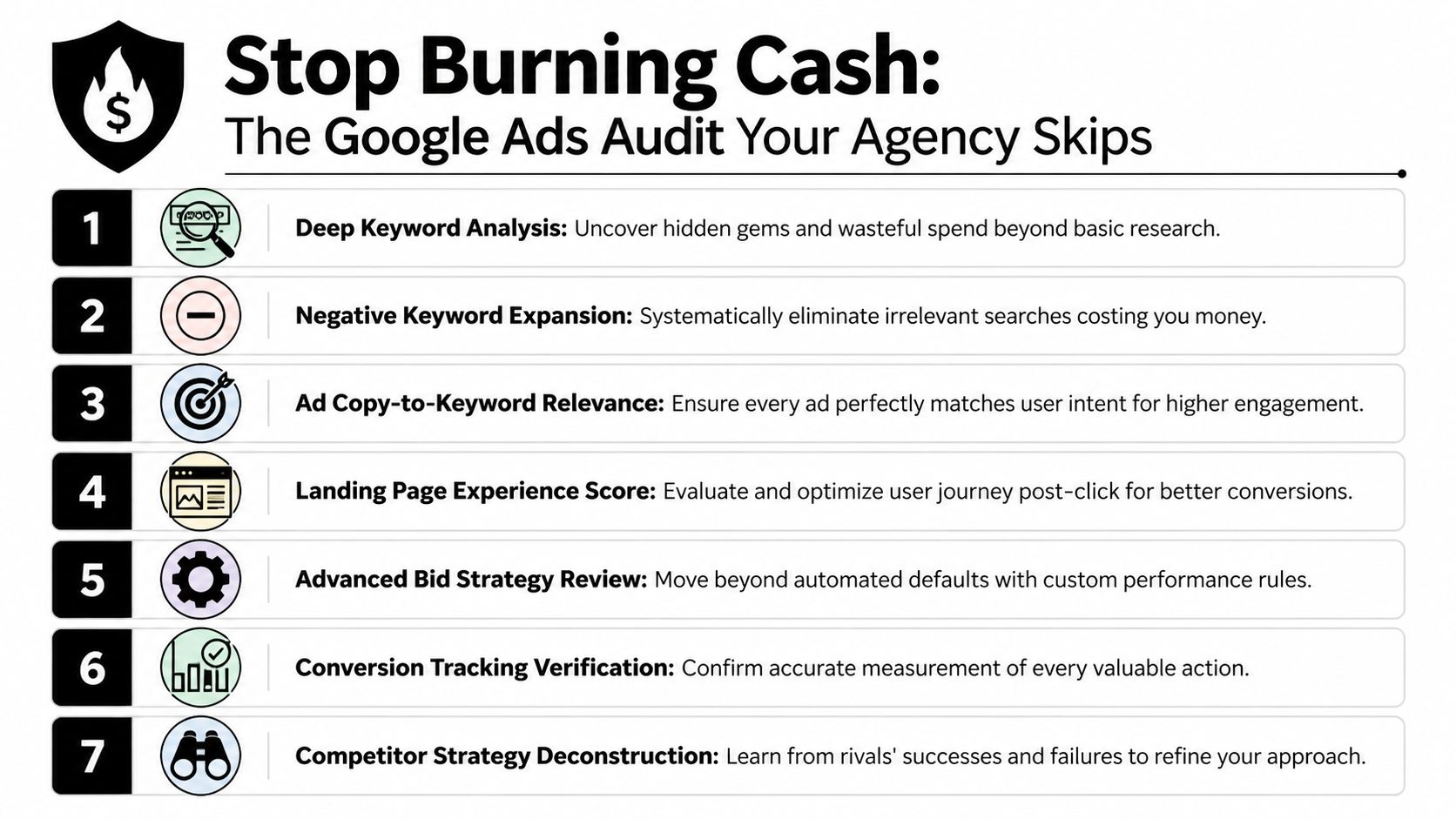
Stop Burning Cash The Google Ads Audit Your Agency Skips
Most agencies do not audit accounts. They skim them.
They check campaign names, look at a few high-level metrics, maybe glance at search terms, and call it a strategy review. That’s not an audit. That’s administrative theater. If your team spends serious money on paid search, a superficial review won’t reduce CPC. It just delays accountability.
A real audit starts before anyone touches bids. If you change bids inside a broken account, you don’t fix waste. You amplify it.
What I check first
I don’t start with Google’s recommendations tab. I start with the parts of the account that determine whether any optimization is trustworthy.
Conversion tracking integrity. If primary conversions are duplicated, inflated, missing, or poorly prioritized, every bid strategy decision downstream gets worse.
Search term waste. Not the top ten queries. The pattern. Are broad themes pulling in irrelevant intent? Are negative keyword lists thin, outdated, or applied inconsistently?
Campaign structure. If dozens of unrelated queries sit inside a handful of lazy ad groups, relevance suffers and CPC usually follows.
Automation settings. Smart Bidding can work. Bad inputs still produce bad outputs.
Historical waste pockets. I want to see where the account has repeatedly paid for clicks that never had a realistic chance to convert.
Ad-to-landing-page alignment. If the promise in the ad changes after the click, Google sees it and users feel it.
Location, device, and schedule leakage. Many accounts overspend because nobody has bothered to isolate weak traffic segments.
Practical rule: If your current partner can’t show you exactly where waste sits by query, device, location, and conversion action, they’re managing the account from the surface.
The checklist that matters
A proper audit should produce a decision log, not a vague summary. That log needs to answer simple business questions.
Audit area |
What you need to know |
|---|---|
Tracking |
Are we measuring the right conversion actions, once, and only once? |
Queries |
Which searches are expensive but low intent? |
Structure |
Can each ad group support tight keyword-to-ad relevance? |
Landing pages |
Does each page match the user’s query and ad promise? |
Automation |
Is bidding trained on clean data or noise? |
Budget allocation |
Which campaigns deserve budget and which ones are being subsidized? |
One resource I like for leadership teams evaluating outside help is Sensoriium's insights on vetting Google Ads agencies. It’s useful because it pushes you to ask the right questions before you sign another retainer and inherit another layer of PPC fog.
If you want a practical baseline for what should be reviewed, use this PPC audit checklist and compare it against what your current agency documents. Most won’t come close.
What agencies usually miss
The biggest misses aren’t exotic.
They miss broken tracking because nobody owns analytics thoroughly enough. They miss structural bloat because rebuilding ad groups is tedious. They miss wasted queries because search term review takes judgment, not just dashboard literacy. They miss automation failures because blaming the algorithm is easier than admitting the account fed it bad signals.
Cheap clicks from bad traffic are still expensive. Expensive clicks from qualified traffic can still be profitable. The audit tells you which problem you actually have.
That’s the mindset shift. You don’t reduce CPC by chasing cosmetic efficiency. You reduce it by removing the reasons Google charges you more in the first place.
Take Back Control From Google's Algorithm
Google wants you to trust automation early and broadly. That’s convenient for Google. It’s often expensive for you.
The most common failure I see is simple. The account relies too heavily on broad match, thin negatives, and oversized ad groups. Then the agency tells the client the algorithm needs “room to learn.” What it’s really learning is how to spend your money faster on mixed-intent traffic.

Use a scalpel, not a sledgehammer
Keyword control still matters. A lot.
Broad match has a place, but only after you’ve built a reliable negative keyword discipline, validated query intent, and proven that the account can separate good discovery from expensive nonsense. Until then, phrase and exact match give you a cleaner operating environment.
Here’s the practical hierarchy I use:
Start with tighter intent control using exact and phrase match for core commercial terms.
Mine search term reports aggressively for negatives and new exact-match opportunities.
Segment by intent theme so ad copy can speak to what the user searched.
Expand carefully into broader discovery only after the account shows discipline.
That’s not old-school for the sake of it. It’s cost control.
Long-tail keywords are underused by lazy managers
A lot of agencies talk about long-tail keywords and then barely deploy them. That’s because long-tail work is manual. It requires research, pattern recognition, and page alignment.
But the payoff can be meaningful. Data from 2025 shows that long-tail keywords with four or more words can produce 30-50% lower CPC in competitive niches like healthcare and dermatology, according to this 2025 discussion on Google Ads cost control and partner traffic testing.
That matters for CMOs in expensive categories. “Dermatologist near me” and “acne treatment” are not the same market. One is broader, noisier, and often pricier. The other can signal more specific intent and more efficient traffic.
If your account is spending heavily on generic head terms while ignoring long-tail commercial intent, that isn’t sophistication. It’s neglect.
Search Partners need testing, not blind trust
Search Partners are another area where mediocre management shows up fast. Many accounts either leave them on forever without segmentation or turn them off automatically because someone heard they were low quality.
Both approaches are lazy.
The same 2025 source notes that Google’s Search Partner Network can deliver 10-20% cheaper clicks, but with a 15% lower conversion rate, which means segmentation and testing are essential if you want efficiency without hidden waste. Cheaper traffic isn’t automatically better traffic.
A simple decision view helps:
Traffic source choice |
Best use |
|---|---|
Google Search only |
When you need tighter control and cleaner intent signals |
Search Partners tested separately |
When you want to explore lower CPC inventory without contaminating core performance |
Search Partners excluded |
When lower-quality placements drag down profitable lead flow |
The point isn’t to reject automation or expansion. The point is to earn them. Control first. Evidence second. Scale third.
That’s how you force the algorithm to serve your business instead of training your business to tolerate algorithmic waste.
The Quality Score Formula for a 50% CPC Reduction

A frustrated CMO usually sees the same pattern. CPC keeps rising, the agency blames competition, and nobody wants to admit the account is paying a tax for weak relevance.
That tax shows up in Quality Score.
If you want a cheaper path to the same auction, start here. Quality Score is Google’s shorthand for whether your keyword, ad, and landing page deserve priority. Agencies love to treat it like a vanity metric because fixing it requires real account surgery. That means tighter structure, harder decisions, and landing pages built for intent instead of generic brand traffic.
Google explains that Ad Rank is influenced by bid, ad and landing page quality, auction competitiveness, and the expected impact of assets and formats in its Ad Rank overview. The practical takeaway is simple. Better quality can lower what you need to pay to hold position.
That is margin, not trivia.
The three inputs that actually move CPC
Quality Score is built from three visible components. If your team cannot explain how each one is being improved inside the account, they are managing tasks, not economics.
Component |
What it means in practice |
|---|---|
Ad relevance |
The keyword, ad copy, and offer match the searcher’s intent closely |
Landing page experience |
The page is fast, clear, useful, and directly continues the promise made in the ad |
Expected click-through rate |
Google expects users to click because your ad has earned engagement on similar queries |
Weak accounts usually break in obvious places. Broad ad groups. Copy written to please the brand team instead of the searcher. Product or service pages that force the visitor to hunt for the answer. Then the agency says CPC inflation is unavoidable.
It isn’t.
Fix the structure before you touch bids
Bid strategy cannot rescue a relevance problem. A keyword that matters needs its own context, its own message, and often its own landing experience. That does not mean mindless overbuilding. It means isolating revenue-driving terms so Google can clearly see the relationship between query, ad, and page.
Use this workflow:
Pull a keyword report and isolate terms with poor Quality Score and meaningful spend.
Break high-value keywords out of mixed ad groups.
Rewrite headlines and descriptions to match the actual query language.
Send paid traffic to pages built for that intent, not a catch-all service page.
Test new ads regularly so historical click-through rate can improve instead of stalling.
If you want a clean refresher on the mechanics, this guide to Google Ads Quality Score fundamentals covers the moving parts well.
SKAGs still have a place
Plenty of agencies dismiss Single Keyword Ad Groups because they are harder to maintain at scale. That is an operations complaint, not a strategy argument.
For high-intent, high-CPC terms, tighter segmentation still works because relevance still works. If one keyword drives qualified pipeline, give it dedicated copy, dedicated assets, and a landing page that answers that search without detours. Ecommerce teams running paid traffic to product-specific pages often understand this faster than lead gen teams do. The same discipline shows up in a good Shopify advertising playbook, where campaign structure follows buyer intent instead of internal site navigation.
This walkthrough gives useful context on how Quality Score mechanics influence cost and structure:
Operator’s view: Treat Quality Score like a pricing variable. If it is weak, you are overpaying for misalignment.
Here is the mindset shift that matters. Stop asking, “How do we get cheaper clicks?” Ask, “Why is Google charging us a premium for this traffic?” That question leads to the fixes agencies avoid because they take work. Cleaner segmentation. Sharper message match. Better pages. Fewer lazy assumptions.
That is how owners reduce CPC. Not with hacks. With tighter economics.
Smarter Bidding and Audience Targeting That Win Auctions
A lot of PPC managers treat bidding, audiences, devices, and geo controls as separate tasks. That’s why their accounts feel reactive. Strong accounts don’t manage these in silos. They use them as one allocation system.
If your conversion data is solid, automated bidding can help. If your conversion data is muddy, automated bidding will confidently make bad decisions. That’s the line too many teams ignore.
Pick the bid strategy your data can support
I’m not anti-automation. I’m anti-unearned automation.
Target CPA and Target ROAS can be excellent when the account has clear primary conversions, stable intent, and enough signal quality for Google to optimize toward outcomes that matter. They’re terrible when the account is feeding in bloated lead counts, soft conversions, duplicate events, or mixed-value actions.
Use this decision lens:
Scenario |
Better starting point |
|---|---|
Tracking is messy |
Fix measurement before trusting automation |
Lead quality varies wildly |
Tighten conversion definitions and segment campaigns |
Core campaigns are stable |
Test Smart Bidding against a controlled baseline |
New campaign or weak signal |
Start narrower and build evidence before scaling |
That’s why I like this guide to Google Ads bidding strategies as a planning reference. It’s useful when you need to decide whether the account is ready for more automation or needs more structure first.
Audience layering is where many expensive accounts wake up
Keywords tell Google what someone searched. Audiences help tell Google who that person is in relation to your business.
That distinction matters. If you have first-party data such as customer lists, qualified leads, repeat buyers, or site visitors, use it. Layering audiences gives bidding more context and helps you stop treating cold traffic and warm traffic like they deserve the same economics.
Here are a few practical approaches:
Customer lists can help you bid more intelligently around existing value, retention, or upsell intent.
Website visitors often deserve different treatment from net-new users.
Segmented remarketing pools can expose which offers and messages pull down wasted spend faster.
Audience exclusions can be just as useful as audience targets when low-fit users keep consuming budget.
One of the better outside resources for thinking about how paid traffic fits into a broader ecommerce acquisition system is this Shopify advertising playbook from Cart Whisper | Live View Pro. It’s useful because it forces you to connect channel tactics to revenue behavior instead of just campaign settings.
Device, location, and schedule controls should not be afterthoughts
Specialist management usually beats large agencies in this regard. The work is less glamorous, but efficiency resides there.
If mobile traffic converts differently from desktop, stop pretending one bid environment fits both. If certain locations bring weak lead quality, stop subsidizing them. If your sales team only closes well during certain windows, your ad schedule should reflect operational reality.
Good bidding is portfolio management. You don’t spread budget evenly. You shift it toward the combinations of intent, audience, device, and location that produce the best commercial outcome.
That’s what winning auctions means. Not paying the most. Paying appropriately for the right traffic.
Turn Cheap Clicks into Profitable Conversions
A lower CPC is useful. A profitable visitor is better.
Weak PPC management often gets exposed. Agencies love platform metrics because platform metrics are easier to report. But if the click lands on a page that confuses people, loads poorly, or breaks message continuity, your “efficient” traffic isn’t efficient at all. You just bought cheaper failure.
The ad must pre-qualify the click
A strong ad does two jobs at once. It earns the click and filters the wrong one out.
That means your copy should be specific about the offer, the use case, and the next step. Generic ads can inflate click volume while lowering conversion quality. For many accounts, that creates the illusion of progress while sales teams complain about lead fit.
Focus your ad testing on:
Headline specificity so the user immediately sees relevance
Offer clarity so nobody clicks expecting something you don’t provide
Extension quality so sitelinks, callouts, and structured snippets strengthen intent alignment
CTA language that matches the actual commitment you want, whether that’s a call, form fill, or purchase
Message match is the conversion multiplier
The fastest way to waste paid traffic is to change the story after the click.
If your keyword and ad promise “emergency dental appointment,” the landing page should not open with a generic brand headline and a wall of copy about your full-service practice. The page should confirm the query, reinforce urgency, and make the next action obvious.
I look for four things on landing pages first:
Page element |
What good looks like |
|---|---|
Headline |
Mirrors the search intent and ad promise |
CTA |
Visible, specific, and friction-aware |
Layout |
Clear path to action without distraction |
Trust elements |
Proof that reduces hesitation and supports conversion |
That’s why I recommend ongoing experimentation rather than one-time redesigns. If your team needs a practical framework, this resource on A/B testing for landing pages is a good place to tighten the process.
You don’t improve PPC economics only by paying less for a click. You improve them by making each click worth more.
Post-click work separates operators from dashboard managers
Independent specialists usually outperform big agencies. Not because they have magic. Because they stay connected to the whole funnel.
A dashboard manager says CPC dropped and calls it a win. An operator asks whether qualified lead rate held up, whether sales accepted the lead, whether the page carried the promise, and whether the ad filtered out weak intent before the click.
That’s the discipline CMOs should demand. Otherwise, the account gets optimized for what’s easiest to manipulate, not what improves the business.
A Reporting Framework That Proves Your ROI
Most PPC reporting is built to protect the manager, not inform the buyer.
You get a slide deck full of impressions, clicks, average CPC, and a few trend lines dressed up with branded colors. It looks serious. It often says almost nothing about whether the spend is producing profitable outcomes.
What belongs on the dashboard
A CMO does not need more charts. A CMO needs faster answers.
Your weekly and monthly reporting should center on business metrics that support decisions. I want to know whether the account is acquiring the right traffic efficiently, whether conversion quality is holding up, and where budget should move next.
A clean reporting framework should include:
Cost per conversion so efficiency is tied to an actual action
Conversion rate so post-click performance is visible
ROAS when revenue tracking is dependable
Lead quality feedback from sales when the account is lead gen
Segment views by campaign, device, location, and audience
Change log context so performance shifts are linked to actions, not guessed at later
Weekly versus monthly reporting
These two views should not look the same.
Reporting cadence |
Focus |
|---|---|
Weekly |
Pacing, anomalies, lead quality signals, waste control |
Monthly |
Trend direction, budget reallocation, conversion economics, strategic changes |
Weekly reporting is for intervention. Monthly reporting is for decision-making.
One useful outside read for leadership teams thinking beyond last-click reporting is this guide for scaling sales conversations from Voicedial.ai. It’s helpful because it connects attribution thinking to how real revenue conversations develop across multiple touches, which is often where PPC reporting gets oversimplified.
The red flags in agency reports
If you’re reviewing agency output, watch for these problems:
They lead with clicks and impressions instead of business outcomes.
They hide segmentation so weak devices, locations, or campaigns disappear inside blended totals.
They report conversions without discussing quality.
They can’t explain changes in plain English.
They avoid accountability for actions taken.
A good report should let you answer three questions quickly. What happened, why it happened, and what changes next.
That’s the standard. If your current reporting doesn’t do that, you’re not getting analysis. You’re getting decoration.
Final Questions From the CMOs Desk
Is a lower CPC always the goal
No.
The goal is profitable acquisition. Lower CPC helps when it comes from better relevance, tighter intent, or smarter targeting. It hurts when it comes from weaker traffic that converts poorly or clogs your pipeline with low-fit leads.
A healthy account does not worship cheap clicks. It buys the right clicks at the right price.
How quickly should you expect meaningful movement
You should expect to see leading indicators after the account is cleaned up and restructured, especially when waste, relevance, or match-type control are obvious issues. The exact pace depends on how broken the foundation is, how much data the account has, and how quickly changes get implemented.
If an agency says improvement takes forever no matter what, they’re often buying time. If they promise instant transformation, they’re selling fantasy. Serious optimization moves in stages. Audit, control, validate, scale.
What do you do when a competitor bids irrationally
Stop trying to out-stupid them.
If a competitor insists on overpaying for broad, ego-driven coverage, let them. Shift into tighter intent segments, strengthen message match, and improve conversion economics. The goal is not to win every auction. The goal is to win the auctions that make sense for your business.
Should you replace an agency with an independent specialist
If your spend is substantial and your current partner can’t explain waste clearly, can’t move quickly, and keeps handing your account to junior staff, yes, you should seriously consider it.
A specialist usually gives you direct access, cleaner accountability, faster testing, and fewer layers between diagnosis and execution. That matters when the account needs judgment, not just maintenance.
What should you do first after reading this
Start with three questions:
Is our conversion tracking trustworthy?
Can we identify wasted spend at the search-term level?
Does our account structure support tight relevance between keyword, ad, and landing page?
If the answer to any of those is no, don’t touch scale yet. Fix the operating system first.
If you want a direct, expert review of your PPC account without agency layers or vague reporting, Come Together Media LLC offers one-on-one Google Ads consulting built for businesses that need sharper strategy, cleaner execution, and real accountability. If your team is spending heavily and still asking why CPC is too high, that’s the right time to get an outside specialist involved.
