


You’re probably looking at a monthly PPC report right now that tells a comforting story and explains nothing.
Clicks are up. Impressions are up. Search terms are “being monitored.” The agency says performance is “stabilizing.” Meanwhile, lead quality is uneven, your sales team doesn’t trust the volume, and nobody can tell you exactly why the account is drifting. You’re paying serious money for management, but the person making changes in Google Ads often isn’t the person who sold you the engagement.
I’ve audited enough large accounts to say this plainly. Google Ads usually isn’t the problem. The management model is. When businesses talk about needing google ads management services, they often think they need more activity. They usually need better judgment, tighter tracking, and a partner whose incentives match the business.
Large agencies sell process. A specialist sells accountability. That difference matters when you’re spending heavily and every bad assumption compounds into wasted budget.
Your Agency Is Failing You Not Google Ads
Your revenue team feels it before your report does.
Pipeline quality slips. Sales starts calling the leads junk. Cost per lead looks acceptable on paper, but closed revenue stalls. Then the agency blames seasonality, competition, or Google’s latest update. I’ve seen that script too many times. In high-spend accounts, the platform usually isn’t what breaks performance. The account is being managed by a model built to protect agency margins, not your return.
Google Ads still commands the paid search market, as Statista’s search advertising market data makes clear. Businesses do not lose in Google Ads because the channel stopped working. They lose because the wrong people are making lazy decisions with expensive consequences.
The pattern is predictable. A senior operator sells the engagement. A junior account manager inherits it. Strategy gets replaced by checklists, automated recommendations, and recycled playbooks from accounts that have nothing to do with your sales cycle. You receive updates. You do not receive judgment.
If that sounds familiar, compare your current setup against what a focused PPC ad agency relationship should actually deliver. Then ask the question agencies hate. Who is accountable for profit, not just platform activity?
What the broken model looks like
The account gets optimized for reporting optics. Click-through rate improves. Conversion volume rises. Nobody checks whether those conversions turn into qualified pipeline or revenue.
Automation gets turned on before the foundation is clean. Smart bidding cannot fix bad tracking, weak offers, or broad match waste.
Execution slows down because too many layers sit between diagnosis and action. Simple fixes wait on calls, approvals, and internal handoffs.
Creative and keyword strategy drift apart. The ad copy promises one thing, the landing page says another, and search intent gets wasted. Stronger messaging starts with proven strategies for high-performing ads.
You are paying for access to an agency system, not access to a specialist. That distinction costs real money.
A bloated agency can keep an account busy for months while search terms rot, match types sprawl, and branded traffic hides acquisition problems.
Specialist management fixes the actual failure point. The person diagnosing the issue is inside the account. The person speaking to your team understands the economics behind lead quality, sales velocity, and margin. Decisions happen faster. Waste gets cut earlier. Accountability becomes obvious.
That is what serious advertisers need. Direct expertise, clear incentives, and someone who cannot hide behind process.
What Elite Google Ads Management Actually Includes
Bad providers talk about “full-service management” as if access to the Google Ads interface is the service. It isn’t. Elite google ads management services come down to judgment in four areas: account structure, tracking, optimization, and reporting that drives action.

Strategic account architecture
The account should reflect how your business makes money. That means campaign segmentation by intent, product line, geography, service profitability, and funnel stage. It also means separating branded demand from non-branded acquisition so nobody hides mediocre performance behind easy wins.
A serious operator doesn’t dump everything into one campaign and let automation “figure it out.” They build control into the structure. Search, remarketing, branded search, competitor terms, and broader prospecting each play different roles. If those roles are blurred, budget allocation gets sloppy fast.
Tracking that reflects revenue reality
If you’re still optimizing around basic form fills, your account is learning from junk data. Google Ads only gets smarter when the inputs are clean. That means conversion tracking has to distinguish between a low-quality inquiry and a real sales opportunity.
For lead generation, I want the account tied to downstream outcomes whenever possible. For e-commerce, I want product-level signals and clean purchase values. For longer sales cycles, I want CRM feedback back into the platform so bidding can optimize toward qualified leads, not just cheap submissions.
Practical rule: If your agency can’t explain exactly which conversions the bidding strategy is using, they are not managing the account at a high level.
Optimization at the keyword and ad level
Weak managers are often exposed by the demands of real optimization. Real optimization isn’t changing bids once a month and calling it proactive. It’s reviewing search terms, adding negatives, trimming waste, testing ad copy, pressure-testing landing pages, and isolating segments that deserve their own budgets.
Quality Score is one of the clearest examples of why detail matters. It’s a 1-10 metric, and a one-point increase can reduce CPC by up to 20-30% according to Google Ads Quality Score analysis. It’s built from Expected CTR, Ad Relevance, and Landing Page Experience. High-scoring keywords can drive 3-5x better ROAS than weak ones from the same source.
That’s not theory. It changes what you pay, where you show, and how efficiently you scale.
A competent manager works all three inputs:
Expected CTR gets improved with sharper hooks, stronger offers, and cleaner message matching. If you want inspiration for better messaging, these strategies for high-performing ads are useful because they force tighter copy, not fluff.
Ad relevance improves when keyword groups are tighter and lazy catch-all ad groups get rebuilt.
Landing page experience improves when the page matches the query, works on mobile, and removes friction.
Reporting that tells you what to do next
Most reporting is decorative. It summarizes platform outputs without helping you make business decisions.
A serious reporting cadence answers questions like these:
Question |
What a strong manager should show |
|---|---|
Where is budget being wasted? |
Search terms, audiences, locations, devices, or products that don’t convert efficiently |
What is improving efficiency? |
Specific tests, structural changes, and bid adjustments tied to outcome shifts |
What should happen next month? |
A clear action plan, not a generic note about “ongoing optimizations” |
Are we aligned to business goals? |
Performance by lead quality, revenue, profit proxy, or pipeline stage |
If you want a useful benchmark for what that work looks like in practice, review this guide on how to optimize Google Ads. Then compare it to the last three months of changes in your own account. The gap is usually obvious.
Deconstructing Pricing Models and Agency Incentives
A company is spending more every quarter, the agency keeps asking for budget increases, and profit stays flat. That is usually a pricing problem before it is a platform problem.
Most buyers ask what Google Ads management costs. Serious buyers ask what the fee structure pushes the provider to do. That question gets to the core issue fast, because pricing drives behavior.
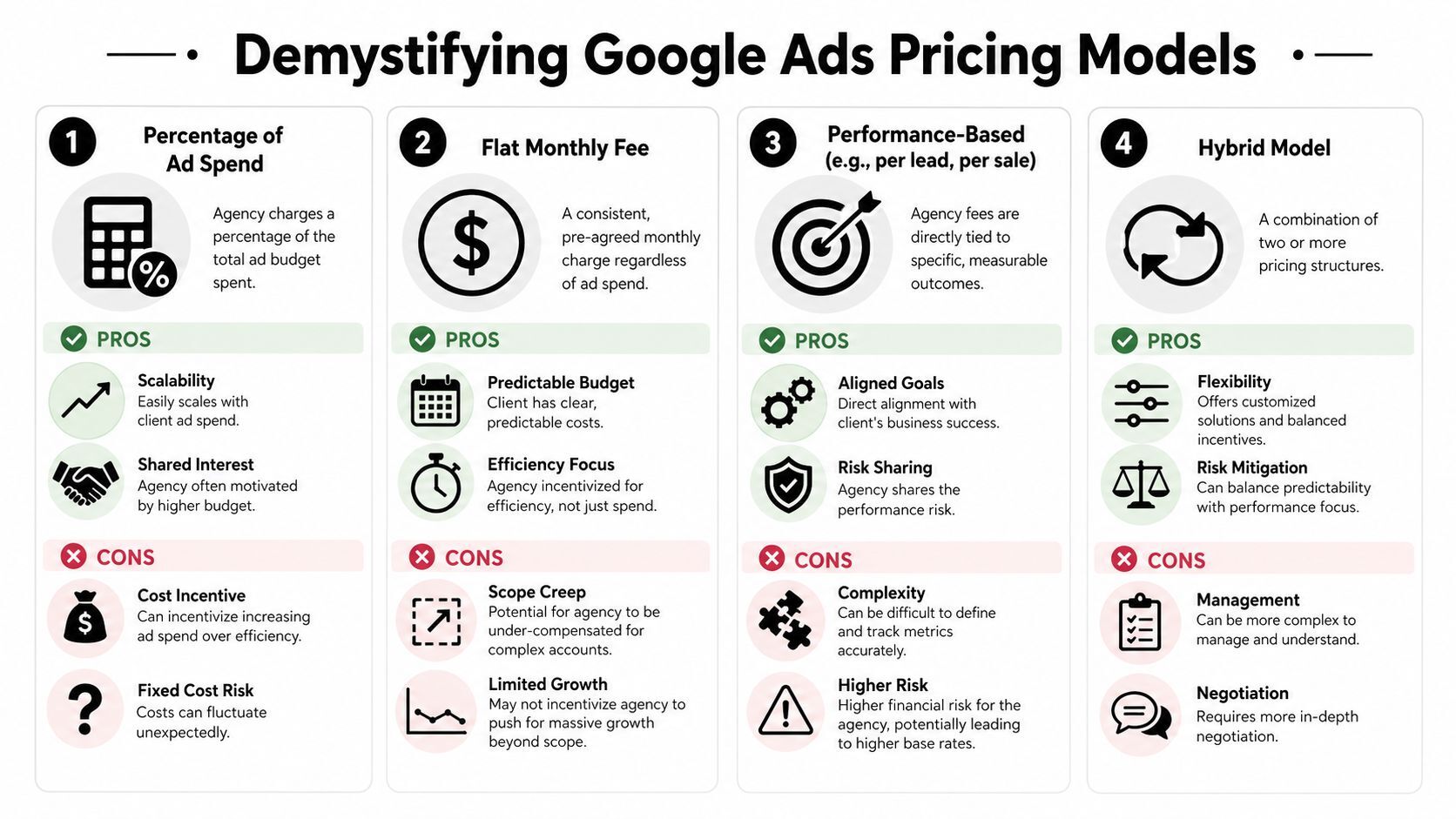
Percentage of ad spend rewards bigger budgets
Agencies love percentage-of-spend pricing for one reason. It pays them more when you spend more, even if your returns get worse.
That incentive conflict is baked in. A manager on 10% of spend has a direct financial reason to protect or increase budget. Cutting waste, shrinking bad campaigns, or pausing weak geographies can be the right move for your business and the wrong move for their invoice.
That does not mean every percent-based agency is dishonest. It means you should judge every recommendation through the fee model. If revenue stalls and the answer is still "raise budget," you are not getting strategy. You are getting a billing reflex.
Flat fees create cleaner incentives
Flat-fee pricing is usually the least distorted model for serious accounts. You agree on scope, access, reporting, testing, and strategic ownership. The consultant gets paid for the work, not for how much cash passes through Google.
That changes the conversation. Waste gets cut faster. Budget gets moved harder. Bad campaigns get shut down without the agency absorbing an unstated fee decrease for doing the right thing.
It also makes finance easier. You can forecast cost. You can compare service levels. You can audit whether the work matches the retainer.
If you want a useful benchmark for how these structures are usually framed, review this breakdown of PPC management pricing for real results. Then compare it to your current agreement line by line.
Performance pricing sounds aligned. It often turns into an argument.
"Pay us per lead" sounds attractive until everyone starts fighting over definitions.
What counts as a lead. A form fill. A qualified call. A booked meeting. A sales accepted opportunity. Each step changes the economics. If tracking is weak, sales follow-up is inconsistent, or offline conversion data is missing, performance pricing becomes a blame-shifting exercise.
The same problem shows up in how companies calculate marketing spend per lead. If your lead cost formula ignores qualification, duplicate submissions, spam, or no-show rates, the fee model rewards volume instead of value.
Performance deals can work. They work when attribution is clean, lead validation rules are written down, CRM stages are synced, and both sides agree on what success means before traffic goes live. Without that discipline, the model creates friction, not alignment.
The real test is simple
Ask what makes your provider more money.
If the answer is higher ad spend, more leads regardless of quality, or vague "optimization" hours nobody can verify, you have a structural problem. Agencies hide behind service language, but incentives tell the truth faster than sales decks do.
Use this quick filter:
Pricing model |
What you are told |
What it usually rewards |
|---|---|---|
Percentage of spend |
“We grow with you” |
Budget growth, even when efficiency slips |
Flat monthly fee |
“We cover the work” |
Better allocation, cleaner decisions, tighter cost control |
Performance based |
“We only win when you win” |
Lead inflation unless tracking and qualification are strict |
Hybrid |
“You get the best of both” |
Can work, but only with clear rules on spend, scope, and outcomes |
What to ask before you sign
Three questions expose bad incentives quickly:
What makes your fee increase? If it rises with spend, ask how often they recommend budget cuts.
What work is included every month? Search term review, feed work, landing page input, tracking checks, and testing should be named clearly.
What happens if efficiency improves and spend drops? A good partner accepts that result. A bad one resists it.
High-spend accounts do not need another agency account manager protecting a retainer. They need a specialist whose income does not depend on keeping waste alive.
Focus on Business Metrics Not Vanity Metrics
A report full of clicks can still hide a failing account.
That’s the trap. Agencies love vanity metrics because they’re easy to present and easy to inflate. Clicks, impressions, click-through rate, and average position can all move in the “right” direction while your pipeline quality gets worse.

The metrics that matter
For 2025, Google Ads benchmarks show an average conversion rate of 7.52% and cost per lead of $70.11 in recent Google Ads benchmark data. Those are useful reference points, not goals. Your manager’s job is to beat the relevant benchmark for your business while protecting lead quality.
The KPI stack I care about is simple:
ROAS for e-commerce, where revenue signal quality is high
CPA or CPL for lead gen, but only when paired with quality checks
Lead-to-opportunity movement for B2B and considered services
Customer value and margin context so acquisition cost has meaning
Sales feedback because the platform doesn’t know who became a good customer unless you tell it
What vanity reporting looks like
If your monthly review sounds like this, you have a problem:
“CTR improved.” Good. Did profitable conversion volume improve?
“Traffic increased.” Fine. Was it qualified traffic?
“Cost per click dropped.” Nice. Did lead quality drop with it?
“Impressions are strong.” Irrelevant unless they lead to revenue.
A mature account has one central question. Did this spend create profitable business movement?
A cheap lead that never closes is more expensive than an expensive lead that consistently turns into revenue.
That’s why CMOs and founders need to push beyond platform metrics. If you need a clean framework for evaluating acquisition economics, this guide to marketing spend per lead is helpful because it forces you to connect ad cost to real conversion value.
Audit your own report today
Use this quick test on the last report your agency sent:
If the report emphasizes |
Ask this next |
|---|---|
Clicks and impressions |
Which of these led to qualified opportunities? |
Conversion count |
How many were sales-qualified or revenue-producing? |
Cost per conversion |
What definition of conversion is this using? |
Platform trends |
What business decision should we make from this? |
A lot of teams also benefit from seeing someone walk through measurement concepts visually, especially when internal stakeholders need alignment. This video is a solid starting point for that conversation.
If your reporting still centers the platform instead of the business, fix that first. Then read this practical breakdown of how to measure advertising effectiveness. Better measurement usually reveals that the account didn’t need more budget. It needed better standards.
Questions to Ask Before Hiring Any PPC Provider
Most bad PPC hires could’ve been avoided with better questions in the sales process.
Don’t ask if they’re “data-driven.” Everyone says that. Ask questions that force them to reveal how they think, how they operate, and whether they’ll personally touch the work.

Ask who actually runs the account
Start here. Not who sells it. Who runs it.
A good answer is direct. You’ll know the person’s name, their role, and their level of hands-on experience with similar account complexity. A weak answer sounds vague, layered, and process-heavy.
Use this phrasing:
Who will manage my account day to day, and will I speak directly with that person?
If they dance around it, expect a handoff after the contract is signed.
Ask how they define success
You want to know whether they optimize around business outcomes or platform noise. If they answer with clicks, CTR, or traffic growth first, that’s a warning sign. A strong operator asks about pipeline quality, gross margins, sales cycle length, close rates, and customer value.
Ask:
Which metrics will you optimize toward for my business, and why?
How do you measure lead quality, not just lead volume?
The best answer usually starts with your business model, not Google Ads features.
Ask about tracking and ownership
This part matters more than most buyers realize. You should own the ad account, conversion setup, historical data, and connected assets. If they insist on running everything through an agency-controlled account, walk away.
Use these:
Will I retain ownership of the Google Ads account and all conversion data?
What conversions will you feed into bidding strategies?
How will you validate tracking before scaling spend?
Ask for process, not slogans
A real specialist can describe their operating rhythm clearly. They can tell you what they review weekly, what triggers structural changes, and how they decide between testing ad copy, revising landing pages, or tightening match types.
Here’s a useful set:
What does your weekly optimization routine look like?
How do you handle search term reviews and negative keywords?
When performance drops, what do you audit first?
How do you decide when to restructure campaigns instead of tweaking bids?
Ask for a turnaround example
You don’t need a theatrical case study. You need proof they can diagnose. The good answer will focus on the problem, the diagnosis, the fix, and the business impact in plain language. The bad answer will be generic, polished, and suspiciously light on specifics.
Try this:
Walk me through a failing account you turned around. What was broken first?
Good providers welcome these questions because they expose shallow competitors. Weak ones prefer chemistry calls and glossy decks.
If you want one final filter, ask this: What would make you tell me not to spend more right now? An honest expert will have an answer. A salesperson usually won’t.
Six Red Flags That Signal a Bad Partnership
You don’t need to wait six months to figure out a PPC provider is wrong for your business. The warning signs usually show up early. Most buyers ignore them because the reporting looks polished and the agency sounds confident.
Confidence means nothing. Diagnosis does.
They promise outcomes they can’t control
If someone guarantees top placement, guaranteed lead volume, or fixed performance outcomes before they’ve audited tracking, website experience, sales process, and market conditions, they’re selling fantasy. Serious PPC work is probabilistic. Good managers control process, quality, and speed of improvement. They don’t control the auction on command.
They treat Google Ads like an isolated channel
This is one of the biggest reasons campaigns underperform. Many PPC campaigns fail because managers ignore foundational problems like non-optimized websites and missing goal tracking, as outlined in analysis of why Google Ads fails for businesses. If your provider talks only about bids and keywords, they’re missing the system around the ads.
Your landing pages, forms, mobile experience, CRM hygiene, call handling, and sales follow-up all affect results. A real partner addresses that. A weak one hides behind media metrics.
If the website is broken, the ads aren’t the first problem to solve.
They report in a black box
You should know what changed, why it changed, and what happened next. If reporting is vague, heavily summarized, or stripped of meaningful details, assume one of two things. Either they don’t know what they’re doing, or they don’t want you to know how little they’re doing.
Look for these symptoms:
Vague language like “continued optimizations” without specific actions
No search term visibility even though waste usually hides there
No discussion of conversion quality despite lead gen being the stated goal
No clear next actions for the coming period
They over-rely on automation
Automation is useful. Blind faith in automation is expensive.
Bad managers use Smart Bidding and campaign automation as a substitute for account control. Good managers use them after tracking is clean, budgets are allocated correctly, and bad signals are stripped out. If your provider can’t explain the logic behind the automation they’ve enabled, they’re not managing it. They’re watching it.
You got sold by a senior person and serviced by a junior one
This is the agency classic. The sharpest person in the room disappears right after kickoff. Then you’re handed to someone well-meaning but underpowered, with too many accounts and not enough authority to challenge a bad strategy.
That handoff kills momentum. It also kills accountability.
They never ask about margins, sales quality, or business goals
If a provider doesn’t understand what a customer is worth, what a qualified lead looks like, and where your sales team sees friction, they cannot manage your account properly. They can operate the platform. That’s not the same thing.
The best PPC managers act like commercial operators. They care about revenue quality, not just ad interface outputs.
How Expert Management Adapts to Your Industry
A generic Google Ads playbook is useless once spend gets serious. The structure, bidding logic, conversion setup, and reporting cadence should change based on how your market buys. That’s where specialist management separates itself from agency templating.
E-commerce needs feed control and profit discipline
E-commerce accounts fail when managers chase top-line revenue without understanding product economics. A store can show attractive ROAS on paper and still lose money after fulfillment, returns, and blended acquisition costs. That’s why product segmentation matters. Best sellers, high-margin items, seasonal inventory, and low-margin traffic magnets should not all share the same strategic treatment.
A sharp e-commerce operator usually focuses on these levers:
Feed quality so Google Shopping and Performance Max have clean product data
Margin-aware segmentation so budget follows profitable inventory, not just high volume
Search intent layering to separate branded demand from real new-customer acquisition
Creative and asset refreshes when Performance Max starts flattening out
If you’re evaluating how AI tools fit into modern retail operations beyond ad buying, this guide to AI for e-commerce is useful context because it shows where automation helps and where human judgment still matters.
Healthcare needs trust, local precision, and clean intake tracking
Medical practices have almost no room for sloppy PPC. The click is expensive, the decision is personal, and the lead value can vary wildly by procedure or appointment type. A dermatology clinic, med spa, or plastic surgery practice should not run with the same account logic as a general service business.
The first adjustment is targeting. Hyper-local relevance matters. So does query filtering. Not every high-volume term reflects high-intent patient demand. A specialist will tighten geographic focus, align messaging to actual services, and make sure forms, call tracking, and scheduling events reflect real patient acquisition goals.
The second adjustment is intake quality. If staff response times are weak or lead routing is unclear, the account can look worse than it is. That’s why experienced consultants often audit front-desk handling and appointment workflows alongside the ads. The media can be fine while the operational handoff is broken.
In healthcare, the ad account and the patient intake process are part of the same system.
B2B needs CRM feedback and patience
B2B advertisers often get burned by agencies that optimize for cheap conversions at the top of the funnel. That creates volume and weakens pipeline. Whitepaper downloads, demo requests, contact forms, and webinar signups do not carry equal value, and Google Ads shouldn’t be trained as if they do.
A specialist builds around sales reality:
B2B challenge |
Specialist response |
|---|---|
Long sales cycle |
Import downstream CRM stages so bidding learns from qualified progress |
Low lead volume but high value |
Protect search intent and avoid broad, noisy expansion too early |
Multiple decision-makers |
Align ad messaging with buying-stage intent, not just one offer |
Offline influence on revenue |
Connect sales feedback to campaign decisions, not just in-platform forms |
This is also where direct communication matters most. CMOs and founders don’t need a generalized media summary. They need someone who can explain why lead volume dipped, whether lead quality improved, and what the account should do next based on pipeline behavior.
For companies that want a direct operator instead of an agency layer cake, Come Together Media LLC provides one-on-one Google Ads consulting, audits, campaign setup, and ongoing optimization with transparent reporting and direct communication. That model fits businesses that want strategic depth without paying for junior staff, account management layers, and agency overhead.
Industry adaptation isn’t optional. It’s the whole job. A campaign that works for an online store can fail badly for a surgical practice or a B2B sales team. High-spend advertisers need management built around how revenue is generated in their market.
Stop Overpaying for Underwhelming Results
If you’re spending heavily on PPC and still getting vague reports, slow execution, and mixed lead quality, the answer isn’t another agency pitch. It’s a different operating model.
Good google ads management services don’t come from bigger teams, fancier decks, or more platform jargon. They come from sharper diagnosis, better tracking, tighter optimization, and direct accountability. That’s why specialist partnerships outperform bloated agency setups so often. The incentives are cleaner. Communication is faster. Strategy doesn’t get diluted.
You don’t need more people touching the account. You need the right person owning it.
If your current provider can’t explain what’s broken, what’s being fixed, and how success is tied to business outcomes, you already have your answer.
If you want a direct review of your account without the usual agency theater, talk to Come Together Media LLC. Chase McGowan offers a no-obligation consultation that looks at account structure, tracking, keyword strategy, and ad copy so you can see where budget is being wasted and what a smarter PPC partnership should look like.
