


If you're a CMO or founder spending upwards of $25,000 a month on paid ads, you know the standard PPC ad agency playbook. Big promises during the sales pitch, followed by big retainers, junior account managers running the show, and performance that never quite materializes. It’s a frustrating and expensive cycle.
I've been in the trenches with high-stakes ad accounts for over a decade. This guide cuts through the agency noise and shows you how to stop wasting your budget.
Is Your PPC Ad Agency Just Expensive Busywork?
I see this all the time. A smart company hires a big-name agency, impressed by a slick presentation and the promise of a massive team. They talk a great game about "data-driven strategy" and incredible ROI.
Then, a few months in, reality hits. The hefty retainer is paid on time, but the day-to-day work on your account is handled by a junior employee following a checklist.
That senior expert who sold you the dream? They’re long gone, pitching the next client. Your "strategy" calls feel more like status updates, and the "optimizations" are minor tweaks that don't move the needle on your bottom line.
This isn't strategy. It's activity disguised as progress—a common agency tactic to justify fees without delivering measurable value.
The Problem with the Bloated Agency Model
The issue is baked into the traditional agency structure. Large agencies are built for volume, which means high overhead. To make their numbers work, they operate in a way that often hurts the client.
Delegation to Junior Staff: The real experts are reserved for sales calls or putting out massive fires. Your six- or seven-figure ad budget ends up in the hands of someone with maybe two years of experience.
One-Size-Fits-All Strategies: They rely on templates and standardized playbooks to manage a huge client roster. This cookie-cutter approach kills the custom strategy required to win in a competitive market.
Slow Execution: Need to launch a new campaign or test ad copy? A simple request gets stuck in a mire of internal processes, costing you time and opportunity.
Lack of Direct Accountability: When performance tanks, who is really on the hook? The account manager? The invisible strategist? The agency model is designed to diffuse responsibility.
The Hard Truth: You’re paying a premium for the agency’s brand name and fancy office, not for the senior-level expertise your account needs. Your ad budget is funding their overhead, not your growth.
A dedicated PPC consultant flips this broken model on its head.
When you hire a specialist, you pay for direct access to the expert. The person who builds your strategy is the same person implementing it, analyzing the data, and answering your calls. That direct line of accountability is the single biggest advantage for any serious business.
This guide isn't just about vetting your next agency; it's about shifting how you think about buying PPC expertise. You'll learn how to spot true specialists and build a partnership that drives results, not just reports.
A good place to start is understanding how different partnerships are priced and how each model impacts your goals. For a closer look, check out our breakdown of pay-per-click packages and what they really mean for you.
First, Define What a "Win" Actually Looks Like
Before you draft a single email to a potential PPC partner, stop. The most critical step happens right now, inside your business.
You must define success on your terms. If you don't, you're just handing over the keys and hoping they don't drive you off a cliff. Hope is not a strategy.
I’ve seen too many sharp founders and CMOs get sidetracked by vanity metrics—clicks, impressions, even a low cost-per-click. Why? Because they never set their own scorecard. A real partner will force this conversation, but you must walk into the room with the answers already in hand.
This isn't about "getting more leads." It's about knowing you need 250 qualified leads per month at a cost that keeps your CFO happy and your business profitable.
From Vague Goals to Hard PPC Metrics
Let's get specific. The only metrics that matter are tied directly to your revenue. An e-commerce brand and a B2B software company are playing two completely different games.
For E-commerce: Your north star is almost always Return on Ad Spend (ROAS). It’s a dead-simple ratio: for every dollar you spend, how much revenue do you generate? If your profit margin is 30%, a 3:1 ROAS is your breakeven point. Anything above that is profit. A great consultant won't just hit your target; they'll help you define a ROAS that fuels growth. If this is new territory, our guide on how to calculate Return on Ad Spend breaks it down clearly.
For Lead Generation (B2B/SaaS): ROAS is harder to track in real-time. Here, we obsess over Cost Per Acquisition (CPA) or, even better, Cost Per Qualified Lead (CPQL). You must know what a sales-qualified lead is worth. If your average customer lifetime value is $50,000 and you close 1 in 10 qualified leads, you can afford to pay up to $5,000 for that lead. That number is your ceiling.
For Market Share & Dominance: Sometimes, the goal isn't immediate profit but aggressive growth. In this scenario, you'll focus on metrics like Impression Share—the percentage of times your ads showed up when they could have. A concrete goal looks like this: "Achieve a 30% impression share on our top 10 commercial keywords by the end of Q3."
This isn't about pulling numbers out of thin air. It's about knowing your numbers cold before anyone tries to sell you on theirs.
Create Your Baseline Performance Audit
To set a realistic goal, you need an honest starting line. Get into your Google Ads account right now and pull the data from the last 90 days. Don't pretty it up. The point is to get a brutally honest picture of where you stand.
Answer these questions with hard data:
What is our current, true CPA or ROAS?
Which specific campaigns are actually profitable?
Which campaigns are a money pit?
What is our average Quality Score on our top 10 keywords? (This is Google's 1-10 rating of your ad relevance, and it directly impacts your ad costs.)
What is our conversion rate from click to actual lead or sale?
Actionable Takeaway: Put these five metrics on a single-page document. This is your internal scorecard. When a prospective partner comes in for a discovery call, their analysis should align with—or intelligently challenge—these numbers. If they can't talk specifics on this level, they haven't done their homework.
Walking into a meeting with this scorecard fundamentally changes the entire dynamic. You're no longer a passive client listening to a sales pitch. You're an informed partner setting the agenda, ready to talk about moving the numbers that actually matter.
The Vetting Checklist Real Experts Use
Forget the generic Request for Proposal (RFP). Any agency worth its salt has canned answers for those. If you want to find a real PPC partner, you need to interview them like an expert.
This isn’t about tripping them up. It’s about digging past the sales pitch to see how they think. A polished account executive can talk about case studies all day, but a true specialist can debate the nuances of bidding strategies and defend their account structure philosophy. That’s how you find the doers among the talkers.
Core Philosophy and Strategy
First, you need to get a feel for their foundational approach. Are they running a process-driven assembly line, or are they bringing real strategy to the table? The answers to these questions will tell you everything.
I always start with these high-level prompts:
"Walk me through your ideal account structure for a business like mine." A good answer is never "we use SKAGs" or "we just throw everything into PMax." A pro will ask you about your product lines, profit margins, and customer LTV before even starting to sketch out a custom plan.
"What’s your stance on automated vs. manual bidding?" An absolute answer here is a huge red flag. The only correct response is, "It depends." A seasoned expert will explain when they’d use Smart Bidding (like for scaling proven campaigns) and when they'd lean on manual CPC (like when you need tight control over spend on unproven keywords).
"How are you handling conversion tracking in a post-cookie world?" If their eyes glaze over or they mumble something about the pixel, run. In 2026, if they aren’t immediately talking about server-side tagging, enhanced conversions, and building a first-party data strategy, they're dangerously behind.
Recent data shows 72% of advertisers are prioritizing efficient growth, and campaign performance is the top concern for 52% of agency pros. While Google's Smart Bidding adoption has jumped 30% year-over-year, it's also a source of frustration for 52% of managers who hate its "black box" nature. You're not just hiring an agency anymore; you're hiring an expert to navigate this complexity.
Dissecting Case Studies and Past Performance
Every agency shows up with a deck full of shiny logos and impressive-looking graphs. Your job is to pick them apart. Don't be wowed by brand names; focus on the actual, undeniable impact.
When they present a success story, dig in with these questions:
"What was the starting ROAS or CPA before you came in?" Doubling a 1x ROAS is a completely different ballgame than moving a 5x ROAS to 6x. Context is king.
"Can you actually show me the reporting dashboard for this client?" They can (and should) hide sensitive client data, but a flat-out refusal to show a real, live dashboard is a major red flag. It suggests the pretty graphs in their PDF might not tell the whole story.
"What was the biggest mistake you made on this account, and how did you fix it?" I love this question. An expert who claims they've never failed is an expert who has never managed a truly difficult account. Honesty here is a sign of confidence, not weakness.
Actionable Takeaway: Ask for their worst client result and what happened. A real professional will own it, explain the lessons learned, and detail the systems they built to prevent it from happening again. An amateur will blame the client, the product, or "the algorithm."
This is a powerful test of accountability. For more ideas on structuring your evaluation, you can reference our complete PPC audit checklist to see what a truly thorough analysis involves.
Any new partner should start by working with you to define clear objectives. It's a foundational step that can't be skipped.
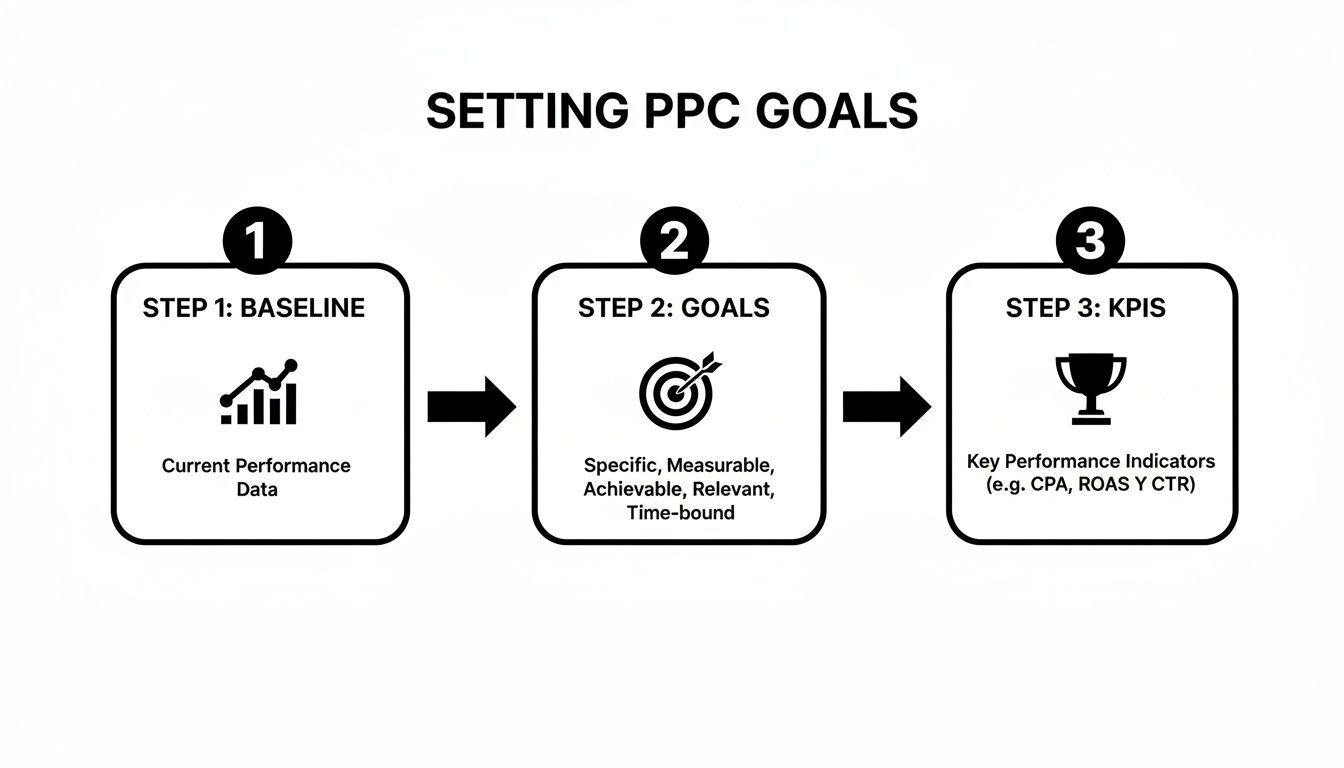
The process is simple but critical: you can't set meaningful goals without a solid baseline, and you can't measure progress without the right KPIs.
Understanding Pricing Models
Finally, let's talk about the money. The way a PPC ad agency or consultant structures their fees reveals their incentives. There are three common models, each with its own pros and cons.
Flat Retainer: You pay a fixed fee every month. This is my preferred model, hands down. It aligns incentives around efficiency and profitability, not just spending more of your money. It’s predictable and rewards strategic thinking.
Percentage of Ad Spend: The agency takes a cut of your media budget (typically 10-15%). I strongly advise against this model. It creates a dangerous conflict of interest where their primary incentive is to get you to spend more, whether it’s profitable for you or not.
Performance-Based: You pay based on results, like a percentage of revenue or a flat fee per lead. This sounds great on paper, but it often leads to endless arguments over attribution and can encourage a focus on short-term gains at the expense of long-term account health.
Your vetting process is your single best defense against a bad hire. As you build your own checklist, it can be helpful to see how others approach it. This Your Guide to Hiring an AEO Agency for Crypto Companies offers some great insights into vetting that apply well beyond its niche. A tough, informed interview process ensures you end up with a partner, not just another vendor.
Red Flags and Green Lights in Your Search
After spending more than 15 years in the trenches with Google Ads, I’ve seen every sales tactic and agency gimmick. Vetting a potential partner isn't about falling for shiny case studies; it's about spotting the subtle signals that separate a true specialist from a slick sales operation.
Learning to read between the lines is your best defense against a very expensive mistake.

And that intuition is critical. While about 55% of companies hire agencies for their PPC, a shocking 52% of B2B ads are still dumped onto generic homepages instead of purpose-built landing pages. With Google Search CPCs jumping 45% in recent years, that isn’t a small oversight—it’s throwing your budget directly into a fire.
A competent partner spots and fixes these fundamental errors on day one. If you want to see more stats that will keep you up at night, check out the full breakdown from ppc statistics from digitalthirdcoast.com.
The Red Flags That Scream "Run"
Some promises are just dead giveaways that you’re talking to a sales-led churn-and-burn shop, not a results-driven partner. If you hear any of these, your guard should go way up.
Guarantees of "#1 Rankings": This is the oldest, laziest trick in the book. Nobody can guarantee a specific rank on Google. Performance is a complex dance between budget, bids, ad relevance, and Quality Score. A guarantee is a lie. Full stop.
Vague, Fluffy Reporting: If their sample reports are full of vanity metrics like impressions and clicks but are suspiciously light on ROAS, CPA, or cost per qualified lead, they're hiding poor performance behind useless numbers. A real pro builds transparent dashboards that tie every dollar of ad spend to an actual business outcome.
Resistance to Direct Access: Ask them: "Who, specifically, will be managing my account day-to-day?" If the answer is vague or they talk about a "team," you have a problem. You need a direct line to the person actually pulling the levers, not an account manager who passes notes to a junior employee you'll never meet.
Blaming the Landing Page for Everything: Don't get me wrong, landing pages are vital. But when an agency’s first move is to blame your website for bad results—without showing you their own ad-level data like abysmal click-through rates or garbage keyword choices—they're just deflecting. An expert diagnoses the entire funnel with you, not just points fingers.
A classic scenario I see all the time: an agency suggests doubling the budget after one bad month. A true pro would never recommend scaling spend without a clear, data-backed hypothesis for why it will work. "Let's spend more" is a hope, not a strategy.
Green Lights That Signal a True Partner
On the flip side, the best consultants and focused agencies operate on a completely different level. These are the green lights telling you that you’ve found someone invested in your success, not just their monthly retainer.
You can get a more detailed breakdown in our guide on choosing a digital marketing agency that delivers results.
A genuine expert will always:
Insist on a Deep-Dive Audit First: They won't throw a price or a strategy at you until they get under the hood of your ad account. They need to see your historical data, campaign structure, and conversion tracking setup to find the real opportunity.
Talk About Your Business, Not Just Ads: The first conversations are all about your profit margins, customer lifetime value (LTV), and sales cycle. They know PPC is just a tool, and they need to deeply understand the business goals that tool is supposed to achieve.
Present a Custom-Built Strategy: You won't get a templated, cookie-cutter proposal. You'll see a plan built from the ground up for your specific situation, outlining clear priorities for the first 30, 60, and 90 days.
Provide a Clear Onboarding Plan: A great partner doesn’t just wing it. They have a structured, proactive process for kickoff that covers everything from tracking setup and communication cadences to defining what success looks like on the dashboard.
Your gut instinct is important, but backing it up with these objective red flags and green lights is what empowers you to cut through the sales pitch. It’s how you find a specialist who will act as a genuine partner in your growth, not just another PPC ad agency.
Building a Partnership from Contract to Kickoff
You’ve run the gauntlet, vetted the field, and finally picked your new PPC partner. The impulse is to sign, hand over the keys, and wait for the magic to happen.
That’s a huge mistake.
The ink on the contract is just the starting gun. The real work—the stuff that builds trust, alignment, and actual results—happens during onboarding. A true pro will guide you through this. A lazy agency just sends an invoice and a Google Ads access request. Don't settle for that.
This initial period sets the rhythm for your entire relationship, from how you share passwords to how you talk about performance.
Essential Contract Clauses to Protect Your Business
Before we get to the kickoff plan, let's talk about the agreement itself. I’ve seen my share of one-sided contracts that leave the client with all the risk. Your lawyer should have the final say, but you need to personally hunt for these three clauses and ensure they’re airtight.
Data and Account Ownership: This one is non-negotiable. The contract must state, in no uncertain terms, that you retain 100% ownership of your Google Ads, Google Analytics, and any other accounts. You are granting access, not ownership. Any agency that tries to build your campaigns inside their own account is holding your data hostage. Run.
Termination Clause: What happens if it's not working out? Look for a clear exit path, usually a 30-day written notice. Avoid getting locked into long-term contracts. A partner who is confident in their work doesn't need to trap you for a year; their performance is what keeps you around.
Service Level Agreement (SLA): This is the "what are we actually paying for" section. It must clearly define what’s included (e.g., campaign management, monthly reporting calls) and, just as importantly, what’s not (e.g., landing page design, CRM integration). This simple clause prevents scope creep and saves you from a world of headaches and surprise invoices.
The contract isn’t just a formality—it's the rulebook for your partnership. If a potential partner pushes back on clauses that protect your ownership and flexibility, that’s not a negotiation tactic. It’s a massive red flag.
Your 90-Day Onboarding Checklist
A great partner will arrive with their own onboarding process. But you need your own checklist to hold them accountable. This isn't just a technical to-do list; it’s about building a collaborative machine from day one.
Getting this right is everything. We know 74% of brands call PPC a massive driver for their business, and the average return is $2 for every $1 spent on Google Ads. A flawless onboarding is how you hit those numbers. It means nailing the fundamentals, like getting your remarketing right—since 92% of first-time visitors don't convert—and pushing for dedicated landing pages, which can lift conversions by 65%. With Google Search CPCs up 45% in recent years, there’s no room for a sloppy start. You can find more detail on how these PPC statistics impact your bottom line.
Here’s a sample 90-day plan you can use.
First 30 Days: Foundation and Tracking
Month one is all about access and data integrity. If your tracking is a mess, you're lighting money on fire.
Grant Secure Access: Set them up with user-level access to Google Ads, Google Analytics 4 (GA4), Google Tag Manager, and your Merchant Center (if e-commerce). Never share your root password.
Conduct a Full Tracking Audit: Your new partner’s first job is a deep dive into your conversion tracking. This means verifying GA4 events, auditing Google Ads conversion actions, and mapping out a plan for server-side tagging.
Establish a Communication Rhythm: Agree on a schedule upfront. A weekly 30-minute check-in and a monthly 60-minute strategy review is the sweet spot.
Outline Initial Strategy & Quick Wins: Based on their audits, your partner should present a 30-day roadmap focused on immediate fixes that stop the bleeding, like axing budget-hog keywords or fixing broken sitelinks.
Days 31-60: Implementation and Testing
With a solid foundation, month two is about execution. The new strategy takes shape and the testing engine fires up.
Campaign Restructuring: If the account needs a rebuild, this is when they should methodically roll out the new, agreed-upon campaign structure.
Ad Copy & Creative Testing: The first round of A/B tests should go live. They should be testing everything: headlines, descriptions, images, and videos.
Landing Page Recommendations: Your partner should analyze initial performance data and come to you with specific, data-backed ideas for improving your landing pages.
Launch Reporting Dashboard: You should get access to a clean, real-time dashboard tracking the KPIs you agreed on.
Days 61-90: Optimization and Scaling
By the end of the first quarter, the relationship should feel less like a project and more like a partnership. The focus shifts from fixing and building to optimizing and scaling what's proven to work. The goal is a well-oiled machine ready for growth.
This kind of structured onboarding makes all the difference. It turns a simple vendor transaction into a true strategic partnership. When you hire a PPC specialist, you’re not just buying a service—you’re investing in a process built for long-term success.
A Few Questions I Get All The Time
After years spent in the trenches of high-stakes ad accounts, I hear the same questions from sharp CMOs and founders. They're tired of getting the runaround from the typical PPC ad agency and just want straight answers. So, here they are.
What’s a Realistic ROAS to Expect?
There's no magic number. If an agency throws out a number without a deep dive into your business, they're selling you a dream. A realistic Return on Ad Spend (ROAS) is completely tied to your industry, profit margins, and how competitive your keywords are.
For an e-commerce brand, a 4:1 ROAS might be a solid starting point. But for a B2B SaaS company, we should be obsessed with Cost Per Qualified Lead (CPQL). A real partner will dig into your historical data and unit economics to set a data-driven target with you, usually within the first 30-60 days.
Should an Agency Use My Google Ads Account or Their Own?
Your account. Full stop. You must insist on using and retaining full, unfettered ownership of your existing Google Ads account. This is non-negotiable.
Any agency pushing to run campaigns from their own account—where you don't have admin access—is a massive red flag. You own the historical data. You own the Quality Score you've paid to build. You own the learnings. A reputable consultant works within your assets, period. If the account is a disaster, they should rebuild it inside your existing one, not lock you out of a new one they control.
A professional works in your house; a shady contractor tries to lock you out of it. Always, always keep the keys.
How Long Before I See Real Results?
You’ll get data like clicks and impressions almost instantly. But meaningful business results? That takes patience.
First 30 Days: This is all about data collection, fixing what's broken, and initial optimizations. Think of it as triage—stopping the bleeding.
Days 60-90: By the end of your first quarter, you should see clear, positive trends in your main KPIs, whether that's conversion rate or cost-per-acquisition.
Anyone promising a miracle overnight is just trying to close a deal. We're building a sustainable growth engine here, not buying a lottery ticket.
Is a Low CPC More Important Than a High Conversion Rate?
A high conversion rate wins that fight every time. Chasing a low Cost-Per-Click (CPC) is a classic vanity metric if the traffic doesn't actually buy anything.
I would much rather pay $25 for one click that converts than $1 each for 25 clicks from tire-kickers who just leave. The only metric that pays the bills is profitability—your ROAS or your cost per acquisition. A true expert focuses on driving profitable actions, not just racking up cheap, empty traffic.
Navigating the PPC world can feel like a minefield, but you don't have to go it alone. If you're done with generic agency answers and want a dedicated expert managing your Google Ads with a relentless focus on real ROI, Come Together Media LLC can help. Get a free, no-strings-attached consultation and see what a specialist approach can do for your account's performance. Learn more at https://www.cometogether.media.
