


Most advice on Google Ads starts in the wrong place. It asks whether the platform works, as if the answer lives inside Google's interface.
It doesn't.
For a founder or CMO already spending serious money on paid media, the core question isn't whether Google Ads can produce returns. Instead, it's whether your company has the tracking, economics, offer, and management discipline to turn intent into profit. That's where most accounts break. Not because Google Ads “stopped working,” but because the business behind the account never built a system that could measure and improve performance properly.
That's also why so many experienced operators get frustrated with agencies. They hear polished reporting, broad recommendations, and recycled best practices, yet they still can't answer the only question that matters: is this spend creating profitable growth? If your wider content and demand generation strategy is also fragmented, it helps to tighten that up too. Klap's video content strategy guide is a useful reference for making sure paid acquisition isn't carrying the full load alone.
Table of Contents
Stop Asking If Google Ads Is Worth It - The question mature operators should ask - Where the answer usually goes wrong
Understanding Your True Return on Ad Spend - Clicks are not the business model - The inputs that actually control profit
Why Your Agency Is Holding You Back - The structural problem with agencies - Why a specialist changes the economics
The High-Spend Account Readiness Checklist - What must be in place before you scale - A fast self-audit
How Specialists Drive Results Case Studies - Case one e-commerce account with wasted Shopping spend - Case two B2B lead gen with fake efficiency - Case three local service business choosing the wrong product
Your Next Steps for a Profitable Google Ads Strategy - The practical next move
Stop Asking If Google Ads Is Worth It
If you're asking “is Google Ads worth it,” you're probably asking the wrong question.
The better question is whether your business is set up to make Google Ads measurable and improvable. That distinction matters because many accounts fail or underperform due to weak attribution, poor post-click conversion, or insufficient optimization capacity rather than the ads themselves, as noted by Factors.ai's analysis of whether Google Ads is worth it. I've seen this repeatedly in high-spend audits. The platform gets blamed for failures created by bad setup and weak management.
That's why generic agency advice gets expensive fast. A dashboard full of impressions, click-through rates, and “optimizations completed” doesn't help if your lead values are unclear, your CRM isn't feeding back revenue, and your landing pages don't convert qualified traffic. In that situation, more spend just amplifies the mess.
The question mature operators should ask
Senior marketers should ask four things instead:
Can we track real business outcomes? Not just form fills. Revenue, qualified pipeline, booked calls, closed deals, or confirmed purchases.
Do we know our target CPA or ROAS? If not, nobody can judge performance accurately.
Is our landing experience strong enough to convert paid traffic? Weak pages make every click look overpriced.
Who is managing this account? A senior specialist or a chain of account managers and junior buyers.
Google Ads doesn't rescue weak economics. It exposes them.
Google Ads is usually worth it for businesses that can attribute sales or lead value accurately and optimize around acquisition cost. It's usually not worth it for businesses that want fast wins without the operational discipline to support them.
Where the answer usually goes wrong
The market loves simple advice. “Google Ads works.” “Google Ads is too expensive.” “Performance Max solved it.” None of that is serious analysis.
A serious analysis starts with readiness and management quality. If your organization can't measure outcomes, respond to search term waste, fix landing page friction, and make budget decisions based on profit, then you don't have a Google Ads problem. You have a management problem.
Understanding Your True Return on Ad Spend
The wrong way to evaluate Google Ads is to stare at CPC and ask whether clicks are cheap enough.
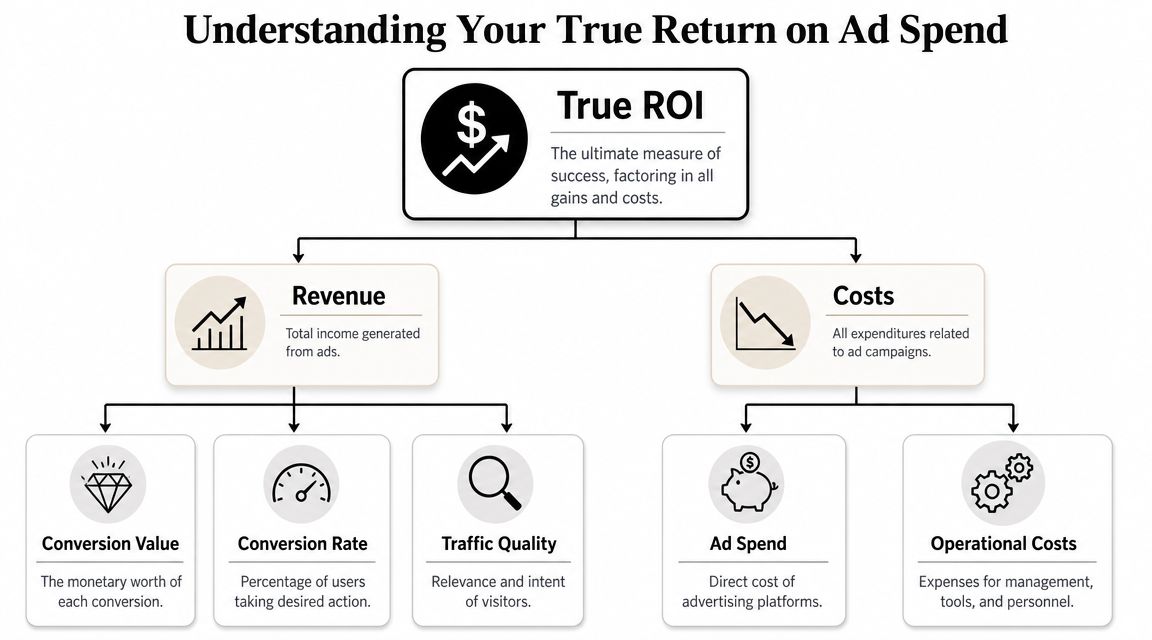
The right way is to treat the account like a profitability engine. Google reports an average return of about $8 in revenue for every $1 spent while average Google Ads conversion rates sit around 3% to 6%, according to WebFX's Google Ads statistics summary. That gap tells you everything. Revenue potential exists, but it only turns into profit when measurement and conversion optimization are handled properly.
Clicks are not the business model
A lot of accounts look healthy on the surface. Traffic is up. Cost per click looks manageable. Search terms appear relevant enough.
Then you inspect the actual business outcome and find one of three problems:
Problem |
What it looks like |
What it causes |
|---|---|---|
Bad tracking |
Leads counted twice, calls missing, offline sales ignored |
False ROAS and bad bidding decisions |
Weak economics |
No clear lead value or customer lifetime value |
You can't set a defensible CPA target |
Poor post-click experience |
Slow pages, weak offer, cluttered forms |
Paid traffic leaks after the click |
This is why I push clients to define ROAS clearly. Return on ad spend means revenue generated divided by ad spend. If you need a practical benchmark framework, this breakdown of what is a good ROAS for Google Ads is the right starting point.
The inputs that actually control profit
Most agencies spend too much time talking about bidding strategies and not enough time fixing the foundations those strategies depend on.
Here's what moves performance:
Conversion tracking hygiene. Google Ads only works as well as the signal you feed it. If purchases, qualified leads, phone calls, and offline outcomes aren't tracked correctly, Smart Bidding learns from bad data.
Customer lifetime value. If a customer buys once, your CPA tolerance is different from a business with repeat purchases or long contracts. That changes how aggressively you can bid.
Quality Score. This is Google's assessment of relevance and landing-page experience. Better relevance can lower costs and improve ad position, but it only matters when tied to profitable conversion behavior.
Search term control. The Search Terms report tells you where budget is leaking into irrelevant intent. Good managers use it relentlessly.
Practical rule: Don't scale spend until you trust the numbers more than the dashboard visuals.
If you're trying to pressure-test whether your landing pages are even in a realistic range, this overview of the average website conversion rate by industry is useful context. Not as a target. As a sanity check.
A strong Google Ads account doesn't win because it found “cheap traffic.” It wins because the business knows what a conversion is worth, tracks it cleanly, and improves every link in the chain from search query to revenue.
Why Your Agency Is Holding You Back
Most agencies don't fail because they're lazy. They fail because their business model is built to preserve agency margins, not your account efficiency.
That distinction matters more as spend increases. Once you're beyond small-budget experimentation, the cost of slow decisions, shallow analysis, and junior execution becomes real. You don't need more meetings. You need better judgment in the account.
The structural problem with agencies
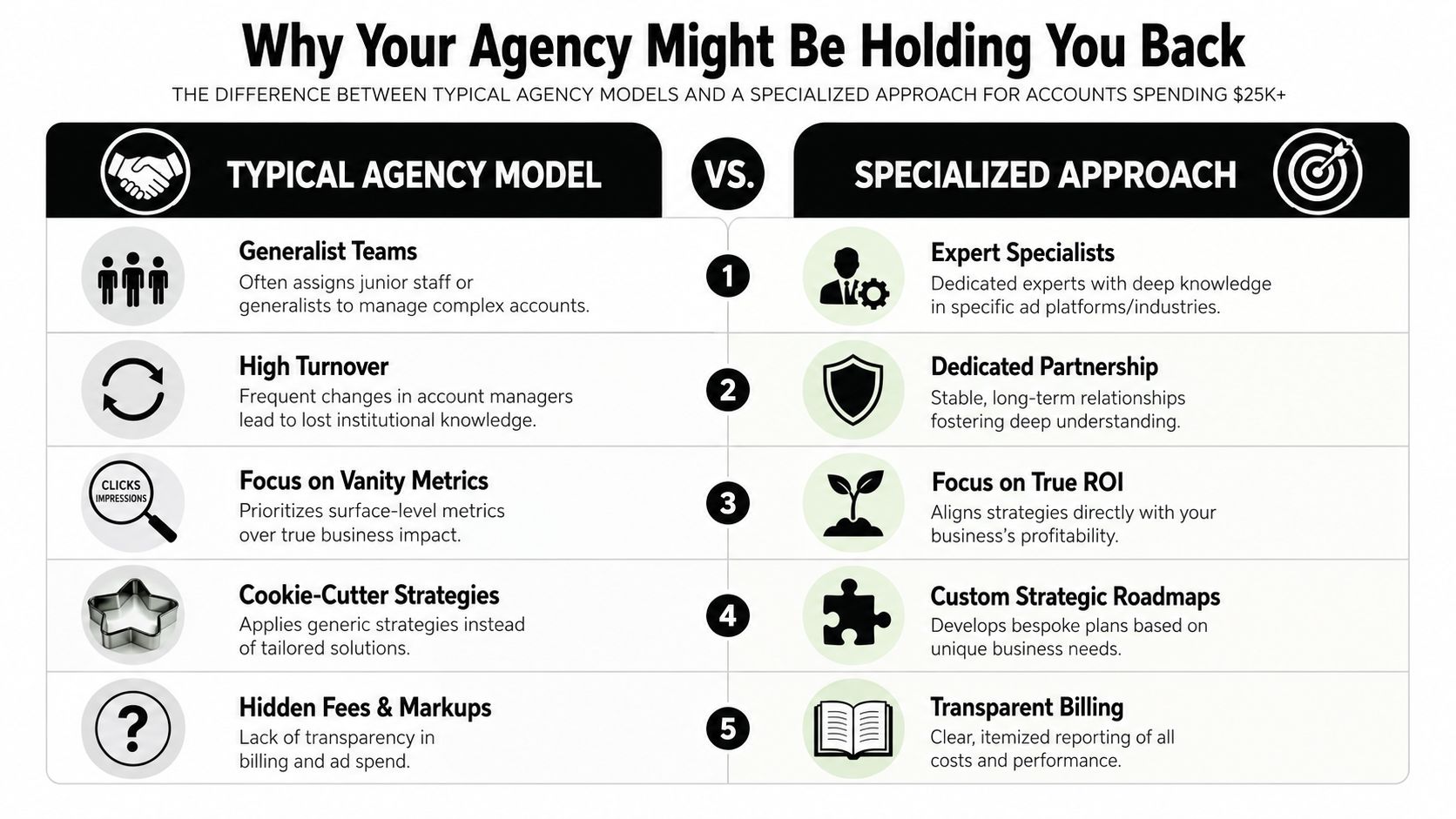
Here's the pattern I see in audits of bloated agency-managed accounts:
Layered communication. You talk to an account manager. The account manager talks to a strategist. The strategist hands work to a coordinator. Execution slows down and nuance gets lost.
Junior handling on senior budgets. The pitch is led by experience. The account is run by whoever has bandwidth.
Percentage-of-spend incentives. If the agency gets paid more when you spend more, you should question how “scale recommendations” are being made.
Reporting theater. Fancy decks, weak business insight.
There's also a basic volume problem. Industry guidance notes that Search CPCs often fall in the $1 to $2 range, and many businesses need at least about $1,000 per month to generate enough traffic for testing, with $1,500 cited as a more workable baseline for faster learning, according to ActiveCampaign's review of Google Ads budgets. Agencies that ignore even that baseline are setting clients up to collect noise, not signal.
That same logic applies at the high end. Big budgets need even tighter oversight because wasted spend scales faster than insight.
A useful comparison of the delivery model problem is this breakdown of the PPC ad agency model. It gets to the point. Agencies often sell breadth when the account requires depth.
Why a specialist changes the economics
An independent specialist fixes the management model first.
You get direct communication with the person making strategic decisions. You get faster feedback loops between search terms, ad copy, landing pages, and CRM outcomes. You get someone who can say no to wasted expansion and redirect budget based on margin, not agency revenue.
That's the difference.
A specialist also has fewer reasons to hide behind process. If tracking is broken, it gets addressed. If match types are too loose, they get tightened. If branded search is flattering the account, someone says it out loud.
This video does a good job showing where a lot of paid media accounts go off course before anyone notices:
Most “underperforming” Google Ads accounts aren't broken because of platform changes. They're underperforming because nobody senior is close enough to the account to make sharp decisions quickly.
If you're spending heavily, the management layer is not a side issue. It is the answer to whether Google Ads is worth it.
The High-Spend Account Readiness Checklist
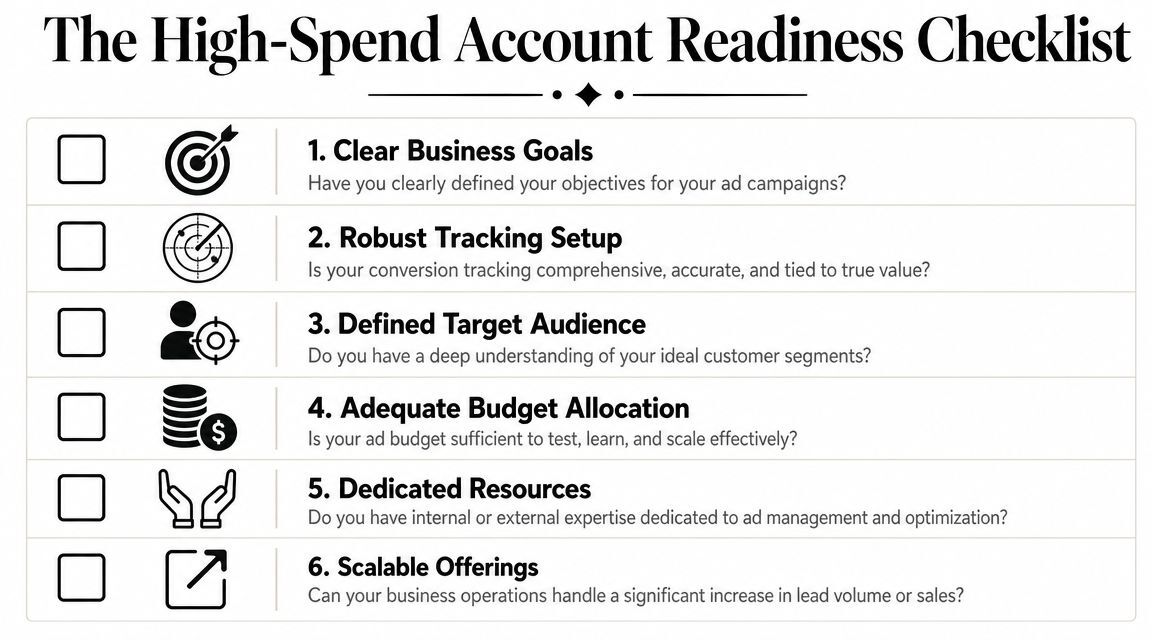
Before you increase budget, launch another campaign type, or blame the platform, run a readiness check.
Google's measurement guidance is clear on the principle. Google Ads becomes worth it when the account has enough conversion volume to support meaningful optimization, and without reliable attribution to specific actions, ROAS calculations become unstable, as explained in Google's guidance on analyzing Google Ads successfully.
What must be in place before you scale
Use this as a blunt diagnostic, not a feel-good worksheet.
Tracking that reaches revenue If your setup stops at “lead submitted,” you're guessing. Good looks like Google Ads linked properly, Analytics connected, auto-tagging enabled, and downstream outcomes mapped back to campaign data where possible.
An offer that converts cold intent Paid search traffic is unforgiving. A vague promise, weak pricing logic, or generic landing page will undercut even well-targeted campaigns. Good looks like a clear offer, a relevant page, and a clean call to action.
Defined unit economics You need a target CPA, lead value, or revenue threshold that makes the campaign worth running. If finance and marketing disagree on what a lead is worth, the account will drift.
Search term discipline Query intent matters more than keyword volume. Good looks like regular review of the Search Terms report, active negative keyword management, and campaign structure built around commercial intent rather than vanity traffic.
A fast self-audit
Score each of these as yes, no, or not sure.
Checkpoint |
Why it matters |
What good looks like |
|---|---|---|
Can you see which campaigns drive qualified outcomes? |
Otherwise bidding is blind |
Sales-qualified or revenue-linked conversion data |
Do your landing pages match search intent? |
Misalignment destroys conversion efficiency |
Message match between keyword, ad, and page |
Can the business handle more volume? |
Scaling ads into operational bottlenecks wastes money |
Sales, fulfillment, and support can absorb demand |
Is someone reviewing search term waste routinely? |
Irrelevant intent drains spend quietly |
Active negative lists and regular query review |
For a broader operational review, this PPC audit checklist is useful because it forces the right questions before budget expansion.
If you can't explain why a campaign wins, you can't scale it safely.
One practical note. This is also where a focused consultant can be more useful than a large agency. Come Together Media LLC provides Google Ads consulting, audits, and ongoing PPC management with direct strategist involvement, which is the kind of setup that tends to expose readiness gaps faster than a layered account team.
How Specialists Drive Results Case Studies
The value of specialist management shows up in the fixes. Not in polished presentations.
Below are common high-spend scenarios I've seen repeatedly. These aren't vanity stories. They're the kinds of account corrections that change the economics of paid search.

Case one e-commerce account with wasted Shopping spend
The account was spending aggressively in e-commerce but performance had flattened. The agency response was predictable. Broaden targeting, test more creative, push more budget into automated campaigns.
The actual problem was simpler. The product feed was messy, search intent was too broad, and the business wasn't separating high-margin products from lower-value traffic. That matters because Shopping Ads account for 85% of clicks on all Google Ads campaigns and drive more than 75% of U.S. retail search ad spend, according to Constant Contact's Google Ads benchmark review. If you manage e-commerce and ignore Shopping structure, you're ignoring the core of the opportunity.
The specialist fix was to tighten feed quality, segment campaigns around commercial value, and cut low-intent query exposure. Same platform. Better control.
Case two B2B lead gen with fake efficiency
This account looked efficient inside Google Ads. Cost per lead appeared acceptable. The agency kept reporting stable performance.
Sales hated the leads.
Once we audited the setup, the issue was obvious. The account optimized for every form fill equally, including low-intent submissions. No serious feedback loop existed between the CRM and ad platform. Broad-match traffic was being praised for volume while quality was deteriorating.
The specialist response was to redefine conversions around qualified outcomes, rebuild campaigns around higher-intent terms, and clean up negatives. Performance usually improves when you stop rewarding junk.
Cheap leads are often just expensive disqualified leads with better presentation.
Case three local service business choosing the wrong product
Some businesses shouldn't default to traditional search campaigns. I've seen local service advertisers force Google Ads traffic to weak websites when a lead-first product made more sense.
That's why channel selection matters as much as campaign execution. For local and service businesses, I often advise leaders to study adjacent operator resources, even outside PPC circles, because they sharpen offer positioning and service packaging. The LunaBloom AI blog is one of those useful outside perspectives.
In these cases, the specialist's job isn't to push one platform. It's to choose the right acquisition layer, then make sure tracking and follow-up support it. If you want more examples of this kind of account triage, these Google Ads case studies show the kind of practical before-and-after thinking that matters.
Your Next Steps for a Profitable Google Ads Strategy
Google Ads is worth it when the business behind it is ready to use it properly.
That means clean tracking. Real unit economics. Strong landing pages. Search term discipline. Senior oversight. If one of those is missing, the platform becomes harder to judge because you're no longer evaluating advertising. You're evaluating a broken operating system.
This is also where a lot of businesses oversimplify the decision. Traditional Google Ads is not always the right answer. For some local service businesses, Google distinguishes standard Google Ads as a pay-per-click product and Local Services Ads as a pay-per-lead model, and using both can make sense depending on the role each plays in the funnel, as outlined in Google's small business marketing guidance. A serious advisor should help you choose the right structure, not force every budget into the same channel mix.
The practical next move
If you're leading a high-spend account, do three things this week:
Audit your conversion actions and remove anything that flatters the platform without reflecting business value.
Review your search terms and landing pages together instead of treating them as separate problems.
Look at your management model critically. If the person making strategic decisions isn't close to the account, that's likely the bottleneck.
You don't need more agency process. You need sharper accountability.
If your current results feel unclear, inconsistent, or artificially polished, get an outside audit from someone who works directly in the account. Not someone selling a retainer first and understanding the economics later.
If you want a second set of eyes on your Google Ads account, Come Together Media LLC offers direct Google Ads consulting and PPC audits through Chase McGowan. The value is simple: a no-obligation review of account structure, tracking, keyword strategy, and ad performance so you can see where money is being wasted and what would need to change to make the spend more profitable.
