


Most advice on what is a good ROAS for Google Ads is lazy.
An agency says 4:1 is good, drops it into a slide deck, and expects applause. That’s not strategy. That’s a shortcut. A generic ROAS target tells you nothing about whether your campaigns are producing profit, supporting cash flow, or acquiring customers you can afford to keep buying.
If you’re spending serious money in Google Ads, you need a business answer, not a platform answer. Google Ads can show a healthy return in the interface while your finance team sees margin disappear. I’ve audited enough large accounts to tell you the pattern is common: bloated agencies optimize to dashboard optics because dashboard optics are easier than real commercial math.
A good ROAS is the one that fits your margins, sales cycle, and customer value. Sometimes that number is higher than the benchmark everyone repeats. Sometimes it’s lower, and still completely rational. The difference comes down to whether you're measuring revenue or measuring profitable growth.
Stop Asking What a Good ROAS Is
“What’s a good ROAS?” is the wrong question. It pushes you toward a generic number when you need a commercial threshold tied to your own economics.
That mistake is everywhere in Google Ads. Agencies quote benchmark ranges because benchmarks are easy to sell, easy to report, and easy to defend in a meeting. None of that makes them useful. A target only matters if it reflects your gross margin, fulfillment costs, sales cost, refund rate, and customer value after the first purchase.
If you want a plain-English definition before you judge the metric, this explanation of ROAS meaning in marketing covers the basics. The problem starts after that, when teams treat a simple ratio like a universal performance standard.
A store with healthy margins and strong repeat purchase behavior can afford a lower first-order ROAS and still grow profitably. A business with thin margins, expensive shipping, financing costs, or a sales team in the conversion path may need a much higher number just to break even.
That gap is why generic ROAS talk wastes time.
Why benchmark chasing leads to bad decisions
I see the same pattern in account audits. Leadership gets attached to a clean round number, then the account gets managed to satisfy the number instead of the business.
A 3:1 ROAS can be excellent if customer payback is fast and repeat revenue is strong. A 5:1 ROAS can still be poor if contribution margin is weak, return rates are high, or the business is buying low-quality customers who never come back.
Platform metrics do not pay your bills. Your P&L does.
That is also where bloated agencies fall apart. They optimize for dashboard optics because dashboard optics are easier than margin math. If your agency cannot tell you what ROAS you need to break even, what ROAS you need to hit your profit target, and where LTV justifies a lower front-end return, they are not managing spend responsibly.
Ask sharper questions:
What ROAS covers ad spend and variable costs
What ROAS produces acceptable contribution margin
What first-purchase ROAS is acceptable if repeat purchase rate is strong
Which campaigns should be judged on immediate efficiency, and which should be judged on customer value over time
A Better Standard
Use a profitable ROAS target, not a popular one.
That target should come from your numbers. Margin first. Then operating realities. Then LTV. Once those inputs are clear, your ROAS target stops being a guess and starts being a control mechanism for growth.
That is the standard serious advertisers use.
What ROAS Actually Measures and Why It Can Mislead You
ROAS means return on ad spend. It tells you how much revenue you generate for each dollar spent on advertising. The formula is straightforward: revenue from ads divided by ad cost.
That simplicity is exactly why people misuse it.
ROAS is useful because it gives you a fast read on advertising efficiency. It’s one of the core paid media metrics, and if you want a quick plain-English refresher, this explanation of ROAS meaning in marketing covers the basic distinction clearly. But the same simplicity that makes ROAS useful also makes it dangerously easy to over-trust.
ROAS is a revenue metric, not a profit metric
This is the mistake I see constantly in large accounts.
ROAS measures gross revenue against ad spend. It does not automatically account for cost of goods sold, shipping, payment processing, platform fees, sales labor, refunds, or fulfillment complexity. It doesn’t even tell you whether the revenue was high-quality revenue.
A campaign can produce a strong ROAS number in Google Ads and still be bad business.
Think of a retailer selling a product with limited margin. If the ad platform says the campaign is efficient, but the business keeps little of each sale after direct costs, the account can look healthy while profit stays weak. The platform did its job. Your reporting failed.
ROAS and ROI are not the same
This distinction matters more than is often fully appreciated.
ROI means return on investment. That’s the broader business question. ROI asks whether the total investment produced profit after all relevant costs. ROAS asks a narrower question: did the ad spend generate revenue efficiently?
Here’s the practical difference:
Metric |
What it focuses on |
What it misses |
|---|---|---|
ROAS |
Revenue compared with ad spend |
Margin, fees, fulfillment, broader business costs |
ROI |
Profit from the full investment |
Less useful for day-to-day campaign optimization |
ROAS is good for managing campaigns. ROI is better for judging whether the business should keep pushing capital into acquisition.
Practical rule: Use ROAS to optimize traffic and conversion flow. Use profit math to decide whether scale makes sense.
Where ROAS most often breaks down
ROAS gets especially messy in accounts with any of these conditions:
Lead generation models where revenue happens offline or much later
Long sales cycles where Google Ads gets early-stage credit but not final revenue visibility
Repeat-purchase businesses where the first order is only part of the customer value
Mixed campaign objectives where Search, Shopping, Performance Max, and Display all get judged by the same number
That last point matters. A brand demand capture campaign and an awareness campaign should not live under one blended target and one smug agency summary slide.
If you only remember one thing from this section, remember this: ROAS is a platform metric. Profitability is a business metric. Confusing them is how ad accounts look successful while companies get frustrated.
Calculating Your Break-Even ROAS The Only Number That Matters
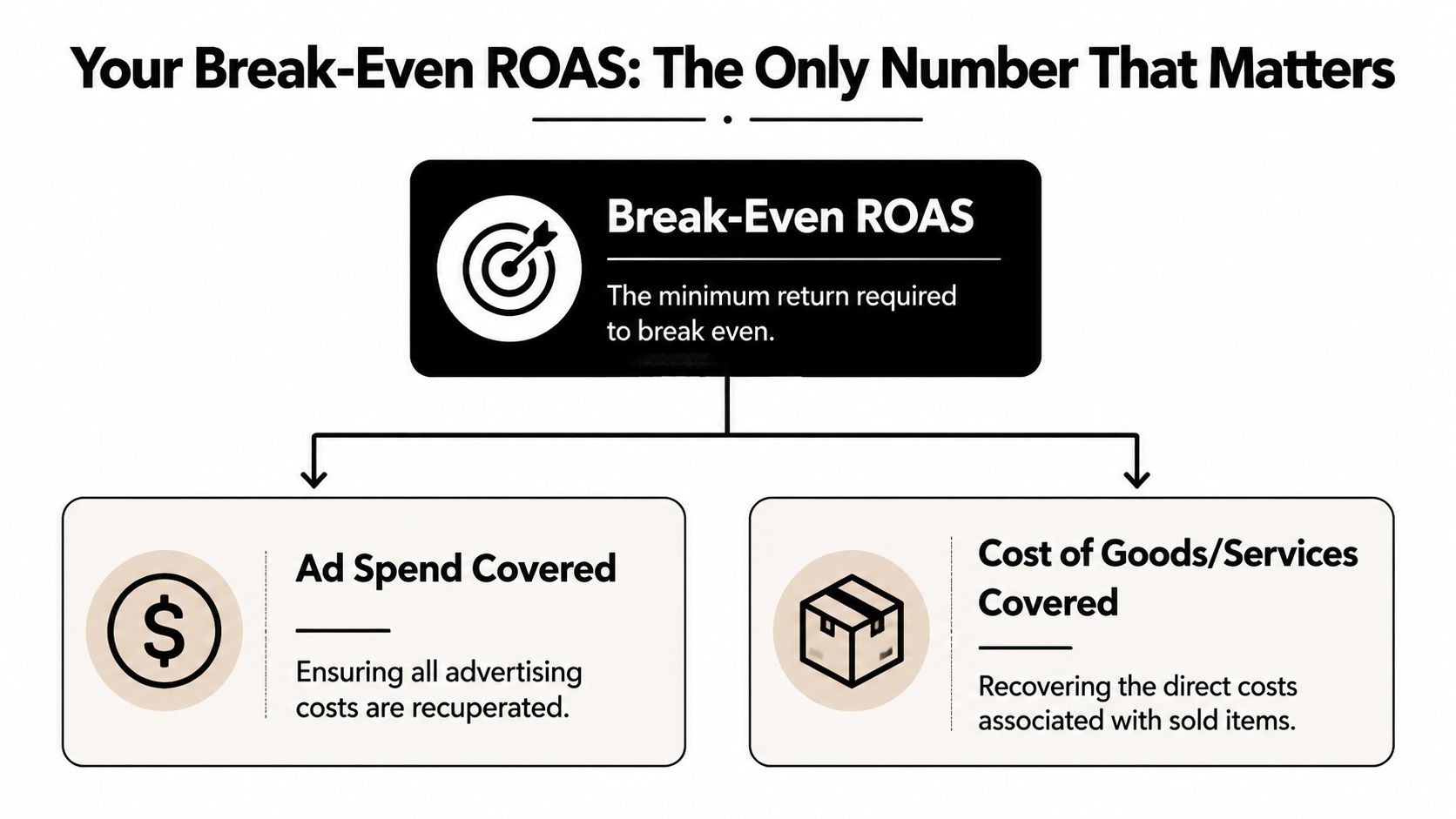
Break-even ROAS is the first number I check in any account. Before bid strategy, before benchmarks, before another agency slide celebrating platform revenue.
It answers one question: how much return do you need from Google Ads before a sale stops losing money?
That number is your floor. If your campaigns sit under it, you are paying to acquire revenue that does not produce enough contribution to support the business. Google Ads can still report a healthy-looking ROAS while your margin gets squeezed financially.
Start with contribution margin
Use contribution margin, not top-line revenue.
For ecommerce, that usually means revenue minus product cost, shipping subsidy, payment processing, and marketplace or platform fees tied to the order. For lead gen or service businesses, use the direct cost to fulfill the work, qualify the lead, onboard the customer, or deliver the first unit of service.
If you skip those costs, your ROAS target is fiction.
The formula is simple
Use this calculation:
Break-even ROAS = Revenue / Gross profit before ad spend
You can also express it with margin:
Break-even ROAS = 1 / contribution margin
Here is a clean example:
Average order value: $120
Cost of goods: $48
Shipping subsidy and packaging: $12
Payment and transaction fees: $6
That leaves $54 in gross profit before ad spend.
So your break-even ROAS is:
$120 / $54 = 2.22
That means you need at least 2.22x ROAS, or 222%, just to break even on acquisition. Anything lower means paid media is taking more out of the order than the order can support.
This is the number bloated agencies avoid because it exposes whether reported performance is actually investable.
What to include in the math
Include costs that change with each sale or booked customer. Leave out fixed overhead like rent, executive salaries, or long-term software contracts unless you are building a full company-level profitability model.
For a usable ad target, include:
Cost of goods or direct service delivery
Shipping, packaging, or fulfillment support
Payment processing and transaction fees
Sales commission or qualification cost, if it applies per conversion
Refunds or cancellation rate, if they materially affect realized revenue
One mistake shows up constantly. Teams use gross revenue in Google Ads, then compare it to ad spend as if every dollar of sales carries the same value. It does not. A $200 order with thin margin can be worse than a $120 order with strong contribution.
Tracking quality changes the answer
Break-even ROAS is only useful if conversion value is reasonably accurate.
If phone orders, CRM closes, or offline revenue are missing from the account, reported ROAS can look worse than reality. If low-quality leads are counted as equal to booked revenue, it can look better than reality. Fix the measurement first if the input data is shaky. A solid Google Ads conversion tracking guide helps tighten the setup so the value in the platform is closer to what finance sees.
LTV can justify a lower first-sale ROAS
LTV changes the calculation only when you can measure it with discipline.
If customers reorder predictably, renew, or expand over time, you may accept a first-purchase ROAS below break-even on the initial transaction because the account becomes profitable over a longer window. That only works when retention, repeat purchase rate, and payback period are documented by cohort. If you need help building that model, start with this guide on how to calculate customer lifetime value accurately.
Do not use LTV as a story you tell yourself. Use it when you can prove it.
Run this audit on your account
Ask for these numbers side by side:
View |
What it shows |
Why it matters |
|---|---|---|
Google Ads ROAS |
Platform-reported return |
Useful for campaign direction |
Contribution margin per sale |
Dollars left before ad spend |
Shows what the business actually keeps |
Break-even ROAS |
Minimum return required |
Shows whether scaling is financially sane |
If your agency cannot produce those three numbers clearly, they are optimizing a dashboard, not the business.
How to Set a Profitable Target ROAS
A profitable target ROAS is a finance decision first and a bidding setting second.
Too many advertisers reverse that order. They pick a number that sounds strong, push it into Google Ads, and hope the account bends to it. That is how agencies produce pretty dashboards and weak profit. Your target should come from contribution margin, required profit per order, and the value of a customer over time.

Start with the business, not the platform
Break-even ROAS is your floor. Profitable target ROAS sits above that floor by enough to leave real dollars behind after ad spend.
Use a simple formula:
Profitable Target ROAS = 1 / (Contribution Margin % - Desired Net Profit %)
Example:
Revenue per order: $100
Variable costs excluding ad spend: $65
Contribution margin: 35%
Desired net profit after ad spend: 10%
That leaves 25% of revenue available for advertising.
1 / 0.25 = 4.0
Your target ROAS is 4:1. Anything below that may still drive sales, but it misses the profit standard you set for the business.
That is the number to manage against.
Set a target the account can actually hit
An aggressive target ROAS does not force efficiency. It usually cuts reach, suppresses impression share, and starves the bidding model of conversion data.
Start with an operating target that is commercially realistic. If your recent campaign mix is producing returns near break-even, jumping straight to a much higher target is poor account management. Fix the account first. Clean up campaign structure. Separate brand from non-brand. Improve feed quality if you run ecommerce. Tighten conversion values. Then raise the target in controlled steps once performance is stable.
For merchants dealing with SKU depth, feed issues, and mixed-margin products, this guide on running Shopify Google Ads profitably is a useful reference because platform setup often determines whether a target ROAS strategy works at all.
Use LTV only when finance can defend it
LTV can justify a lower front-end ROAS target. It does not excuse sloppy math.
If a customer reliably reorders, renews, or expands, you can accept less profit on the first transaction and recover it later. But you need proof. Cohort retention, repeat purchase behavior, refund rates, and payback period all have to be clear. If finance cannot show that pattern cleanly, keep your target tied to first-sale economics.
I see this mistake constantly in agency accounts. They talk about lifetime value, bid like every customer will come back, and ignore the fact that retention is uneven or cash flow is tight. That is not strategy. That is wishful reporting.
Use three ROAS targets, not one blended number
One account-wide ROAS target is lazy. Different campaign types and traffic temperatures do different jobs, so set targets by role.
Target type |
What it does |
How to use it |
|---|---|---|
Floor target |
Protects contribution margin |
Set this at break-even or just above it |
Operating target |
Controls day-to-day bidding |
Set this at the level that produces acceptable profit consistently |
Growth target |
Expands volume without losing discipline |
Use this only after tracking quality and margin data are dependable |
This framework keeps you out of two common traps. The first is setting one inflated target that crushes volume. The second is accepting a blended account ROAS that hides underperforming campaigns behind branded search.
The standard I use in audits
Before I approve a target ROAS strategy, I want four answers:
What dollar amount can you afford to spend to acquire one order or lead
What profit do you need that acquisition to produce
How long can you wait to recover ad spend
Which campaigns deserve different targets based on margin or customer value
If those answers are vague, the target is guesswork.
Set your profitable ROAS target from your numbers, not from an industry talking point. That is how you build an account that can scale without lying about profitability.
Google Ads ROAS Benchmarks A Necessary Reality Check
Benchmarks are useful for context. They become destructive when people turn them into universal goals.
The market data proves why. Search campaigns show a median ROAS of 5.17:1, while Performance Max averages 2.57:1, Shopping averages 2.88:1, and Display averages 0.12:1 according to Focus Digital’s campaign-type ROAS benchmark analysis. That spread is enormous.
If someone tells you “good ROAS” without asking which campaign type they mean, they’re skipping the hard part.

Search should not be judged like Display
Search captures intent. Display usually supports awareness, remarketing, and assisted conversion paths. Of course their direct ROAS profiles differ.
That’s why I don’t respect blended reporting that dumps every campaign into one pot and calls the result strategy. A brand campaign, a non-brand search campaign, a Shopping campaign, and a Display campaign all do different jobs. If your agency rolls them into one benchmark story, they’re hiding the actual mechanics.
A simple way to view this is:
Campaign type |
Typical role |
ROAS expectation |
|---|---|---|
Search |
Capture high intent demand |
Usually held to the toughest direct-response standard |
Shopping |
Product-led demand capture |
Strong, but often more margin-sensitive |
Performance Max |
Broad automated coverage |
Useful, but needs tighter oversight |
Display |
Awareness and assist |
Should not be forced into short-term direct ROAS logic |
Business model matters as much as channel
Focus Digital also notes that for B2B SaaS, a ROAS around 1.55:1 can be acceptable if value is evaluated via LTV in that same benchmark review. That’s a perfect example of why benchmark worship fails senior operators.
A lead with downstream expansion value should not be judged the same way as a one-time ecommerce order. The account structure, conversion setup, and target model need to reflect the sales motion.
If you run Shopify, this is also why channel mix and campaign intent matter when reviewing ecommerce efficiency. A practical companion read is this guide to Shopify Google Ads strategy, especially if your team keeps comparing branded Search against broader prospecting campaigns as if they’re interchangeable.
The only honest use of benchmarks is calibration. They tell you what kind of variance is normal. They do not tell you what your company should target.
The benchmark trap agencies fall into
Large agencies often use benchmarks as cover.
If performance is weak, they say your industry is hard. If performance is strong, they say you’re beating the benchmark. In both cases, the benchmark becomes a narrative device instead of a management tool.
What you need is simpler:
Use market numbers to sense-check expectations
Use your own margin and LTV model to set goals
Use campaign intent to assign the right target to the right asset
That’s a much better standard than “our blended account ROAS looks healthy.”
Tactical Levers to Meaningfully Improve Your ROAS
Once your target is tied to business reality, execution gets easier to judge. The account either supports profitable growth or it doesn’t.
Specialist management often outperforms agency bloat. Improving ROAS is rarely about one dramatic trick. It’s usually the compound effect of cleaner tracking, tighter structure, stronger search intent capture, and faster decision-making. Google Ads has an average ROAS of 2:1, but on the Google Search Network specifically, companies can earn an average return of $8 for every $1 spent, according to Triple Whale’s Google Ads ROAS overview. That gap indicates where a key opportunity sits. Intent matters.

Tighten campaign structure before touching bids
A messy account can’t produce trustworthy signals.
I still see high-spend accounts where branded and non-branded traffic are mixed, match types are sloppy, search terms are poorly controlled, and conversion actions are bloated with low-quality events. Then someone wonders why target ROAS bidding feels unstable.
Fix the structure first:
Separate intent clearly Keep branded Search, non-brand Search, Shopping, Performance Max, and upper-funnel campaigns distinct. Don’t let one campaign type hide another’s weakness.
Trim conversion noise Count the actions that matter. If soft conversions dilute bidding signals, Smart Bidding will optimize to junk.
Control traffic quality Search term discipline still matters. If irrelevant queries slip through, ROAS erodes fast.
Negative keywords still do heavy lifting
This is one of the oldest levers in PPC because it still works.
In agency accounts, negative keyword management often gets neglected after the initial build. That’s usually because junior managers don’t want to spend time inside search term reports. But those reports still reveal waste, weak intent, and category confusion.
A practical weekly audit should look for:
Check |
What to look for |
Why it helps ROAS |
|---|---|---|
Irrelevant modifiers |
Informational or mismatched terms |
Reduces wasted clicks |
Low-intent phrasing |
Research-only searches |
Preserves budget for buyers |
Cross-campaign overlap |
Queries hitting the wrong campaign |
Improves bidding control |
If you're managing local service campaigns, cost dynamics vary sharply by geography and intent. This overview of Google Ads for local businesses is a useful reference for understanding why localized search quality matters so much when budgets tighten.
Don’t let Target ROAS strangle the account
Target ROAS bidding is powerful. It’s also one of the easiest tools to misuse.
If the target is set too high, the algorithm gets restrictive. You lose auction participation, conversion volume thins out, and the system becomes less responsive. That creates a nasty loop where the account looks “efficient” on paper while total business output weakens.
I prefer a measured approach:
Stabilize conversion tracking
Clean campaign segmentation
Set realistic value-based targets
Adjust slowly rather than forcing a jump
That’s not conservative. It’s competent.
Improve the traffic before you chase more of it
Too many managers react to ROAS pressure by tinkering with bids while ignoring ad rank, relevance, and landing page alignment.
That’s backwards. Better traffic economics often start with ad quality and search relevance. If your account suffers from poor ad relevance, weak expected click-through rate, or landing page mismatch, work on Quality Score first. If your team needs a practical breakdown, this guide on how to improve Google Ads Quality Score is worth reviewing before you squeeze budgets harder.
Here’s a useful video if you want a visual walkthrough of optimization thinking in Google Ads:
One immediate account audit to run today
Export your Search campaigns and sort them into three buckets:
Search campaigns capturing obvious high intent
Broad automation campaigns that assist but don’t close as cleanly
Campaigns with spend but weak commercial intent
Then compare each bucket against the conversion actions feeding bidding.
If your most valuable Search traffic is grouped with softer campaign types and all are sharing one target, you’ve probably found a big reason ROAS feels erratic. This is exactly the kind of issue a dedicated specialist catches quickly and the average agency leaves untouched for months.
Clean segmentation and trustworthy conversion data usually improve ROAS before “advanced strategy” does.
Conclusion From Chasing Metrics to Driving Business Growth
A good ROAS for Google Ads is not a benchmark you borrow. It’s a threshold you build.
That threshold starts with break-even economics. Then it expands into a target that reflects profit goals, cash flow tolerance, and customer lifetime value. Once you do that, the usual generic advice starts to look flimsy. That’s because it is flimsy.
This is the difference between platform management and commercial management. Platform management chases dashboard efficiency. Commercial management asks whether the account is producing profitable growth for the business. If you’re responsible for a serious PPC budget, you need the second one.
You also need to stop accepting agency theater. Big agencies tend to hide weak thinking behind blended metrics, benchmark talk, and polished reports built by people far from your actual P&L. A dedicated specialist has a structural advantage here. You get direct communication, faster changes, tighter strategic accountability, and someone who can challenge bad assumptions instead of defending a process.
That matters beyond Google Ads too. Strong paid media performance often depends on what happens after the click and across channels. For example, if you’re trying to improve paid social efficiency, this breakdown of how email capture can increase Meta ROAS is a useful reminder that acquisition economics improve when retention and owned-channel follow-up are doing their job.
It's not merely 'what is a good roas for google ads.' Instead, the fundamental question is this: what ROAS allows your business to grow profitably, predictably, and with confidence?
If your team can answer that clearly, you’re in control.
If they can’t, you’re still being sold reporting.
If you want a sharper, more accountable approach to Google Ads than the usual agency model, Come Together Media LLC offers specialist PPC consulting built around direct communication, transparent analysis, and profit-focused optimization. Chase McGowan works one-on-one with businesses that want clearer strategy, tighter execution, and a partner who understands the numbers behind the ad account.
