



You are probably living the same pattern I see in high-spend ecommerce accounts every week.
You spend serious money on Shopify Google Ads. You get polished decks, generic commentary, and a lot of “learning phase” excuses. Meanwhile, performance stalls, reporting feels fuzzy, and no one can explain exactly where your budget is leaking.
That is usually not a Google problem. It is not even a Shopify problem. It is an operating model problem.
Large agencies tend to standardize everything. That helps them protect margin. It does not help your account. Shopify stores need tight tracking, disciplined campaign structure, sharp product feed work, and weekly intervention from someone who knows the account. Not a junior coordinator relaying notes.
The opportunity is too big for lazy management. Shopify generated $11.56 billion in total revenue in 2025, a 63% increase from 2023, and nearly two-thirds of top-performing Shopify stores use Google Ads according to Brenton Way’s Shopify marketing statistics roundup. If you want a useful baseline before making changes, our detailed guide to Shopify Google Ads is worth reading alongside this playbook.
Why Your Agency-Run Shopify Google Ads Are Failing
Most agency-run Shopify Google Ads accounts fail for boring reasons.
Not dramatic reasons. Not secret algorithm reasons. Boring execution failures.
The account gets a cookie-cutter setup. The product feed goes mostly unchecked. Conversion tracking gets installed once and ignored. Bidding gets left to automation without any guardrails. Search terms drift. Creative goes stale. Nobody senior is close enough to the account to spot the problem early.
The agency model creates slow, expensive decisions
If you spend heavily on PPC, speed matters. A specialist can see a tracking break, a feed issue, or a waste pocket and fix it fast. Agencies usually add layers. Strategist, account manager, media buyer, reporting person. That structure sounds reassuring, but it slows action and dilutes responsibility.
The result is familiar:
You get reports instead of decisions.
You talk to someone who does not touch the account daily.
Your budget gets spread across broad tactics with weak accountability.
The same playbook gets reused whether you sell low-AOV consumables or high-ticket products.
That is why so many brands end up reading articles like this breakdown of PPC agency tradeoffs after wasting months on retainers that produced very little.
Shopify needs precision, not account maintenance
Shopify Google Ads works when the data is clean and the structure matches the business model.
A store with thin margins needs a different bidding posture than a store with premium pricing. A catalog with hero SKUs needs a different campaign setup than a broad catalog with seasonal demand. A store using post-purchase upsells needs a different tracking setup than one with a simple checkout.
Many agencies do not build around those realities. They maintain accounts. They do not engineer them.
Practical takeaway: If your agency cannot explain, in plain language, how your Shopify checkout flow, product feed quality, campaign segmentation, and bidding logic fit together, they are not managing strategy. They are managing spend.
What better looks like
A strong Shopify Google Ads account has a few traits:
One owner of performance. No handoff chain.
Direct communication. Problems get fixed in hours, not after the next call.
A clear thesis. Why this campaign exists, what traffic it targets, and what metric decides whether it stays live.
Weekly intervention. Not passive observation.
That is the difference between specialist management and the wasteful agency model. One is built around accountability. The other is built around utilization.
The Foundation Flawless Tracking and Account Syncing
The fastest way to destroy return on ad spend is to trust bad data.
Most Shopify advertisers do exactly that. They connect the native integration, confirm tags are “active,” and assume Google Ads is measuring the business correctly. It often is not.
Start with the basic account connections
Your Shopify store, Google Ads account, GA4 property, Google Merchant Center, and Google Tag Manager setup need to agree with each other. That sounds obvious. It still goes wrong all the time.
I look for three issues first:
Broken merchant sync Products are not fully approved, variants are messy, or channel eligibility is inconsistent.
Weak event setup Purchases may be tracked, but important intent signals like product views and add-to-cart events are either missing or not useful.
Primary conversion confusion Google Ads optimizes to the wrong event because the account treats low-value actions like the main goal.
The native Shopify connection helps with speed, but it does not replace an audit. You still need to verify event quality, value passing, attribution consistency, and policy compliance.
If your current setup feels shaky, this practical guide on how to fix your Google Ads conversion tracking is a good companion resource.
The biggest blind spot is post-purchase upsells
This is the nuance many agencies miss.
Shopify stores often add post-purchase upsells to improve order value. Good move for revenue. Bad move for tracking if no one engineers around it. A verified analysis found that Shopify’s post-purchase upsell features can interfere with tracking pixels, leading stores to report only 20-30% of their actual conversions. Auditing and fixing this gap can recover 50-80% of these lost conversions according to UAWC’s write-up on Shopify Google Ads ROI blind spots.
That single issue can wreck everything downstream.
If Google Ads sees only a fraction of real purchases, it learns from the wrong signals. It can overvalue low-quality traffic, undervalue profitable campaigns, and distort your reported ROAS. Then the agency starts making “optimization” decisions based on bad measurement.
Key takeaway: If your Shopify store uses post-purchase upsells and nobody has audited whether purchase pixels still fire correctly, you do not know your Google Ads performance.
What I recommend instead
I do not rely on a basic pixel setup and hope for the best. I want redundancy and validation.
A strong tracking foundation usually includes:
Google Tag Manager for controlled deployment and troubleshooting
GA4 integration for cross-checking event flow
Enhanced conversion support where appropriate
Server-side or custom event handling when post-purchase flows interfere with client-side tracking
Merchant Center diagnostics review before scaling spend
This is not “more technical for the sake of it.” It is about making sure the bidding engine gets trustworthy conversion data.
A clean audit checklist
Use this before you scale budget:
Audit area |
What to check |
Why it matters |
|---|---|---|
Merchant Center |
Product approval status, policy warnings, variant handling |
Feed issues limit reach and create disapprovals |
Google Ads conversions |
Purchase event marked as primary, values passing correctly |
Smart bidding depends on accurate value data |
Checkout tracking |
Confirmation page event firing, especially after upsells |
Prevents undercounting purchases |
GA4 validation |
Purchases and revenue roughly align directionally |
Helps spot broken tags or duplicate events |
Tag Manager |
Event triggers and deduplication logic |
Reduces misfires and messy reporting |
What wasteful agencies usually do
They install the app. They import the purchase event. They call tracking complete.
That is not enough for a serious Shopify brand.
A specialist treats tracking as a profit lever, not a setup task. If reported conversions are wrong, every bid target, budget decision, and performance discussion is compromised from day one.
Campaign Architecture for Ecommerce Dominance
Once tracking is clean, campaign architecture decides whether Google Ads becomes a growth engine or a money pit.
Many agency accounts are too blunt. One broad Performance Max campaign. Maybe a search campaign that covers both branded and non-branded traffic. Little segmentation by product role, margin profile, or buyer intent. That setup is easy to maintain. It is also lazy.
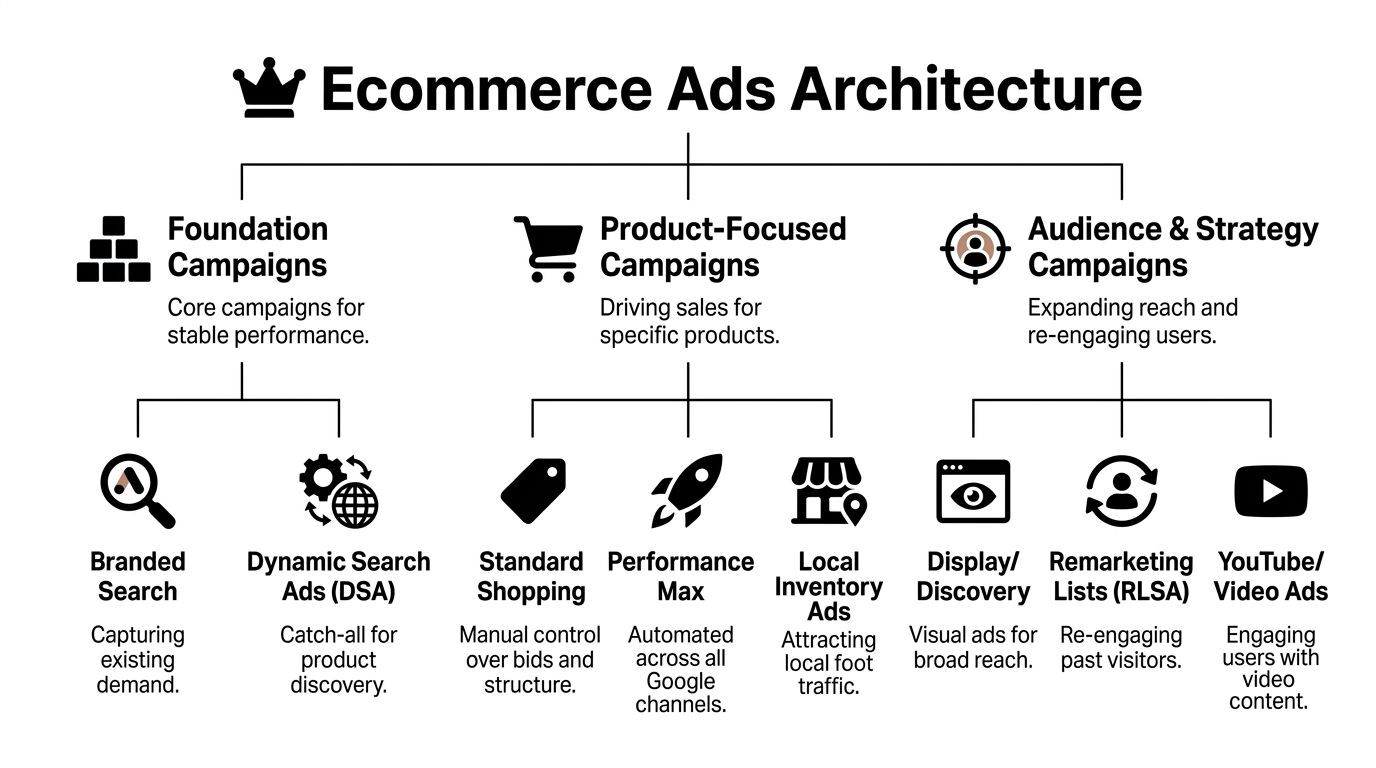
Google Shopping sits at the center of Shopify Google Ads. Shopping ads capture 85.3% of all clicks on Google Ads, and Performance Max delivers an average 25% boost in conversion value compared to traditional Shopping campaigns, according to Blackbelt Commerce’s guide to Shopify Google Shopping ads. That does not mean “turn on one PMax campaign and walk away.” It means the Shopping feed deserves disciplined structure.
Performance Max is the workhorse, not the whole strategy
Performance Max can be excellent for Shopify. It can also hide waste if you give it weak inputs.
I split campaigns by business purpose, not by convenience. Common segmentation points include:
Best sellers Products with proven demand deserve their own budget and asset logic.
High-margin products These products can tolerate more aggressive acquisition economics.
New product discovery New launches need their own learning environment so they do not get buried by established winners.
Seasonal or promotional inventory Temporary demand should not contaminate evergreen campaign data.
The mistake agencies make is grouping everything into one campaign because “the algorithm will sort it out.” Sometimes it does. Often it just sends more traffic toward what is easiest to convert, not what is best for your margin mix.
Asset groups need intent, not filler
A feed-only PMax build is the hallmark of rushed management.
Yes, feed-only can launch quickly. No, it is not how I want a scaled Shopify account to live long term. Distinct asset groups with customized creative, audience signals, and product groupings give Google better context.
For example:
Campaign layer |
Good specialist setup |
Typical agency shortcut |
|---|---|---|
PMax asset groups |
Organized by category, margin, or bestseller status |
One generic asset group |
Creative |
Product-specific images, short videos, clear value props |
Reused brand visuals with weak relevance |
Audience signals |
Cart visitors, product viewers, customer lists where available |
Broad or default audience inputs |
Landing destination |
Specific product or collection pages |
Homepage or generic collection pages |
That last point matters more than many teams admit.
Branded Search is defensive, and necessary
A properly built branded Search campaign is not optional. If people search your brand name, you should own that traffic with a clean, controlled campaign.
I keep branded Search separate because it does three jobs:
Protects branded demand from competitors
Gives cleaner reporting on demand you already created elsewhere
Lets you control messaging for high-intent navigational searches
Agencies often blend branded and non-branded performance in the same reporting narrative. That flatters results and hides acquisition weakness.
Dynamic Search Ads can fill useful gaps
I use Dynamic Search Ads carefully as a discovery layer, especially for larger catalogs or fast-changing inventory. DSA is not a substitute for intentional keyword strategy, but it can catch relevant search demand your manual campaigns have not covered.
The key is supervision. Search term mining and exclusions matter. If nobody reviews what DSA is matching to, it becomes a leak.
A helpful reference for the underlying logic is this guide to Google Ads account structure.
Practical takeaway: If your Shopify account has one PMax campaign, no separate branded Search campaign, and no product-tier segmentation, you are not running a strategy. You are renting Google’s defaults.
Remarketing belongs inside the architecture
I do not treat remarketing as an afterthought. Warm traffic should shape how your campaigns learn.
That means feeding strong audience signals into PMax, using buyer and visitor intent intelligently, and making sure product-viewers and cart abandoners are not lumped together with cold traffic assumptions. The point is not more complexity. The point is more relevance.
Smart architecture gives Google constraints and context. Wasteful agency structure gives Google a pile of inventory and a vague goal.
Mastering Bidding Budgets and Auction Dynamics
Bidding is where many high-spend Shopify accounts lose control.
The platform suggests a target. The agency accepts it. Spend rises, efficiency slides, and everyone waits for the machine to “stabilize.” That is not strategy. That is compliance.
Start with the right bidding posture
For most scaled Shopify Google Ads accounts, the choice is not manual bidding versus automation. The primary choice is which automated strategy fits the account’s current maturity and economics.
I usually think about it like this:
Maximize Conversion Value Useful when you want the system to find value aggressively and you do not yet trust a strict return target.
Target ROAS Useful when tracking is stable, conversion values are trustworthy, and you know the account can support a disciplined efficiency target.
Agencies often rush into Target ROAS because it sounds advanced. Sometimes that strangles volume. Other times they leave Maximize Conversion Value running too loosely for too long and let spend drift into lower-quality inventory.
The right answer depends on margin structure, catalog depth, and how clean your conversion data is.
Thin-margin stores need different math
Most guidance on Shopify Google Ads assumes you can bid your way to scale. That is not true for every business.
A verified source notes that most guides overlook how auction dynamics favor advertisers who maximize lifetime value, and that matters even more as average ecommerce CPCs rose 18% in 2025 according to this analysis on auction dynamics for Shopify stores.
That matters because Google’s auction is not just rewarding the highest bid. It rewards advertisers who create stronger value signals over time.
If your margins are thin, bidding high on first-purchase economics alone gets dangerous fast. In those accounts, I care more about:
repeat purchase behavior
customer quality by product type
which SKUs introduce profitable customers
whether remarketing and brand demand are supporting paid acquisition efficiently
A low-margin store cannot afford vanity scale. It needs disciplined acquisition around products and customers that can create downstream value.
High-ticket stores need patience and signal quality
High-ticket products create the opposite problem.
Brands see large order values and assume aggressive Target ROAS will solve everything. It often does not. Longer consideration cycles, more research behavior, and cross-channel influence can make direct-response interpretation too narrow.
For those businesses, I want:
stronger product segmentation
tighter landing-page alignment
thoughtful remarketing layers
bidding strategies that do not punish valuable upper-funnel interactions too early
Agencies often get lost at this stage. They try to force one reporting model across every product category. A specialist adjusts expectations and auction strategy to the product economics.
A simple decision framework
Store profile |
Bidding bias |
Main risk |
|---|---|---|
Thin-margin, repeat purchase potential |
Protect efficiency, value customer quality, use smarter audience inputs |
Overpaying for first orders that never become profitable |
High-margin hero products |
Push qualified volume, support consideration, measure value carefully |
Over-constraining campaigns before enough data accumulates |
Mixed catalog |
Segment by product role and economics |
Letting low-margin items absorb budget intended for profitable lines |
Key takeaway: Do not let Google choose your business model. Bidding strategy should reflect your margins, customer behavior, and catalog realities. Not platform defaults.
Budgets should follow confidence, not hope
I increase budgets when three things line up:
Tracking is trustworthy
Search quality or shopping quality looks stable
The campaign is producing the kind of customer the business wants
Agencies often scale off surface-level ROAS while ignoring what changed underneath. A specialist looks at the quality of the result, not just the reported result.
That is how you avoid the cycle of scaling too early, pulling back too late, and calling the whole thing volatility.
Optimizing for Profit Ads Landing Pages and Measurement
A good campaign can still lose money if the ad message is weak, the landing page is lazy, or the measurement routine is shallow.
Agencies often hide behind “platform performance” in such situations. In reality, they are sending expensive traffic into poor user journeys and then acting surprised when efficiency fades.
Send paid traffic to the right page
This should not be controversial. It still gets ignored constantly.
A verified source notes that sending traffic to generic homepages can cause 50% bounce rates, and failing to use negative keywords can waste 15-25% of ad spend on irrelevant searches according to this Shopify Google Ads implementation walkthrough. Directing users to the right product page is not a nice-to-have. It is basic paid search hygiene.
If someone clicks an ad for a specific product category, send them to the most relevant PDP or collection page. Not the homepage. Not a bloated “shop all” page. Not a brand manifesto.
Creative needs refresh discipline
Search ads need clear, commercial intent. Performance Max needs usable assets.
That means you need:
Search copy that mirrors buying intent Product type, differentiator, and reason to click should be obvious.
Fresh visual assets If your PMax inputs are stale, the campaign eventually reflects it.
Message match The promise in the ad must show up immediately on the landing page.
If your in-house team needs help producing visual concepts fast, these prompt templates for product ads can be a practical shortcut for generating better creative directions before your designer or editor polishes them.
The landing page audit I use
I do not need a 60-slide CRO review to spot the common failures. I check the basics first.
Page element |
What I want to see |
What usually goes wrong |
|---|---|---|
Headline and product clarity |
Immediate match with ad intent |
Generic brand copy |
Mobile usability |
Fast, easy scroll, visible CTA |
Busy layout and buried buy buttons |
Offer visibility |
Price, shipping, returns, core trust points |
Important buying details hidden |
Variant selection |
Simple, obvious options |
Confusing selectors or out-of-stock friction |
Checkout path |
Minimal distraction |
Upsells or popups interrupting purchase intent |
For a deeper benchmark, this guide to a high-converting landing page is a useful reference.
Negative keywords are not optional maintenance
Irrelevant search traffic is one of the easiest ways to leak budget. It is also one of the easiest problems to fix if someone is paying attention.
I review search terms regularly and exclude junk aggressively. That is especially important for premium brands that do not want traffic from low-intent modifiers. If your agency is not actively shaping search quality, they are letting the platform spend your budget on experiments you did not approve.
Practical takeaway: Open your Search Terms report and look for modifiers that conflict with your offer or positioning. If you sell premium products, terms that signal bargain intent usually do not belong in the account.
My measurement rhythm
I do not believe in vanity dashboards. I believe in operating checks.
Weekly checks
Search terms and negative keyword additions
Product feed diagnostics
Landing page destination accuracy
Asset quality and creative fatigue signals
Budget pacing and campaign-level anomalies
Monthly checks
Branded versus non-branded efficiency
Product or category-level contribution
Conversion path consistency
Whether reported ROAS still matches business reality
Whether winning campaigns deserve more budget, or more control
That routine is not glamorous. It is profitable.
Your Path to a True PPC Partnership
A real Shopify Google Ads partner does not just “manage campaigns.”
They protect data integrity. They shape account structure around the business. They make bidding decisions with margin reality in mind. They watch search quality, landing pages, and creative inputs closely enough to stop waste before it compounds.
That is why specialist management consistently beats the bloated agency model.
Agencies sell access to a team. In practice, that often means distance from the person making decisions. A specialist gives you the opposite. Direct communication. Faster adjustments. Clear accountability. Better context on every move inside the account.
The easiest way to test whether your account is in good hands
Do one thing today. Check how your team handles negatives and search quality.
An expert methodology includes weekly reviews of negative keywords to prevent a significant portion of budget from being wasted on irrelevant terms like “free” or “cheap.” I covered the broader structural issue earlier, but this specific habit is one of the clearest signs that someone is really managing the account rather than observing it.
If nobody is reviewing negatives weekly, that is not active management.
What to look for in a real PPC partner
They explain the why Not just what changed, but why it mattered.
They challenge bad assumptions Especially when tracking, attribution, or catalog economics are muddy.
They move fast High-spend accounts cannot wait two weeks for a fix.
They stay close to the money Search terms, feed quality, landing pages, conversion integrity. Not just dashboard summaries.
Final takeaway: If your Shopify store uses post-purchase upsells, start there. A tracking audit may do more for profit than any bid change, creative refresh, or agency status call.
The best-performing accounts are rarely magical. They are managed with care, precision, and ownership. That is what many agencies cannot deliver at scale.
If you want a second opinion on your Shopify Google Ads account, Come Together Media LLC offers a straightforward audit focused on wasted spend, tracking gaps, campaign structure, and profit leaks. You get direct feedback from a specialist, not a sales team, and a clear view of what to fix first.
