


You’re spending serious money on Google Ads. The dashboards look busy. The reports look polished. The business impact still feels soft.
That’s usually the moment a CMO starts asking the right question. Not “Should we spend more?” but “Why are we paying agency fees for work that doesn’t feel senior, strategic, or accountable?”
If you’re at $25K per month or more in PPC spend, you don’t need another vendor who tweaks bids, forwards Google’s recommendations, and calls it optimization. You need a google ads consultant who can read the account like an operator, tie paid search to revenue, and tell you when your structure, tracking, landing pages, or offer are the problem.
A bloated agency can hide weak thinking behind process. An independent specialist can’t. That’s exactly why the right consultant is often the better hire.
The $25K/Month Question Why Is Your Agency Underwhelming
If your agency is underperforming, the problem usually isn’t Google Ads. It’s the management model.
At higher spend levels, bad PPC management gets expensive fast. A WordStream study of over 15,000 Google Ads accounts found that most waste over $1,000 per month, one in four generate zero conversions, and accounts using strategic negative keyword lists achieve 3X higher conversion rates. That’s not a minor efficiency issue. That’s a structural failure.

A lot of agencies keep the same bad pattern going. They show you impressions, clicks, click-through rate, and broad “growth” language while avoiding the harder conversation about cost per acquisition, lead quality, conversion tracking integrity, and blended ROAS. They don’t fix waste first. They ask for more budget.
What underwhelming usually looks like
You’ve probably seen some version of this:
Junior account management: You signed because of the senior strategist. You got handed to someone who’s still learning match types, bidding logic, and attribution basics.
Vanity metric reporting: Plenty of charts. Very little clarity on pipeline, revenue, or margin.
Slow execution: Changes take days because every update moves through layers of meetings, approvals, and project queues.
Budget-first thinking: Instead of tightening the account, they push expansion before the fundamentals are stable.
Practical rule: If your agency can’t explain exactly where wasted spend is coming from, they’re managing activity, not performance.
That’s why many teams start re-evaluating their pay-per-click pricing and package structure. The issue usually isn’t just the fee. It’s what that fee is buying. If the answer is slower communication, generic strategy, and recycled reporting, you’re overpaying.
The real issue is lack of ownership
Google Ads rewards precision. Tight keyword control. Real negative keyword discipline. Clean conversion tracking. Strong landing page alignment. Clear bidding strategy. Most agencies talk about these things. Fewer execute them with the discipline a high-spend account needs.
When results feel flat, don’t assume your market is tapped out. Don’t assume CPC inflation is the whole story. Start by assuming the account is leaking money in places your current team either can’t see or won’t admit.
That’s when hiring a specialist stops being a nice-to-have and becomes the rational move.
Moving Beyond the Agency Finding a True PPC Partner
A real PPC partner isn’t selling “full service.” They’re solving the exact business problem tied to your paid acquisition.
That distinction matters. Agencies sell capacity. A strong google ads consultant sells judgment.
Why the agency model breaks at higher spend
The traditional agency setup sounds reassuring on paper. Strategy lead, account manager, analyst, creative support, reporting team. In practice, that often means fragmented thinking and diluted accountability.
Nobody fully owns the outcome. One person builds reports. Another handles client calls. A junior specialist makes platform changes. A senior strategist drops into quarterly reviews. You get activity, but not sharp decision-making.
For a business with meaningful spend, that’s a bad trade.
By contrast, a specialist consultant usually works closer to the account, closer to leadership, and closer to the numbers that matter. Faster diagnosis. Faster changes. Less translation between what the business needs and what happens inside Google Ads.
What a true partner does differently
The benchmark matters here. Businesses earn an average of $2 for every $1 spent on Google Ads, or a 200% ROI, according to these Google Ads benchmarks from Tenet. That’s a baseline, not a victory lap. If you’re spending heavily, your consultant’s job is to beat average by removing waste and focusing on high-value conversions.
A serious consultant typically brings a different operating posture:
Direct communication: You talk to the person doing the thinking.
Business-first strategy: They start with revenue goals, sales capacity, margin, and lead quality. Not ad formats.
Sharper prioritization: They know what to fix first because they’ve seen where accounts usually break.
Less overhead: You’re not funding layers of management that don’t improve performance.
The best PPC relationships feel less like outsourced execution and more like having a paid acquisition lead in the room.
Bigger team does not mean better strategy
A lot of CMOs still assume a larger agency means deeper expertise. That’s outdated thinking.
In Google Ads, the edge rarely comes from having more people touching the account. It comes from having the right person making the right calls. One experienced operator who understands search intent, bidding strategy, offer alignment, conversion tracking, landing page friction, and reporting quality can outperform a whole stack of disconnected generalists.
That’s also why broader resources can be useful for perspective, but not enough for execution. If you want a high-level overview of where consulting fits into a wider growth strategy, Wise Web's guide to digital marketing is a useful read. Just don’t confuse broad consulting theory with hands-on PPC leadership.
The partnership standard you should expect
If you’re hiring a consultant, expect them to challenge you. A good one won’t just ask for account access. They’ll ask about:
sales process friction
CRM quality
offline conversion import
branded versus non-branded dependence
landing page offer match
whether Performance Max is adding value or hiding bad segmentation
That’s what a strategic partner sounds like.
If someone only talks about campaign setup, bidding, and ad copy, they’re still thinking like a channel manager. You need someone who understands that Google Ads is a revenue system, not a dashboard.
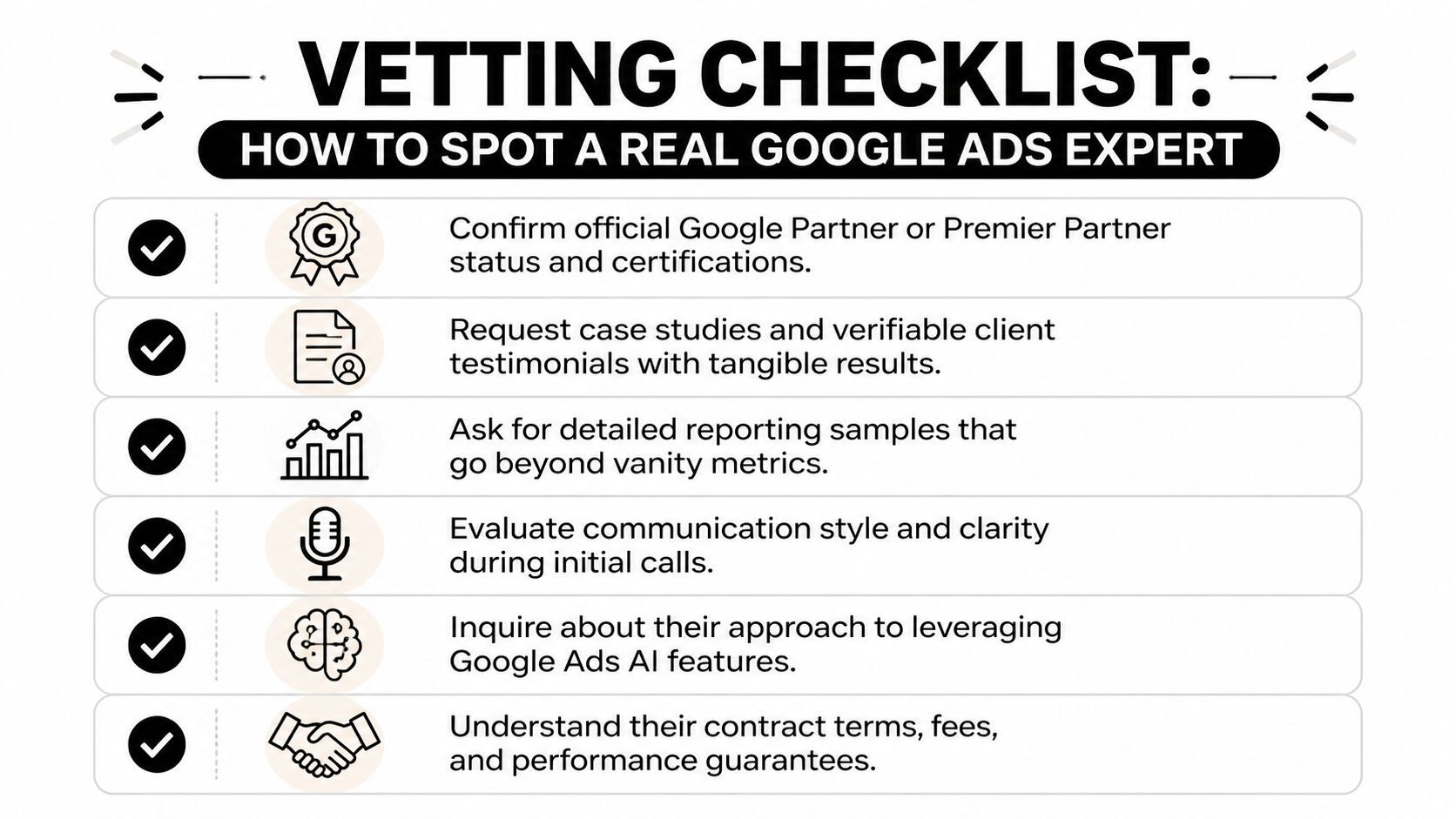
The Vetting Checklist How to Spot a Real Google Ads Expert
Most candidates eliminate themselves before you ever book a call. You just need to know what to look for.
A real google ads consultant leaves evidence. Not hype. Not recycled jargon. Evidence.
Check their positioning first
If their homepage says they do SEO, Meta Ads, web design, branding, email, social, content, CRO, and Google Ads, that’s not specialization. That’s a menu.
You want someone whose public presence makes one thing obvious. They live inside paid search and paid media. They understand search campaigns, Shopping, remarketing, audience layering, conversion tracking, GA4, and landing page performance. They don’t treat Google Ads like one tab in a larger service business.
Start with these filters:
Niche clarity: Do they clearly specialize in PPC, or are they another “digital marketing expert”?
Point of view: Do they publish opinions, audits, breakdowns, or practical takes, or just bland service pages?
Language quality: Can they explain technical issues in plain English? If their site is vague, their client communication will be worse.
Look for proof that survives scrutiny
Ignore generic testimonials like “great to work with” or “helped our business grow.” Those prove almost nothing.
Ask for work samples that show thinking. That doesn’t mean they need to hand over private client data. It means they should be able to explain the situation, the problem, the diagnosis, the changes, and what improved.
What you’re looking for:
Case studies with context: What was broken before they touched the account?
Decision logic: Why did they change campaign structure, bidding, match types, or conversion setup?
Business framing: Do they talk about qualified leads, sales quality, and profit, or only in-platform metrics?
Reporting examples: Can they show how they communicate performance to leadership?
Hiring filter: If a consultant can’t walk you through a messy account and explain what they’d fix first, don’t hire them.
You should also review how they think about waste. A useful starting point is this article on hiring a Google Ads expert to cut waste and work with a specialist. It’s worth comparing a candidate’s language against that standard. Strong consultants talk about leaks, tracking, intent, and prioritization. Weak ones talk about “boosting visibility.”
Use their public content as a stress test
LinkedIn matters. Their website matters. Guest posts matter. Not because content alone proves skill, but because public writing exposes how they think.
A strong consultant usually shows these signals:
They answer hard questions directly. They don’t dodge topics like attribution gaps, poor lead quality, broad match waste, or account bloat.
They can say no. If every problem somehow requires more budget, they’re not objective.
They understand modern platform changes. They should discuss Google’s automation and AI tools with nuance, not blind trust or knee-jerk rejection.
They sound like an operator, not a salesperson. You should hear tradeoffs, constraints, and prioritization.
Verify communication before skill
A brilliant PPC technician who communicates badly is still a bad hire.
Watch how they handle the first conversation. Do they answer the question you asked? Do they interrupt? Do they talk in acronyms without explanation? Do they ask useful follow-ups? Can they explain something like Quality Score or offline conversion tracking without sounding rehearsed?
That call tells you a lot. So does the follow-up email.
Clear recap: Did they summarize issues accurately?
Specific next steps: Did they suggest focused actions or generic “optimizations”?
Speed with substance: Fast is good. Fast and shallow is not.
The best consultants make complex decisions understandable. That’s not a soft skill. It’s part of the job.
Interview Questions That Separate a Consultant from a Guru
Most hiring calls are too easy.
You ask how they optimize campaigns. They say keywords, bids, ad copy, testing, reporting. None of that tells you whether they can run a high-spend account under pressure.
A real consultant should be able to reason through messy situations in real time. That’s what you need to test.
Ask for process, not philosophy
Bad candidates hide inside broad principles. Strong candidates can describe sequence.
Ask this instead of “How do you manage Google Ads accounts?”
Walk me through your first 90 days in an account like ours. What do you audit first, what do you change second, and what do you leave alone until the data is clean?
That question forces structure. It reveals whether they understand dependency order. A seasoned operator knows you don’t change bidding, audience targeting, conversion actions, and landing pages all at once and then pretend you learned something.
Other strong prompts:
We have rising CPCs and weaker lead quality. What are your first diagnostic checks?
Our branded search performs well but non-branded lags. How do you evaluate whether the issue is keywords, message match, landing pages, or offer?
If GA4 and Google Ads disagree, how do you decide what to trust?
What would make you cut spend, not increase it?
Force them into tradeoffs
Anyone can sound smart when there’s no constraint. Good interview questions introduce one.
For example:
You inherit an account with strong click volume, mediocre conversion rate, questionable CRM feedback, and a sales team complaining about lead quality. You can only tackle two areas in the first month. What do you choose and why?
That question matters because Google Ads performance is never just a platform problem. The consultant has to decide whether to fix search intent, tighten negatives, clean tracking, restructure campaigns, or improve post-click experience. Their answer shows whether they think like a business partner or a button-pusher.
Listen for how they talk about automation
You want someone who understands automation, but doesn’t worship it.
Ask:
How do you decide when to use automated bidding versus more controlled approaches?
How do you evaluate Performance Max when reporting is limited?
What inputs do you improve before trusting Google’s AI to scale?
Weak answers sound like this: “Google’s machine learning usually knows best.”
Strong answers usually include better feed quality, stronger conversion signals, audience inputs, exclusions, search query monitoring, clean account structure, and clear business goals. They understand that AI works best when you train it with good inputs.
Use scenario questions to expose experience
Here are the interview questions I’d use for any account spending serious money:
Show me how you’d audit wasted spend in the first week. You’re looking for search terms, match type sprawl, poor geo settings, bad device segmentation, duplicate conversions, weak negatives, and campaign overlap.
How do you define a good lead for a business like ours? If they can’t connect PPC to sales qualification, they’re not senior enough.
What do you put on an executive report? What do you leave out? You want focus on business outcomes, not dashboard theater.
Tell me about a time you disagreed with a client request. This reveals backbone. Good consultants push back when the request is wrong.
What’s your view on branded search protection? Their answer should show nuance, especially around incrementality and demand capture.
A consultant who answers every question with certainty is usually less experienced than one who explains the tradeoffs clearly.
Red flags in the answers
You’re not just listening for good ideas. You’re listening for weak patterns.
Watch for these:
Template answers: They say the same thing regardless of your business model.
Tool obsession: They talk about scripts, dashboards, and AI prompts more than customers and revenue.
No mention of tracking quality: That’s a major warning sign.
No curiosity: If they don’t ask about your margins, sales cycle, close rates, or CRM, they’re not thinking thoroughly enough.
A strong consultant should leave the interview sounding thoughtful, commercially aware, and slightly hard to impress. That’s good. You want someone who sees the flaws before they touch the account.
Pricing Models Onboarding and Reporting Expectations
Pricing tells you how the consultant thinks about the relationship.
If the fee structure rewards more spend regardless of efficiency, you’ve already got a misalignment problem.
Comparing Google Ads Consultant Pricing Models
Pricing Model |
How It Works |
Pros |
Cons / Red Flags |
|---|---|---|---|
Percentage of ad spend |
Consultant fee rises as your media budget rises |
Simple to understand, common in the market |
Incentive can drift toward higher spend instead of better efficiency |
Flat retainer |
Fixed monthly fee tied to scope, complexity, and support level |
Cleaner alignment, predictable cost, easier to judge value based on outcomes |
Bad fit if scope is vague or the consultant can’t define deliverables clearly |
Performance hybrid |
Base fee plus incentive tied to agreed outcomes |
Can align interests if metrics are defined properly |
Dangerous if tracking is weak or goals are too easy to game |
For high-spend accounts, I usually prefer a flat retainer or a carefully designed hybrid. A percentage-of-spend model can work, but it often creates the wrong incentive. Your consultant should get rewarded for better decisions, not just a bigger budget.
If you want a deeper breakdown of how fee structures affect accountability, this guide on decoding PPC management pricing for real results is worth reviewing before you sign anything.
What strong onboarding looks like
A serious onboarding process should feel like a diagnosis, not an admin checklist.
You should expect the consultant to review account structure, conversion tracking, campaign segmentation, search terms, negative keyword coverage, bidding logic, location settings, ad assets, landing pages, and CRM feedback loops. If they only ask for account access and billing permissions, that’s not onboarding. That’s platform access.
A proper start usually includes:
Business alignment: Revenue goals, margins, sales cycle, seasonality, and offer priorities.
Tracking review: Google Ads conversions, GA4 events, CRM integration, offline conversion quality.
Account audit: Campaign structure, search intent coverage, negatives, bidding, asset quality, extensions, and audience use.
Landing page review: Message match, speed, form friction, and call-to-action clarity.
One practical option in the market is Come Together Media LLC, which offers Google Ads audits, one-on-one strategy sessions, and ongoing PPC optimization with a focus on account structure, keyword selection, and transparent reporting. That’s useful if you want specialist support instead of another agency handoff.
Reporting should answer business questions
A good report doesn’t just show performance. It helps leadership decide what to do next.
You do not need a 40-slide deck full of charts nobody uses. You need a concise operating view. What improved. What slipped. Why it happened. What gets changed next.
Your report should speak to:
Lead quality or sales quality
Cost per acquisition trends
Conversion tracking reliability
Branded versus non-branded dependence
Search term waste
Landing page friction
Budget reallocation logic
What to ask for: “Show me the exact report you’d present to a CMO after a rough month.”
That question cuts through a lot of nonsense.
Forward-looking consultants should address AI in onboarding
This now belongs in the onboarding conversation, not as a side note.
If your consultant isn’t discussing how your account should handle automation, signal quality, and AI-driven campaign types, they’re behind. That doesn’t mean handing everything to Google’s black box. It means deciding where AI helps, where guardrails matter, and what data must be fixed before automation can do useful work.
That topic becomes a hard requirement after hire.
Red Flags and Why Your Consultant Must Be an AI Expert
The consultant you hire today has to manage the account you’ll be running tomorrow, not the version of Google Ads that existed a few years ago.
That means AI competence is no longer optional.

According to Directive’s overview of current Google Ads trends, the post-May 2025 shift centers on AI Max adaptation. Early adopters saw 15-30% ROAS uplift, while 40% of SMBs reported stalled scaling because they lacked expert guidance connecting AI tools to business strategy. That’s the exact gap a modern google ads consultant is supposed to close.
Red flags that should worry you now
Some warning signs are old. Some are newer. All of them matter.
They accept Google recommendations blindly: Not every recommendation improves business outcomes.
They can’t explain conversion inputs: AI bidding is only as good as the signals it receives.
They report platform metrics without CRM context: That’s how bad leads get mistaken for progress.
They don’t discuss feed quality, audience signals, or exclusions: That suggests shallow understanding of automated campaign control.
They sound either anti-AI or blindly pro-AI: Both extremes are lazy.
A good consultant knows where automation helps and where human judgment still matters. They know that machine learning can scale the wrong thing fast if your conversion actions, audience signals, or landing pages are weak.
AI expertise is broader than Google Ads alone
Paid search doesn’t live in a vacuum. If your consultant thinks only in terms of campaigns and ignores the rest of the customer journey, they’ll miss obvious advantages.
For example, businesses using AI across customer touchpoints often create cleaner feedback loops. If you’re exploring ways to integrate AI with your business phone system, that can improve how leads are handled, routed, and qualified after the click. That’s relevant because PPC performance doesn’t stop at form fills. Sales handling shapes actual return.
What an AI-capable consultant should do
They should do more than mention Performance Max, Smart Bidding, or AI-generated assets. They should know how to steer them.
Look for someone who can talk through:
Conversion action selection: Which events should inform bidding, and which ones should not.
Signal quality: Whether imported offline conversions are strong enough to guide optimization.
Campaign boundaries: When to isolate brand, high-intent non-brand, Shopping, or remarketing.
Creative inputs: How headlines, descriptions, images, and feeds influence machine performance.
Measurement gaps: Where platform reporting overstates value.
That conversation also overlaps with how teams are using generative tools in ad operations. If you’re sorting through actual use cases versus the hype, this piece on ChatGPT advertising is a useful practical reference.
Here’s a quick example of the broader shift in action:
The modern red flag is strategic passivity
The biggest warning sign isn’t that your consultant lacks a specific tactic. It’s that they wait for Google, for the data, or for your team to tell them what to do.
You want proactive leadership. Someone who spots weak signals early. Someone who questions whether the AI is optimizing toward the right outcome. Someone who says, “Your account doesn’t need more complexity. It needs cleaner inputs and tighter control.”
If your consultant is still learning modern Google Ads automation on your budget, you hired too late-stage a beginner for too expensive a problem.
Your Next Steps to a Profitable PPC Partnership
If your current setup feels expensive, slow, and oddly vague, trust that instinct.
Google is too dominant a revenue channel to tolerate mediocre management. In 2023, Google’s advertising revenue reached $237.8 billion, more than double its closest competitor, according to Semrush’s Google Ads market overview. For businesses investing heavily in paid search, mastery of this platform is not optional. It’s a core growth function.
Your next move is simple. Thoroughly audit the account. Look for wasted spend, weak tracking, poor reporting, soft lead quality, and slow decision-making. Then compare your current agency model against what a dedicated specialist would change.
Hire for judgment. Hire for direct access. Hire for accountability.
That’s how you turn Google Ads from a frustrating line item into a reliable acquisition engine.
If you want a direct second opinion on your account, Come Together Media LLC offers Google Ads consulting, PPC audits, and one-on-one strategy support for businesses that need clearer answers, tighter execution, and a more accountable paid media partner.
