


You're probably living this already. Google Ads still spends money every day, reports still populate, and the dashboard still looks busy. But your confidence in what's driving revenue has dropped. Remarketing looks softer, attribution feels shaky, and every agency pitch sounds the same: more automation, more creative testing, more audience expansion.
That's not a strategy. That's stalling.
If you're spending serious money on PPC, a first party data strategy is no longer a side project for the CRM team. It's the control layer for Google Ads performance. It gives you better audiences, better bidding signals, and better measurement when browser-based tracking stops behaving the way it used to. The brands that build this now will keep their edge. The brands that delay will keep funding waste and calling it optimization.
Table of Contents
The End of Easy PPC and the Rise of Owned Data - Why CMOs feel the pain first - Owned data is the only durable asset
What Is a First-Party Data Strategy Really - Owned signals beat rented assumptions - Strategy means collection plus activation
The Business Case Why This Is a Non-Negotiable - Three ways first-party data changes PPC economics - Why agency reporting often misses the point
The Five-Step Implementation Roadmap - Step 1 audit and collect - Step 2 unify and govern - Step 3 segment for decisions not decoration - Step 4 activate inside Google Ads - Step 5 measure what the platform can't infer alone
Sector-Specific Plays E-commerce and Healthcare - E-commerce play - Healthcare play
The End of Easy PPC and the Rise of Owned Data
Easy PPC is over. You can still buy traffic, but you can't rely on the old signal stack and expect clean answers.
The root problem isn't that your team forgot how to run campaigns. The environment changed. Privacy rules tightened, consent standards got stricter, and third-party tracking became less dependable. Google's Privacy Sandbox rollout made that uncertainty impossible to ignore. Chrome began limiting third-party cookies for 1% of users in Q1 2024, expanded to 100% of users by Q3 2024, then reversed course in July 2024 after CMA feedback and kept third-party cookie choice prompts while continuing Privacy Sandbox work, as outlined in this first-party data strategy analysis from LiveRamp.
That's exactly why this issue gets misread by agency teams. They hear “cookies aren't gone” and assume the problem is solved. It isn't. The planning problem got more complex, not simpler. Your tracking environment is now unstable by design. That means your first party data strategy has to do more than support personalization. It has to protect identity and measurement.
Why CMOs feel the pain first
You feel this before your agency admits it. You see it in softer audience quality, weird conversion paths, and reports that look precise but don't line up with what sales sees in the pipeline.
A bloated agency usually responds the same way:
More platform automation: They lean harder on black-box bidding.
More broad targeting: They call it scale, even when lead quality slips.
More reporting slides: They substitute dashboards for diagnosis.
None of that fixes signal loss.
Practical rule: If Google Ads can't reliably understand who your best customer is, it will optimize toward the easiest conversion it can detect, not the most valuable outcome for your business.
Owned data is the only durable asset
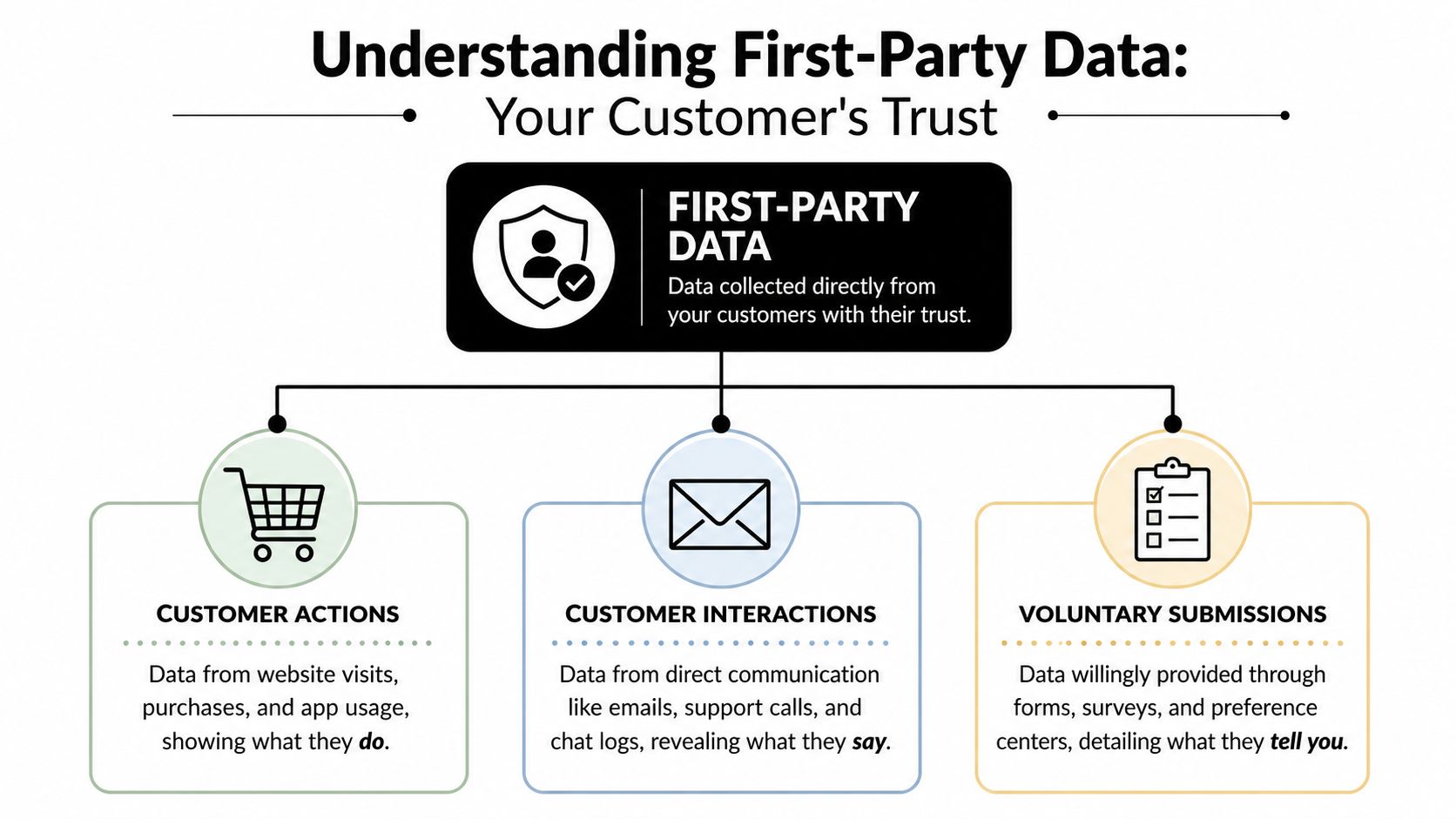
First-party data is the one input you control. It comes from your site, your CRM, your email engagement, your purchase history, your forms, and your customer interactions. It doesn't vanish because a browser changes policy. It doesn't depend on an outside broker. And it reflects actual relationships with your business.
For a CMO, that matters because PPC isn't just a media-buying exercise anymore. It's an operating system question. Do you own the customer signal that drives targeting, bidding, and reporting, or are you still renting fragments and hoping the platform fills in the blanks?
That's why first-party data isn't a trend. It's the only path forward if you want control over ROAS instead of excuses about market conditions.
What Is a First-Party Data Strategy Really
A first-party data strategy is simple. It's your plan to collect, organize, and use information that people give you directly through channels you own.
Imagine a good shop owner. They know who buys often, who asks about premium products, who disappears for months, and who always responds to a specific offer. They don't need a stranger's rented list to recognize a valuable customer. They use direct knowledge from real interactions.
That's what first-party data is in PPC. It's not a buzzword. It's usable customer truth.
Owned signals beat rented assumptions
At a practical level, first-party data includes website visits, form fills, CRM records, email engagement, and purchase history. Several industry guides in 2025 described the shift clearly: businesses moved data collection into owned assets through tactics like progressive profiling, loyalty programs, and consent-based tracking because that data is usually more accurate, more privacy-compliant, and more useful for segmentation and personalization than third-party alternatives. One industry claim says 75% of B2B marketers are already transitioning to first-party data strategies to reduce risk and improve campaign performance, according to S2W Media's 2025 write-up.
If you run Google Ads, that means your best audience inputs should come from things like:
High-value buyers: Customers with strong purchase history or repeat behavior
Engaged prospects: Leads who requested demos, pricing, or consultations
Category intent: People who viewed specific products, services, or content themes
Lifecycle stage: New lead, active customer, lapsed buyer, or expansion opportunity
For commerce brands, this is central to unlocking sustainable growth for Shopify. The point isn't collecting more random fields. The point is building better audience inputs from signals you own.
Strategy means collection plus activation
A lot of teams stop at storage. They dump records into a CRM and call it progress. That's not strategy.
A CRM stores relationship data. A CDP helps unify data from multiple sources into a more usable customer view. You don't need to obsess over the acronym battle. What matters is whether your Google Ads account can access reliable audience signals built from one consistent customer record.
Here's the difference between having data and having a strategy:
Situation |
What it means |
|---|---|
Data without strategy |
Contact records exist, but nobody uses them to improve targeting or bidding |
Strategy without governance |
Teams collect everything, then create messy records nobody trusts |
Real first-party data strategy |
You collect the right fields, clean them, segment them, and push them into ad decisions |
Collect less junk. Use more signal.
A good first-party data strategy answers three questions fast:
What customer data matters for ad performance
Where that data lives today
How it gets activated inside Google Ads
If your agency can't answer those in plain English, they don't have a strategy. They have a slide deck.
The Business Case Why This Is a Non-Negotiable
Let's talk money, because that's the standard that matters.
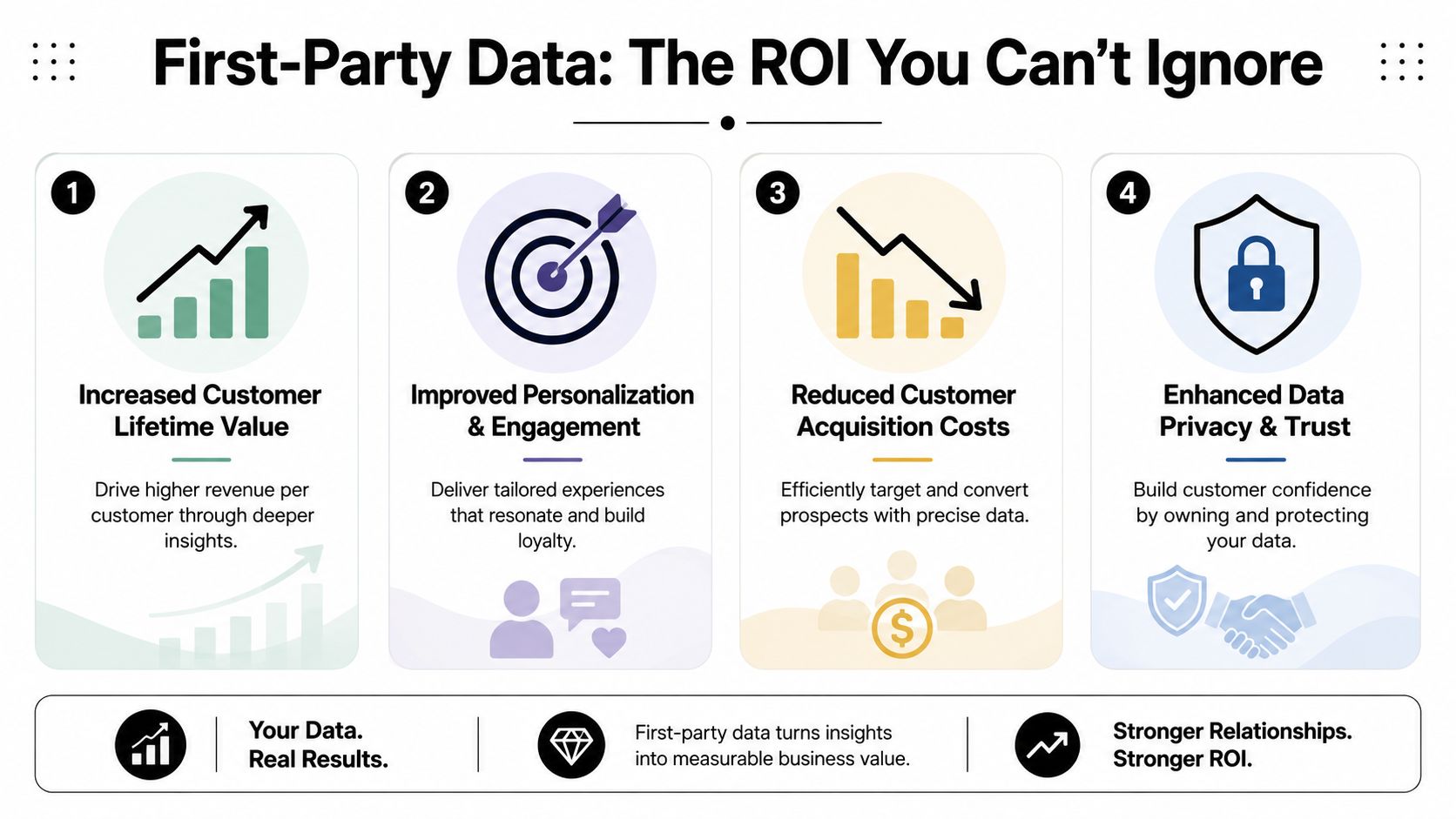
A first-party data strategy improves PPC when it helps Google Ads find better people, bid toward better outcomes, and measure performance against real business value. That's the short version. The stronger version is this: a 2025 publisher-focused guide reports that brands using first-party data can see up to 8x return on ad spend and 25% lower cost per acquisition, while also improving ad relevance and budget allocation, according to Adtelligent's guide on first-party data monetization.
That doesn't happen because “data” is magical. It happens because cleaner inputs produce better decisions.
Three ways first-party data changes PPC economics
First, it sharpens targeting. Customer Match works better when you upload meaningful lists, not bloated exports full of weak contacts. A list of past purchasers, qualified leads, or high-value customers gives Google far better direction than generic in-market targeting.
Second, it improves bidding. If your campaigns optimize only to shallow conversions like page visits or low-intent forms, Google will chase volume. Feed in deeper outcomes, including qualified pipeline steps or revenue-linked conversions, and your bidding strategy gets smarter.
Third, it creates an asset you own. Platforms will keep changing. Browser policies will keep changing. Agency teams will keep renaming the same tactics every year. Your first-party data is the one thing that compounds instead of resetting.
Here's where many teams go wrong:
They optimize for leads, not revenue
They upload all contacts instead of best-fit segments
They trust platform attribution without pressure-testing it
They ignore view-through noise until budget gets wasted
If you need a clearer lens on attribution inflation, read this breakdown of view-thru conversions in Google Ads. It's one of the easiest ways executive teams get fooled by reported performance.
Why agency reporting often misses the point
Agencies love metrics they can present cleanly. CMOs need metrics that connect to profit. Those aren't always the same thing.
A campaign that generates more tracked conversions can still be worse for the business if those conversions are low-intent, duplicate, or low-value.
A specialist PPC consultant usually sees this faster because there's no account-management theater in the middle. No junior media buyer hiding behind templates. No incentive to keep complexity high just to justify fees.
The business case is straightforward. Better first-party inputs create better audience quality, better bidding behavior, and better reporting integrity. If you spend enough on Google Ads for mistakes to matter, this becomes essential.
The Five-Step Implementation Roadmap
Teams often don't fail because they lack data. They fail because their data is scattered, inconsistent, and disconnected from campaign execution.
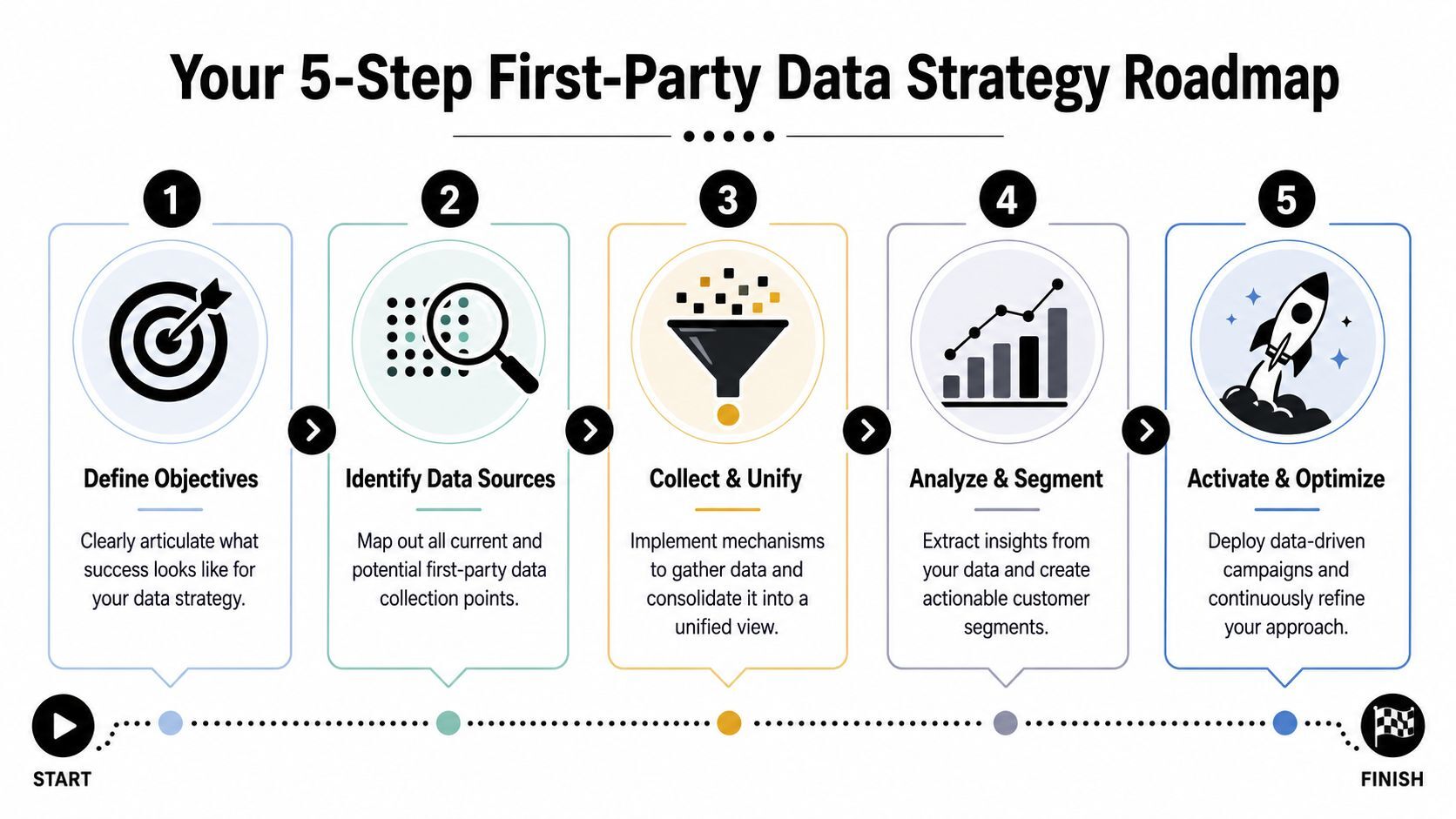
The fix isn't complicated, but it does require discipline. A technically sound first-party data strategy should start with a data-coverage audit across owned and recorded touchpoints such as CRM, website or app events, loyalty, email, in-store interactions, and past campaigns before enrichment or activation. If the source layer is fragmented, downstream segmentation and bidding decisions inherit inconsistent identifiers and missing fields, as explained in Epsilon's framework for maximizing first-party data.
Use this roadmap.
Near the start, get the visual straight in your team's head:
Step 1 audit and collect
Start with what already exists. Pull a plain inventory of every owned signal source.
Include:
CRM records: Lead status, sales stages, purchase data, renewal data
Website and app events: Product views, pricing page visits, key form starts, purchases
Owned engagement data: Email clicks, SMS responses, support interactions
Offline records: In-store activity, call outcomes, closed deals, canceled deals
This is also where operational teams often need cleaner reporting inputs from marketplaces and commerce systems. If that's part of your stack, a practical resource on how to sync Amazon sales data with Google Sheets can help your team centralize data before it ever reaches ad platforms.
Step 2 unify and govern
Now make the data usable. Standardize naming, formatting, update frequency, and validation rules.
If your CRM stores one customer as three conflicting records, Google Ads won't magically solve it. You need a single reliable view tied to stable identifiers and fields that matter. This is also where consent and permissions need to be handled properly.
A good governance rule is simple: every field in your system should have a reason to exist.
Step 3 segment for decisions not decoration
Segmentation should help you spend better. Nothing else.
Create audiences that map directly to ad decisions, such as:
Recent buyers for upsell or cross-sell
High-LTV customers for Customer Match and value-based expansion
Abandoned high-intent visitors for focused remarketing
Sales-qualified leads for search bid adjustments and exclusion logic
Lapsed customers for win-back campaigns
Avoid vanity segments. “People who downloaded any content in the last year” is usually lazy. “Customers who purchased twice and viewed premium products in the last month” is more useful.
To support clean audience creation later, your foundation should include solid Google Ads conversion tracking setup. Without that, activation turns into guesswork.
A helpful walkthrough on the broader mindset sits below.
Step 4 activate inside Google Ads
Here, agencies often become vague. Don't let them.
Activation in Google Ads should mean direct use of first-party audiences in:
Customer Match
Search observation audiences
Performance Max audience signals
Remarketing lists
Offline conversion imports and value rules
If your team isn't pushing audience lists and business outcomes back into the account, you're underusing your best asset.
Google Ads doesn't need more “data.” It needs cleaner instructions.
Step 5 measure what the platform can't infer alone
Close the loop. Tie ad clicks to qualified leads, opportunities, purchases, repeat purchases, and revenue quality wherever possible.
Specialist oversight is paramount. A good consultant asks whether the campaign drove profitable outcomes. A bad agency asks whether the dashboard looks full. Those are different questions, and they produce very different budgets.
The practical takeaway is immediate: this week, export one audience of your best customers, one audience of qualified leads, and one audience of lapsed customers. If you can't build those cleanly, your first-party data strategy isn't ready.
Sector-Specific Plays E-commerce and Healthcare
The best first-party data strategy is never generic. It should fit buying behavior, sales cycle, and compliance realities.
That's also why broad agency playbooks usually disappoint. They recycle the same audience logic across completely different businesses and hope automation handles the nuance. It won't.
E-commerce play
For e-commerce, the mistake is usually overcollection. Teams track everything, store everything, and then fail to act on the few fields that matter.
The better model is lean. Most content treats first-party data as universally beneficial, but it rarely deals with the tradeoff between data volume and decision quality. The smarter approach is a minimum viable first-party data model that keeps only the fields that materially improve conversion quality, segmentation, or offline value imports, plus a process for pruning stale or redundant data, as argued in Piwik PRO's piece on first-party data value.
For an e-commerce brand, that usually means prioritizing:
purchase history
order value bands
product or category affinity
recency
repeat purchase behavior
cart or checkout intent
That dataset can drive stronger Shopping, Search, and Performance Max decisions than a giant warehouse of low-signal attributes. If your merchandising team is also thinking about discovery and product relevance, this overview of AI search for e-commerce retailers is worth reviewing alongside your audience strategy.
For broader channel alignment, a specialist in e-commerce marketing services should be thinking about feed quality, audience quality, and conversion quality together, not in separate silos.
Healthcare play
Healthcare is different. You often have longer consideration cycles, narrower service intent, and tighter privacy expectations. That means your first-party data strategy has to be more selective.
You do not need every detail. You need enough signal to separate:
Audience type |
Useful paid media signal |
|---|---|
High-intent inquiry |
Service line requested, location, consultation request |
Existing patient |
Prior service category or engagement status |
Low-intent lead |
General form fill without meaningful next-step behavior |
A healthcare provider can use consented inquiry data from contact forms, call outcomes, and service-interest submissions to build focused search campaigns around high-value procedures or service lines. The point is not aggressive personalization. The point is relevance with restraint.
That's the lesson many agencies miss. In sectors with trust sensitivity, the best first-party strategy is often narrower, cleaner, and more disciplined than the “collect everything” model.
Your First-Party Data Quick Audit Checklist
A CMO should be able to answer one question without calling a workshop, an agency strategist, or a data engineer. Can your team feed Google Ads the customer signals that predict revenue?
If the answer is fuzzy, you have an execution problem, not a data problem.
Use this audit to find the gap fast. The goal is simple. Identify whether your first-party data is usable inside Google Ads, or trapped in a CRM, spreadsheet, or agency slide deck. If you need outside help, look for a partner that builds activation systems, not one selling theory under the label of data-driven marketing agency services.
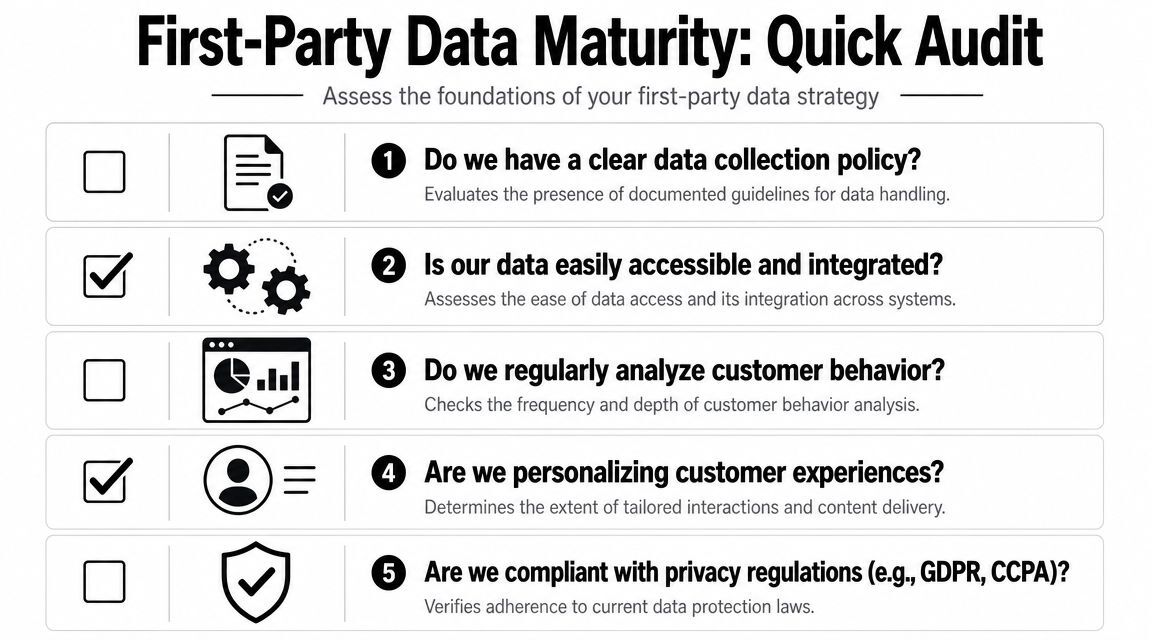
Answer yes or no:
Can you identify your best customers today? Pull a clean list by lifetime value, repeat purchase behavior, or qualified revenue contribution without manual cleanup.
Can Google Ads use those audiences? Customer Match lists, remarketing audiences, and imported conversion actions should map to real business segments, not generic site visitors.
Is your CRM connected to campaign decisions? Reporting alone is useless. Audience updates, exclusions, and offline conversion imports need to affect bidding and targeting.
Do you measure lead quality after the click? Separate raw leads from qualified leads, pipeline opportunities, and closed revenue.
Have you cleaned out stale or redundant fields? Bloated records create weak audiences and bad automation.
Do you know which conversions deserve bidding priority? If every form fill carries the same value, Google will optimize toward cheap volume instead of profitable outcomes.
Can your team explain consent and data use clearly? If legal, marketing, and operations give different answers, your process is unstable.
More than two “no” answers means your Google Ads account is running on partial signals. That usually leads to wasted spend, weaker audience matching, and bidding decisions based on low-value actions.
Fix the first broken point on the list. That is usually the constraint depressing ROAS.
Your Next Move as a Data-Driven Leader
The critical decision isn't whether first-party data matters. That argument is over. The decision is whether your team will use it as an operational asset or keep treating it like background infrastructure.
A serious first-party data strategy gives you three things every CMO wants: cleaner audience targeting, better bidding inputs, and more trustworthy measurement. It also changes your position in the market. You stop depending on platform guesses and start feeding the system the signals that reflect customer value.
That's why this is the path forward for PPC leaders. Not because it sounds modern, but because it improves control. The old model leaned on rented identifiers, vague attribution, and agency storytelling. The new model leans on owned signals, direct activation, and accountability.
If you're evaluating partners, be ruthless. Ask whether they can map CRM stages to conversion actions. Ask whether they can build decision-ready audience segments from your current systems. Ask how they validate platform reporting against actual business outcomes. If they answer with jargon, layers of account management, or a six-month “discovery phase,” move on.
A dedicated PPC specialist is usually the better fit here because the work demands speed and clarity. You need someone who can inspect tracking, challenge inflated reporting, build clean audience logic, and make changes without hiding behind internal process. That's hard for big agencies with junior account teams and too much overhead. It's much easier for a senior operator who works directly with your business.
If you want a broader view of what to watch for in partner selection, this take on data-driven marketing agencies is a useful benchmark.
Your next move is simple. Audit what you own, decide what matters, and push that data directly into Google Ads in a way that reflects profit, not vanity conversions. That's how you protect spend and build a system that gets stronger over time.
If you want a direct, senior-level review of your Google Ads setup, Come Together Media LLC offers exactly that. No bloated agency structure, no junior handoffs, and no fluff. Just focused PPC strategy, transparent feedback, and practical recommendations built to improve ROAS with a first-party-data-led approach.
