


You’re probably living this right now.
Your agency sends a polished monthly report. It has branded slides, conversion graphs, and a lot of commentary about engagement trends. But when you ask a basic executive question, nobody gives you a clean answer.
What did we spend, what did we get back, where is the waste, and what changes are being made this week?
That gap is why so many companies get burned by so-called data-driven marketing agencies. The problem usually isn’t access to data. The problem is that most firms confuse reporting with decision-making. They can export dashboards. They can’t diagnose performance at the level a high-spend PPC account requires.
I’m biased toward specialists because I’ve seen the alternative too many times. Once spend gets serious, generic account management falls apart fast. The budget is too large, the sales cycle is too complex, and the cost of weak attribution is too high. If you spend heavily on Google Ads, paid search, display, remarketing, or paid social, you don’t need more charts. You need a partner who can turn data into profitable action.
The Agency Report Is In and It Means Nothing
A bloated PDF is not strategy.
Most agency reports are built to look busy. They highlight impressions, clicks, average position trends, engagement, view-through activity, and broad-channel summaries. Those metrics can be useful in context. On their own, they are often camouflage.
Your business doesn’t run on charts. It runs on margin, qualified pipeline, booked revenue, and customer economics.
Why vanity reporting survives
The traditional agency model rewards presentation more than precision.
A sales team closes the account. An account manager runs meetings. A strategist appears occasionally. A junior specialist pulls reports and tweaks campaigns. By the time feedback reaches the person touching the platform, the original business problem is diluted.
That structure creates a predictable outcome:
You get summaries instead of answers because nobody close to the account owns the full picture.
You hear channel language instead of business language because the team isn’t tied tightly enough to CRM and revenue data.
You see lagging explanations because agencies often report after the month ends instead of acting while the problem is still fixable.
Most underperforming PPC accounts don’t fail because the platform is hard. They fail because nobody senior is paying close enough attention.
What a useful report should do
A useful PPC report should make decisions easier. It should show what changed, why it changed, and what happens next.
If it doesn’t answer those three questions, it’s decoration.
Here’s the standard I use when auditing an account inherited from an agency:
Report element |
Weak version |
Useful version |
|---|---|---|
Business outcome |
Leads or conversions only |
Qualified leads, sales value, pipeline contribution |
Trend explanation |
“Performance was mixed” |
Specific cause tied to search terms, bids, landing pages, tracking, or auction shifts |
Next actions |
Generic testing notes |
Named actions with priority and expected impact |
Accountability |
Team summary |
Clear owner and execution timeline |
The real issue
I’ve audited too many accounts where the report said things were fine while the account structure was leaking money.
The pattern is common. Broad match runs without enough guardrails. Conversion tracking counts junk actions. Brand traffic props up blended ROAS. Remarketing gets credit for sales it didn’t create. Nobody checks search query quality closely enough. Then the agency says the account needs more time.
No. It needs adult supervision.
If you spend at a meaningful level, you need direct access to the person who can read messy auction data, spot tracking failure, challenge the attribution model, and change the account immediately. That’s not an account coordinator skill. That’s senior operator work.
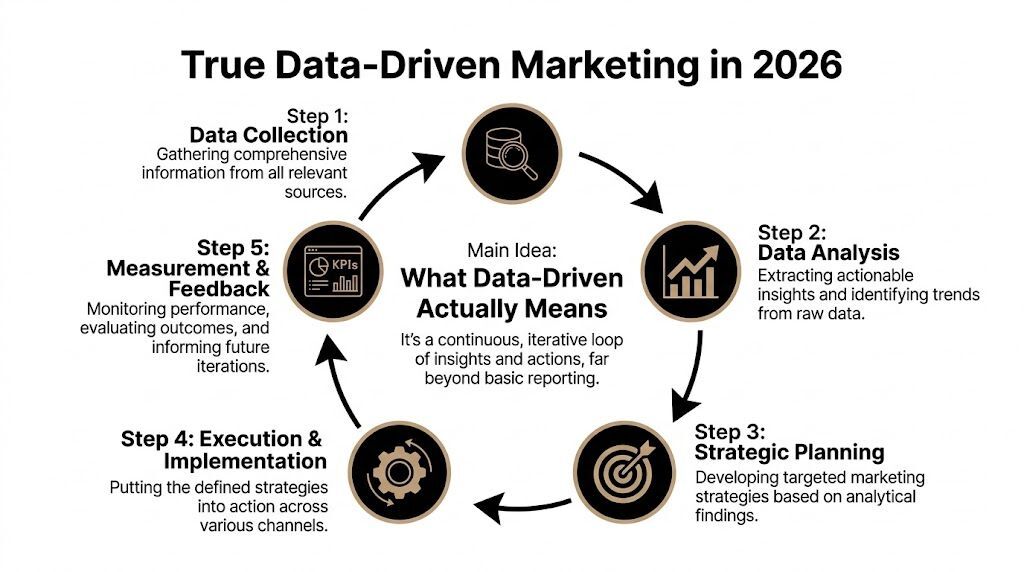
What Does Data-Driven Actually Mean in 2026
“Data-driven” has become one of the emptiest phrases in digital marketing.
Having Google Analytics, GA4, Looker Studio, HubSpot, or Salesforce access doesn’t make a partner data-driven. It just means they can log in. Real discipline looks different.
According to a 2025 industry analysis, data-driven marketing strategies deliver 5 to 8 times higher ROI than non-data approaches, yet 87% of marketers view data as their most underutilized asset. High-performers also use predictive analytics at 71% adoption and achieve 28% faster revenue growth (cmointern.com). The opportunity is obvious. Most marketing teams still waste it.
The three parts that matter
I don’t define data-driven marketing by software. I define it by operating behavior.
Accurate tracking
If your conversion tracking is wrong, every optimization decision built on top of it is compromised.
That means more than counting form fills. You need to know which conversions were qualified, which became opportunities, which became revenue, and which should never have been counted in the first place. If your Google Ads account says a campaign is winning but the CRM says those leads don’t close, the CRM wins.
Structured testing
Random changes are not optimization.
Every serious PPC account needs a testing framework. That includes ad copy tests, landing page tests, bid strategy reviews, audience segmentation, search term expansion, and negative keyword control. Each change should have a reason. If a partner can’t explain the hypothesis behind a test, they’re guessing.
Strategic interpretation
Here, most agencies break.
A dashboard can tell you CPCs are rising. It can’t tell you whether higher CPCs are acceptable because lead quality improved, whether the account is entering a more competitive auction, or whether match type sprawl is dragging you into irrelevant traffic. That requires judgment.
Data is not the same as intelligence
Think of data like ingredients in a kitchen. Good ingredients matter. But ingredients don’t cook dinner on their own. A chef still needs a recipe, timing, and taste.
Marketing works the same way.
A solid Business Intelligence setup helps unify reporting and surface trends, but tooling is only useful when someone can interpret the signal and act on it quickly. The same applies to broader indicators like share of search, which can add context to brand demand and competitive pressure when paired with PPC performance data.
What you should demand from any partner
Ask for evidence of this operating model:
Tracking integrity: Can they show how ad platform conversions tie to CRM stages or revenue?
Test discipline: Do they run deliberate experiments, or just “make optimizations” every month?
Decision logic: Can they explain why a campaign should scale, pause, split, or rebuild?
Practical rule: If a partner talks more about dashboards than decision rules, they’re not data-driven. They’re data-adjacent.
That distinction matters more in 2026 than it did a few years ago. Privacy changes, weaker third-party signals, and more automation in ad platforms make bad interpretation more expensive. The less clean the signal, the more valuable senior judgment becomes.
Core PPC Services That Move the Needle
When spend is high, performance doesn’t improve because someone found a hack. It improves because the account is managed with rigor across the fundamentals.
That’s where a specialist earns their keep.
A junior account manager usually follows platform defaults and periodic checklists. A seasoned PPC operator treats the account like a live trading environment. Inputs change. Competitors react. Lead quality shifts. Search behavior moves. The account needs active interpretation.
According to a 2025 industry source, AI-based segmentation boosts efficiency by 25%, and 54% of marketers use real-time bidding to lower customer acquisition cost by integrating predictive models with CRM data (peertopeermarketing.co). That doesn’t mean you should blindly “use AI.” It means smart segmentation and better feedback loops matter.
Bidding isn’t set-and-forget
Automated bidding can be powerful. It can also burn budget fast when fed weak signals.
A real operator checks whether the conversion actions included in bidding are worth optimizing toward. They watch device splits, hour-of-day behavior, geo performance, search intent quality, and auction movement. They don’t just accept target CPA or target ROAS recommendations because the interface suggests them.
What this looks like in practice:
Bid strategy selection: Maximize conversions, target CPA, target ROAS, or manual control should reflect your sales cycle and data quality.
Signal quality review: Offline conversion imports, qualified lead scoring, and CRM feedback improve bidding decisions.
Volume versus efficiency calls: Sometimes you should push harder. Sometimes you should tighten immediately. The platform won’t make that business call for you.
Search term control separates experts from passengers
Keyword strategy isn’t a one-time build. It’s continuous search query management.
Here, agency neglect quickly shows. I often see accounts with decent campaign names and terrible query hygiene. The structure looks organized, but the money is going to weak intent.
A specialist reads search terms for meaning, not just for traffic volume. They separate research intent from buying intent. They isolate branded traffic from non-brand. They use negatives aggressively. They build around commercial patterns that convert.
Here’s the simple version:
Area |
Weak management |
Specialist management |
|---|---|---|
Match types |
Broad usage without controls |
Match type aligned to intent and data quality |
Negatives |
Occasional cleanup |
Ongoing exclusion based on query waste |
Campaign structure |
Theme-based only |
Intent-based and funnel-aware |
Expansion |
Add more keywords |
Add better keywords and prune bad traffic |
If you run Google Ads alongside CRM workflows or internal reporting, a clean Google Ads integration matters because it helps connect platform data to the rest of your decision stack.
Conversion tracking is the foundation
Most PPC disasters start with bad tracking.
I’m not talking about obvious breakage only. I’m talking about subtle problems that agencies ignore because fixing them requires actual effort. Duplicate conversions. Primary actions set incorrectly. Calls counted with no quality filter. Thank-you-page triggers firing on low-value actions. Import mismatches between ad platform and CRM.
If you optimize to the wrong event, you train the platform to chase the wrong users.
If your account can’t distinguish a junk lead from a qualified opportunity, your optimization model is broken before the first click lands.
Creative and landing page testing still matter
A lot of agencies hide behind automation and underinvest in testing.
That’s lazy. Automation changes how testing is prioritized. It doesn’t eliminate the need. Headlines, offers, form friction, trust elements, page speed, mobile experience, and message match still change conversion outcomes. So do ad assets like sitelinks, callouts, and structured snippets.
This is worth watching if you want a fast diagnostic framework:
One actionable takeaway
Pull your last 30 days of search terms and label each query into one of three buckets:
High intent
Ambiguous
Irrelevant
If your agency can’t explain why each expensive query belongs in the account, you’ve found a leak. Most high-spend accounts have one. Many have several.
The Specialist Advantage Over the Agency Model
If you’re spending serious money on PPC, paying for agency overhead is usually a bad trade.
That’s the blunt version.
The agency model sounds comforting because it looks staffed. You get a client success lead, an account manager, maybe a strategist, maybe an analyst, and occasional access to a senior director. But layers don’t create clarity. They create delay.

The game of telephone problem
Every extra layer between business goal and platform execution weakens the result.
You tell the account lead that lead quality is slipping. They relay that concern internally. Someone updates a task list. A junior buyer makes a few changes. A week later, you get a note saying the team is monitoring performance.
That is not management. That is administrative drift.
By contrast, a specialist consultant works much closer to the account. The same person who hears your sales concerns is often the person inside Google Ads, reviewing search terms, changing bidding logic, validating conversion actions, and checking CRM feedback.
Better communication produces better optimization
High-spend PPC accounts need tight loops.
You want direct answers to questions like:
Why did branded cost jump this week?
Which non-brand campaigns are driving pipeline versus soft leads?
Did the landing page change affect conversion rate?
Are we over-crediting remarketing?
Should we keep feeding this bid strategy or reset it?
Those answers get better when one operator owns both strategy and execution.
According to one industry source, 98% of marketers view CRM and CDP integration as critical, yet many agencies still provide opaque reporting without a unified customer journey view (performancemarketingadvisors.com). That’s exactly the point. A partner who can’t tie ad activity to sales activity will default to platform metrics and polished storytelling.
Why specialists usually win on economics
Agencies have overhead. Offices. management layers. sales teams. internal meetings. margin targets. You fund all of it.
A specialist has less drag. More of what you pay goes to actual thinking and actual execution.
That doesn’t mean every independent consultant is strong. Plenty aren’t. But when you find one who knows Google Ads thoroughly, understands attribution, and can speak fluently with both marketing and sales, the value is usually better than what you get from a generalist agency team.
What to look for instead
A strong specialist partner should give you:
Direct access: You talk to the person doing the work.
Faster change cycles: Less waiting, fewer handoffs.
Clear opinions: Not endless options with no recommendation.
Business alignment: Revenue, lead quality, and customer value matter more than platform vanity.
Agencies often sell depth and deliver process. Specialists sell expertise and are forced to prove it faster.
If you want an example of this operating model, Come Together Media LLC works as a consultancy rather than a full-service agency, focusing on Google Ads consulting, account audits, and ongoing PPC optimization for larger-spend accounts. That model is appealing when you want fewer layers and more direct accountability.
How to Evaluate and Hire Your Next PPC Partner
Stop interviewing PPC partners like they’re creative agencies.
This isn’t a branding exercise. It’s a capability audit.
If someone is going to manage a high-spend account, they should be able to think on their feet, diagnose quickly, and explain tradeoffs in plain English. Slick decks are irrelevant. You need to see how they reason.
Start with a live audit
Don’t accept a canned credentials presentation.
Ask for a live review of your account. Share limited access if needed. Then watch how they work. A qualified operator should be able to identify major issues, likely waste, tracking risks, structural problems, and testing opportunities quickly.
You’re not looking for perfection in a short review. You’re looking for signal. Do they go straight to conversion actions, change history, campaign segmentation, search terms, asset quality, and lead-path integrity? Or do they stay at the surface and talk about “improving performance over time”?
Push hard on attribution
If they still think in last-click terms only, move on.
Advanced partners use multi-touch attribution, not because it is complex, but because it prevents bad budget decisions. According to a 2025 source, agencies that use multi-touch attribution modeling and custom dashboards reduce marketing waste by 21% and improve budgeting efficiency by 24% by unifying Google Ads and CRM data (supermetrics.com).
That matters when paid search assists demand creation, branded campaigns harvest it, and sales closes the deal later.
If you need a clear benchmark for what good evaluation looks like, this perspective on choosing a PPC ad agency is worth comparing against any sales pitch you hear.
Use scenario questions, not generic questions
Most bad vendors survive discovery calls because buyers ask soft questions.
Don’t ask, “How do you optimize campaigns?”
Ask, “Our ROAS fell sharply in the last month. Walk me through your diagnostic sequence.”
A serious answer should include some version of the following:
Check tracking first: Was anything changed in conversion actions, site tagging, imports, or form handling?
Review change history: Did someone alter bids, budgets, targeting, match types, assets, or exclusions?
Inspect search quality: Did query intent deteriorate?
Review auction context: Are competitors pushing harder, or did impression share behavior change?
Compare CRM outcomes: Did lead quality or close rate change even if ad platform conversions stayed stable?
Check landing pages: Was there a speed, UX, or messaging issue introduced?
An amateur gives vague answers about testing new creative. An expert gives you a sequence.
Green flags and red flags
Here’s the split I use.
Green flags
They ask for CRM access or revenue feedback, not just ad account access.
They explain tradeoffs clearly, including when scaling would hurt efficiency.
They challenge your reporting assumptions instead of accepting platform numbers at face value.
They speak comfortably about offline conversion imports, lead qualification, and attribution models.
Red flags
They lead with certifications. Certifications are baseline, not proof of judgment.
They promise quick wins without seeing your data.
They obsess over dashboards but can’t explain decision rules.
They hide who will work on the account.
What to ask directly: “Who touches the account weekly, and what decisions do they personally make?”
A short interview script you can use
Question |
Strong answer sounds like |
Weak answer sounds like |
|---|---|---|
How do you validate tracking? |
Specific process for testing actions and checking CRM alignment |
“We use standard platform tracking” |
How do you handle falling ROAS? |
Structured diagnosis across tracking, auction, query quality, and landing pages |
“We test new ads and audiences” |
How do you report success? |
Revenue, qualified lead quality, attribution context, and next actions |
Clicks, CPCs, and broad summaries |
Who manages my account? |
Named senior operator with direct platform access |
Team-based model with unclear ownership |
The point isn’t to hire the person with the smoothest pitch. It’s to hire the one who can think under pressure and act with precision.
The Ultimate PPC Partner Vetting Checklist
Use this during discovery calls. Save it. Print it. Score every candidate against it.
If a partner misses several of these, don’t rationalize it. High-spend PPC is unforgiving. Weak thinking gets expensive fast.
PPC Partner Evaluation Checklist
Category |
Evaluation Item |
What to Look For (Green Flag) |
|---|---|---|
Strategy |
Account diagnosis |
They can explain what’s wrong in the account without hiding behind jargon |
Strategy |
Intent segmentation |
They separate branded, non-brand, competitor, and remarketing logic clearly |
Strategy |
Testing discipline |
They describe hypotheses, not random “optimizations” |
Tracking |
Conversion setup |
They verify primary actions, duplicate risks, and lead-quality alignment |
Tracking |
CRM integration mindset |
They care about what closes, not just what submits |
Attribution |
Measurement model |
They can discuss multi-touch thinking and the limits of last-click reporting |
Reporting |
Executive clarity |
Reports answer what happened, why, and what changes next |
Reporting |
Dashboard usefulness |
They show actionable views, not vanity metric overload |
Communication |
Direct access |
You speak with the operator, not only an account manager |
Communication |
Response quality |
They answer with specifics and push back when needed |
Execution |
Search term management |
They talk about negatives, query quality, and waste control in detail |
Execution |
Bid strategy judgment |
They explain when automation helps and when it hurts |
Commercial fit |
Scope honesty |
They define what they will and won’t own |
Commercial fit |
Accountability |
They commit to decisions and timelines, not just activity |
How to score it
Don’t overcomplicate this. Use a simple pass-fail mindset first.
If the candidate fails on tracking, reporting clarity, or account ownership, that’s enough to stop the process. Those are foundational. Everything else sits on top of them.
For a sharper review, pair this with a practical PPC audit checklist and compare each partner’s answers against what you’d expect to see in a real account audit.
The one non-negotiable
You need someone who can say “no” with a reason.
If every recommendation sounds agreeable, polished, and noncommittal, you’re probably talking to a salesperson or a coordinator. A strong PPC partner should be willing to tell you that your attribution is flawed, your landing page is weak, your sales follow-up is hurting paid performance, or your budget allocation is irrational.
That candor is useful. You’re not hiring comfort. You’re hiring judgment.
From Data Overload to Decisive Action
The market doesn’t reward you for having more dashboards. It rewards you for making better decisions faster.
That’s the central problem with a lot of data-driven marketing agencies. They present data as proof of effort. You need a partner who uses data as a trigger for action.
For high-spend advertisers, the benefit comes from precision. Precise tracking. Precise intent targeting. Precise attribution. Precise budget shifts. When those things are handled by a senior specialist instead of passed around inside an agency machine, performance gets clearer and decisions get faster.
That matters even more as privacy rules tighten. One industry source notes that 2026 trends point toward privacy-compliant behavioral personalization without third-party cookies, which makes governed, unified data strategy essential for compliant ROAS (almcorp.com). In plain English, sloppy data practices and surface-level reporting will become even less useful.
The practical takeaway
Do one thing this week.
Open your current PPC report and ask these four questions:
Can I connect ad spend to qualified revenue, not just platform conversions?
Can I see what changed and why?
Do I know who made the decisions in the account?
Would I trust this team to explain attribution under pressure?
If the answer is no to even two of those, your issue probably isn’t the channel. It’s the partner.
A good consultant or agency should reduce confusion, not package it more attractively. If you need a sharper lens for this, this guide to what attribution modeling is versus agency hype is a useful place to recalibrate expectations.
The right PPC partner won’t impress you with volume. They’ll impress you with clarity, accountability, and better decisions.
If you want a direct, specialist-level review of your PPC account, Come Together Media LLC offers Google Ads consulting and audits built for businesses that need clearer attribution, tighter execution, and fewer layers between strategy and action.
