


If you’re spending over $25,000 a month on PPC, you’re sick of reports filled with impressions and clicks. They’re busy metrics, but they don’t predict revenue. It's time to cut through the agency fluff and pivot to the one metric that actually forecasts growth: Share of Search (SoS).
SoS measures your brand’s slice of all search queries within your market. It’s a direct signal of customer demand and a leading indicator of future sales. Stop wasting money on lagging indicators and let’s focus on what drives the bottom line.
Stop Wasting Money on Vanity Metrics

Let’s be direct. As a fractional CMO or entrepreneur, your time is your most valuable asset. You don’t have it to waste deciphering bloated agency reports that obscure what really matters—your bottom line. Impressions, clicks, and even click-through rates (CTR) are lagging indicators; they tell you what already happened, not what’s coming next.
Many agencies love these numbers because they’re easy to inflate and create a facade of activity. But a high impression count means nothing if it doesn’t drive sales. Before you can harness the power of Share of Search, you have to recognize how wasting money on vanity metrics actively stalls your growth. It’s what leads to pouring budget into campaigns that generate clicks but zero real conversions.
The Agency Trap of Fluff Metrics
I’ve seen it countless times: businesses spending big with large agencies, only to get a monthly report celebrating "visibility." These reports are often delivered by a junior account manager who had nothing to do with the actual strategy. The focus stays locked on metrics that are easy to measure but nearly impossible to connect to real business outcomes.
The core problem with most agency relationships is a misalignment of goals. They are incentivized to report on activity, while you need to see business impact. This is why working with a dedicated PPC specialist—who is directly accountable for your results—is a fundamentally better model for growth.
As an independent Google Ads consultant, my focus is singular: your Return on Ad Spend (ROAS). I cut through the noise. My job is to move beyond the vanity metrics that agencies use to justify their retainers and zero in on the leading indicators that predict future success.
This is exactly where Share of Search comes in. It’s not just another metric on a dashboard; it's a direct signal of consumer intent and a powerful predictor of future sales.
It’s Predictive: SoS measures brand interest at the source—the search bar—forecasting future market share and revenue.
It’s Unbiased: Unlike advertising-heavy metrics, SoS captures genuine consumer demand across both your paid and organic search footprint.
It’s Strategic: It tells you whether your marketing is actually growing your brand’s relevance in the minds of your customers.
By shifting your focus from busywork metrics to a predictive one like SoS, you can finally align your PPC strategy with tangible business growth. It ensures every dollar you spend is an investment in your future market dominance, not a payment for a fluffy report.
Understanding Share of Search as a Predictive Metric
Let's cut through the noise. Share of Search isn't just another buzzword for your next board meeting—it's a direct forecast of your future market share.
The concept is simple. Imagine all the searches for your entire category—say, 'enterprise accounting software' or 'local cosmetic dentists'—as one big pie. Your Share of Search (SoS) is how big your brand's slice is.
It's a powerful metric because it taps directly into customer intent. Before people buy, they search. If you own a bigger piece of those initial, high-intent searches, you’re positioned to win a bigger piece of the market. It really is that straightforward.
This marks a huge shift away from old-school, reactive metrics like impressions. A big impression number looks great on an agency report, but it tells you nothing about whether people are actually interested in your brand. A rising Share of Search, on the other hand, proves your brand is gaining real traction with the people who matter.
The Direct Link Between Search and Sales
The connection between what people search for and what they buy is undeniable. This is why SoS isn't a vanity metric; it’s a startlingly accurate predictor of market share.
Across different categories, countries, and languages, studies have found an 83% average correlation. Think about that. If your brand’s slice of all industry-related searches is growing, your sales are extremely likely to follow suit in the coming months.
This is the kind of data that lets you make strategic moves with confidence. It’s not about guessing what the market wants; it's about reading the demand signals before your competitors even know they exist.
As a PPC specialist, I see this play out constantly. Brands that focus on growing their Share of Search consistently see a corresponding lift in revenue. They aren't just buying clicks; they are systematically winning their market one search at a time. This is the advantage of working with an expert who knows which levers to pull, rather than an agency running a generic playbook.
SoS vs. Impression Share
It’s critical not to confuse Share of Search with Impression Share. They sound similar, but they measure completely different things.
Impression Share is a tactical, paid-media metric. It tells you what percentage of ad impressions you received out of all the ads you were eligible to show for. It’s a measure of your visibility inside the Google Ads auction—and that’s it.
Share of Search is a strategic, market-level metric. It measures your brand's total search volume—paid and organic—against the entire search volume for your category.
Impression Share is about how well you’re competing for ad space. Share of Search is about how well you’re competing for the customer’s attention in the market as a whole. While boosting your Impression Share is a solid tactic, growing your overall Share of Search is the ultimate goal.
Tracking SoS gives you a true north for all your marketing. It cuts through the fluff of bloated agency reports and gives you a clear, predictive view of your brand’s health and future growth.
How to Calculate Your Share of Search Today
You don’t need a six-figure agency retainer or a team of data scientists to figure this out. Share of Search isn't some mythical metric locked in an ivory tower. It’s a dead-simple calculation you can do right now, for free.
The formula is incredibly straightforward: (Your brand's search volume ÷ Total market search volume) × 100.
Think about it this way. If your brand gets 2,000 branded searches a month, and the total search pie for you and your top competitors is 20,000 searches, your Share of Search is 10%. That’s your benchmark. That's the number to grow.
This isn't just a number; it’s a hard diagnostic that tells you exactly how much mindshare your brand owns. You can get a deeper dive into how this calculation signals purchase intent on seomator.com.
Your Toolkit: The Google Trends Method
Forget the expensive platforms. For a quick, dirty, and surprisingly effective analysis, all you need is Google Trends.
Most paid tools are just repackaging this same public data anyway. As a specialist, my job is to show you how to get these insights yourself, without the agency markup.
Google Trends doesn't give you absolute search numbers. Instead, it gives you an index of search interest over time. Since it compares the relative popularity of different search terms, it’s the perfect proxy for calculating your Share of Search.
For example, look at this comparison for three fictional running shoe brands: "AlphaRun," "Momentum Stride," and "Velocity Kicks."
It's immediately obvious. AlphaRun (the blue line) is crushing the competition in search interest. This simple chart proves they are the market leader. This is the kind of instant clarity you're after.
A Step-by-Step Guide to Your First Calculation
Alright, let's get our hands dirty. Follow these steps and you'll have your own Share of Search benchmark in the next ten minutes.
We’ll use a B2B SaaS company that sells "AI-powered sales dashboards" as our example.
Step 1: Define Your Market and Competitors First, list your brand and your top 3-5 direct competitors. You know who they are. Then, list the main non-branded terms people use to find a solution like yours (for context).
Your Brand: "SalesIQ"
Competitors: "DashPro," "LeadFlow," "Metricly"
Category Terms: "sales dashboard software," "AI sales analytics," "sales performance tracker"
Step 2: Gather Your Data in Google Trends Head over to Google Trends. Plug in your brand name and your competitors' names as separate search terms. Set the location to your primary market (e.g., United States) and the time range to the "Past 12 months" for a stable average.
Step 3: Calculate the Total Market Volume Google Trends provides an average "interest" number for each brand. Let's say the indexed values are:
SalesIQ: 15
DashPro: 45
LeadFlow: 25
Metricly: 10
Add them up. The total branded search interest is 15 + 45 + 25 + 10 = 95.
Step 4: Calculate Your Share of Search Now, plug your numbers into the formula: (Your Brand's Interest / Total Branded Interest) x 100.
(15 / 95) x 100 = 15.8% Share of Search
This 15.8% isn't just a number—it’s a diagnosis. It tells you that out of every 100 people in your market looking for a solution by name, fewer than 16 are looking for yours. This is the kind of gut-punch clarity that should drive your entire marketing strategy.
To operationalize this, you need a system. Building a robust dashboard that tracks SoS over time and ties it to revenue is where a specialist shines. This often requires specialized Google Analytics Consulting Services to ensure the data is clean and the insights are connected directly to your business goals.
Turning SoS Insights Into Profitable PPC Actions
Knowing your Share of Search is one thing. Using it to make money is what separates a specialist from a typical agency. Data without action is just noise. Let's get into how you can turn that SoS percentage into smarter budget decisions and a better ROAS.
This is where an experienced consultant earns their keep. A junior account manager at a big agency might show you the SoS number on a report and move on. I see it as a diagnostic tool that tells us precisely where to point your PPC budget for maximum impact. The goal isn't to spend more—it's to make your ad spend work harder.
Calculating your Share of Search is a straightforward process, as you can see here.
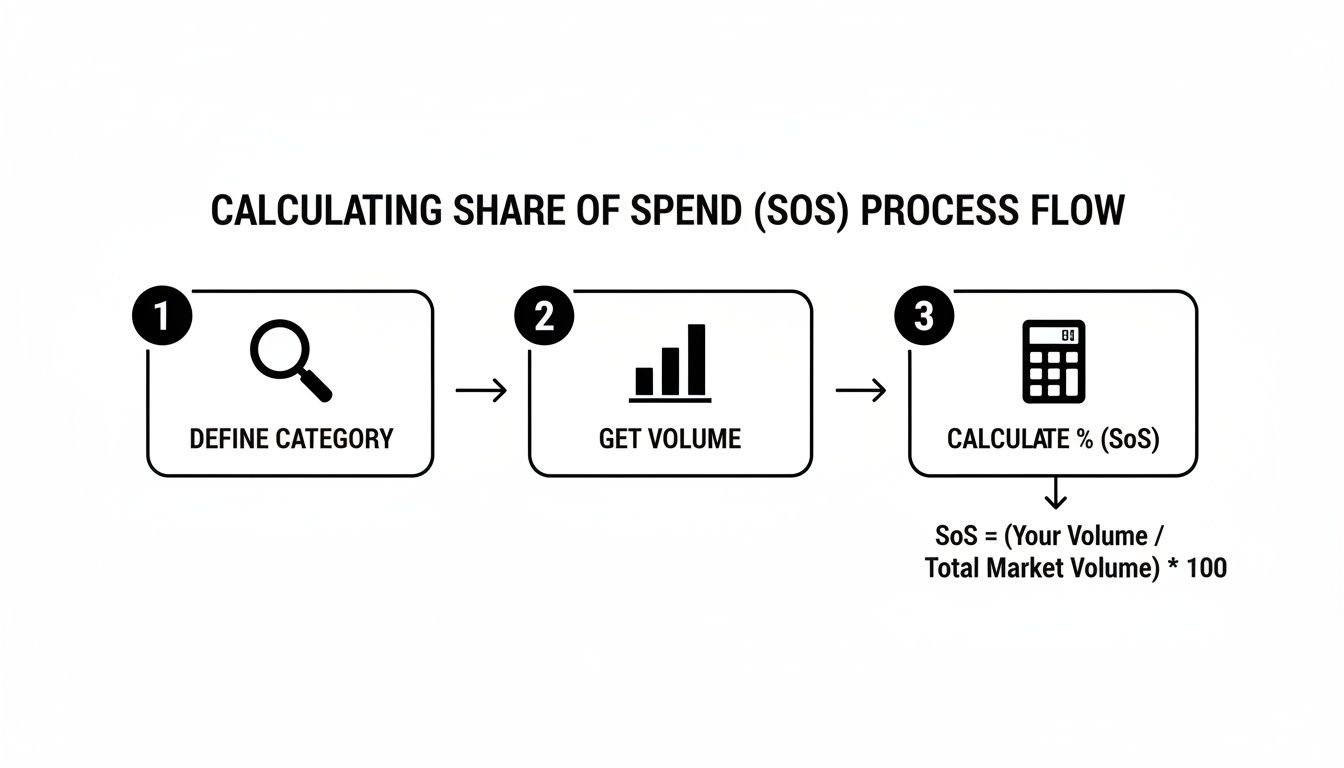
This workflow boils it down to three steps: define your market, pull the search volume data, and run the numbers. That single percentage is the key to unlocking smarter strategic moves.
Diagnosing Your Market Position
When you look at your SoS next to other key PPC metrics, it tells a story. It exposes the weak spots in your marketing funnel—the kinds of problems most agencies either miss or don't know how to fix.
Here are two common scenarios I see all the time:
Low SoS / High Branded Impression Share: This screams brand awareness problem. Your ads are great at capturing people who already know you, but not enough people know you exist. The answer isn't just dumping more cash into branded search. The right move is to shift budget to top-of-funnel campaigns—think Display, YouTube, or targeted social ads—to get your brand in front of fresh eyes.
High SoS / Low Market Share: This one is frustrating. People are searching for you, but they aren't buying. The problem isn't visibility; it's what happens after the click. Your budget is better spent on conversion rate optimization (CRO) for your landing pages, improving your offer, or fixing a product-market fit issue—not just buying more traffic to a leaky bucket.
This diagnostic approach ensures you're solving the right problem. It stops you from wasting thousands on bottom-funnel ads when the leak is at the top of the funnel, and vice-versa.
Mini Case Study: Launching a New Product with SoS
Let's say you're an e-commerce brand launching a new line of sustainable cookware. A bloated agency might just throw money at broad keywords and cross their fingers. A specialist's approach is far more surgical.
First, we'd calculate the current SoS for the "sustainable cookware" category to get a baseline. Then, the initial campaigns wouldn't just be about getting sales; they'd be specifically engineered to steal SoS from the competition.
Actionable Takeaway: For a new product launch, build a dedicated Google Ads campaign that targets your top 3 competitors by name. Set an aggressive Impression Share target (aim for 80%+) for these keywords. This tactic directly intercepts their customers and grows your SoS by grabbing high-intent searchers right when they're ready to buy.
We'd track SoS monthly right alongside sales. If sales are slow but SoS is climbing, we know the strategy is gaining traction and it's a matter of time before revenue follows. If neither metric is moving, we pivot the strategy now—not wait three months for a quarterly agency report.
This is where a deep PPC competitor analysis to outsmart your rivals becomes your secret weapon, fueled by SoS insights. By using Share of Search as your north star, you stop being a reactive ad buyer and start becoming a proactive market builder.
Why Share of Voice Is a Relic of the Past
You'll still hear agencies talk about "Share of Voice" (SOV). Let’s be blunt—it’s an outdated metric from a bygone era of advertising. If your agency is still fixated on it, they’re driving with their eyes on the rearview mirror.
It's critical to understand why this metric is broken for making decisions today, and why Share of Search is the only successor that matters.
Traditionally, SOV was a measurement of your brand’s advertising spend versus your competitors'. It was a metric of output, not impact. It just measured who was shouting the loudest through TV, radio, and print. In a world driven by real consumer curiosity—expressed through a search bar—SOV is irrelevant.
Demand, Not Dollars
The core flaw of Share of Voice is that it measures dollars spent, not demand earned. It tells you nothing about what your customer actually wants.
An agency can easily boost your SOV by throwing more of your money at low-quality display networks. The number goes up, your invoice gets bigger, but your brand’s actual position in the market hasn't budged. It’s a classic agency shell game.
SOV is a useless metric because it ignores how modern customers find and choose a brand:
It ignores organic search: It can’t account for the trust and authority you build when people find you naturally.
It misses genuine interest: It doesn't capture the momentum from PR or word-of-mouth that drives people to look for your brand by name.
It rewards inefficiency: It encourages wasteful spending to "dominate" airwaves rather than smart, targeted investments that connect with real buyers.
As a business leader, you need to track real demand, not just advertising noise. Share of Voice measures ad spend; Share of Search measures brand relevance and consumer intent directly at its source.
The Clear Superiority of Share of Search
Let's put this into perspective. Your brand could have a low SOV because a cash-rich competitor is blanketing the airwaves with ads. Who cares?
If your Share of Search is consistently climbing, you are winning the only battle that matters. You are becoming the brand people actively seek out when they have a problem to solve.
Focusing on SoS gives you a truer picture of your competitive standing. When your SoS increases, it means your marketing—from PPC to content to PR—is working together to build real brand equity. It shows you’re not just renting attention; you’re earning it.
This is the mindset shift that separates a tactical, budget-burning agency from a strategic, growth-focused partner. Stop asking how much your competitors are spending. Start asking how many customers are searching for them versus how many are searching for you. That’s the number that predicts future revenue.
Building an Actionable Share of Search Dashboard
Forget the 50-page agency reports that nobody reads. As a business leader spending real money on PPC, you need clarity, not clutter. A valuable report is one you can digest in under 60 seconds.
A powerful Share of Search dashboard isn’t complicated. It’s your blueprint for tracking what really matters. This isn't about creating more work; it's about creating a living document that gives you a real-time health check on your market position.
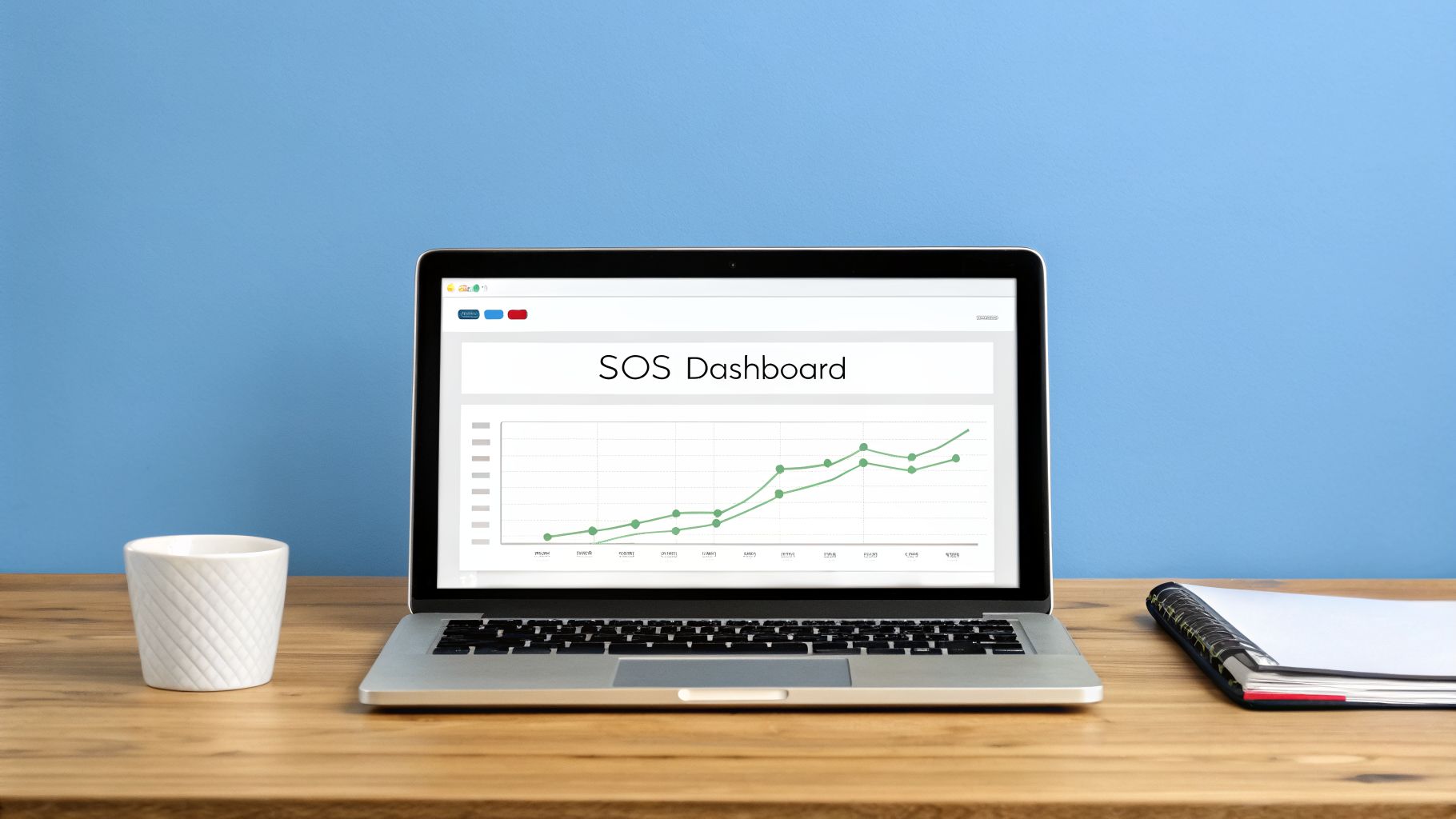
This is the difference between working with a specialist and a bloated agency. An agency builds reports to justify its fee. I build dashboards to drive your profit.
The Three Core Components of Your Dashboard
Your SoS dashboard should be surgically focused. It only needs to track a few critical data points to be effective.
Your Brand's SoS Over Time: This is your North Star. Is your brand’s relevance growing, stagnating, or falling? This single line tells you more about your long-term health than any impression report ever will.
Competitor SoS Tracking: You don't operate in a vacuum. Plot the SoS of your top 3-5 direct competitors on the same graph. This immediately exposes who is gaining ground and who is losing it.
SoS vs. Sales Volume: This is the money chart. Plot your Share of Search on one axis and your sales volume or lead count on another. This visualizes the correlation between rising market interest and rising revenue, proving the ROI of your brand-building efforts.
This focused approach lets you have strategic conversations about what's next, instead of reacting to last quarter's stale data. For more ideas, check out these actionable analytics report example templates.
Tools and Automation
You don't need expensive enterprise software. A simple, well-organized dashboard is all it takes.
Google Sheets: This is the fastest, no-cost way to begin. Manually pull data from Google Trends monthly and plot it on a line chart. It’s effective and requires zero budget.
Looker Studio (formerly Google Data Studio): For a more automated setup, a tool like Looker Studio is perfect. By using a connector to pull in Google Trends data automatically, you can build a dashboard that updates itself, saving you time.
The goal isn’t another report that gets ignored. The goal is to build a command center for your market strategy. When you see a competitor’s SoS spike, you can immediately analyze their ads. When your own SoS dips, you know it’s time to double down on top-of-funnel campaigns.
This dashboard becomes the foundation of our partnership, ensuring every dollar of your PPC budget is working to make your brand the definitive answer in your category.
Your Share of Search Questions, Answered
Alright, the theory is great. But how does this work in the real world? Let's get into the nitty-gritty questions I hear from smart CMOs and founders—the people tired of vanity metrics and ready to measure what actually drives their business. Here are the straight answers.
How Often Should I Measure My Share of Search?
For most brands, quarterly is the sweet spot. This gives you enough data to spot real market trends without getting thrown off by a noisy week. It also lines up perfectly with strategic planning.
But if you're in a cutthroat industry or in the middle of a big product launch, switch to a monthly check-in. This gives you a tighter feedback loop to fine-tune your PPC campaigns before your competitors know what you're up to.
Can I Use This for My Local Business?
Absolutely. Share of Search is a killer metric for local businesses. The idea is the same; you just tighten the focus. Your "Total Market Search Volume" becomes the search volume within your specific service area.
You can easily do this with Google Trends. Just filter the results down to your state or even your city. This lets you calculate a super-relevant local SoS that directly maps to your market share in the towns you actually serve. It’s how you become the only name people think of in your area.
What's a Good Share of Search Number?
There's no magic number. "Good" is completely relative to your market.
In a fragmented market with a dozen smaller players, a 15% SoS could make you the undisputed leader.
In a concentrated market with two or three giants, you might need a 30-40% SoS just to be in the game.
The real goal isn't hitting some random percentage. It's about consistent, measurable growth. You want to see your trend line moving up and to the right—and climbing faster than your key competitors. That’s what winning looks like.
Is Share of Search Just for B2C?
Not a chance. SoS is just as powerful for B2B. Business decision-makers are constantly on Google, searching for software, partners, and solutions.
You just need to define your category precisely—think "cybersecurity solutions for finance" or "project management software for construction." Your Share of Search shows how much mindshare your brand commands among the professionals actively looking to make a purchase.
A high SoS in B2B means you’re seen as an authority, not just another vendor. And since all this research is happening in one place, your focus is clear. As of March 2026, Google owns the search market with a staggering 89.85% global share, per Statcounter.com. For any business spending real money on ads, this is a clear signal: your PPC dollars belong in Google Ads.
Stop wasting your budget on bloated agencies and vanity metrics. As an independent Google Ads specialist, Come Together Media LLC offers the direct partnership and expertise you need to see real results. If you're ready for a focused strategy that grows your Share of Search and your bottom line, let's talk. Book your free, no-commitment consultation today.
