


You're spending serious money on Google Ads. The reports look polished. Clicks are up, impressions are healthy, and your agency keeps talking about “machine learning” and “optimization.” But when you ask a simple question, which campaigns produced qualified leads that turned into revenue, the answers get fuzzy fast.
That's the problem with most Google Ads management for service businesses. The account isn't built for control. It's built for convenience. A large agency hands the work to a junior account manager, drops your budget into broad campaign types, and calls activity a strategy. For high-spend service accounts, that approach burns cash.
Google Ads still deserves a central place in your acquisition mix because of the scale and intent behind the platform. Google processes more than 8 billion searches every day, and one 2026 compilation reported an average return of $2 for every $1 spent on Google Ads, as summarized by Tenet's Google Ads statistics roundup. But that upside only shows up when the account is built around lead quality, attribution, and profitability. Not vanity metrics.
If you're trying to build or fix Google Ads for service businesses, you need a sharper operating model. If you want a useful benchmark for what disciplined execution looks like, study how strong teams build effective pay-per-click campaigns around intent, tracking, and commercial outcomes instead of surface-level traffic.
Table of Contents
The Blueprint for an Account Built to Scale - Start with control, not automation - Choose the right lane for each service
Mastering Keywords, Bidding, and Budget Allocation - Build keyword groups that reveal intent - Treat bids like business decisions
High-Converting Ads and Landing Pages for Services - Write ads that qualify, not just attract - Landing pages should finish the sale
Establishing a Bulletproof Conversion Tracking System - Most accounts measure leads badly - Build the truth layer
The Optimization Playbook for Scaling Profitably - What gets checked every week - What gets decided every month
Stop Burning Cash on Ineffective Google Ads
Most underperforming service accounts have the same disease. Too much automation, too little scrutiny, and almost no connection between platform conversions and actual sales. The agency says performance is stable because click volume looks fine. Meanwhile, your sales team complains that lead quality is erratic, your cost per booked job is rising, and nobody can explain why certain campaigns keep getting budget.
That's not a reporting issue. It's a management issue.
Large agencies fail here because their model rewards scale on their side, not precision on yours. They need repeatable processes, junior labor, and accounts that can be managed in batches. High-spend service businesses need the opposite. They need tight control, direct accountability, and someone willing to challenge bad assumptions quickly.
Most service businesses don't have a traffic problem. They have a filtering problem.
When I audit these accounts, I usually find the same patterns:
Campaign sprawl: Too many campaign types launched too early, which muddies intent signals.
Bad lead incentives: Bidding is optimized toward form fills or calls without checking whether those contacts become customers.
Weak qualification: Ads invite everyone, including price shoppers, bad fits, and existing customers who should never hit paid acquisition campaigns.
Opaque reporting: Leadership sees PPC metrics, not business outcomes.
If you're spending at a level where mistakes compound fast, you can't tolerate “good enough” account management. You need an operating standard that starts with account structure, protects budget, and forces Google Ads to work for your business model instead of the other way around.
The Blueprint for an Account Built to Scale
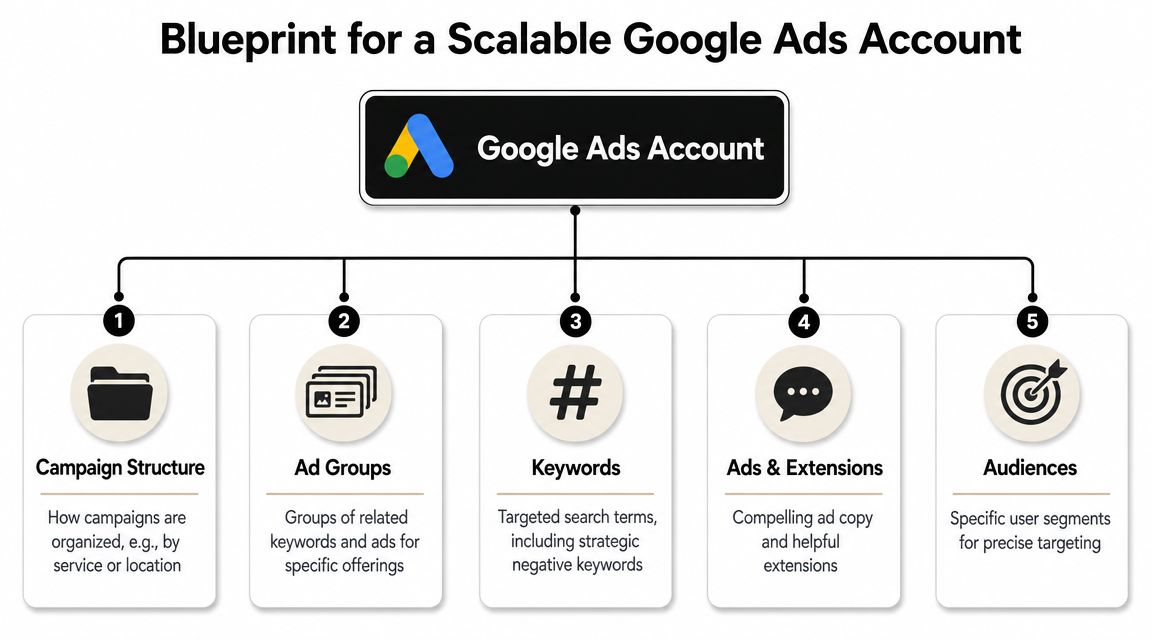
A scalable account starts with structure. Not creative. Not bidding tricks. Structure.
Most agencies skip this because it takes thought. They'd rather launch Performance Max, point traffic at generic pages, and let Google decide where your budget goes. That's lazy management. For service businesses, especially those with multiple service lines or locations, you need architecture that isolates intent and exposes what is working.
Start with control, not automation
The right launch sequence is simple. Start with Search. A practical playbook for local service businesses recommends starting with Search campaigns, using geo-targeting set to “Presence” only, building long-tail broad-match themes supported by strong negatives, and delaying remarketing until the account has roughly 1,000 site visitors. That same playbook advises only scaling with Performance Max after Search is already profitable, as detailed by Defined Digital Academy's Google Ads strategy for local service businesses.
That guidance is right. Search gives you cleaner intent data. You see which queries triggered the ad, which services pull qualified demand, and which geographies deserve budget. You can't get that level of clarity from a black-box campaign launched on day one.
A high-control account usually looks like this:
Separate campaigns by core service Don't cram plumbing repair, water heater installs, drain cleaning, and maintenance plans into one campaign. Segment by service so budget, copy, and landing pages match the offer.
Split by geography when markets behave differently A dense metro, affluent suburb, and fringe service area rarely perform the same way. Treating them as one market hides waste.
Keep ad groups tight If an ad group contains everything, it teaches you nothing.
For a deeper breakdown of clean segmentation, this guide to Google Ads account structure is worth reviewing.
Choose the right lane for each service
Service businesses now have two Google lead products to manage, not one. That matters.
A strong strategic approach recognizes that Local Services Ads use pay-per-lead, while traditional Google Ads uses pay-per-click. A nuanced allocation model treats LSAs as the better fit for high-intent, commoditized jobs, while Google Ads is often stronger for specialized, high-value services that need more control and scaling room, as explained in this comparison of Google Ads vs. Local Services Ads for service businesses.
Practical rule: Use LSAs to capture urgent, straightforward demand. Use Search campaigns to shape, qualify, and scale the demand that needs explanation, differentiation, or stronger pre-sell.
If you run both, don't duplicate thinking. Give each platform a job. LSAs can own the “need help now” calls. Search can own branded protection, specialty services, problem-based queries, and markets where landing page control matters.
That's how adults structure an account. Not by handing Google the wheel and hoping the monthly report looks respectable.
Mastering Keywords, Bidding, and Budget Allocation
Keywords and bids decide whether your budget buys qualified opportunities or garbage. At this point, average account managers get exposed. They'll talk about smart bidding as if it's a substitute for judgment. It isn't. Smart bidding only works as well as the signals you feed it.
If your account is optimized toward junk leads, Google will efficiently find more junk leads.
Build keyword groups that reveal intent
The cleanest framework I've seen for service businesses is also the least glamorous. Keep ad groups narrow. One specialist guide recommends only 5 to 7 closely related keywords per ad group, using customer lists to exclude existing customers from acquisition campaigns, and applying bid adjustments by device, hour, and geography based on observed conversion quality. The same guide warns against trusting platform lead counts without validating whether those leads become sales, as outlined in Step On Digital's guide to maximizing ROI from Google Ads.
That structure forces relevance. It also makes ad writing easier because each ad group serves one clear intent cluster.
Use match types with discipline:
Broad match: Useful when paired with strong negatives and close monitoring. Good for discovery, dangerous in lazy hands.
Phrase match: A strong middle ground when you want reach without opening the floodgates.
Exact match: Best when budget protection matters and you already know which terms produce real customers.
Here's the mistake agencies make. They treat keyword expansion like progress. It's not. More queries don't help if they dilute commercial intent.
Treat bids like business decisions
Bidding strategy should reflect how your company makes money. Not what Google recommends in a tooltip.
If you have reliable revenue values and strong offline feedback, target return on ad spend can make sense. If your business runs on qualified lead acquisition with fairly stable economics, target CPA can work. But neither strategy rescues bad inputs. The account still needs human judgment around service margins, close rates, and sales capacity.
A few operational rules matter more than generally assumed:
Focus area |
Specialist approach |
Typical agency mistake |
|---|---|---|
Device bidding |
Lower exposure where lead quality lags |
Chase volume because clicks are cheaper |
Time of day |
Fund hours when staff can answer and sell |
Run all day because “the algorithm will learn” |
Geography |
Push budget into profitable service zones |
Treat the whole radius the same |
Existing customers |
Exclude them from acquisition campaigns |
Pay to reacquire people already in the database |
If you need a clear refresher on when different bid models fit, this explainer on Google Ads bidding strategies is a useful reference.
Cheap clicks can be expensive leads. Expensive clicks can be profitable customers. Know the difference before you touch bids.
Budget allocation follows the same principle. Put money behind services and locations that produce sales, not just lead counts. If your reporting can't tell you that, the issue isn't budget. It's your measurement system.
High-Converting Ads and Landing Pages for Services
Ad copy should do two jobs at once. It should pull the right prospect in and push the wrong one away. Most service advertisers only do the first part. They write broad, harmless ads that invite curiosity clicks from people who were never going to buy.
That's why so many accounts have decent click-through rates and disappointing pipelines.

Write ads that qualify, not just attract
Good service ads are specific. They name the service, the geography, and the next action. Better ads also set expectations. If you offer premium work, say it. If you focus on emergency response, say it. If you don't serve certain job types, qualify that in the copy or on the landing page.
Strong ads for service businesses usually include:
Service clarity: Say exactly what you do. “Commercial HVAC repair” beats “trusted HVAC solutions.”
Location relevance: Mention the city, region, or service area when it helps qualify the searcher.
Decision cues: Use extensions like call, location, and structured snippets so the ad answers practical questions before the click.
Trust signals: Reviews, credentials, years in business, or screening status can reduce hesitation when presented clearly.
For service brands where reputation carries real weight, improving your review pipeline matters. If appointments drive revenue, this resource on Google reviews for appointment businesses is useful because reviews often do more qualification work than ad copy alone.
If your ad could work for ten different competitors, it's too generic.
Landing pages should finish the sale
The landing page is not a prettier version of your homepage. It's a sales page with one job.
A proper service landing page should match the keyword intent, repeat the offer clearly above the fold, and make the next step obvious. If the user clicked for drain repair, don't dump them on a page that also talks about remodeling, financing, careers, and your company history.
The page should include:
A visible primary CTA Click-to-call for urgent services. Short forms for considered services. Don't make visitors hunt.
Proof Reviews, accreditations, service guarantees, or concise trust elements. Not vague claims.
Commercial clarity Explain what's included, who it's for, and what happens next after submission.
Minimal friction Ask for what sales needs. Nothing more.
If you want a practical reference point for page-level improvements, this guide to Google Ads landing page optimization covers the essentials well.
A final note. Compliance matters in regulated or sensitive sectors. Healthcare, legal, and financial services can't borrow direct-response tactics blindly. The page still needs to convert, but it also needs to respect the rules of the category. Skilled consultants know that line. Agencies often pretend every service business is interchangeable.
Establishing a Bulletproof Conversion Tracking System
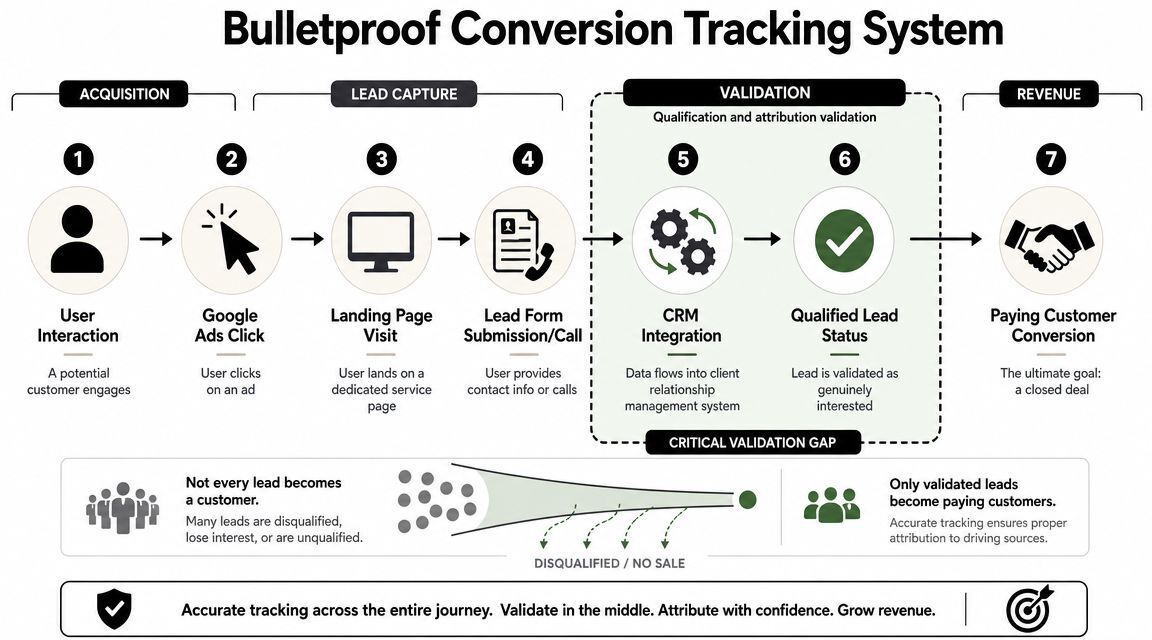
Most Google Ads accounts overstate performance because they stop measurement at the lead. That's amateur hour. A form fill isn't revenue. A phone call isn't revenue. Even a booked appointment isn't always revenue.
If your reporting can't separate raw inquiries from qualified opportunities and closed customers, your bidding system is learning from noise.
Most accounts measure leads badly
The operational trap usually starts early. Teams launch campaigns, install basic thank-you-page tracking, and call it done. Then they add call extensions, import some GA4 events, and assume the data is reliable enough for automated bidding. It usually isn't.
The safer path is slower and more disciplined. As noted earlier, a strong service-business playbook recommends launching with Search first, gathering clean intent data, and delaying remarketing until the account has enough traffic to support it. That same approach treats Performance Max as a later-stage tool, not a default starting point.
Here's the principle behind that advice. You need signal quality before you scale signal volume.
This walkthrough is a useful visual primer:
Build the truth layer
A serious tracking stack for service businesses should connect four systems:
Google Tag Manager Use GTM to deploy event tracking cleanly across forms, buttons, and key engagement actions without hard-coding every change.
GA4 Use GA4 to validate user behavior, pathing, and major conversion events. Don't let it become your only source of truth for paid media decisions.
Call tracking Dynamic number insertion matters when phone calls drive revenue. You need campaign and keyword-level attribution, not a generic “calls increased” summary.
CRM and offline conversion imports This is the big one. Push qualified lead status and closed-sale outcomes back into Google Ads so the platform can optimize toward what your business values.
Hard truth: If your CRM isn't talking to Google Ads, your bidding strategy is training on half the story.
The difference between agency management and specialist management shows up here fast. Agencies often stop at “tracked conversions.” A specialist asks harder questions. Which lead sources produce booked calls? Which booked calls turn into estimates? Which estimates close? Which services produce the highest-value customers by market?
For a practical setup reference, review this guide on Google Ads conversion tracking.
Once that loop is closed, optimization gets sharper. Search terms that looked mediocre can reveal strong close rates. Campaigns with pretty lead numbers can be exposed as dead weight. That's when Google Ads becomes a business system instead of an ad platform.
The Optimization Playbook for Scaling Profitably
Scaling profitably isn't about making more changes. It's about making the right changes in the right sequence. Agencies tend to confuse motion with management. They adjust bids, rotate ads, launch new campaign types, and flood you with dashboard screenshots. None of that means the account is improving.
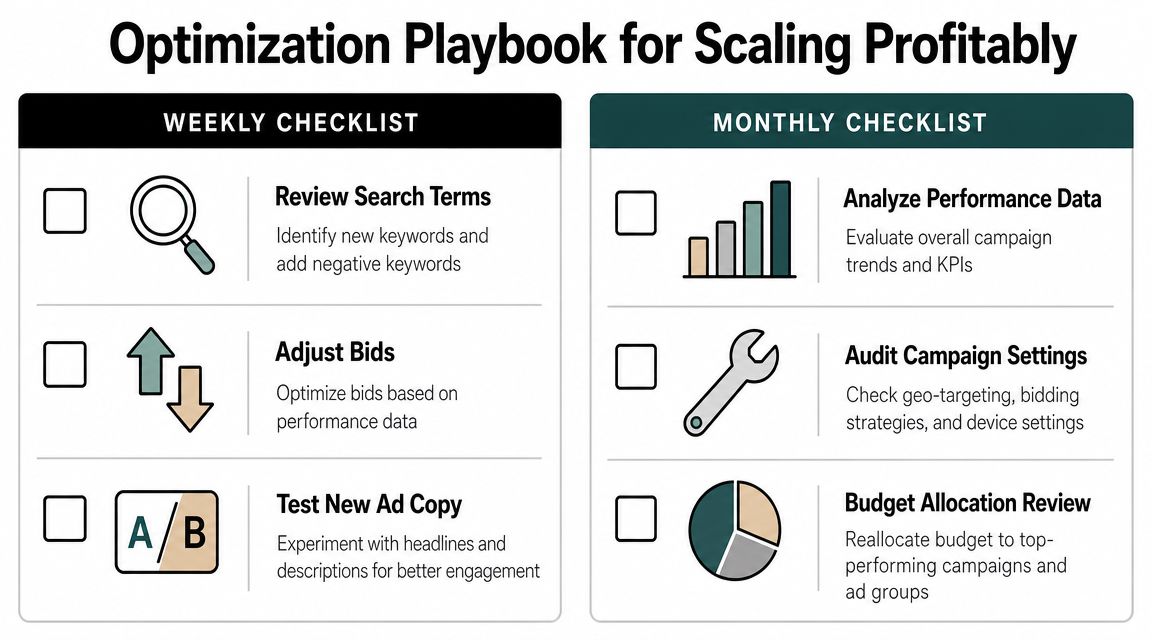
A disciplined operator follows a checklist. The same checklist, every week and every month.
What gets checked every week
Weekly work should stay close to the money. Focus on query quality, lead quality, and budget waste.
A clean weekly operating rhythm includes:
Search term review Pull the search terms report and look for two things. New commercially relevant queries to graduate into tighter themes, and irrelevant intent that deserves immediate negative keywords.
Lead quality checks Compare platform conversions against what sales says happened. If a campaign is producing noise, don't wait for the month-end report to admit it.
Bid and budget tuning Shift spend toward the service lines and geographies producing qualified pipeline. Pull back where bad-fit leads are clustering.
Ad testing Test new headlines and descriptions that improve qualification, not just click-through rate. Better copy often reduces waste by discouraging low-intent users.
Good optimization removes bad traffic faster than it chases more traffic.
What gets decided every month
Monthly review is where leadership-level decisions happen. This is also where a specialist separates from a bloated agency. A specialist explains what changed in the business and what the account should do next. An agency often just narrates the dashboard.
Google's own business guidance makes the strategic split clear. Google Ads uses a pay-per-click model for full-funnel targeting, while Local Services Ads use a pay-per-lead model designed for immediate-need customers, and Google recommends using both together for fuller market coverage in its small business marketing guidance. That matters at the optimization stage because budget allocation between these two products should follow actual business outcomes, not habit.
A proper monthly review should cover:
Monthly decision area |
Questions that matter |
|---|---|
Service mix |
Which services produced qualified demand and actual revenue contribution? |
Geographic allocation |
Which areas deserve more spend, tighter radius controls, or exclusion? |
LSA vs Search budget |
Are urgent, commoditized jobs better handled in LSAs while specialized work scales through Search? |
Sales feedback |
Which campaigns generated contacts sales wants more of, and which produced friction? |
Tracking integrity |
Did any forms, call flows, or CRM fields break attribution? |
Remarketing also belongs in the scaling conversation, but only after the account has enough clean traffic and enough clarity on who should be brought back. Bad remarketing amplifies confusion. Good remarketing follows intent and sales cycle stage.
Hyperlocal targeting is another lever agencies usually misuse. They set a broad radius and move on. A specialist looks at market-by-market performance and tightens exposure where travel time, service fit, or close quality drops. That's how you dominate profitable territory instead of paying to “be present” everywhere.
The final reporting layer matters too. Leadership doesn't need another click report. They need a decision report. What happened, why it happened, what changed, and where the next dollar should go. If your current partner can't produce that clearly, they're managing a platform. They're not managing your growth.
Take Back Control of Your Ad Spend
The gap between a mediocre Google Ads account and a profitable one usually isn't creativity. It's discipline. Better structure. Better filtering. Better tracking. Better decisions about where budget belongs and where it doesn't.
That's why so many high-spend service businesses get frustrated with agencies. They're paying for access to senior expertise and getting process instead. The account gets managed in bulk, the reporting stays shallow, and the hard questions about lead quality and true profitability never get answered.
You don't need more activity. You need a tighter system.
If you're running Google Ads for service businesses at a meaningful spend level, insist on a few things. Search-first control before aggressive automation. Clear separation between LSAs and traditional Search roles. Ad copy and landing pages that qualify leads. Conversion tracking that ties back to CRM outcomes. Optimization tied to revenue, not platform vanity.
That's the standard. Anything less is expensive noise.
If you want a senior-level second opinion on your account, Come Together Media LLC offers specialist Google Ads consulting built for businesses that need direct communication, rigorous tracking, and sharper performance than the typical agency model delivers.
