


Using Google Ads to find high-intent buyer and seller leads isn't a clever tactic—it's the proven playbook for generating revenue. Forget casting a wide net with traditional marketing. Here, you get in front of people actively searching for exactly what you offer. This means immediate visibility and results you can measure down to the dollar.
Table of Contents
Building a High-Intent Campaign Structure - High-Intent vs. Low-Intent Keyword Structure
Your Questions on Real Estate PPC Answered - What’s a Realistic Google Ads Budget for Real Estate? - How Long Until I See Real Results?
Why Your Real Estate Google Ads Are Failing
If you’re pouring serious budget into Google Ads—$25,000 a month or more—you know the feeling. The reports show clicks, but the leads go nowhere. Your cost-per-lead keeps climbing, and you start to wonder if you're just lighting money on fire.
Let me be direct: the problem isn’t Google Ads. It’s the outdated, bloated agency model you’re paying for.
Too many agencies run the same tired playbook. They assign your account to a junior manager, apply a cookie-cutter strategy, and then celebrate all the low-intent clicks they've bought you. I've audited dozens of these accounts, and the pattern is always the same.
The fundamental issue is a total disconnect between ad spend and lead quality. Agencies get rewarded for clicks. Your business needs qualified appointments on the calendar.
This guide cuts through that noise. It's a direct-from-the-trenches playbook on what actually works, written by a specialist who manages high-stakes accounts every single day. We're going to tear down the common agency mistakes and show you how a focused, expert-led approach drives real leads—not vanity metrics.
Before we get into the weeds, run a quick health check on your current campaigns. Use this PPC audit checklist to spot the most obvious money-wasters right away.
Building a High-Intent Campaign Structure
If you want to win with Google Ads in real estate, you have to get your account structure right from day one. Forget the sprawling, messy accounts most agencies build. A disciplined structure isn't just a "best practice"—it's everything.
I build my accounts around one core principle: searcher intent. This means creating separate campaigns for someone typing "sell my house fast" versus someone searching "homes for sale in [your city]". Why? Because their mindset, urgency, and value are completely different. Mixing them in the same campaign kills your budget and your message. It's a rookie mistake, but one I see constantly.
Think about it—97% of home sellers start their journey online. By focusing on high-intent keywords, you’re tapping directly into that ready-to-act demand. I’ve seen this strategy deliver conversion rates between 5% and 35% for real estate investors, a figure that most marketing channels can't touch. You can find more data backing this up from the team at SoarSEM.
High-Intent vs. Low-Intent Keyword Structure
Understanding the difference between high and low-intent keywords is critical for allocating your budget effectively. This isn't academic; it's how you protect your ROI.
Intent Level |
Keyword Example |
Searcher Mindset |
Campaign Goal |
|---|---|---|---|
High |
"sell my house fast for cash" |
Problem-aware, actively seeking an immediate solution. They need you now. |
Generate qualified leads (calls, form fills) immediately. |
Low |
"how to increase home value" |
Researching, gathering information, not ready to act. |
Nurture audience with content, build brand awareness. A smaller, separate budget applies here. |
Your primary budget must be focused on high-intent campaigns to capture users who are ready to convert. Most agencies get this backward. They lump everything together, which leads to wasted ad spend and dismal results. The process often looks something like this:
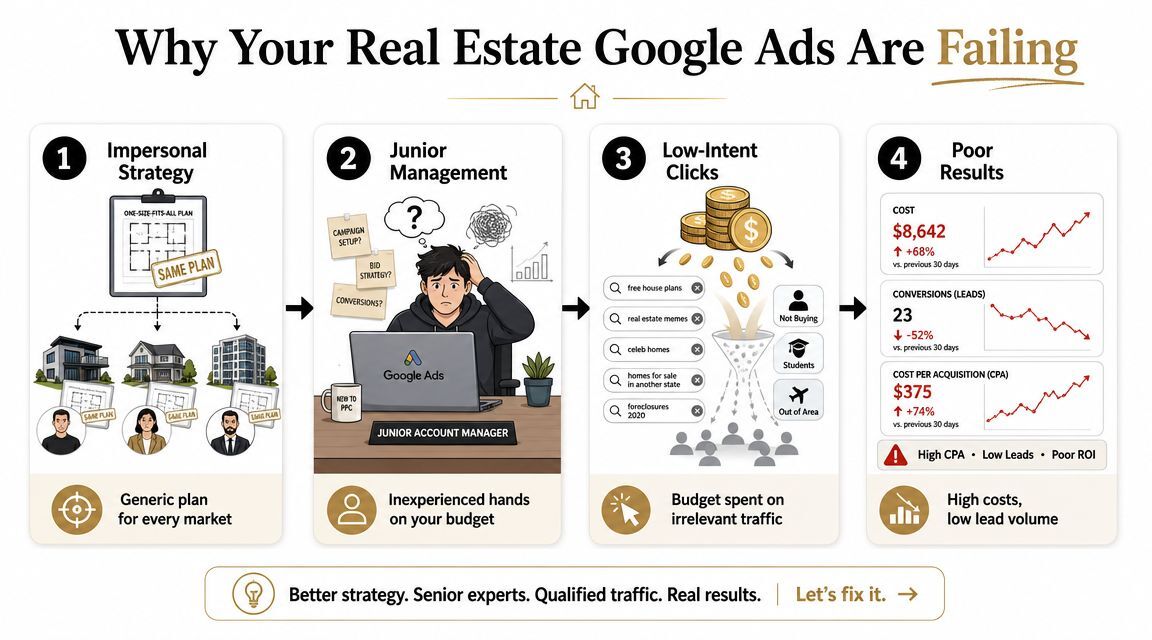
This flawed model is exactly why a deliberate, expert-built structure is your best defense against burning through your marketing budget. To really dig into this foundational element, check out my guide to Google Ads account structure.
Crafting Ads and Landing Pages That Actually Convert
A high click-through rate is a vanity metric if that traffic doesn't convert. This is precisely where most agencies drop the ball. They obsess over clicks; I obsess over engineering a seamless path from search to conversion.
It starts with ad copy that mirrors the searcher's exact intent. Are they looking to "get a cash offer" or for "new construction homes"? The ad must speak their language.
From there, we build trust and create urgency. Using ad extensions is non-negotiable for any serious campaign. They're not "extras"; they are conversion tools.
Location Extensions show you're local and credible.
Call Extensions give motivated prospects a direct line, bypassing the landing page entirely.
Image Extensions make your ad pop and dominate valuable screen real estate.
Getting the click is only half the battle. Your landing page must deliver on the promise your ad just made. If there's a disconnect, you’ve just paid for a bounce. A crystal-clear value proposition, a dead-simple lead form, and undeniable social proof are the core components.
Don't forget the power of visuals on the page itself. You can boost conversions with virtual tours and give prospects an immersive experience that makes your ad spend work that much harder.
Actionable Takeaway: Before you spend another dollar, audit your top landing page. Does it have one, and only one, clear call-to-action (CTA)? Is the lead form visible without scrolling on a smartphone? Is your phone number click-to-call? If the answer is no to any of these, fix it now. This is low-hanging fruit.
If you want to go deeper on this, I've laid out the entire process in my guide to building a high-converting landing page.
Mastering Advanced Targeting and Bidding Strategies
This is where the amateurs get left behind. If you think targeting by city is enough, you’re burning money. True performance comes from getting granular.
I go much deeper than standard geo-targeting. We implement radius targeting around your highest-value zip codes and even use "drive-time" targeting. This lets us capture affluent commuters with long-term plans to relocate—leads your competitors are completely missing.
Next, we layer on audiences. This is non-negotiable.
Using remarketing lists for search ads (RLSA), we can instantly bid more aggressively on people who have already visited your site. They’re warm leads. We'll also build custom audiences by uploading your own CRM data, which allows you to focus your budget on prospects who already know your brand.
But targeting is only half the battle; the real core is mastering the bid.
I use automated strategies like Target CPA, but more importantly, I know when to take back manual control. Real estate lead costs are volatile—they swing wildly based on season and local market conditions.
For example, recent data showed the average buyer CPL in Los Angeles was $13.97, while in Miami it was just $9.65. Following some national "best practice" benchmark is a recipe for disaster.
Your account performance must be managed like a live auction, with constant, data-driven adjustments. This requires an expert in the driver's seat, not an algorithm left on autopilot.
You can dig into more of this real estate data on CINC to see just how much these costs vary market by market.
Measuring ROI Instead of Vanity Metrics
I’ve seen it a thousand times: agencies dazzling clients with reports full of vanity metrics. Clicks, impressions, click-through rates... they all look great on a slide deck, but they don't pay the bills.
As a CMO or brokerage leader, the only metric that truly matters is Return on Investment (ROI). Everything else is just noise.

Getting to real ROI starts with bulletproof conversion tracking for every lead touchpoint, from website form submissions to ad-driven phone calls. That's the baseline. The real work is connecting ad spend to actual business outcomes.
This means importing offline conversion data—like qualified leads or closed deals from your CRM—back into your Google Ads account. This "closes the loop," training Google's algorithm to find more high-value clients, not just more low-quality form fills. A solid CRM is non-negotiable for this, and this guide for international real estate firms is a great resource to get started.
When recent data shows the average real estate cost per lead is a staggering $100.48, you can see why just chasing traffic volume is a losing game. The goal isn't more leads; it's more profitable leads.
This is the specialist mindset versus the agency model. I'm obsessed with profitable outcomes, not bloated reports. To get this foundation right, check out my guide on how to set up Google Ads conversion tracking the correct way.
Your Questions on Real Estate PPC Answered
I get the same questions from CMOs and entrepreneurs trying to crack the Google Ads code. Let's cut to the chase.
What’s a Realistic Google Ads Budget for Real Estate?
To get any real traction and data, you need to spend at least $3,000-$5,000 per month. That's the floor for generating enough data to make smart decisions.
Once you cross the $25,000+ per month mark, you have the firepower for serious testing and aggressive bidding strategies. But here's the truth: it’s not about how much you spend, but how efficiently you spend it. An experienced specialist with a $10,000 budget will outperform an agency's bloated $20,000 spend simply by cutting out the waste. I see it every day.
How Long Until I See Real Results?
You'll see clicks and impressions almost immediately—that's noise. Real, actionable data starts rolling in within the first 1-2 weeks.
The true optimization happens in the first 60-90 days. This is the critical "learning phase." It’s an intense period where a hands-on expert is constantly tweaking bids, refining audiences, and sculpting campaigns to improve not just lead volume, but lead quality. This isn't "set it and forget it." It's active, daily management.
For a deeper dive into the nuances of building a winning strategy, mastering Google real estate ads is a must-read for any agent serious about PPC.
Stop wasting your ad spend on impersonal agencies and junior account managers. Partner with a dedicated PPC specialist for a focused strategy that delivers real ROI. Book your free consultation today.
