


You're paying for clicks, getting traffic, and still watching lead volume stall. That's the pattern I see in expensive Google Ads accounts all the time. The ads aren't always the problem. The page after the click usually is.
Most agencies obsess over bids, match types, and dashboards because that work looks impressive in a client meeting. Then they dump tightly themed traffic onto a generic page and call it “good enough.” It isn't. If your landing page conversion rate rises from 1% to 4%, you get four times as many customers from the same ad budget, according to this Google Ads landing page optimization breakdown. That's why I treat the landing page as a core paid media asset, not a design side project.
If you're sending paid traffic to a weak page, you're not scaling. You're leaking budget. If you want a useful primer before rebuilding anything, this guide on a high-converting landing page is a solid place to compare against what you're running now.
Table of Contents
Your Ads Are Working Your Landing Pages Are Not - Why the landing page gets ignored - What better looks like
The Specialist's Audit Before You Change a Single Word - Why the audit comes first - The three checks that matter - What to fix first
Aligning Ad Intent With Landing Page Content - Generic pages kill qualified traffic - Build around intent clusters - A simple message match matrix
Mastering UX and Mobile Performance for Higher Conversions - Speed is a conversion issue - Reduce friction in the form and layout - What to hand your developer today
Implementing Bulletproof Conversion and Goal Tracking - Most accounts track too little - Track primary conversions and micro conversions - The setup should answer business questions
A Strategic Framework for A/B Testing and Iteration - Stop testing trivia - Use an impact versus effort filter - Run tests that teach you something
Your Ads Are Working Your Landing Pages Are Not
If your account spends real money, your biggest problem usually isn't a lack of traffic. It's a lack of relevance after the click.
I've audited plenty of high-spend accounts where click-through rate looked healthy, search terms were directionally right, and bidding was competent. But the landing page was lazy. One page served every ad group. Headlines were generic. Forms were too long. Mobile UX was clumsy. The offer wasn't clear enough to justify the click.
That disconnect is expensive because google ads landing page optimization affects both conversion rate and the economics of the auction. Google evaluates landing page experience as part of ad performance. If the page is weak, you don't just lose conversions. You often pay more for weaker outcomes.
A polished ad can't rescue a page that makes visitors work to understand what you do, who it's for, and what happens next.
Specialist work beats agency process. A large agency usually splits responsibility across media buyers, designers, analysts, and junior account managers. Nobody owns the full path from keyword to conversion. An independent PPC consultant does. That matters because landing page optimization isn't a design exercise. It's a revenue exercise.
Here's the blunt version. If your team keeps talking about market conditions, rising CPCs, or ad fatigue while ignoring the page itself, they're treating symptoms instead of the source.
Why the landing page gets ignored
Agencies optimize what they control easily: bids, budgets, and ad copy live inside the ad account.
Landing pages require cross-functional thinking: offer clarity, UX, speed, measurement, and intent alignment have to work together.
Generic pages feel efficient: they're easier to launch, but they flatten performance across campaigns that should behave very differently.
What better looks like
A strong landing page does three things fast:
Element |
What it should do |
|---|---|
Message match |
Confirm the searcher landed in the right place |
Offer clarity |
Explain the value without forcing the user to hunt |
Conversion path |
Make the next step obvious and low friction |
If your ads are solid and your results still feel mediocre, stop blaming the traffic. Fix the destination.
The Specialist's Audit Before You Change a Single Word
The initial approach often involves the wrong question. They ask what headline to test. I ask why the page is underperforming in the first place.
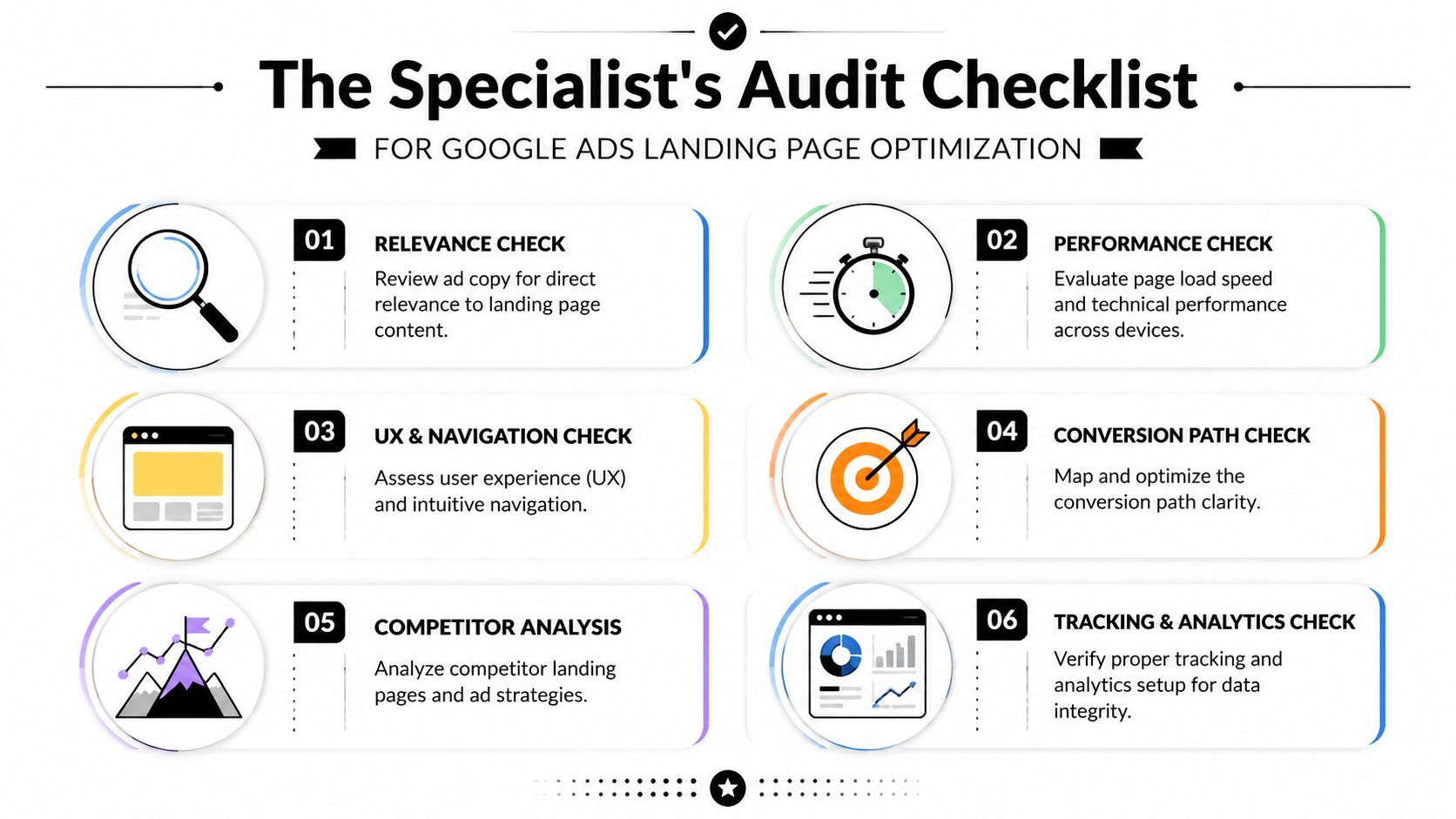
A proper audit tells you what's suppressing Quality Score, what's creating friction, and what deserves attention first. That's the difference between systematic optimization and random marketing activity. If you need a broader review framework, this PPC audit checklist complements the landing page process well.
Why the audit comes first
Google itself gives advertisers a direct clue about what matters. In the Google Ads “Landing pages” report, Google tells advertisers to review landing pages and check mobile performance using Mobile-friendly click rate and Valid AMP click rate. If a page isn't consistently mobile-friendly, its Mobile-friendly click rate falls below 100%, as described in Google Ads Help. The same verified guidance also notes that a 0.1-second improvement in loading speed can increase conversion by 8–10%.
That's enough to stop guessing. Small technical improvements can change conversion outcomes materially. In paid search, that means landing page work deserves the same rigor as keyword and bidding strategy.
Practical rule: Don't edit copy until you know whether relevance, speed, mobile usability, or tracking is the actual bottleneck.
The three checks that matter
I use three audit lenses before I recommend a single test.
Message match
Start at the ad-group or keyword-cluster level. Pull the search terms, ad copy, and destination page into one view. Then check whether the page confirms the user's intent immediately.
Ask hard questions:
Does the headline reflect the promise in the ad?
Does the page mirror the CTA from the ad?
Does the hero section answer the specific query, or just describe the company?
Does proof on the page support the exact offer being promoted?
A mismatch is usually obvious. The ad says one thing. The page says something broader, vaguer, or unrelated.
Technical and speed diagnosis
Agencies love to say “the page is fine” because it loads eventually on their laptop. That's useless. Paid traffic lands under real-world conditions on inconsistent devices and networks.
Look for:
Heavy hero images: these often create the biggest avoidable delay.
Render-blocking scripts: chat widgets, tag overload, and animation libraries frequently slow the first useful interaction.
Bloated templates: page builders can stack unnecessary assets that look harmless but drag performance.
I care less about vanity scores and more about whether the page becomes usable fast enough for a paid click to have a fair chance.
Mobile experience review
Desktop reviews miss the problem. Most landing page friction shows up on mobile.
Check the basics manually on an actual phone:
Can a visitor understand the offer without scrolling forever?
Is the primary CTA visible and easy to tap?
Does the form feel manageable on a phone?
Do trust signals appear before commitment is required?
A page can technically be mobile-friendly and still be miserable to use.
What to fix first
Don't hand your team a giant wishlist. Prioritize by business impact.
Priority |
Issue type |
Why it matters |
|---|---|---|
First |
Severe message mismatch |
It weakens conversion rate and relevance signals immediately |
Second |
Mobile and speed friction |
Paid traffic won't wait for a slow or awkward page |
Third |
Conversion path confusion |
Extra choices and unclear next steps create avoidable drop-off |
Fourth |
Cosmetic cleanup |
Useful later, rarely the main driver early |
Most accounts don't need a full redesign first. They need a disciplined diagnosis, a tighter keyword-to-page relationship, and removal of obvious friction. That's specialist work. It's also faster than the drawn-out redesign cycles agencies love to sell.
Aligning Ad Intent With Landing Page Content
The most common landing page mistake in Google Ads is simple. Teams build detailed campaign structure, then send all that segmented traffic to one bland page.
That's not strategy. That's convenience.
Generic pages kill qualified traffic
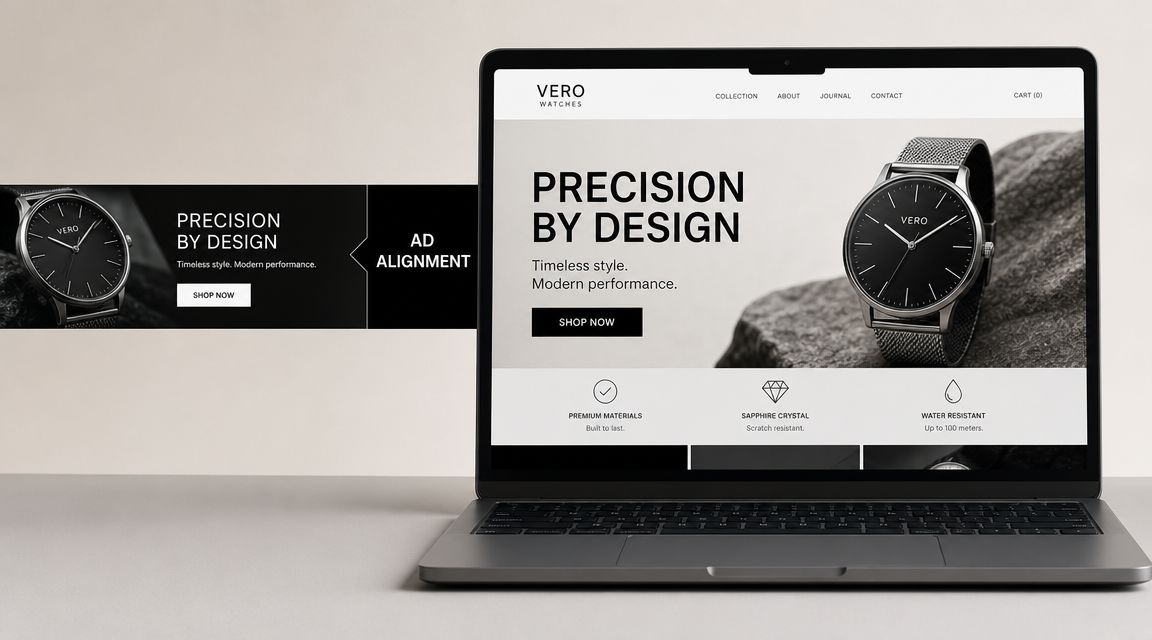
A searcher doesn't arrive as a blank slate. They come with a specific problem, level of urgency, and expectation created by the ad. If the page shifts tone, broadens the message, or hides the answer, you lose them.
That's why “message match” is too narrow if you treat it as headline keyword insertion. Good alignment is about preserving intent from query to ad to landing page to CTA.
One implementation cited in this intent alignment example) improved form submit rate from 1.09% to 1.80% (+65%), raised engagement from 34.71% to 48.57%, and increased scroll rate from 15.26% to 26.09% on the same traffic and spend. The improvement came from matching landing page content to search intent, not from rebuilding the whole account.
If your ad is specific and your page is generic, you've already broken the funnel before the user reads the second paragraph.
Build around intent clusters
You do not need a separate page for every keyword. That's the trap teams fall into when they hear “personalization.”
You need base pages for intent clusters. Then you adapt the high-impact elements.
Here's the framework I use:
Group keywords by job-to-be-done Don't group only by theme. Group by what the searcher wants now. Comparison intent, pricing intent, service-specific intent, and broad category intent do not belong on the same page.
Define the opening promise for each cluster The first screen should confirm the user is in the right place. Headline, subheadline, hero copy, and CTA must speak to that cluster's need.
Swap proof elements to match the concern A high-intent buyer may need credibility and a direct CTA. An earlier-stage searcher may need explanation and lower-friction proof first.
Keep the page architecture stable Marketers don't need endless custom builds. They need one solid page structure with targeted variation in the top section and key proof blocks.
A simple message match matrix
Use a matrix like this when reviewing top ad groups:
Intent cluster |
Ad promise |
Landing page requirement |
CTA style |
|---|---|---|---|
Service-specific |
Clear solution for a defined need |
Headline and hero copy reflect that service directly |
Direct inquiry or booking |
Comparison |
Why choose you over alternatives |
Differentiation, proof, objection handling |
Decision-focused CTA |
Pricing or cost |
Transparency and qualification |
Pricing context, value framing, next-step clarity |
Quote or consultation CTA |
Broad category |
Education and fit |
Simple explanation, trust, strong first-step offer |
Lower-friction CTA |
Consultants outperform layered agencies. Agencies tend to standardize landing pages because standardized process protects their margins. A specialist standardizes the framework, not the message. That distinction is what improves ROI at scale.
If you manage many campaigns, this matters even more. Good google ads landing page optimization isn't about making every page unique. It's about making every click feel expected.
Mastering UX and Mobile Performance for Higher Conversions
You don't need an award-winning page. You need a page that loads fast, feels obvious, and removes excuses not to convert.
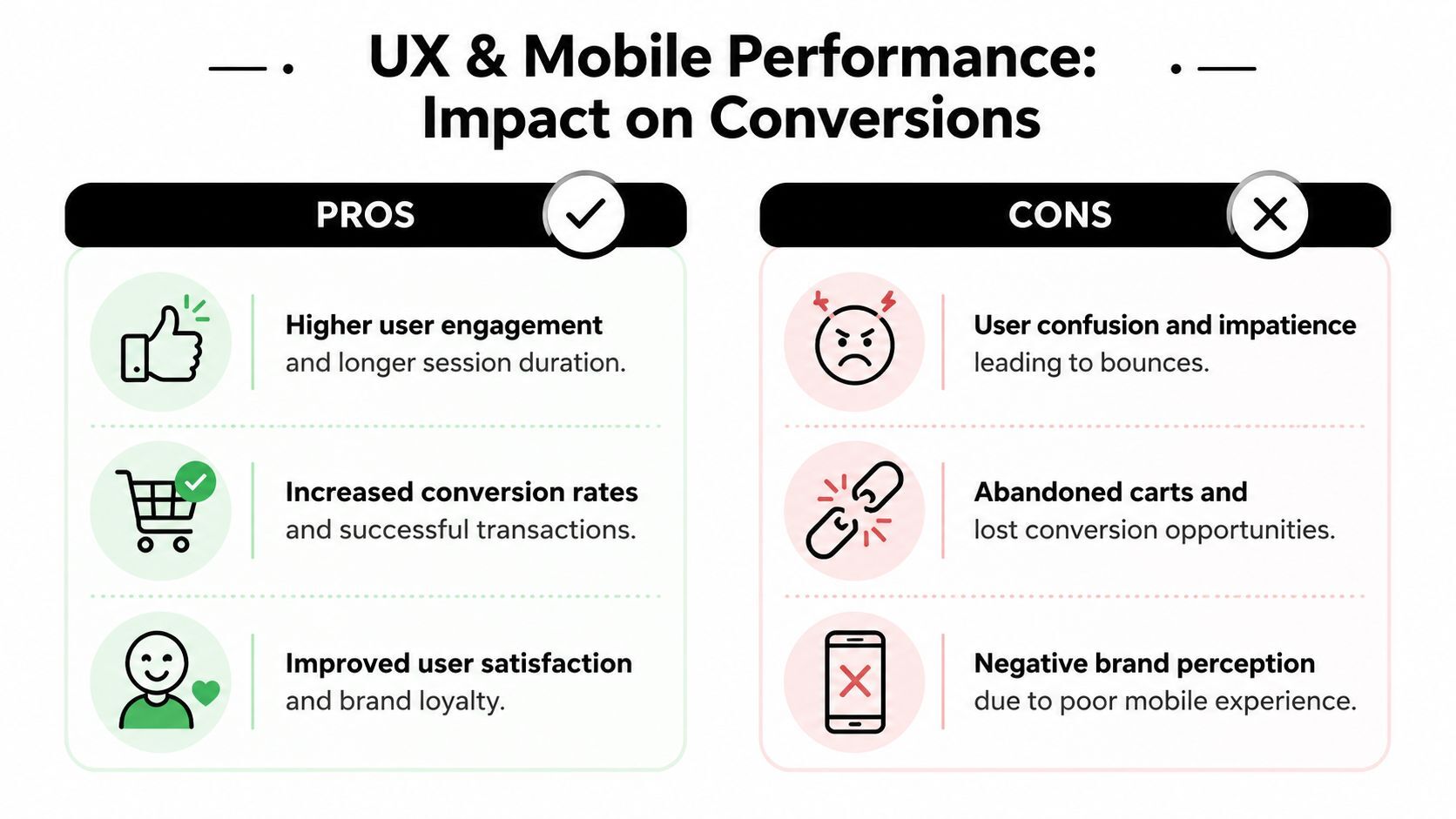
That's why I treat UX and mobile performance as direct conversion levers, not technical housekeeping.
Speed is a conversion issue
Guidance cited in this landing page experience resource recommends targeting under 2 seconds for page load time. The same source notes that bounce rates increase 32% when load time goes from 1 to 3 seconds. If you buy expensive clicks and send them to a slow page, you're paying a premium for abandonment.
The easiest place to start is usually image handling. Large hero banners are often the worst offender. Compress them properly, use modern formats such as WebP when appropriate, and stop uploading oversized visuals just because they look good in a design review.
What fast pages usually have in common
Lean media: right-sized images, compressed assets, limited decorative motion
Fewer third-party scripts: only essential tools remain on the page
Simple templates: less clutter above the fold, fewer render delays
Focused content order: offer, proof, CTA, then supporting information
Reduce friction in the form and layout
The same verified guidance says each additional form field reduces conversions by 7% on average, and single-purpose landing pages convert 13.9% higher than multi-purpose pages in the cited source.
That should change how pages are generally constructed.
If the page asks for too much information too soon, visitors hesitate. If it offers too many exits, they take one. That means your form should collect the minimum required to start a sales conversation, and your layout should support one primary action.
The best converting landing pages don't feel clever. They feel easy.
Friction usually shows up in these places
Too many fields: name, company, job title, budget, timeline, phone, location, and a long message box is overkill for a first touch.
Competing CTAs: “Book now,” “Download guide,” “Learn more,” and “Contact sales” on the same page dilute intent.
Navigation menus: paid landing pages rarely need a full website header.
Weak mobile spacing: buttons are hard to tap, forms are cramped, and trust signals sit too far down the page.
What to hand your developer today
Give your developer or designer a short sprint brief, not vague CRO talk.
Cut unnecessary form fields Keep only essential inputs for initial qualification.
Remove top navigation and extra footer distractions Preserve a single conversion path.
Compress and replace oversized images Prioritize the hero section first.
Review the page on an actual phone Check tap targets, CTA visibility, and form usability.
Keep one dominant CTA above the fold Make the next step obvious immediately.
If you run lead gen for regulated or trust-sensitive industries, add credibility early. That can mean testimonials, review snippets, certification language, or privacy reassurance. Not as decoration. As friction reduction.
Implementing Bulletproof Conversion and Goal Tracking
Most Google Ads accounts don't have a landing page problem alone. They have a measurement problem hiding underneath it.
If all you track is a thank-you page, you don't know what's helping the conversion happen. You don't know which page variants assist performance. You don't know whether a high-intent visitor engaged meaningfully before leaving. That leaves your optimization shallow and your reporting weak.
Most accounts track too little
Google's own guidance says landing pages should closely match ad text and mirror the CTA, but advanced optimization goes further. Building pages for specific intent clusters and personalizing key elements requires granular tracking to see which variations improve conversions and Quality Score, as described in Google Ads guidance on landing page relevance.
That means your tracking setup has to capture more than the final form fill. It should tell you which version of the page the visitor saw, what they interacted with, and whether those interactions correlate with better lead outcomes.
Track primary conversions and micro conversions
I separate landing page measurement into two layers.
Primary conversions
These are the business outcomes the campaign is buying.
Lead form submissions
Booked calls or demos
Qualified phone calls
Completed purchases
These should feed Google Ads bidding if they represent real value.
Micro conversions
These are supporting behaviors that help you understand page quality and user intent.
CTA button clicks
Click-to-call taps
Form starts
Video views
Downloads
Engagement with proof sections or key content blocks
Micro conversions don't replace primary outcomes. They explain them. They also help when you're testing new landing page variants and need earlier signals before enough final conversions accumulate.
Clean data beats more data. If your naming conventions are a mess and your events are inconsistent, your reports will lie to you.
The setup should answer business questions
I usually build this infrastructure through Google Tag Manager and GA4, with clear event naming and a documented measurement plan. The point isn't technical complexity. The point is decision quality.
A useful setup should answer questions like:
Business question |
Tracking requirement |
|---|---|
Which intent cluster converts best? |
Capture landing page variant or parameter data |
Where do users hesitate? |
Track form starts, field interaction, CTA clicks |
Which page elements influence action? |
Track engagement with proof, media, and key sections |
What should bidding optimize toward? |
Separate primary from secondary events clearly |
If your team needs a practical walkthrough, this guide on how to set up Google Ads conversion tracking covers the foundation. For marketers who also care about broader marketplace measurement, this article on optimizing Amazon and Walmart PPC analytics is a useful example of how GTM supports cleaner cross-channel event tracking.
One more point. This is the kind of work that often gets butchered inside agencies because nobody owns the whole chain. Media buys sit with one person, analytics with another, web with someone else, and the client gets a monthly slide deck full of partial truth. A specialist usually fixes that faster because the tracking plan is tied directly to the landing page strategy, not bolted on after the fact.
A Strategic Framework for A/B Testing and Iteration
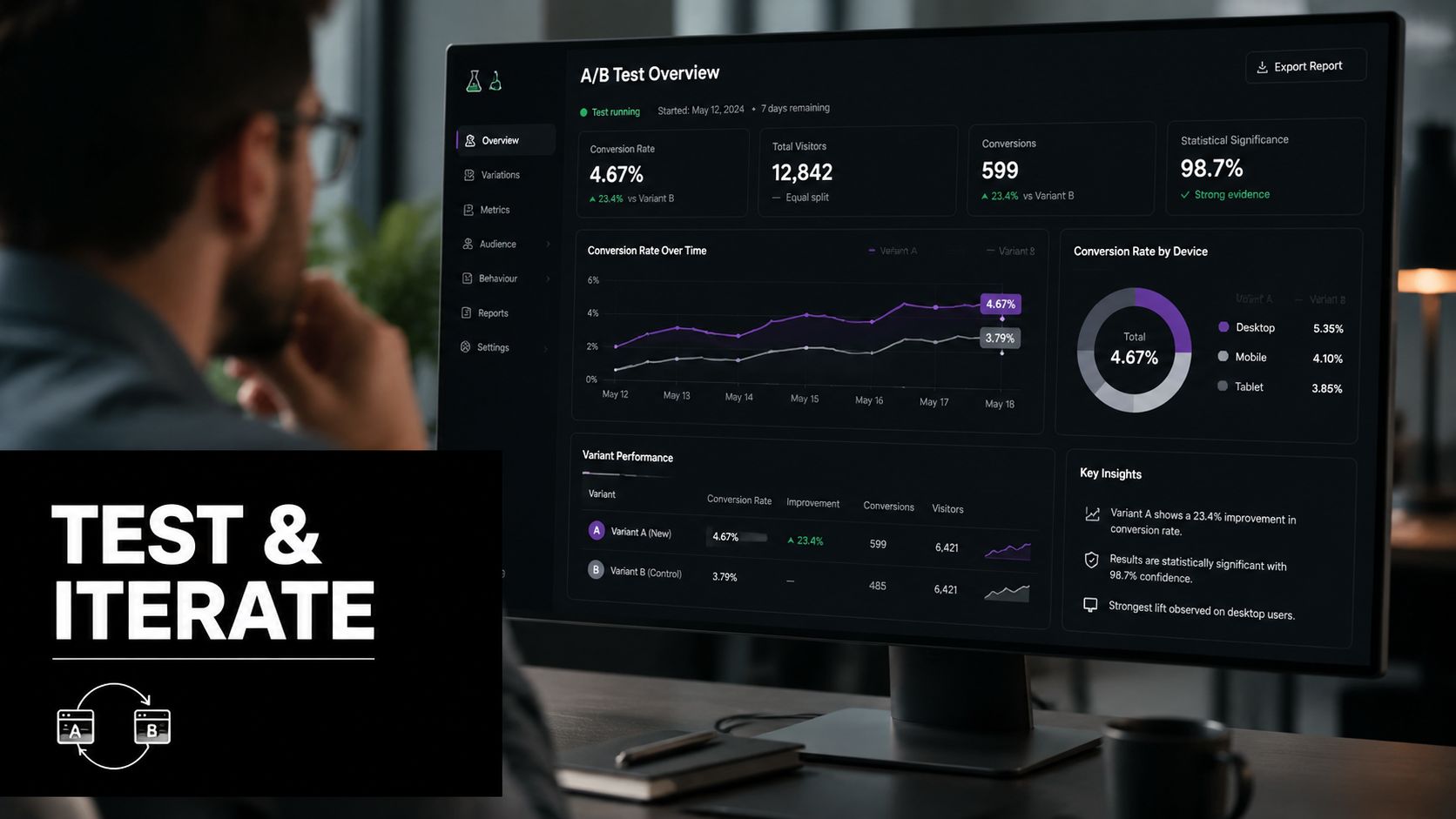
A/B testing gets abused in PPC. Teams test button colors, swap a hero image, wait around, and call that optimization.
That isn't a testing program. It's busywork.
Stop testing trivia
The biggest wins usually come from first-order variables. Offer. Headline. Intent alignment. Proof. CTA framing. Form friction. Page structure.
Minor UI tweaks matter later, after the fundamentals are right.
If your page underperforms, start with a hypothesis that connects directly to user intent. For example, if traffic from a pricing-focused ad group lands on a page with vague brand messaging, test a version that leads with pricing context and qualification language. That's a meaningful test because it addresses a probable reason for drop-off.
Use an impact versus effort filter
I like a simple decision model before any test goes live.
High impact and low effort
Test these first.
Headline rewrite tied to intent
CTA copy that mirrors the ad
Form simplification
Removing navigation
Reordering proof closer to the top
High impact and higher effort
These are worth doing when the page gets enough traffic.
New hero section structure
Offer repositioning
Segment-specific page variants
Major layout changes
Low impact items
Leave these for later unless you already have a mature program.
Button color changes
Minor icon swaps
Tiny spacing adjustments without a behavioral hypothesis
Operator note: If you can't explain why a variation should improve conversion behavior, you're not ready to test it.
A lot of in-house teams need help operationalizing this. One option is a specialist consultant. Another is a service provider that handles A/B testing landing page work as part of a broader PPC and page optimization process, including landing page design and implementation.
Run tests that teach you something
The best test doesn't just produce a winner. It gives you a clearer model of what your audience responds to.
Use a consistent log for every experiment:
Test element |
What to document |
|---|---|
Hypothesis |
Why this change should improve behavior |
Audience |
Which campaign, ad group, or intent cluster it applies to |
Primary metric |
The main conversion outcome you care about |
Secondary signals |
Supporting behaviors such as form starts or CTA clicks |
Decision |
Launch, refine, or reject |
Some teams like a visual walkthrough before they redesign their process. This overview is a useful primer:
A key advantage here is compounding learning. Good tests improve one page. Great testing programs improve how you build every future page, ad group, and offer. Agencies tend to run occasional tests because testing looks good in reports. Specialists build iteration into the operating model because that's how performance improves.
Stop Burning Budget Start Optimizing for ROI
Better Google Ads performance rarely starts with spending more. It starts with making the click worth paying for.
That means treating the landing page as part of the ad system, not as a disconnected web asset. Audit the page properly. Align it to intent clusters. Remove friction from mobile UX. Track what matters. Test the variables that can move revenue, not vanity details.
The agency model breaks down. Too many layers, too little accountability, and not enough urgency around the page itself. When nobody owns the path from keyword to conversion, results stall and excuses multiply. A specialist consultant works differently. Direct communication. Faster decisions. Tighter strategy. Cleaner execution.
If you run local campaigns alongside broader paid search, resources like this guide to boost your local marketing ROI can help frame how landing pages fit into the wider acquisition picture. But inside Google Ads, the priority is simpler. Stop paying for traffic that lands on pages built to satisfy internal stakeholders instead of buyers.
The companies that scale paid search well don't just buy more clicks. They build a stronger post-click system. That's the actual job.
If you want a direct second opinion on your landing pages, ad-to-page alignment, or tracking setup, Come Together Media LLC offers one-on-one Google Ads consulting and PPC management focused on practical fixes that improve conversion efficiency and ROAS.
