



Most advice about digital marketing for real estate is wrong.
It tells you to do everything at once. Post on every social platform. Run broad PPC campaigns. Retarget everyone. Start a blog. Send a newsletter. Tweak SEO. Boost posts. Add more automation. That approach keeps agencies busy, but it rarely gives marketing leaders what they need, which is qualified pipeline.
That's the core problem. Real estate marketers don't usually suffer from a lack of activity. They suffer from too much low-value activity attached to weak measurement and even weaker lead qualification. If you're spending serious money, you don't need more dashboards, more junior account managers, or more “awareness.” You need a system that produces high-intent opportunities and tells you which channels are driving deals.
The shift online is old news, but the implications still get ignored. The National Association of REALTORS® reports that 99% of homeowners begin their search online, and 97% of all home buyers use the internet during their property search, up from 44% in 2001 in its guidance on effective online marketing. That doesn't mean you should be everywhere. It means your digital presence now carries the weight that curb appeal used to carry.
If you want a broad overview of digital marketing for real estate, that resource is useful. But broad overviews aren't enough when your budget is large and your patience is short.
Table of Contents
Stop Burning Cash on Ineffective Digital Marketing - Focus beats activity - A specialist sees waste faster
Build Your Digital Foundation Before Spending on Ads - Fix the leaky bucket first - Treat local visibility like infrastructure
Generate High-Intent Leads with Google Ads - Structure campaigns around intent - Write ads for serious prospects - Sample Monthly Google Ads Budget Allocation ($25,000)
Use Content and Social Media to Build Authority - Build once and distribute many times - Use social media like a credibility channel
Nurture Long-Cycle Leads with Smart CRM and Email - Segment by intent, not by source alone - Build automation that surfaces buying signals
Measure True ROI with Privacy-First Tracking - Stop optimizing to cheap leads - What a modern measurement stack needs
Stop Burning Cash on Ineffective Digital Marketing
Big agencies love complexity because complexity protects the retainer.
They'll sell you a bundle of SEO, paid social, display, video, branded search, remarketing, blog production, landing page tests, and reporting layers that make the work look impressive. Then the account gets handed to a junior manager who optimizes for click volume, form fills, and whatever metric is easiest to defend in a monthly slide deck. That's not strategy. That's overhead disguised as service.
High-spend real estate marketing needs a sharper standard. You don't need more channels. You need tighter alignment between buyer intent, offer quality, landing page conversion, and offline sales feedback. If one of those breaks, the whole system degrades.
Focus beats activity
A campaign can generate a lot of leads and still fail.
That happens when marketers treat every inquiry as equal. Someone searching a hyper-local listing term is not the same as someone clicking a curiosity-driven ad, skimming a gallery, and leaving a generic question. Yet many agency setups throw both into one reporting bucket and call it performance.
Practical rule: If your reporting stops at cost per lead, you're probably overpaying for weak demand.
Real digital marketing for real estate works when you narrow your attention to a few levers:
Intent capture: Show up when the search suggests a real transaction window.
Message match: Send that click to a page that reflects the exact need.
Qualification: Ask for just enough information to separate browsers from buyers.
Feedback loop: Push sales outcomes back into ad platforms and your CRM.
A specialist sees waste faster
An independent PPC consultant outperforms a bloated agency model.
A specialist doesn't need layers of internal process to pause waste, restructure campaigns, fix conversion tracking, or challenge bad assumptions from the sales team. You get direct communication, faster decision-making, and clearer accountability. No handoff chain. No account theater. No padded scope designed to justify a management fee.
If your spend is substantial, you should expect someone to tell you where money is being wasted, which campaigns are attracting poor-fit leads, and what to cut next. Not after a quarter. Now.
Build Your Digital Foundation Before Spending on Ads
Paid traffic magnifies whatever already exists.
If your site is slow, your forms are clumsy, your calls to action are buried, or your local presence is weak, ads won't fix that. They'll just expose it faster and make the bill larger.

Fix the leaky bucket first
A practical real estate funnel should be built for mobile first. SearchLab's real estate marketing statistics report that 71% of property discovery happens on mobile, the average real estate website converts 2.1% of visitors into leads, and top performers reach 4.7%+. That gap usually comes down to execution, not luck.
Start with these fixes:
Shorten the path to contact Put the primary action above the fold. “Schedule a tour,” “Request pricing,” or “Talk to an agent” should appear before anyone scrolls.
Reduce form friction Don't ask for everything upfront. Capture what sales needs to make a useful first response, then qualify deeper later.
Match the landing page to the ad If the ad mentions a neighborhood, price band, building type, or seller solution, the page should continue that exact story.
A lot of marketers still send paid traffic to generic homepage experiences. That's lazy. Build dedicated landing pages instead. If you need a useful benchmark for structure, review this guide to a high-converting landing page.
Treat local visibility like infrastructure
Before you spend aggressively, tighten the basics that influence both trust and conversion.
Google Business Profile: Keep categories, service areas, office details, photos, and review responses current. In local real estate, stale profile data diminishes credibility.
Location pages: Build pages around real neighborhoods, not vague city-level fluff. Serious prospects search with local intent.
Visual proof: Use listing imagery, team photos, market-specific content, and virtual-tour-ready assets that show your knowledge of the area.
Mobile UX: Tap targets, page speed, and readable layouts matter because the first visit often happens on a phone.
The job of your site isn't to impress your internal team. It's to turn intent into a trackable next step.
That's why I push marketers to audit the website before scaling media. A specialist will usually do this faster than an agency because there's no internal silo between paid media, conversion strategy, and reporting. The same person seeing the wasted clicks is also the person seeing where the page fails.
Generate High-Intent Leads with Google Ads
Google Ads is still the most effective paid channel for real estate when the account is built around intent instead of reach.
That distinction matters. Too many campaigns chase broad traffic, loose match types, and vanity click volume. The result is predictable. Lots of inquiries. Weak conversations. Sales teams complain. Budget gets blamed. The account wasn't underfunded. It was poorly structured.
A real estate search strategy works because search captures active demand. One industry analysis from Ruler Analytics reports that organic and paid search drive 57% of website visitors in real estate, with PPC cost per click around $0.50 to $4.00 and an average paid search conversion rate of about 1.5%. That's exactly why precision matters. Small improvements in query quality and landing page match change the economics fast.
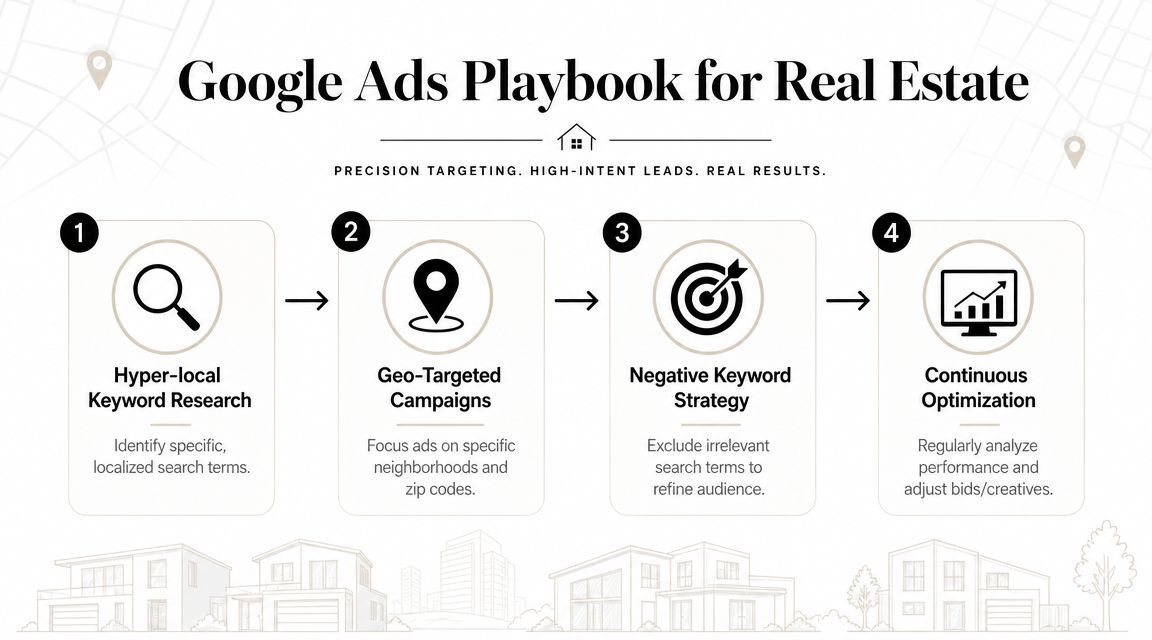
Start with this visual framework.
Structure campaigns around intent
Don't mix buyer, seller, branded, competitor, and remarketing traffic in one campaign family. Segment by commercial intent and geography.
A clean structure often looks like this:
Buyer search campaigns: Target hyper-local terms tied to listings, neighborhoods, property types, and price bands.
Seller search campaigns: Focus on valuation, listing, and agent-selection queries.
Brand protection campaigns: Own your branded traffic so competitors don't siphon it.
Remarketing support: Re-engage visitors who showed meaningful on-site behavior.
Keyword strategy matters more than account cosmetics. “Homes for sale in [ZIP code]” is closer to transaction intent than broad portal-style browsing terms. The same goes for seller searches. “List my condo in [neighborhood]” beats generic informational traffic every time.
Negative keywords do just as much heavy lifting as your target list. If you don't aggressively exclude low-fit search themes, Google will happily spend your budget finding them.
A disciplined negative keyword strategy is one of the fastest ways to improve lead quality without raising spend.
Here's a deeper reference on Google Ads for real estate if you want campaign-level examples.
A short explainer can also help align your team before a rebuild:
Write ads for serious prospects
Most real estate ad copy is forgettable because it sounds like everyone else.
“Find your dream home.” “Trusted local experts.” “Luxury service.” None of that filters intent. Serious prospects respond better to specifics. Speak to the location, the use case, and the next step.
Examples:
Buyer angle: Browse homes for sale in [Neighborhood]. View current listings, price ranges, and tour options.
Seller angle: Thinking of selling in [City]? Request a pricing review and local market guidance.
Investor angle: Track available properties in [Area] with local market insight and fast follow-up.
Quality Score matters. Quality Score is Google's rating of your keyword, ad, and landing page relevance. Better relevance can improve ad positions and reduce wasted cost. Agencies often mention it, but they rarely build around it with discipline.
Bidding strategy should also match account maturity. If tracking is weak, automated bidding can optimize toward the wrong actions. If tracking is strong and qualification feedback is flowing back from the CRM, automation becomes much more useful.
Sample Monthly Google Ads Budget Allocation ($25,000)
Campaign Type |
Focus |
Allocation |
Objective |
|---|---|---|---|
Buyer Search |
Hyper-local buyer intent terms |
$10,000 |
Capture active home search demand |
Seller Search |
Listing and home valuation intent |
$7,000 |
Generate seller consultations |
Brand Search |
Branded queries and agent name terms |
$2,500 |
Defend branded demand |
Remarketing |
Re-engage high-intent site visitors |
$3,000 |
Bring back warm prospects |
Testing Budget |
New ad copy, landing pages, and keyword themes |
$2,500 |
Improve efficiency and learn faster |
That split isn't universal. It's a decision framework. The right mix depends on inventory, geography, close rates, and sales capacity. But the principle stays the same. Put more budget behind queries and audiences that correlate with real pipeline, not just cheap conversions.
A specialist usually outperforms a large agency here because campaign decisions happen closer to the data. No lag. No handoff. No junior account manager waiting for approval to pause a bad keyword cluster.
Use Content and Social Media to Build Authority
Social media is not your primary lead engine if you're selling high-value real estate. It's your credibility engine.
That's an important distinction because many teams use content badly. They post listings, announce closings, recycle market clichés, and wonder why engagement is weak. People don't follow agents and brokers to see endless self-promotion. They follow local experts who help them understand the market.
Build once and distribute many times
The best content strategy starts with pillar assets. These are durable pieces that answer the questions serious buyers and sellers keep asking.
Good examples include:
Neighborhood guides: Schools, commute patterns, housing mix, walkability, local feel.
Buying process explainers: Financing readiness, inspection expectations, offer strategy.
Seller prep content: Pricing, staging decisions, timeline planning, common mistakes.
Market interpretation: Not generic stats dumps, but what current conditions mean for real decisions.
One strong piece can become multiple assets. A neighborhood guide becomes a landing page, a short-form video, several social posts, an email sequence, and ad creative for remarketing. That's a better use of effort than publishing disposable content every day.
You don't need more posts. You need more reusable insight tied to actual buyer and seller decisions.
Use social media like a credibility channel
Instagram, Facebook, LinkedIn, and YouTube all matter differently.
Instagram and Facebook are useful for visual storytelling, local proof, and keeping your brand familiar. LinkedIn works better for professional trust, relocation audiences, investor relationships, and referral visibility. YouTube is powerful when you have footage, walkthroughs, neighborhood commentary, and educational explainers that support search and remarketing.
A strong social cadence usually includes a mix of:
Local expertise posts: Show that you know the block, not just the city.
Process education: Explain what buyers and sellers usually misunderstand.
Proof of judgment: Comment on market conditions with a clear point of view.
Human presence: Put agents on camera so prospects feel less uncertainty before first contact.
Don't judge social content only by direct leads. Its job is often to warm the market before search happens, improve conversion once someone clicks an ad, and reinforce trust when leads check you out after visiting the site.
That's why content should support paid search, not compete with it. Search captures active demand. Content makes your brand easier to choose.
Nurture Long-Cycle Leads with Smart CRM and Email
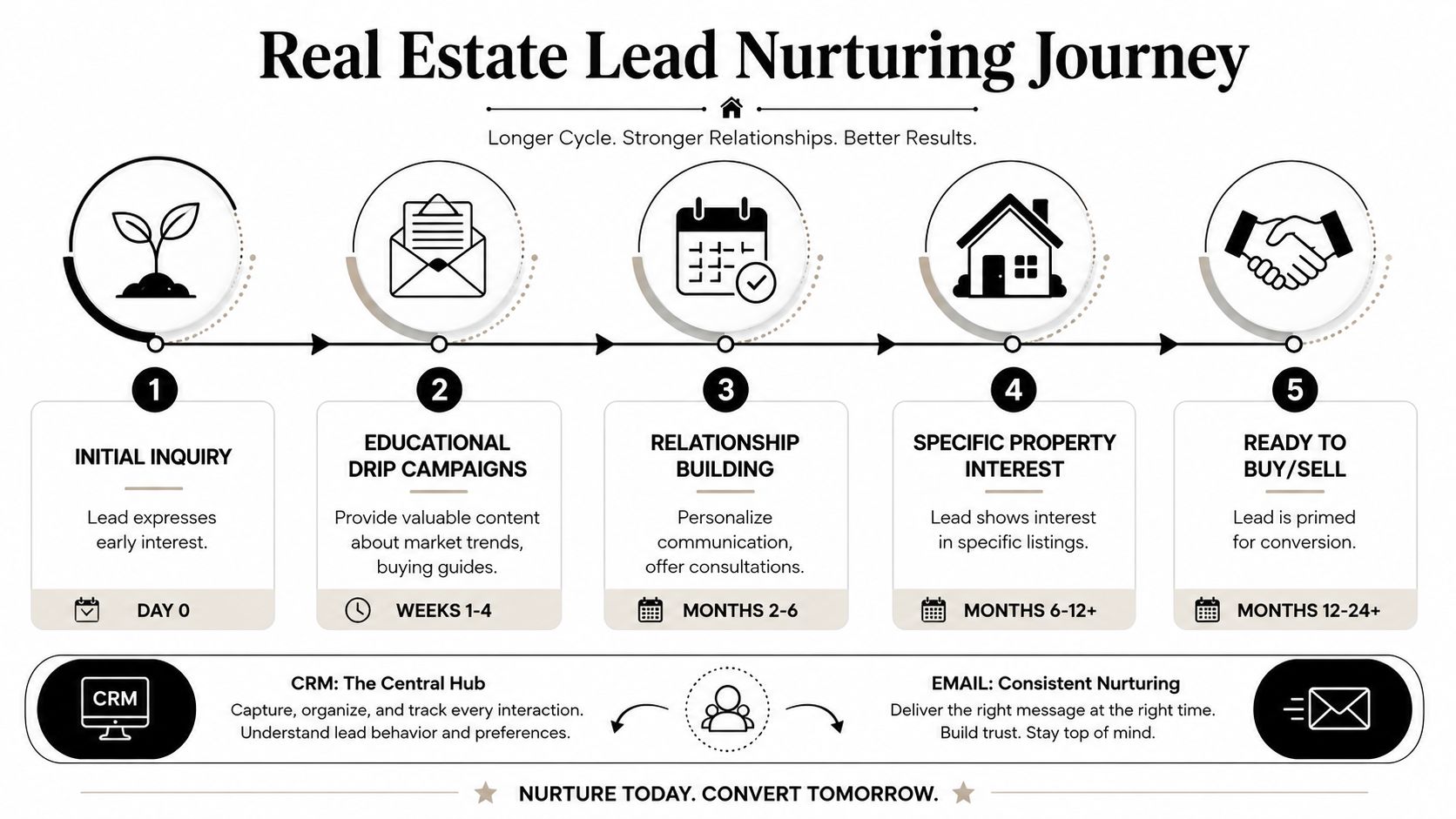
Most real estate leads are not ready to transact when they first convert. Treating them like they are is how expensive inquiries get wasted.
The deeper issue is lead quality. TREM Group's starter guide for real estate agents notes that buyers often spend months researching before contacting an agent, which makes last-click optimization misleading. The practical fix is to combine search, remarketing, and content signals with qualification data so you can identify intent earlier.
Segment by intent, not by source alone
Most CRMs are full of leads sorted by source, campaign, or date. That's useful, but it's not enough.
A better segmentation model also includes signals like:
Financing readiness: Pre-approved, exploring options, or unknown.
Geographic specificity: Named neighborhood versus broad region browsing.
Property type: Condo, single-family, luxury, investment, new development.
Timeline language: Immediate need, medium-term planning, casual research.
Behavioral depth: Listing views, repeat visits, saved properties, return sessions.
That lets you separate “curious” from “credible.” It also helps sales respond appropriately. A lead asking generic questions about the market needs education. A lead requesting a tour in a specific neighborhood needs speed and precision.
Build automation that surfaces buying signals
Email should not be a monthly batch blast. It should be a trigger-based system tied to what the lead did.
A strong nurture flow usually includes:
Immediate response sequence Confirm the inquiry, set expectations, and point to the next useful action.
Education sequence Send content based on intent. Buyer leads get financing, neighborhood, and inventory guidance. Seller leads get prep, pricing, and timing content.
Behavior-based branching Increase follow-up when leads revisit listings, click key pages, or engage with property-specific content.
Human intervention points Assign outreach when a lead's behavior suggests rising intent, not just because the calendar says so.
Deliverability matters here. If your nurture emails land in spam, the sequence is broken before it starts. This guide on how to stop email from going to spam in Gmail is worth sharing with whoever owns your sending setup.
For measurement and audience control, this is also where a real first-party data strategy becomes useful. First-party data means the information prospects willingly share with you through forms, email engagement, site activity, and CRM updates. In a long sales cycle, that dataset is more valuable than broad traffic numbers.
The best nurture systems don't just send more email. They tell sales when a lead has changed from passive interest to active intent.
A specialist tends to build better automation logic because they're closer to the original campaign promise. Agencies often stop at lead capture. That's where the expensive part of the problem begins.
Measure True ROI with Privacy-First Tracking
Cost per lead is one of the most overrated metrics in real estate marketing.
Cheap leads often become expensive campaigns once you account for sales time, no-shows, weak qualification, and low close rates. A higher-cost lead that turns into real pipeline is usually the better buy. But you can't optimize toward that if your tracking ends at a thank-you page.
The old model is failing. Zillow's real estate digital marketing guidance highlights the gap clearly. As third-party tracking weakens and Google rolls out privacy changes, marketers need consent-based, modeled attribution instead of depending on user-level tracking that no longer holds up reliably.
Stop optimizing to cheap leads
If your platform only sees form fills, it will optimize for more form fills.
That sounds obvious, yet many accounts still feed Google Ads a flat stream of identical “conversions” with no indication of whether those leads were qualified, contacted, booked, shown a property, or closed. Then marketers act surprised when automated bidding finds the lowest-quality pockets of demand.
Fix that by redefining what counts.
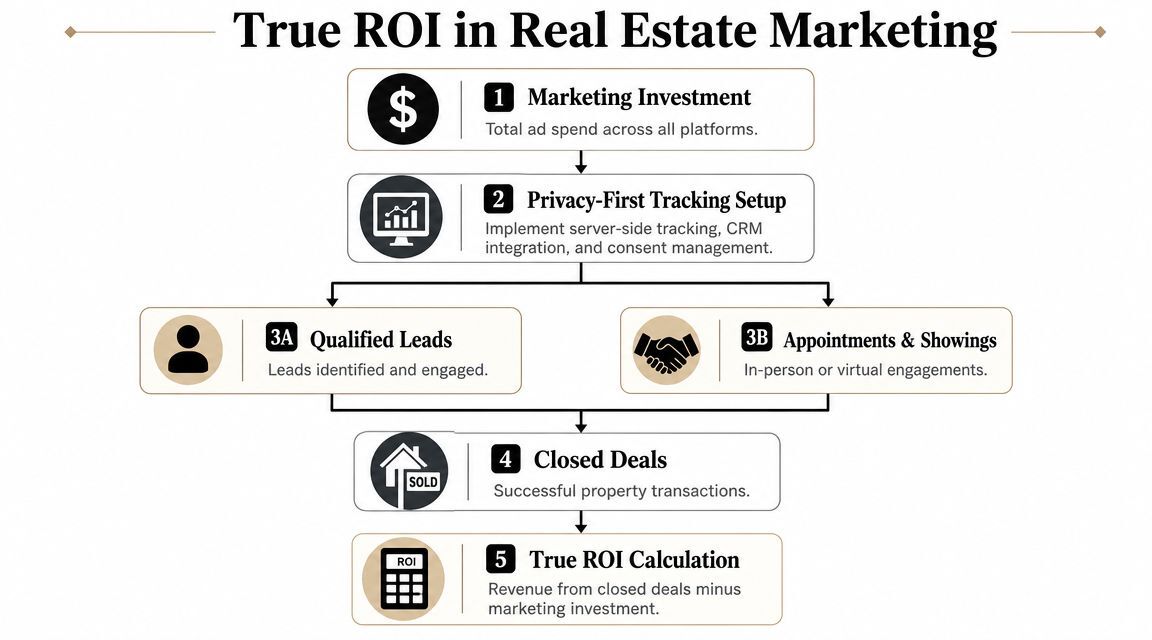
Track and label stages such as:
Raw lead: An inquiry entered the system.
Qualified lead: Sales validated fit and intent.
Appointment or showing: The lead advanced to real engagement.
Closed deal: Revenue happened.
When those downstream outcomes get pushed back into the ad platform, bidding has a chance to improve in a way that matters.
What a modern measurement stack needs
You don't need a bloated martech diagram. You need a working loop.
That loop should include:
Consent-aware tracking: Respect user consent and build measurement accordingly.
First-party data capture: Use your forms, CRM, and site interactions as the backbone.
Offline conversion imports: Send qualified-lead and closed-deal signals back to Google Ads.
CRM feedback discipline: Sales must update statuses consistently or your optimization data turns useless.
Modeled attribution acceptance: In privacy-constrained environments, some measurement will be estimated. That's better than pretending last-click is truth.
If your current setup isn't reliable, start with your conversion plumbing. This walkthrough on how to set up Google Ads conversion tracking is a good baseline, but the key value comes from extending tracking beyond lead capture into revenue stages.
A specialist consultant usually pushes this further than a large agency because they're not protecting a legacy reporting model. They can challenge bad attribution, simplify what's bloated, and tie campaign optimization to qualified outcomes instead of vanity metrics.
Real ROI comes from connecting spend to closed business, not from generating a prettier lead report.
If you're spending serious money on PPC and want senior-level help without the bloated agency model, Come Together Media LLC offers direct Google Ads consulting, account audits, conversion tracking support, and ongoing optimization built around qualified lead quality and real return on ad spend.
