


Most advice about e-commerce marketing services is backwards.
You don’t need a bigger agency because your ad budget is bigger. You need tighter control, cleaner data, faster decisions, and someone who knows your account well enough to protect profit. That’s the part most CMOs get wrong, especially after months of paying retainers that bought them slide decks, delays, and junior execution.
I’ve seen the same pattern too many times. The account spends enough to matter. The brand has demand. The catalog is viable. But performance stalls because the service model is broken. The agency sells “full service,” then hands day-to-day management to someone who’s juggling too many accounts and following a template.
That’s not a media problem. That’s an operating model problem.
Stop Burning Cash on Ineffective E-commerce Marketing
If you’re spending serious money on PPC and results feel mushy, stop blaming the platform first. Google Ads isn’t usually the main failure point. The management is.

The popular advice says high-spend brands should hire a large, full-service agency. I disagree. Once spend rises, the cost of slow execution and generic strategy rises with it. Bigger budgets don’t justify more layers. They punish them.
Global e-commerce sales are projected to reach $7.5 trillion in 2025, and median cost per acquisition has risen to $32.74, which means ad efficiency is now a survival issue, not a nice-to-have (Cimulate digital commerce statistics). If your team wastes budget on poor query control, weak feed quality, lazy remarketing, or broken tracking, scale just magnifies the leak.
What frustration usually means
When a CMO says, “Our campaigns are active, but I don’t trust what I’m seeing,” that usually points to one of four problems:
Reporting is shallow. You’re getting platform metrics, not business metrics.
Strategy is templated. The account looks like every other retail account the agency manages.
Execution is delayed. Good ideas die in project queues.
Ownership is unclear. Nobody takes responsibility for profit, only activity.
That’s why many expensive agency relationships feel strangely impersonal. You’re paying for a team, but no single person is accountable enough.
Practical rule: If your PPC partner can’t explain exactly why acquisition cost moved, which search themes are driving margin, and what they changed in the last two weeks, you don’t have strategy. You have account maintenance.
What strong e-commerce marketing services should actually do
Real e-commerce marketing services should give you three things:
Demand capture through paid search, Shopping, and remarketing.
Conversion support through landing page alignment, offer clarity, and tracking discipline.
Retention optimization through email, SMS, and customer value feedback loops.
Most agencies talk about all three. Very few coordinate them tightly enough to improve profit.
That’s why a specialist often beats a bigger shop. Not because broader marketing doesn’t matter. It does. But when paid media is carrying serious revenue responsibility, direct expert access matters more than a bloated org chart.
The E-commerce Marketing Services Ecosystem Explained
Most companies treat channels like separate departments with separate goals. That’s a mistake. E-commerce marketing services only work when the channels behave like one system.
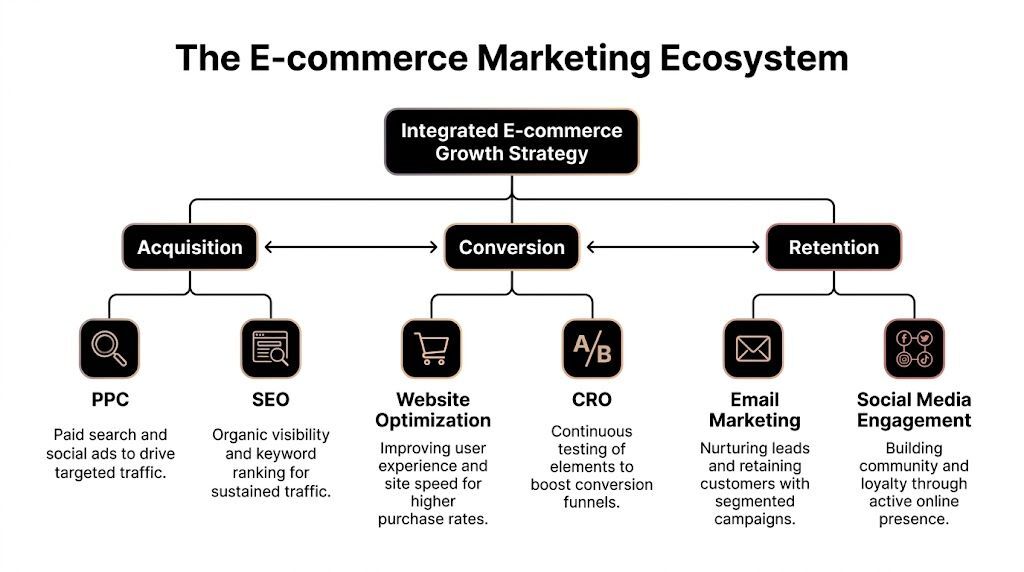
A useful framework is simple. Acquisition gets attention. Conversion turns that attention into sales. Retention increases customer value. If one part is weak, the whole machine underperforms.
If you want a broader overview of how brands package and evaluate e-commerce marketing services, that guide is a decent companion read. But the key issue isn’t listing channels. It’s knowing what job each one should do.
Acquisition brings in qualified traffic
Paid media should capture existing demand first. That means Google Search, Shopping, and high-intent remarketing before you chase novelty.
SEO matters too, but it plays a different role. It builds authority and non-paid visibility over time. It should support paid search by increasing product page relevance, sharpening category language, and surfacing informational intent that paid campaigns might not target efficiently.
Social sits in a different lane. It’s useful for discovery, creative testing, and audience building. It’s less useful when teams expect it to behave like branded search.
Conversion decides whether traffic was worth buying
A lot of service providers stop at traffic. That’s lazy.
Conversion depends on:
Landing page match between keyword, ad, and page
Product page clarity including pricing, shipping, and reviews
Checkout simplicity with minimal friction
Tracking accuracy so decisions are based on clean signals
A paid click doesn’t fail only because of targeting. It often fails because the site gives the buyer reasons to hesitate.
Good media buyers don’t hide behind “we drove traffic.” They diagnose what happened after the click.
Retention protects profitability
Email and SMS are not side channels. They’re part of the economic engine.
They matter because first-purchase acquisition gets harder as competition rises. Retention helps absorb paid media costs and increases the value of every acquired customer. Brands that separate acquisition from retention usually overspend on the front end and under-monetize the back end.
Why the full-service pitch often falls apart
The “we do everything” pitch sounds convenient. In practice, it often creates shallow execution across every channel.
Here’s the cleaner way to think about it:
Channel |
Primary job |
Common mistake |
|---|---|---|
PPC |
Capture demand fast |
Buying traffic without controlling intent |
SEO |
Build durable visibility |
Expecting short-term rescue |
Email and SMS |
Drive repeat purchase |
Sending campaigns without segmentation |
Social |
Generate attention and creative signals |
Judging it by search-style efficiency |
CRO |
Improve revenue from existing traffic |
Treating it as optional |
For ongoing channel thinking, the material on https://www.cometogether.media/blog is worth reviewing because it stays close to practical PPC and account management, not generic marketing fluff.
The right model isn’t “one vendor does everything.” It’s “one strategy aligns everything.” If your paid media lead doesn’t understand how acquisition affects conversion and retention, you’re not running an ecosystem. You’re running disconnected tactics.
The Specialist Consultant Versus The Bloated Agency
High-spend accounts don’t fail because they lack dashboards. They fail because nobody with real experience is close enough to the account to make hard decisions quickly.
That’s the core difference between a specialist consultant and a traditional agency. One is built for accountability. The other is often built for scale on the vendor side, not performance on yours.
Why agencies disappoint experienced CMOs
You’ve probably seen the pattern.
The pitch is senior. The onboarding is polished. Then the account gets handed to a junior manager following a standard process. You get recurring calls, recycled recommendations, and slow changes because every edit has to move through layers.
Meanwhile, the market keeps moving. Competitors change bids. search terms drift. product priorities change. inventory shifts. Promotions need fast response. The agency model struggles because it treats speed as an internal staffing problem instead of a client requirement.
Recent Salesforce data shows 82% of buyers demand B2C-like experiences, and many SMBs in complex verticals are underserved by traditional agencies. In niches like healthcare, CPCs have surged 25% year over year, which makes deep audits and compliant, conversion-focused campaign management a real advantage (Zest Logic on underrated e-commerce sales channels).
That point matters beyond healthcare. In any niche with tighter compliance, trickier demand cycles, or expensive clicks, generic account management gets punished fast.
Service Model Comparison
Attribute |
Specialist Consultant |
Traditional Agency |
|---|---|---|
Who manages strategy |
Senior expert doing the work |
Senior seller, junior operator |
Communication |
Direct and fast |
Layered and slower |
Account knowledge |
Deep familiarity with your business |
Split across team members |
Decision speed |
Rapid changes and tighter feedback loops |
Delayed by meetings and process |
Strategy quality |
Customized to margin, demand, and funnel issues |
Often templated across accounts |
Reporting |
Focused on business outcomes |
Often broad and presentation-heavy |
Incentives |
Keep the account profitable and retained |
Protect agency utilization and margin |
Fit for niche verticals |
Strong when nuance matters |
Weak when nuance breaks templates |
Where specialists win
A specialist doesn’t need to pretend every channel deserves equal attention. That’s one of the biggest advantages.
If Search is your best buyer-intent channel, a specialist leans into it. If your Shopping feed is underperforming, that gets fixed before anyone proposes a brand awareness experiment. If remarketing audiences are polluted, that gets cleaned up before budget expands. The work follows economics, not a service menu.
A strong specialist also asks for information agencies often ignore:
Actual margin by category
Repeat purchase behavior
Inventory priorities
Offer constraints
Sales cycle differences by product type
Compliance limitations in regulated verticals
That level of detail changes how campaigns are built. It affects keyword targeting, exclusions, creative claims, landing page choices, and bid limits.
If your current partner never asked for margin data, they’re optimizing for platform success, not company success.
A niche example that exposes the gap
Take an e-commerce-adjacent healthcare brand or practice with strict ad language constraints. A generalist agency tends to reuse retail habits. Broad match gets sloppy. ad copy pushes too hard. Landing pages don’t answer high-intent objections. Search terms drift into irrelevant or risky territory.
A specialist approaches the account differently. They tighten keyword themes, review ad language for compliance, shape conversion paths around real buyer hesitation, and separate high-intent traffic from exploratory traffic. That’s not glamorous. It’s profitable.
That’s the agency myth in plain terms. More people on the org chart doesn’t mean more expertise touching your account. Usually it means the opposite.
The PPC Engine Powering E-commerce Growth
PPC is still the fastest way to capture demand in e-commerce. It’s also the fastest way to waste budget if account structure is weak.
Paid search works because it meets buyers at the moment of intent. Seventy-five percent of users say paid search ads simplify finding information, but median e-commerce performance still sits at a 1.77% click-through rate and a $32.74 CPA. The top 10% of accounts reach a 4.7% conversion rate or better, which is exactly why expert management matters (Seoprofy e-commerce marketing statistics).
That gap between average and top-tier performance doesn’t come from luck. It comes from structure, feed quality, query control, and post-click alignment.
Search captures high-intent buyers
Google Search campaigns are the sharpest tool in the box because intent is explicit. Buyers tell you what they want with their query.
For high-spend accounts, Search should usually be segmented by intent and business value, not just dumped into broad campaign groupings. Brand, non-brand, competitor, and product-category themes need different budgets, bids, and expectations.
Quality Score matters here because it reflects relevance between keyword, ad, and landing page. Better relevance usually lowers cost pressure and improves traffic quality. It isn’t a vanity metric. It’s a signal about account discipline.
Shopping sells the product before the click
Shopping campaigns and feed-based formats matter because they put price, image, and product detail in front of the buyer early. That changes click quality.
A weak feed causes weak traffic. If titles are vague, attributes are incomplete, or product categorization is messy, the campaign can’t match products to the right queries well. That’s one reason many accounts spend heavily but still attract low-intent clicks.
If you want to see how product-led paid media thinking plays out in practice, the examples at https://www.cometogether.media/copy-of-esc-case-study show the kind of account-level focus more brands need.
Performance Max needs supervision
Performance Max can help. It can also hide waste.
It works best when the account already has clean conversion tracking, strong creative inputs, solid audience signals, and disciplined exclusions. Without that, it becomes a black box that spends money across placements you can’t evaluate clearly enough.
Don’t delegate judgment to automation. Use automation where it has earned trust.
Remarketing recovers lost demand
Most visitors don’t buy on the first session. That doesn’t make them bad traffic. It makes remarketing necessary.
A smart remarketing setup separates visitors by behavior. Product viewers, cart visitors, and previous customers should not see the same message. The more specific the audience, the more useful the ad.
Here’s a quick way to think about the core campaign roles:
Campaign type |
Primary purpose |
What a specialist watches closely |
|---|---|---|
Search |
Capture explicit demand |
Query quality, match type discipline, landing page fit |
Shopping |
Showcase products in-market |
Feed quality, product segmentation, margin control |
Performance Max |
Expand reach with automation |
Asset quality, signal quality, spend concentration |
Remarketing |
Re-engage non-buyers and past buyers |
Audience hygiene, frequency, message sequencing |
This walkthrough is useful if you want a visual refresher on Google Ads mechanics and optimization decisions:
What CMOs should demand from PPC management
Ask simple questions:
Which campaigns are finding new customers profitably
Which product groups absorb spend without enough return
Which search terms should be excluded immediately
Which landing pages are killing otherwise good traffic
The account should tell a clear story. If your partner needs a dashboard and a week to answer basic profitability questions, control is already slipping.
Advanced Google Ads Structure and Optimization Tactics
The gap between average management and real management becomes obvious. Most underperforming accounts don’t need more activity. They need a better structure.
Start with campaign separation that reflects economics
At minimum, split campaigns based on how buyers behave and how your business makes money.
A practical structure often includes:
Brand search for defensive coverage and message control
Non-brand search for category and problem-based acquisition
Shopping or feed-driven campaigns split by priority product groups
Remarketing campaigns segmented by user behavior
Performance Max only when tracking and creative inputs are strong
That structure sounds basic because it is basic. The problem is that many agencies still blur these together, which makes budget allocation muddy and reporting nearly useless.
Use bidding strategy with guardrails
Too many accounts run on “Maximize Conversions” because it’s easy to launch. That’s not strategy.
For long-term profitability, a business needs a CLV-to-CAC ratio of at least 3:1, and a competent PPC operator uses that ratio to set hard bidding ceilings so campaigns produce healthy unit economics instead of hollow revenue (Anchanto on e-commerce performance metrics).
That means your bidding approach should flow from customer economics.
If the business can only sustain a certain acquisition cost based on lifetime value, that limit needs to shape:
Target CPA settings
Target ROAS expectations
Budget distribution by campaign type
Which products deserve aggressive scale
Which search themes get cut
Build tighter control into search and remarketing
The biggest wins in mature accounts often come from cleanup, not expansion.
Search query control
Review search terms constantly. Add negative keywords aggressively. Cut ambiguous traffic fast. If a query doesn’t show credible purchase intent, it shouldn’t keep spending.
A lot of wasted budget comes from near-relevant traffic that looks promising in a report but doesn’t convert in reality.
Ad copy discipline
Good ad copy isn’t clever. It’s clear.
Test offers, differentiators, and buyer objections directly in headlines and descriptions. Match the ad to the search intent and the page experience. If the click expects one thing and the page delivers another, conversion rate drops.
Landing page scent
“Conversion scent” means the page should feel like the natural continuation of the ad and keyword. If someone searches for a specific product type and lands on a generic collection page, you’ve already created friction.
Operational advice: Pull your top spend keywords and compare them line by line against ad copy and landing pages. Misalignment shows up fast when you force that review.
Structure Performance Max with intent in mind
If you use Performance Max, don’t dump the whole catalog into one campaign unless you enjoy bad visibility.
Group products and assets in a way that reflects real business distinctions. Product category, margin class, seasonality, and buyer intent all matter. Asset groups should have a reason to exist. If they don’t, reporting turns into noise.
A quick optimization checklist
Use this with your team this week:
Check negatives first. Waste often hides in search terms.
Audit campaign overlap. Brand and non-brand should not blur together.
Review feed quality. Product titles and attributes shape traffic quality.
Compare device behavior. Don’t assume mobile and desktop deserve identical treatment.
Inspect conversion paths. Cart friction can erase media gains.
Reset testing priorities. Test what changes profit, not what changes cosmetics.
That’s how advanced optimization works in practice. It’s less about hacks and more about disciplined decisions repeated consistently.
Measuring What Actually Matters KPIs and True ROI
Most PPC reports are built to look busy, not useful.
Clicks, impressions, and average position can help with diagnosis, but they do not tell a CMO whether the account is creating profit. You need a smaller set of metrics tied directly to business outcomes.
Start with the big three
The three metrics that matter most are conversion rate, customer acquisition cost, and customer lifetime value.
Each tells a different part of the story:
Conversion rate tells you whether traffic turns into action.
CAC tells you what it costs to acquire a customer.
CLV tells you how much value that customer is likely to produce over time.
Read them together. Separately, they mislead.
Why conversion rate deserves obsession
Conversion rate is the most important efficiency metric. A modest 0.5% improvement for a store with 10,000 monthly sessions can produce 50 additional sales, which is why strong operators focus so hard on CR before demanding more spend (Cometly on e-commerce performance metrics).
That’s the lever many agencies ignore because it sits partly outside the ad account. But serious PPC management doesn’t stop at the click. It checks the product page, the offer, the trust elements, and the checkout path.
If you want examples of what accountable PPC performance analysis looks like, review the work collected at https://www.cometogether.media/google-ads-case-studies.
How to diagnose the account like an operator
Use the metrics in combinations:
Signal |
Likely issue |
What to investigate |
|---|---|---|
High clicks, weak conversion rate |
Post-click friction |
Landing pages, product pages, checkout |
High CAC, acceptable conversion rate |
Traffic cost or poor targeting |
Keyword mix, bids, audience quality |
Strong ROAS but weak new customer flow |
Overreliance on existing demand |
Brand share, prospecting reach |
Good front-end sales, poor payback |
Weak customer value |
Repeat purchase, retention, offer quality |
That’s the level your partner should speak at. Not “traffic is up.” Not “engagement improved.” Those are supporting details, not decision metrics.
A report should help you decide where to push, where to cut, and what broke. If it can’t do that, it’s decoration.
ROI has to connect media to finance
A lot of teams still calculate return loosely. That’s one reason agency accountability gets fuzzy.
If your internal team needs a straightforward framework, this guide on how to calculate marketing ROI and prove its value is useful because it forces the conversation back to cost, return, and business impact instead of platform vanity.
The standard for your PPC partner should be simple. They should know the difference between a campaign that looks efficient in-platform and one that makes financial sense after margins, repeat behavior, and customer quality are factored in.
That’s what true ROI means. Not prettier dashboards. Better economic decisions.
How to Choose and Brief Your Next PPC Partner
If you’re replacing an agency, don’t just swap vendors. Change the rules of engagement.
The right PPC partner should feel closer to an operator than a presenter. You need someone who can audit quickly, make decisions confidently, and tell you the truth when the website, offer, or product mix is hurting performance.
Questions worth asking before you hire
Don’t ask broad questions like “What’s your process?” Ask sharper ones.
Use questions like these:
How do you audit an account in the first stage
What do you check first when CAC rises
How do you separate traffic problems from website problems
How often do you review search queries and negatives
How do you set bid ceilings based on unit economics
What inputs do you need from us besides ad access
Who will do the work each week
How do you report performance to a CMO, not just a media buyer
You should also ask how they handle communication. If the answer sounds slow, layered, or meeting-heavy, walk away.
What your new partner needs from you
Even the best specialist can’t fix what you hide.
A proper brief should include:
Revenue goals tied to time period
Margin reality by product line or category
New customer versus repeat customer priorities
Geographic constraints
Inventory issues
Promotional calendar
Known conversion bottlenecks
What has already failed and why you think it failed
That last one matters. A lot of businesses waste months repeating the same bad tests because nobody documented the earlier mistakes clearly.
What a good first month should look like
A strong PPC partner usually does some version of the following:
Audit structure and tracking
Identify waste and obvious exclusions
Reframe campaign segmentation
Align bidding with margin and customer value
Create a reporting view tied to business outcomes
Set testing priorities for ads, feeds, and landing pages
You’re not hiring someone to “manage Google Ads.” You’re hiring someone to impose order on a revenue channel that can drift into expensive chaos.
For brands evaluating one-on-one help instead of another agency contract, https://www.cometogether.media/google-ads-consultant is the type of specialist model worth considering.
The big takeaway is simple. Large agencies sell breadth. Experienced CMOs usually need depth, speed, and accountability. If your current partner can’t give you those three things, replacing them isn’t reactive. It’s overdue.
If you want a direct assessment of your Google Ads account without another bloated agency pitch, Come Together Media LLC offers exactly the kind of specialist support high-spend e-commerce brands usually need: one-on-one strategy, transparent audits, practical optimization, and clear reporting tied to real business outcomes. If you’re tired of paying for layers and want expert eyes on structure, tracking, keyword selection, ad copy, and profit levers, start with a no-commitment consultation.
