Pricing Google AdWords: Unlock Smarter Investment Strategies
- Sep 10, 2025
- 12 min read
When you start looking into the pricing for Google AdWords, you quickly realize it's not just about the ad spend. The real cost is what you pay for someone to manage that spend—and more importantly, the specialized expertise you get for your money. I've seen too many businesses get burned by over-priced, bloated agencies that deliver generic results while treating you like just another account number.
Why Traditional Agency Pricing Models Are Broken
When you sign a contract with a big digital marketing agency, you’re not paying for their top expert to personally manage your account. You’re paying for their massive overhead. We're talking about their swanky office, a huge support staff, and multiple layers of management—all of which get baked right into your monthly bill without adding a single dollar of value to your campaigns.
This creates a massive disconnect. Your account gets passed down to a junior manager who's probably juggling a dozen other clients, following a templated playbook. Their goal shifts from maximizing your return on ad spend to just keeping their head above water. It’s a fundamental flaw in the old-school, bloated agency approach.
The Architect vs. The Construction Firm Analogy
Think about managing your Google Ads like building a custom home. You have two choices. You can hire a master architect—an individual expert—who designs the entire project with painstaking detail and oversees every single step. Or, you can hire a giant construction firm where your blueprint is just another piece of paper passed down a long chain of command.
The big firm has more bodies, sure. But the architect brings the specialized vision that ensures the foundation is solid and the final build is exactly what you wanted. As a dedicated Google Ads consultant, I am that architect for your campaigns. I am personally invested in seeing you succeed because my reputation is built on delivering real-world results, not just on how many clients an agency can sign.
The problem with bloated agencies is simple: you pay for their scale, not for specialized skill. Your budget ends up subsidizing their operational costs instead of being put to work by a dedicated expert who knows your account inside and out.
Where Your Money Really Goes with an Agency
With a large agency, your investment gets diluted before it ever touches your campaigns. A huge chunk of your fee is often covering things that have nothing to do with your success:
High Overhead: Rent for that downtown office, utilities, and administrative salaries.
Sales Commissions: The cost for the slick sales team that signed you.
Layered Management: Multiple managers who might not even know your company's name.
Inexperienced Staff: Your campaign becomes a training ground for a junior employee following a generic checklist.
As an independent consultant, my pricing is tied directly to my expertise and the actual time I spend working on your account. Every dollar goes toward strategy, hands-on optimization, and clear communication. It’s a lean, efficient approach that means more of your investment translates directly into better campaign performance. To see how this compares to other industries, it's worth exploring some modern service pricing models to understand the difference.
How the Google Ads Auction Really Works
To get a grip on what Google Ads will actually cost you, you first need to understand where your money goes. Most people think it’s a straightforward auction: whoever bids the most gets the top spot. But it’s not that simple, and this is where agencies often get it wrong.
The system is far more strategic. It's less about who has the deepest pockets and more about who is the most relevant advertiser for the searcher.
Google’s whole system hinges on a concept called Ad Rank. Think of it as the score that decides where your ad shows up on the page. Crucially, it’s not just about your bid. Google combines your maximum bid with your Quality Score—a 1-to-10 rating on how good your ads, keywords, and landing page are.
This is where the entire game is won or lost. And honestly, it’s the biggest difference between a hands-on expert like myself and a bloated agency just managing your spend.
The Power of Quality Score Over Big Bids
A high Quality Score is basically Google’s way of rewarding you for giving their users a good experience. When your ad nails the searcher's intent and your landing page delivers on the promise, Google gives you a thumbs-up in the form of a better score.
This one metric has a massive impact on your costs.
A higher Quality Score means a lower cost-per-click (CPC) and a better ad position. You can literally pay less than your competitors and still outrank them, just by being more relevant.
This is a dynamic that big, impersonal agencies often ignore. Their management fees are usually a percentage of your ad spend, so their incentive is to get you to spend more, not less. But a true specialist’s first job is to obsess over your Quality Score. It’s a powerful lever that drives down your actual advertising costs and makes every dollar in your budget work harder. It’s a strategy built on efficiency, not just volume.
Understanding Real-World Costs
The cost of a single click can swing wildly from one industry to another, which is why a cookie-cutter agency approach rarely works. For example, the average CPC on Google Search is around $2.69, but that number can skyrocket for hyper-competitive keywords.
In contrast, running ads on the Google Display Network is much cheaper, averaging just $0.63 per click. For e-commerce brands, Google Shopping Ads hit a sweet spot, averaging about $0.66 per click and making up over 75% of all U.S. retail search ad spending. You can dig deeper into how these cost-per-click stats break down by industry to see the variance.
An individual expert knows this landscape inside and out. Instead of just throwing your money at the most expensive keywords like an agency might, I find that sweet spot between cost and relevance. My goal is to make sure your budget is invested for the highest possible return, not just spent.
Mastering Your Quality Score to Lower Ad Costs
Think of Quality Score as your secret weapon for getting more out of your Google Ads budget. It’s Google’s internal report card, grading your ads on a scale of 1 to 10. A high score is your ticket to better ad positions at a lower cost.
While most agencies just push for bigger budgets, a seasoned pro knows the real leverage is in obsessing over this one metric. It's the key to making every dollar you spend work harder.
An exceptional score isn’t about acing one thing; it’s about balancing three critical components. This takes hands-on work and genuine expertise—the kind that gets lost when agencies rely on templates and junior account managers. Before you can win the game, you need to start by understanding what Quality Score is and why it's so damn important.

The Three Pillars of Quality Score
Getting that score up isn’t a job for a junior account manager with a checklist. It requires a specialist’s touch across three key areas.
Expected Click-Through Rate (CTR): This is Google's best guess on how likely someone is to click your ad when it shows up. As a dedicated consultant, I don't use generic, robotic ad copy. I dig deep to write compelling, emotionally-driven ads that connect directly with what the searcher is looking for, which naturally boosts clicks.
Ad Relevance: Google demands a tight, logical link between your keyword, your ad copy, and the original search. I meticulously build ad groups and craft hyper-targeted copy, making sure every ad feels like the perfect answer to the keyword that triggered it.
Landing Page Experience: When someone clicks, your website has to deliver on the ad's promise. I will give you direct, actionable feedback on your landing pages—from matching the headline to the ad, to making sure it works flawlessly on a phone. It's all about creating a smooth user journey that Google loves to see.
A lot of big agencies will automate ad creation and send you a generic PDF on landing page best practices. A real consultant gets in the weeds with you, personally critiquing and refining these moving parts. I know the real savings are found in the details, not just by throwing more money at the problem.
This hands-on, expert approach changes everything. An agency might just report on a low Quality Score as a line item in a monthly summary. I see it as the most critical puzzle to solve.
This kind of dedicated expertise is what turns your ad spend from a simple line-item expense into a powerful, efficient engine for growth. It proves that a smarter strategy will always beat a bigger budget.
How to Set a Realistic Google Ads Budget
One of the biggest questions I hear from new clients is, "So, how much should I actually spend on Google Ads?" It’s a question that can cause instant analysis paralysis, but figuring out your starting budget doesn't have to be a shot in the dark. The trick is to stop looking for generic answers from agencies and start building a smart framework based on your industry and your goals.
A smart budget isn't just some number you pull out of thin air. Think of it as a calculated starting point with a single, crucial purpose: to buy enough real-world performance data to make intelligent decisions later. This is where my agile, test-and-learn approach as an experienced consultant really shines, especially when compared to the rigid, long-term contracts most big agencies demand. We're not trying to lock you into a massive commitment; we're trying to start small, prove what works, and then scale intelligently.

A Data-Driven Starting Point
So, where do we begin? We start with the data. I use tools like Google's own Keyword Planner to get a feel for the estimated cost-per-click (CPC) for the keywords that matter most to your business. This initial research gives us a baseline—a rough idea of what a single click might cost in your market. From there, we work backward from your business objectives.
My approach is all about minimizing your financial risk upfront. We define a strategic test budget—just enough to learn what resonates with your audience—and then we scale what’s delivering a clear return. It’s about investing wisely, not just spending heavily.
This method keeps you in complete control. For most small and medium-sized businesses, monthly ad spends can be anywhere from $100 to $10,000. A test budget ensures you aren’t overcommitting your cash before you even know if the ads are working. It’s a completely different world from the agency model, which often requires hefty retainers and long-term contracts regardless of how the campaigns are actually performing.
From Testing to Scaling
Once those initial campaigns are live, the real work begins. I meticulously track the data, shifting our focus to a few key metrics like conversion rates and cost per acquisition. This is where the magic happens. We can see exactly which keywords and ads are driving results, allowing us to double down on what works and cut the strategies that are just burning cash. If you need a refresher on this critical step, check out our guide on how to calculate return on ad spend for real profit.
This process transforms your ad budget from a fixed line item into a dynamic, performance-based investment. To really dial in your numbers, it helps to review expert advice on how much to spend on your initial ad campaigns to set yourself up for sustainable growth. Working with me as your consultant gives you a partner who lives and breathes this agile process, ensuring every dollar is put to work for maximum impact.
Comparing Real-World Agency Fees vs. Consultant Costs
Let's make the financial difference tangible. The whole conversation around pricing Google Ads management gets stuck on the monthly retainer, but that’s missing the forest for the trees. The real story is in the results those fees actually generate.
It’s never about who has the lower price tag; it's about who delivers the highest return on your total investment.
A bloated agency and a dedicated consultant are playing two completely different games. Agencies are built on scale, using cookie-cutter processes and junior staff to manage your money. As a consultant, I bring direct, specialized expertise to the table. That single difference has a huge ripple effect, impacting not just your management fee but your actual campaign performance—the stuff that matters, like your Cost Per Acquisition (CPA) and overall Return On Ad Spend (ROAS).
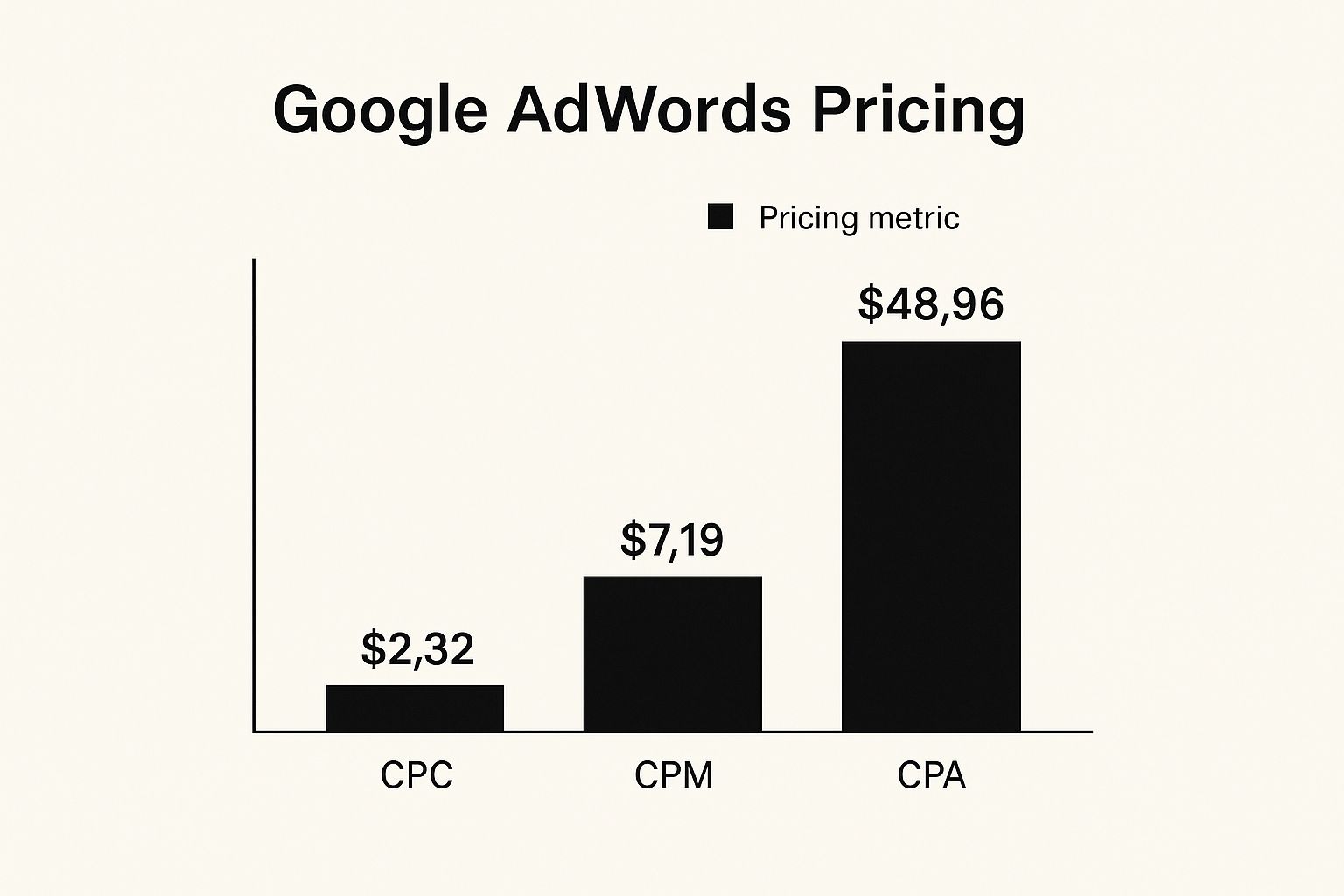
Your Budget at Work: A Hypothetical Breakdown
Imagine you have a monthly ad budget of $5,000. Let's walk through how that cash gets put to work under two very different management styles: the bloated agency vs. the individual expert.
The key takeaway here isn't just the fee. It's how a specialist’s hands-on optimization makes your ad spend work smarter, not just harder, leading to dramatically better outcomes.
Agency vs. Consultant: A Real-World Cost Comparison
This table breaks down a typical scenario. You've got a $5,000 ad budget, and you're deciding between a standard agency and an expert consultant like me. Watch what happens to the bottom line.
Metric | Large Agency Model | Expert Consultant Model |
|---|---|---|
Monthly Ad Budget | $5,000 | $5,000 |
Management Fee | $1,000 (20% of spend) | $750 (Fixed Rate) |
Total Monthly Cost | $6,000 | $5,750 |
CPA (Optimized) | $60 (Generic template) | $45 (Hands-on expert optimization) |
Conversions | 83 | 111 |
Return On Ad Spend | 3.5x ROAS | 5x ROAS |
The table makes it pretty clear. While my fee is lower, the real win comes from superior performance.
By hammering down the CPA through meticulous, daily optimization—something agencies with dozens of clients per manager can't do—I generate 28 more conversions and a much healthier ROAS. You can dig deeper into why an expert consultant outperforms most agencies in our detailed guide.
This scenario proves a crucial point I see every day: the cheaper management option is the one that makes you the most money. Paying a premium for an agency's fancy office and bloated team often means sacrificing the very expertise needed to drive down your acquisition costs and actually grow your business. It's a classic case of efficiency trumping scale.
The Smart Choice: Partnering with a Google Ads Expert
Let’s get one thing straight. The core of effective Google Ads management isn’t about the size of the agency cashing your check—it’s about the skill of the single person managing your budget.
Your Google Ads pricing only becomes a true investment when it’s guided by focused, specialized expertise. Unfortunately, that’s the first thing to get diluted in a large, overpriced agency setting.
When you sign with a bloated agency, you aren't just paying for ad management. You're covering their massive office lease, the sales team's commissions, and the salaries of managers who will likely never even glance at your account. Your business becomes just another logo in their portfolio, handed off to a junior employee who’s just following a generic playbook.
Beyond the Vendor Relationship
As an independent Google Ads consultant, I operate on a completely different wavelength. This is a genuine partnership where my success is directly tethered to yours. There are no layers of bureaucracy, no junior staff learning the ropes on your dime, and absolutely no incentive to recommend strategies that just inflate your ad spend so an agency can collect a higher percentage.
This direct, one-on-one relationship means you actually get what you pay for:
A Truly Custom Strategy: I build your campaigns from the ground up to hit your specific business goals. No templates, no cookie-cutter approaches.
Transparent Communication: You speak directly to the person doing the work. This means clear, honest feedback and the ability to make quick, intelligent pivots.
Deep, Hands-On Expertise: Every decision is made by a seasoned pro with years of in-the-trenches experience driving down costs and maximizing returns.
The real advantage here is accountability. As your consultant, the person who builds your strategy is the same person who executes it and reports on the results. There’s nowhere to hide. That's how we build a relationship on trust and a shared obsession with tangible growth.
Choosing the right partner is what transforms your ad spend from a line-item expense into your most powerful engine for growth. It’s about choosing a specialist over a generalist, and a dedicated partner over a detached vendor.
Frequently Asked Questions About Google Ads Pricing
Let's cut through the noise. Here are some quick, no-nonsense answers to the questions I hear most often from business owners trying to make sense of Google Ads costs.
How Much Should a Small Business Budget for Google Ads?
While you'll often hear a starting range of $1,000 to $2,500 a month, that figure is almost meaningless without context. The right budget depends entirely on your industry, your goals, and what the data tells us.
A smart approach doesn't start with a magic number. It starts with a strategic test budget. As your consultant, I help you define that initial investment based on real keyword costs and what you need to achieve, focusing on proving profitability before you even think about scaling up. This way, you invest with confidence, not on a long-term agency contract and a prayer.
Is It Easy to Lose Money on Google Ads?
Absolutely. Without an expert keeping a close eye on things, it's astonishingly easy to burn through your budget on clicks that go nowhere. This is the biggest risk of trying to DIY your campaigns or signing on with a big, distracted agency where your account is just one of hundreds.
As a dedicated consultant, I am your safeguard. My job isn't just to spend your budget; it's to protect it. I am actively managing your account every day to plug leaks, cut waste, and make sure every single dollar is pulling its weight toward your actual business goals.
What Is a Good Return On Ad Spend for Google Ads?
The industry benchmark you’ll always hear is a 4:1 ratio—that’s $4 back for every $1 you spend. But honestly, a "good" ROAS is completely unique to your business and its profit margins. An agency can show you a fancy report with a 4:1 ROAS, but if your margins are thin, you could still be losing money.
That’s why my first job as a consultant is to work with you to figure out the exact ROAS you need to be profitable. From there, we build a strategy specifically to hit that number, leaving the one-size-fits-all metrics behind to focus on what actually matters: your bottom line.
Why Not Just Use Google's Automated Smart Campaigns?
Think of Smart Campaigns as the "easy button" for Google Ads. They’re designed for simplicity, not performance. The problem is, they operate like a black box, giving you almost zero control, strategic depth, or real insight into what's happening with your money. It's often where businesses start, and it's usually where they realize they're leaking cash without knowing why.
An expert brings the sophisticated, hands-on management that automated tools just can't match. We're talking about advanced bidding strategies, detailed audience targeting, and constant creative testing that gives you a genuine edge over the competition. It’s the difference between letting a machine guess and having a specialist execute a winning game plan. If you want to dive deeper, this guide to better ad spending really breaks down the impact of expert management.
Ready to stop guessing and start seeing a real return on your ad spend? At Come Together Media LLC, I provide the one-on-one expert guidance that bloated agencies can't match. Book your free consultation today and let's build a smarter Google Ads strategy together.


Comments