Google Ads Consultant for Small Business: Your Expert Guide
- Aug 20, 2025
- 15 min read
Choosing the right partner for Google Ads is one of those make-or-break decisions for a small business. Get it right, and you’ve got a growth engine. Get it wrong, and you’re just burning cash with nothing to show for it.
The best move? Ditch the bloated, over-priced agency and find an individual, expert consultant who treats your investment like their own—not some massive, impersonal firm where your account becomes just another number.
Why Your Google Ads Partner Can Make or Break Your Business
Let's be real—Google Ads can feel like a high-stakes game. You know the potential is huge, but you've probably felt the sting of wasted ad spend and stared blankly at a dashboard full of confusing metrics. This isn’t just about flipping a switch and running ads; it’s about finding a partner who actually gets your business goals and is hell-bent on hitting them.
This choice matters. A great partner is more than a service provider; they become a true extension of your team. They bring the focused skill and direct communication needed to turn clicks into real customers, driving growth you can actually count on.
The Difference Between an Expert Consultant and a Bloated Agency
The market is swamped with options, but they usually boil down to two types: the giant, full-service agencies and the individual, expert consultant. For a small business, the difference is night and day.
Big agencies often come with layers of account managers, crazy overhead costs that get passed straight to you, and cookie-cutter strategies that completely miss what makes your business unique. You’re paying for their downtown office, not for better results.
An independent consultant, on the other hand, lives and breathes this stuff. Their success is tied directly to yours. You work with the actual expert, which means your strategy is built with precision and a deep-seated understanding of what you’re trying to achieve. You can learn more about this in our guide on why a specialist beats a bloated agency.
The Power of Obsessive Expertise
Google Ads is not a "set it and forget it" channel. It demands constant attention, testing, and fine-tuning. A dedicated expert brings a level of focus that a jack-of-all-trades agency just can't match. They're obsessed with the metrics that actually move the needle—like conversion rates and return on ad spend (ROAS)—not vanity metrics like clicks and impressions.
The right Google Ads partner doesn’t just manage your account; they own the results. Their goal is to make every single dollar you spend work harder for your business, turning your ad budget into a reliable profit machine.
This kind of focused approach pays off. Seriously. Google Ads is still a top performer, with a recent study clocking the average search ad conversion rate at an impressive 7.52%. That same report found that 76% of small businesses are happy with their search advertising efforts, proving what’s possible when it’s managed correctly. With the right strategy, small businesses can—and do—win big.
The True Cost of Big Box Agencies
Ever wonder where your high agency fees are really going? When you sign a contract with a large, well-known agency, it’s easy to assume you’re paying for top-tier expertise and dedicated attention.
But let's pull back the curtain. A huge chunk of that payment isn't going toward strategy or campaign management. It's covering the agency's massive overhead: flashy downtown offices, a bloated sales team, layers of management, and expensive marketing campaigns designed to attract more clients just like you.
Here's the kicker: the senior strategist who wowed you during the sales call? They probably won't ever touch your account again. Instead, it gets handed down the line, landing on the desk of a junior account manager.
The Junior Manager Dilemma
This isn't a knock on junior managers themselves. They're often sharp, ambitious, and eager to prove themselves. The real issue is the system they're stuck in.
These are typically recent grads with limited real-world experience, and they are almost always buried under an impossible workload.
I’ve seen it firsthand. It's not uncommon for a single manager at a large google ads agency for small business to be juggling 20, 30, or even 40 different client accounts. Each business has its own unique goals, products, and market challenges. It's simply not humanly possible to give any single account the deep, focused attention it needs to thrive.
Your business becomes just another tab open on their crowded screen. And what you get is a generic, paint-by-numbers approach to your advertising.
When "Best Practices" Mean "Cookie-Cutter"
Large agencies are built for efficiency and scale. This inevitably leads to templated, one-size-fits-all strategies. They apply the same general playbook to every client, whether you're a plumber, a SaaS company, or an e-commerce store.
Let’s use a real-world example. Imagine 'Business A,' a local plumbing company. They sign with a big-name agency and pay a premium fee. What they get is a standard campaign structure—a few broad keywords, generic ad copy, and basic conversion tracking.
This cookie-cutter approach completely misses the mark on what actually moves the needle for a local business:
Hyper-local targeting for the specific neighborhoods where their ideal customers live.
Ad copy that speaks to local pain points, like "24/7 emergency service in [Your City]."
Competitor analysis focused on other local plumbers, not faceless national chains.
The agency checks all the boxes, the campaign runs, but the results are just… meh. Clicks are expensive, leads are low-quality, and the ROI is dismal. The high fees paid by Business A are funding a system, not a strategy.
The biggest hidden cost of a big-box agency isn’t the monthly retainer; it's the missed opportunity. It’s the growth you could have had if your budget was managed by an expert truly dedicated to your specific success.
Recognizing the Red Flags of a Bad Fit
The problems with this model usually become painfully clear a few months after you’re locked into a contract. The initial excitement wears off, replaced by a nagging feeling that something isn’t right.
Here are the tell-tale signs that you're just another number in a big agency's portfolio:
Slow Response Times: Your emails take days to get a reply because your point of contact is drowning in other accounts.
Vague Reporting: You get reports full of fluffy metrics like clicks and impressions but get fuzzy answers when you ask about what really matters—cost per lead and ROI.
Constant Upselling: Every conversation seems to pivot toward adding more services or increasing your budget, rather than optimizing what you're already paying for.
Lack of Proactivity: You’re the one pushing for strategy calls and asking for updates. The agency is just reacting, not leading the charge.
Ultimately, choosing a google ads agency for small business is about finding a partner who is as invested in your bottom line as you are. For most small businesses, the impersonal structure of a large agency means their unique needs get lost and their budget ends up paying for bloat, not brains.
The Dedicated Consultant Advantage
This is where the game really changes for small businesses. Forget the impersonal, factory-like approach of big agencies. Partnering with a dedicated Google Ads expert is a fundamentally different—and far more powerful—experience.
Imagine getting the actual strategist on a call with you. Not an account manager, not a salesperson, but the person physically building and tuning your campaigns. They don’t just know your account name; they understand your business goals, your customer, and the daily pressures you're up against.
This direct partnership is what it's all about. It’s the difference between being a small fish in a giant agency pond and becoming the priority client whose success is your consultant’s entire focus.
Your Fee Funds Expertise, Not Overhead
When you hire an independent consultant, your money goes directly into high-level strategy and meticulous execution. You're paying for years of experience, not a corner office in a downtown skyscraper, a bloated sales team, or layers of project managers who just get in the way.
A consultant’s business model is lean by design. Their reputation isn't built on a flashy brand name; it's built on the tangible results they get for their clients. This creates a perfect alignment of interests: your success becomes their single most valuable marketing asset.
Just look at the typical performance gap between DIY efforts and working with a pro who can optimize your campaigns from day one.
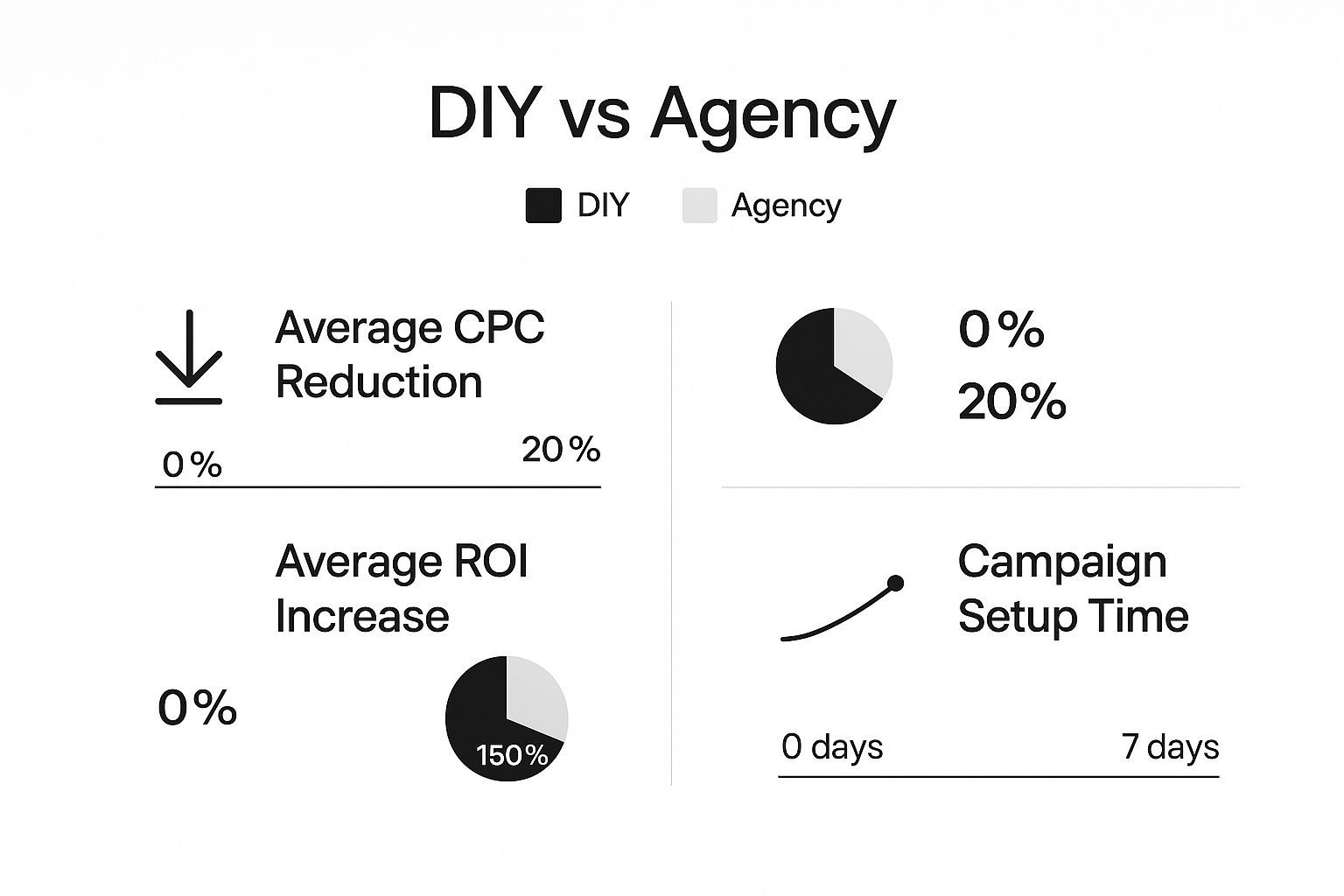
The data is clear. Expert management isn't just another expense; it’s an investment that can dramatically cut costs while multiplying your returns.
Direct Communication and Total Transparency
Ever felt like your feedback gets lost in translation at a big agency? That’s because it’s passing through multiple people before it ever reaches the person doing the work. With an expert consultant, you have a direct line to the source.
This simple change eliminates frustrating delays, miscommunications, and that sinking feeling that you’re not being heard. Have a question about a sudden dip in performance? Need to pivot fast for a new promotion? You get a clear, informed answer straight from the person running your account.
This structure fosters a level of transparency that big agencies just can't offer.
You know who’s managing your account. No more wondering if a seasoned pro or a rookie intern is at the helm.
You get honest, unfiltered reporting. The focus is on metrics that actually matter to your bottom line, like Cost Per Acquisition (CPA) and Return on Ad Spend (ROAS)—not vanity metrics like clicks.
You receive proactive strategy updates. A dedicated consultant doesn't wait for you to ask what’s next. They’re constantly in the data, bringing fresh ideas to the table to improve performance.
The table below breaks down the real-world differences a small business can expect.
Large Agency vs Expert Consultant: A Small Business Comparison
Feature | Large Agency Model | Expert Consultant Model |
|---|---|---|
Main Contact | A junior account manager or salesperson. | The senior expert running your campaigns. |
Strategy Source | Diluted through multiple layers of staff. | Direct, hands-on, and customized by the expert. |
Communication | Slow, filtered through a chain of command. | Instant, direct, and clear. No intermediaries. |
Your Fee Pays For | Overhead, sales teams, multiple salaries, office space. | 100% focused expertise and execution. |
Business Priority | You are one of many accounts, often a lower priority. | Your success is their top priority and best case study. |
Agility & Speed | Bureaucratic. Changes can take weeks to implement. | Nimble. Strategy pivots can happen the same day. |
Ultimately, the choice comes down to what you value most: a big agency name or a direct, results-focused partnership.
A True Strategic Partnership
The biggest shift is moving from a vendor-client transaction to a genuine partnership. A consultant becomes deeply invested in your business because their professional reputation is on the line with every single campaign. They don't have dozens of other accounts to fall back on if yours doesn't work out.
An expert consultant doesn't just manage your ads; they help you build a smarter growth strategy. They challenge your assumptions, uncover new opportunities in the data, and act as a true extension of your marketing team.
They aren't just checking boxes in a generic playbook. They’re building a custom strategy designed for your specific niche, budget, and business goals. For a closer look at this process, check out our guide on how an expert consultant slashes customer acquisition costs in ways that large agencies simply can't.
This hands-on, tailored approach is what separates a good Google Ads agency for small business from a great one. It's about finding a partner who is just as obsessed with your ROI as you are.
How to Find and Vet Your Google Ads Expert
Finding the right Google Ads partner is a hunt. You’re not just looking for someone who does Google Ads; you’re looking for a specialist whose success is directly wired to yours. It’s about cutting through the noise of slick sales pitches to find genuine, hands-on expertise.
Forget the top-of-Google results for a minute. Those are often dominated by massive agencies with even bigger marketing budgets. The real pros? They're usually found in different circles.
Where to Find True Specialists
Authentic Google Ads experts build their reputation on results, not on their own ad spend. Their business thrives on word-of-mouth and professional networks.
Here’s where you should be looking:
Industry Referrals: This is your best starting point. Ask other business owners in your space who they trust with their ad budget. A recommendation from someone who gets your specific challenges is pure gold.
Professional Platforms like LinkedIn: Search for terms like "Google Ads Consultant" or "PPC Specialist." The key is to look past the salesy content and find individuals who share detailed case studies, have solid client recommendations, and post valuable insights.
Niche Communities: Are you in a specific e-commerce vertical or a local service industry? Find the private mastermind groups or forums for your niche. The best freelancers and consultants are often active participants there, sharing what they know.
Once you have a shortlist, the real work starts. You need to vet them with questions that go way beyond, "So, what are your fees?"
Questions That Cut Through the Sales Pitch
Anyone can talk a good game. Your job is to get past the prepared script and see how they really think. A true expert will welcome the chance to dig into the details and prove their process.
Here are the questions that separate the pros from the pretenders:
"Walk me through a campaign you turned around for a business with a budget similar to mine." This forces a specific, relevant example. Listen for the details: What was the initial problem? How did they diagnose it? What changes did they make, and what were the tangible results (like a 30% drop in Cost Per Lead)?
"What's your process for keyword research in a competitive niche like mine?" A lazy answer is, "We use the best tools." A great answer details their actual methodology—how they dissect competitor strategies, hunt for long-tail opportunities, and aggressively use negative keywords to stop budget leaks.
"How do you approach the first 30 days with a new client?" The first month is all about getting the foundation right. A skilled consultant will immediately talk about auditing conversion tracking, setting up A/B tests for ad copy, and establishing clear baseline KPIs.
"What's your fee structure, and why do you use it?" This is a window into their business philosophy. Big agencies often use a percentage of ad spend, which can incentivize them to just spend more of your money. In contrast, many expert consultants prefer a flat monthly fee, aligning their goals with your profitability and efficiency—not just your total spend.
The goal here isn't just to get answers; it's to see how they answer. Are they confident and specific? Or do they fall back on vague marketing jargon? An expert is always ready to talk shop.
Reading Between the Lines of Case Studies
Case studies are crucial, but you have to know how to decode them. A glossy PDF boasting a 200% increase in clicks is a meaningless vanity metric without context.
Look for case studies that clearly show:
The Starting Point: What was the situation before they took over?
The Business Goal: What was the actual objective? (e.g., increase qualified sales leads, improve e-commerce ROAS).
The Metrics That Matter: Zero in on results like Cost Per Acquisition (CPA), Return On Ad Spend (ROAS), and Conversion Rate.
This is especially critical for small businesses. One study found that 23.3% of small business owners name budget constraints as their top challenge, while 22.8% struggle with lead generation. And with 71% emphasizing the need for performance tracking, finding a google ads agency for small business that delivers measurable ROI isn't just a preference—it's a necessity. You can find more on these small business marketing challenges on postcardmania.com. A great partner understands these pressures and reports on the metrics that prove they're solving these exact problems.
For a closer look at what effective, hands-on management involves, check out a consultant's guide to PPC management for small businesses.
By following this playbook, you can move beyond a simple Google search and confidently find an expert partner who is truly equipped to help your business win.
Building a Partnership That Drives Growth
Hiring a great consultant is a huge first step, but the real magic happens next. To get incredible results, you need to become a great partner.
The most successful Google Ads campaigns I've ever seen are a fusion of two things: your deep, firsthand knowledge of your industry and your consultant's technical mastery of the ad platform.
This is what separates the good campaigns from the great ones. When you treat your consultant as an extension of your team, you give them the context to make smarter, faster decisions that directly impact your bottom line. It’s not about handing over the keys and walking away; it’s about building a relationship focused on mutual growth.
Setting the Stage for Success on Day One
The partnership truly begins the moment you sign the contract. Your first few conversations should be laser-focused on defining what success actually looks like. Clicks and impressions are just noise; you need to nail down the key performance indicators (KPIs) that really matter to your business.
This means getting specific. "I want more leads" isn't a goal. "I need to generate 20 qualified leads per month at a cost per lead under $50" is a goal. An e-commerce business might aim for a 4:1 Return on Ad Spend (ROAS) on their top product categories.
These concrete numbers give your consultant a clear target to aim for. They turn your business objectives into a technical roadmap, guiding every single decision from keyword selection to bid strategy.
A great consultant will push you on this. They won't just accept vague goals. They’ll help you translate your broad business ambitions into the specific, measurable metrics that define a winning Google Ads campaign.
Sharing Your Secret Weapon: Customer Insights
Your consultant is an expert on Google Ads, but you are the expert on your customer. The insights locked away in your head are the secret weapon that can give your campaigns an unbeatable edge. You have to share this knowledge openly and often.
Think about what your consultant doesn't know:
What are the most common pain points your customers have before finding you? This is absolute gold for writing ad copy that resonates.
What specific questions do they ask on sales calls? These are often perfect long-tail keywords just waiting to be targeted.
Who is your *worst* type of customer? Defining this helps build powerful negative keyword lists to stop wasting money on the wrong clicks.
What's your real competitive advantage? It's rarely just "price" or "quality." Get specific.
Sharing this level of detail allows your consultant to craft campaigns that speak directly to your ideal buyer, filtering out the noise and attracting higher-quality traffic right from the start.
Creating a Productive Feedback Loop
Your ongoing involvement is crucial for long-term success. A healthy partnership requires a steady, productive feedback loop—not micromanagement, but providing the qualitative data that performance reports can't show.
When you're reviewing reports, don't just look at the numbers. Ask your consultant to explain the "why" behind strategic shifts. If lead volume is up, your job is to report back on the quality of those leads.
A simple email saying, "The leads from the 'emergency repair' campaign last week were excellent, but the ones from the 'service quote' campaign were mostly tire-kickers," is incredibly valuable information.
This kind of feedback allows your consultant to double down on what’s working and quickly cut what isn’t, making your ad spend smarter every single week. It's this active collaboration that makes choosing the right google ads agency for small business so important. A true consultant wants this feedback; a bloated agency barely has time for it.
This partnership is vital, especially when you consider that around 65% of small businesses run PPC campaigns and rely heavily on platforms like Google Ads to find their customers. You can dig into more Google Ads statistics and facts on webfx.com.
Still Have a Few Questions?

Choosing a Google Ads agency for your small business is a big step. It’s a major investment, and you absolutely deserve clarity before you sign anything.
Let's cut through the agency sales pitch and tackle the questions I hear most often from business owners. This will help you sidestep some common traps and see why a dedicated expert is almost always the right call.
How Much Should a Small Business Budget for Management?
This is usually question number one. The answer depends on the agency's model, and the difference is critical.
Big, impersonal agencies almost always charge a percentage of your monthly ad spend—typically between 15-20%. This model is a trap. It incentivizes them to spend more of your money, not necessarily to spend it better. Their revenue goes up even if your profits don't.
A dedicated consultant or a specialized firm, on the other hand, usually works on a flat monthly retainer. The fee is based on the complexity of your account, not just how much you're spending. For a small business, this is the only model that makes sense. It aligns your goals (profitability and efficiency) directly with theirs.
A quick gut-check: always ask what’s included. A transparent expert will have a clear, simple answer. A bloated agency might hit you with surprise fees for reporting, calls, or "strategy sessions."
What Are the Biggest Red Flags to Watch For?
Knowing what to avoid is just as important as knowing what to look for. Some promises are so outrageous they should send you running.
Anyone guaranteeing a #1 ranking on Google is lying. It’s an impossible claim and a dishonest sales tactic, period.
Another major red flag is a lack of transparency. Who, specifically, will be working on your account? If you can't get a straight answer or speak directly with the strategist, it’s because a junior employee is pulling the levers.
But here’s the most critical one of all: account ownership. If an agency insists on creating the Google Ads account under their name and refuses to give you full admin access, walk away. Immediately. You must always own your data, your campaigns, and your history. No exceptions.
Does a Google Premier Partner Badge Actually Matter?
You’ll see that shiny Google Premier Partner badge plastered all over large agency websites. It looks impressive, but what does it really mean for you?
All it really shows is that they meet certain ad spend thresholds and have certified staff. A massive agency can earn that badge just by managing hundreds of accounts at once. Your small business campaign could still end up with their least experienced team member.
Here's what to focus on instead:
Relevant Case Studies: You want proof of success with businesses like yours, in your industry and at your budget level.
Direct Expertise: The skill of the individual managing your account is far more important than a company-wide logo.
Clear Communication: A direct line to your strategist is infinitely more valuable than any badge.
Plenty of world-class independent consultants deliver far better results but don't manage enough total spend to qualify for the badge. Don't let it distract you from what really drives results.
How Long Until I See Real Results?
Every small business owner needs to know this. You’ll see traffic and clicks almost immediately after launching a campaign, but real, profitable results take a little time.
Think of the first 30 days as the data collection and testing phase. By the 60-90 day mark, your consultant should have dialed in the targeting, ad copy, and bidding strategy, giving you a very clear picture of your return on investment.
Be skeptical of anyone promising you a mountain of cash overnight. PPC is a marathon, not a sprint. A true expert sets realistic expectations and focuses on building a strong, profitable foundation that lasts.
If you're tired of the bloated agency model and want a true partner dedicated to your growth, Come Together Media LLC offers the expert, one-on-one Google Ads consulting your small business deserves. Get a free, no-commitment review of your account and see what a specialized approach can do. Learn more at https://www.cometogether.media.


Comments