A Consultant's Guide to PPC Management for Small Businesses
- Aug 16, 2025
- 16 min read
Managing your Pay-Per-Click (PPC) ads effectively isn't about hiring a massive agency with a fancy downtown office; it's about having a dedicated expert who treats your budget like their own.
For small businesses, the standard agency model is often a terrible fit. You get pulled in by a flashy sales pitch from a slick salesperson, see a long list of impressive clients, and sign on the dotted line. What happens next is painfully predictable: your account gets handed off to a junior manager who's juggling a dozen other clients and following a templated playbook.
Suddenly, you’re just another number in their system.
Why Your Small Business Needs a Different PPC Approach
That bloated agency structure means a huge chunk of your fee is paying for things that don't help you grow—think layers of management, sales team commissions, and high-rise office rent. When every dollar in your budget counts, that model is fundamentally broken.
You end up with slow response times, generic strategies, and a sinking feeling that nobody is really paying attention. A local plumber gets the same campaign structure as a national e-commerce store, which is a surefire way to burn through your budget with little to show for it. It’s a common story, leaving you feeling like a small fish in a very big, very expensive, and indifferent pond.
The Agency Trap vs. The Consultant Advantage
An independent consultant’s business model is completely different. My success is directly and transparently tied to yours. Since I run a lean, expert-led operation, your investment goes straight into high-level strategy and hands-on management, not corporate overhead.
You’re also communicating directly with the person doing the actual work. No more playing telephone through a chain of account coordinators. This direct relationship means I gain a much deeper understanding of your business, which leads to quicker adjustments and smarter, more effective campaigns that are built for you, not recycled from another client.
The real difference is this: An agency sells you a system and fits you into it. As an expert consultant, I become a true partner in your growth. Your goals become my goals.
The benchmarks below show what's possible with a well-managed PPC campaign. Hitting these numbers isn't about a massive budget; it's about a focused, expert-led strategy that a volume-based agency simply can’t provide because their model doesn't allow for it.
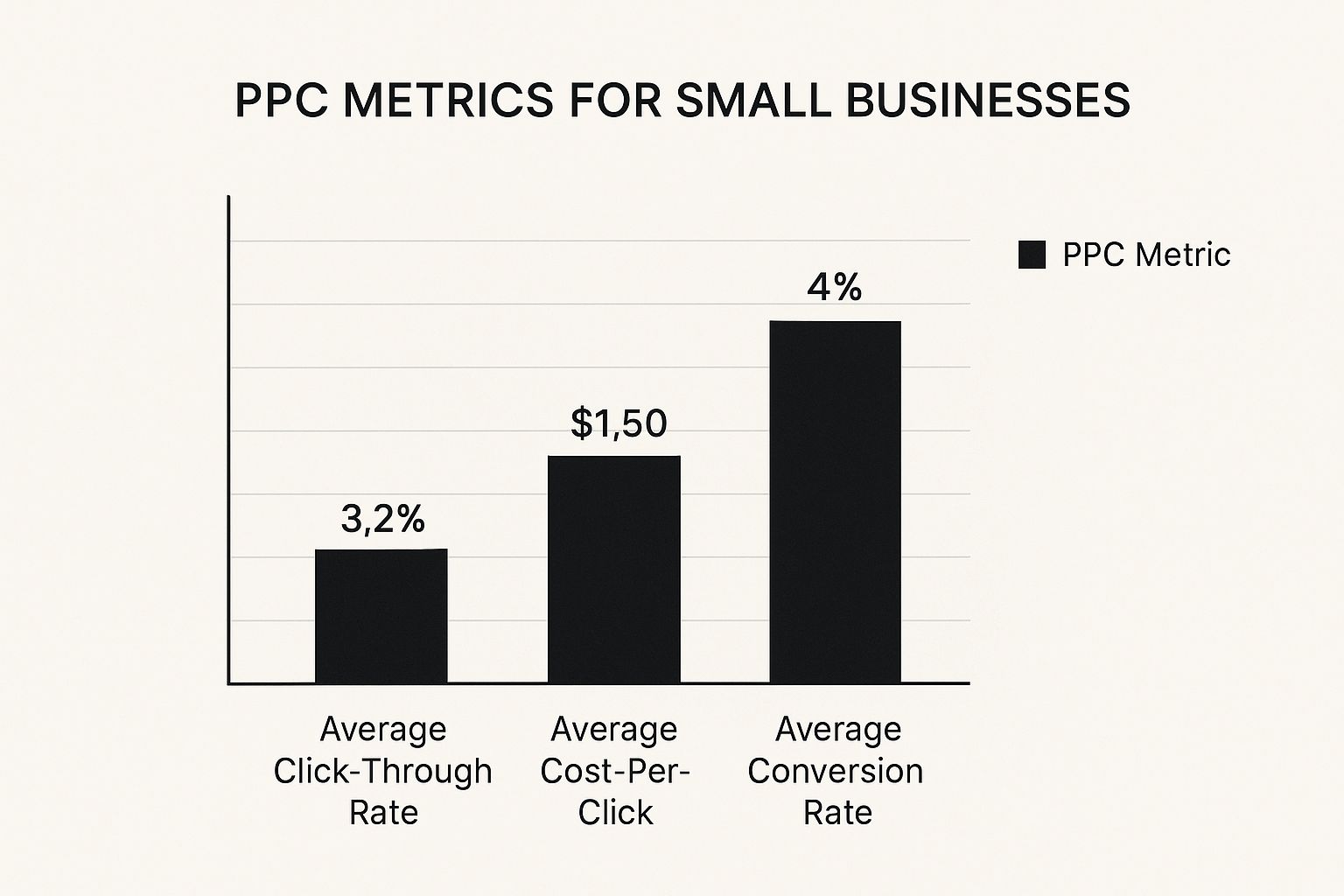
Achieving a solid conversion rate and a manageable cost-per-click like this requires a level of precision you just don't get from a templated, "one-size-fits-all" approach.
To illustrate the difference, let's break down what a small business owner typically experiences when working with each model.
Consultant vs. Agency: The Small Business PPC Breakdown
Factor | Large Agency Model | Expert Consultant Model |
|---|---|---|
Point of Contact | A junior account manager juggling 10-20+ clients. | The actual expert managing your account. |
Strategy | Templated, "one-size-fits-all" campaign structures. | 100% customized to your specific market and goals. |
Cost Structure | High overhead inflates your monthly retainer. | Lean and transparent. Your fee pays for expertise. |
Communication | Slow, filtered through multiple layers of staff. | Direct, fast, and proactive. |
Flexibility | Rigid processes and slow to adapt to market changes. | Nimble. Can pivot strategy in real-time. |
Attention | You are one of many. Your account gets limited focus. | You are a key partner. Your success is my success. |
Ultimately, the choice comes down to whether you want to be a small client in a big, impersonal system or a valued partner with a dedicated expert focused on your results.
Making a Modest Budget Work Harder
Success with a smaller budget is all about smart strategy and expert execution. You don't throw your entire budget at one big, unproven campaign. That's just gambling, and it's what agencies do when they're not paying close attention.
The right way to do it is to start small. This lets us gather real performance data and minimize risk while we figure out what works. Effective PPC for small businesses means getting hyper-specific with your keywords, focusing only on the high-intent phrases that signal someone is ready to buy.
This is where a dedicated consultant really shines. I dive deep to find the niche opportunities and long-tail keywords that the big competitors—and their big, lazy agencies—completely overlook. Your smaller budget actually becomes an advantage because it forces a level of precision that leads to higher profitability.
While a big agency is busy bidding on broad, expensive keywords, I find the profitable gaps in the market. To get a better sense of how this targeted approach works, you can learn more about the PPC advantage over SEO in our detailed guide.
Building a Profitable Foundation Before You Spend a Dime
Jumping straight into Google Ads without a plan is like trying to build a house without a blueprint. You can start nailing boards together, but you’ll end up with an expensive, unstable mess that eventually collapses. This is exactly where most PPC management for small businesses goes wrong, especially when agencies rush to launch campaigns just so they can start billing you.
Uncovering Opportunities Through Competitor Analysis
The first move isn't picking keywords; it's understanding the battlefield. A lot of large agencies will run a quick, superficial keyword report and call it a day. I go much deeper by completely reverse-engineering your competitors' strategies to find their weak spots.
What ad copy are they running? Which landing pages are they driving traffic to? What offers are actually converting for them? By digging into their every move, we can spot the gaps they've missed—the profitable keyword niches they don't know exist, the customer pain points they aren’t addressing, and the ad angles they aren’t using. This intel lets us enter the market with a message that immediately cuts through the noise.
For instance, a local HVAC company might see all its major competitors bidding on broad, expensive terms like "ac repair." My analysis would hunt for high-intent, less competitive phrases like "emergency AC repair near me" or "Trane furnace maintenance cost." These are the terms people use when they're much closer to making a decision.
Big agencies chase the obvious, expensive keywords. A dedicated consultant finds the hidden, profitable opportunities that give you an immediate edge, even with a smaller budget.
This strategic groundwork means we can sidestep a costly bidding war and start targeting customers your competition is completely ignoring.
Defining Your Ideal Customer Persona
So, who are you actually trying to reach? "Everyone" isn't an answer. A generic message is a weak message that connects with no one. Before I write a single line of ad copy, we need to build a laser-focused customer persona.
This goes way beyond basic demographics like age and location. It’s about getting inside their head to understand their motivations, their fears, and the exact language they use to talk about their problems.
What’s their primary pain point? (e.g., "My website isn't getting any leads.")
What is their dream outcome? (e.g., "I need a predictable way to get 10 new clients a month.")
What are their biggest objections or fears? (e.g., "I've been burned by marketing agencies before and wasted a ton of money.")
When we have these answers, we can craft ad copy and landing pages that speak directly to the person on the other side of the screen. They'll feel like you truly get them, and that connection is what drives conversions, not just clicks.
Setting Up Conversion Tracking That Matters
Here’s a critical mistake I see all the time from overworked agencies: businesses tracking clicks or website traffic as "conversions." These are vanity metrics. They might look good in a report, but they don't pay the bills. Effective PPC management for small businesses hinges on tracking actions that generate actual revenue.
For a service business, this means tracking:
Phone calls that come directly from your ads.
Form submissions for quotes or consultations.
Live chat conversations that are initiated.
For an e-commerce startup, we can get even smarter. Instead of just tracking total revenue, we can set up tracking to measure the actual profit margin on every single sale. This lets us make optimization decisions based on pure profitability, not just sales volume. An agency juggling 30 accounts at once rarely has the time or the incentive to implement this level of detailed, business-centric tracking.
By focusing on these three pillars—competitor intelligence, customer personas, and meaningful conversion tracking—we build a campaign that's designed for profit from day one. It's a methodical, strategic process that makes sure your investment is protected and positioned for the best possible return before you ever click "launch."
How to Structure Google Ads Campaigns for Maximum ROI
This is exactly where most big agencies, juggling dozens of accounts, completely drop the ball. They lean on lazy, overly broad campaign setups that look efficient on paper but are quietly torching your budget in the background.
As a hands-on consultant, my entire approach is built on meticulous structure because I know your money has to count. My methodology is all about clarity and control. We’re not just launching ads; we're building a scalable machine that predictably generates leads and sales. This strategic, hands-on structuring is at the heart of effective PPC management for small businesses.

Segmenting Campaigns by Service and Intent
First thing's first: we have to organize campaigns around your different services or product lines. This is especially critical when they attract customers with completely different problems and levels of urgency. A classic agency mistake is lumping everything into one campaign, which immediately destroys your ability to control budgets or write ads that speak to a specific need.
Let’s take a plumber with a $1,500 monthly budget. This is a very common scenario, as most small businesses spend between $1,000 to $10,000 a month, with over 80% of them relying on Google Ads as their primary channel.
My first move is to split their services into distinct campaigns based on customer intent.
Campaign 1: Emergency Repairs. This campaign will only target high-intent, "I need help now" keywords like "24-hour plumber near me" or "burst pipe repair." The ad copy is all about speed and immediate response.
Campaign 2: Bathroom Remodels. Here, we’re targeting people in the research phase with keywords like "bathroom renovation cost" or "modern shower installation." The ads for this campaign will focus on quality, design, and free consultations.
This simple split gives us instant control. We can push more budget to the high-margin emergency jobs when they come in or pull back on the remodel campaign during a slow season without messing up the entire account.
The Power of Granular Ad Groups
Inside each campaign, we get even more focused with ad groups. This is where the real magic happens, and it's how you achieve a high Quality Score—Google's rating of your ad's relevance. A better Quality Score directly translates to lower costs and higher ad placements.
I am a huge believer in hyper-themed ad groups. The core idea is simple: create an ad group so tightly focused that the keyword, the ad, and the landing page are all in perfect sync.
An agency will create one ad group called "Plumbing Services" and stuff 20 different keywords into it. As a consultant, I create separate ad groups for "drain cleaning," "water heater repair," and "leak detection," each with its own specific ads. That's the difference between shouting into a crowd and having a one-on-one conversation.
This granularity has a direct impact on your wallet. When someone searches for "clogged drain service" and your ad says "Expert Clogged Drain Service," they are far more likely to click than if they saw a generic "Local Plumber" ad. That click-through rate goes up, and your Quality Score follows.
Building an Aggressive Negative Keyword List
Finally, let's talk about the most underrated piece of a strong campaign structure: the negative keyword list. This is your shield against wasted ad spend, telling Google all the search terms you don’t want your ads to show for.
Agencies often use generic, pre-made lists. I build a custom one from scratch for every single client. For our plumber, this would be non-negotiable.
Example Negative Keywords for a Plumber:
DIY terms: "how to," "tutorial," "DIY," "video"
Job seekers: "jobs," "hiring," "careers," "salary"
Irrelevant services: "septic tank," "pool plumbing" (if they don't offer them)
Tire-kickers: "free," "cheap," "discount"
By proactively blocking these searches, we guarantee the budget only goes toward clicks from actual potential customers. This isn't a one-time setup; it’s a living part of the account that gets refined and smarter every single week.
To dive deeper into this topic, check out our guide on the top search engine marketing strategies to boost your ROI.
Crafting Ad Copy and Landing Pages That Actually Convert
Getting someone to click your ad is just the opening move. The real win comes when that click turns into a paying customer.
This is where the entire game can be won or lost, and it all comes down to two things: the ad copy they just read and the landing page they arrive on. This is precisely where focused, expert-led PPC management for small businesses proves its worth, moving beyond generic tactics to build a seamless path from click to conversion.
An overextended agency, juggling dozens of clients, almost always defaults to template-based ad copy. They write vague, uninspired headlines trying to appeal to everyone, which means they end up connecting with no one. My approach is the complete opposite. I write ad copy that works like a surgical tool—designed to attract your ideal customer and actively repel everyone else.

Writing Ad Copy That Speaks Directly to Pain Points
Think about it: your potential customer is searching because they have a problem they need to solve right now. Your ad needs to instantly signal that you get it—you understand their problem and you have the solution. This is about empathy, not just jamming in keywords.
Instead of a generic headline like "Local Roofing Services," we have to dig deeper. We use that customer persona we built earlier to craft copy that really hits a nerve.
Before (The Agency Approach):
Headline: Local Roofing Contractor
Description: We offer quality roofing services. Call today for a free estimate on your new roof or repair.
After (The Consultant's Approach):
Headline: Stop Leaks Fast | Emergency Roof Repair
Description: Storm damage? Don't wait. Get a guaranteed leak-proof repair in 24 hours. 5-star rated. Book your inspection online.
See the difference? The second version isn't just selling a service; it's selling a solution to an urgent, stressful problem. It uses action-oriented language, addresses a specific pain point (leaks), and builds immediate trust with a guarantee and social proof. An agency juggling 20 other clients simply doesn't have the time or specialized focus to get this granular.
The Anatomy of a High-Converting Landing Page
Once they click, the landing page has one job: fulfill the promise of the ad and make it incredibly easy for the visitor to take the next step. A high-converting landing page is a masterclass in focus, stripping away anything that doesn’t lead directly to a conversion.
Bloated agencies often just dump traffic onto a generic homepage, which is a total conversion killer. I build or advise on dedicated landing pages that must include these non-negotiable elements:
A Clear Value Proposition: A headline that immediately confirms the visitor is in the right place. It should perfectly mirror the ad's message.
Compelling Social Proof: This means customer testimonials, case studies, or trust logos. People want to see that others have successfully used your service.
A Frictionless Call-to-Action (CTA): A single, obvious button with clear instructions like "Get My Free Quote" or "Schedule My Consultation."
A common mistake is offering too many choices. When a landing page has navigation bars, social media links, and multiple offers, it creates decision paralysis. The best landing pages remove all exits except for the one you want the user to take: converting.
I once worked with an e-commerce client whose landing page button simply said "Submit." We changed the button's color to a more vibrant, contrasting orange and updated the text to "Get My 10% Off Now."
This tiny tweak, which took less than five minutes, resulted in a 22% increase in leads within the first month.
This is the kind of high-impact, granular optimization that gets lost in a large agency's workflow. It’s the direct result of a consultant being deeply invested in every single click and every single conversion. I don't just drive traffic; I build the entire path to profitability.
The Consultant's Approach to Ongoing Optimization
Launching a Google Ads campaign is just firing the starting pistol. The real work—the part that actually makes you money—starts after you go live.
This is where the difference between a hands-on expert and a passive, bloated agency becomes painfully obvious.
PPC management for small businesses isn't a "set it and forget it" channel. An agency might send you a glossy automated report once a month, but a dedicated consultant is in the trenches with your account every single day, treating your budget like it's their own.
This ongoing, active management is what transforms a decent campaign into a predictable, profit-generating machine.
Daily, Weekly, and Monthly Management Rhythms
So, what does "active management" actually look like? It’s a structured rhythm of tasks designed to incrementally improve performance day after day. An agency might glance at your account once a week; I live in it.
This is my process for making sure your investment is always working as hard as possible.
Daily Checks (5-15 minutes): This is all about proactive defense. I'm scanning for sudden performance dips, checking budget pacing to make sure we're on track, and looking for any red flags that could burn through your money before you've had your morning coffee.
Weekly Analysis (1-2 hours): This is where the strategic adjustments happen. I'm diving deep into search term reports to find waste, analyzing competitor moves in the auction insights, and reviewing ad performance to pause the losers and give more visibility to the winners.
Monthly Strategy Review (2-3 hours): Time to zoom out and look at the big picture. I'm analyzing broader trends, reallocating budget between campaigns based on pure profitability, and planning the next round of A/B tests for ad copy and landing pages.
This consistent, hands-on approach is something a junior account manager juggling 15 other clients simply cannot provide. They are incentivized by volume, not by the granular success of your specific account.
Interpreting Data to Drive Real Business Growth
The biggest trap in PPC is getting distracted by vanity metrics like clicks and impressions. A big agency report might proudly show a jump in clicks, but if those clicks didn't lead to a single sale or lead, who cares? It's just noise.
As a consultant, my focus is singular: turning your ad spend into tangible business results. When I look at your data, I'm not just reporting on it; I'm interpreting it to find opportunities.
An agency reports on what happened. A consultant analyzes why it happened and uses that insight to make your next dollar work even harder. This is the fundamental difference in mindset and value.
This means asking the right questions. For example, if a campaign's conversion rate suddenly drops, I don't just note it down. I investigate. Was it a change in competitor bidding? Did a new, irrelevant search term start triggering our ads? Is there an issue with the landing page on mobile devices? This investigative work prevents small problems from becoming budget-draining disasters.
This meticulous management is why PPC remains such a powerful tool. When managed correctly, research from Google shows businesses typically earn an average of $2 for every $1 spent, and some campaigns can achieve returns as high as 800%. Better yet, paid ads often convert around 50% better than organic traffic, proving their ability to attract high-intent customers. You can discover more about these compelling PPC statistics and see the data for yourself.
Strategic Budget Reallocation
One of the most powerful levers we can pull is strategically reallocating your budget. A passive agency will often let budgets run on autopilot, continuing to feed money into underperforming campaigns just because that’s how it was set up initially.
Frankly, that's a cardinal sin of PPC management.
My approach is fluid and completely data-driven. If the "Bathroom Remodels" campaign is generating leads at a cost per acquisition (CPA) of $150, but the "Emergency Repairs" campaign is bringing in leads for $50, we act on that information immediately.
We'll systematically shift budget away from the high-cost campaign and into the more profitable one to maximize your overall return. We don't wait for a quarterly review; we make these adjustments in real-time. Understanding these metrics is key, and you can learn more about cost per acquisition and how to lower it in our in-depth article.
This constant, dynamic optimization is the secret to scaling a small business budget effectively. It’s not about spending more; it’s about spending smarter. That’s the hands-on expertise you get with a consultant, not the automated oversight you get from an agency.
Your Small Business PPC Questions Answered
Let's cut through the noise. When small business owners ask me about PPC, the same few questions always come up. Forget the high-level theory for a minute—this is where the rubber meets the road.
Here are my straight-up answers, based on years in the trenches, to help you understand what really matters when you're thinking about Google Ads.
How Much Should A Small Business Budget For PPC?
There’s no magic number here, but a realistic starting point for most small businesses is somewhere between $1,000 and $2,500 per month in actual ad spend.
But the starting number isn't what's important. The real goal is to begin with a budget you can comfortably test, prove you're getting a positive return, and then scale up from a position of strength. My job as a consultant is to make every single one of those initial dollars count, squeezing out measurable results even from a modest budget.
Can I Just Run Google's Automated Campaigns Myself?
Look, I get the appeal. Google makes its automated campaigns look like a simple, push-button solution. But relying on them alone is one of the fastest ways to burn through your cash.
Think of automation as a powerful tool, not a complete strategy. These campaigns are notorious for wasting money on overly broad keywords and poor targeting because they lack critical human oversight. They’re built to get you to spend, not necessarily to get you profitable leads.
An experienced consultant uses automation strategically, but we bring the irreplaceable human element: nuanced strategy, ad copy that actually connects with people, and aggressive negative keyword management. That combination of machine efficiency and expert oversight is where you find the real ROI.
The core difference is this: a consultant works for your business goals. Google's automated systems are designed to work for Google's goal—which is to increase your ad spend.
How Long Does It Take To See Results From PPC?
You’ll start seeing raw data—clicks, impressions—almost immediately, within a day or two. But that's not what you're really after. Building a consistently profitable campaign is a process.
Realistically, it takes a full 60 to 90 days to gather enough meaningful performance data to truly optimize your account and see a stable, positive return on your investment.
Here’s how it usually breaks down:
Month 1: Launch and learn. This is all about gathering that crucial initial data.
Month 2: Refine and optimize. We take what we learned and start making smart adjustments.
By Month 3: You should have a clear, reliable picture of your campaign’s performance and ROI.
What Makes A Consultant Different From An Agency?
This is probably the most important question of all. For a small business, it really comes down to three things: direct access, specialized expertise, and no fluff.
With a consultant, you work directly with the expert who is actually managing your account. There are no junior account managers or layers of bureaucracy to go through. My overhead is low, so your money goes toward expert management and ad spend—not funding a sales team and a fancy office.
Most importantly, the strategy is built from scratch, specifically for your business. It’s not a recycled template from an agency playbook. It’s a true partnership designed for your growth, not a volume-based service where you're just another account number on a spreadsheet.
Ready to see what a dedicated, expert-led approach to PPC can do for your business? At Come Together Media LLC, I provide the one-on-one strategic guidance that big agencies can't. Let's build a profitable Google Ads campaign together. Schedule your free consultation today!


Comments