
A premium ecommerce account increased average order value from $1,995 to $3,753, added $6.65 million in revenue on $119,000 less ad spend, and moved platform-reported ROAS from 13x to 33x over three years, while average CPC fell 25%. That result didn't come from chasing the cheapest clicks. It came from treating Google Ads as a system for qualified demand, measurement, and profitable customer acquisition.
I'm Chase McGowan, a self-taught, independent Google Ads and paid media operator. I keep a deliberately small client roster because I want the person speaking with a client to be the person doing the work. If you're spending $10,000 to $100,000 or more per month, frustrated by agency layers, junior account managers, and AI-generated sameness, you don't need another generic optimization checklist. You need an account built around the economics of your offer.
Premium brands have long research cycles, expensive mistakes, and more complex definitions of success. A qualified call, booked procedure, profitable customer, or high-value repeat purchase matters more than a cheap click or an impressive platform-attributed ROAS number. A useful PPC playbook for 2026 should start there.
Table of Contents
- Why Premium Google Ads Is a Different Game
- Account Structure Built for High-AOV Brands
- Tracking First, The Technical Prerequisite for Bidding
- Audience, Creative, and Landing Pages That Protect Brand Equity
- Why Last-Click Misreads Prospecting on Premium Offers
- Brand Safety, Budgets, and the Next Step
Why Premium Google Ads Is a Different Game
Low CPCs are often a distraction for premium advertisers. A cheap visit from someone who will never qualify is still wasted spend, while a more expensive click from a buyer researching a high-value purchase can be economically sound.
The premium ecommerce result above makes the point. The account's CPC declined, but the more important changes were AOV, revenue, and ROAS. The account produced more value from fewer dollars because the campaign system was aligned with customer quality, not just traffic volume.
That distinction matters for a business owner paying real money for acquisition. Agencies often report rising click volume, improving CTR, and strong branded ROAS while leaving the harder questions unanswered:
- Are new customers entering the account, or is branded Search harvesting demand created elsewhere?
- Are leads becoming qualified opportunities, booked procedures, or closed revenue?
- Does bidding favor profitable products, or just products with the easiest conversion path?
- Is the account protecting the brand from poor auction positioning and irrelevant queries?
The premium funnel is slower
A high-consideration buyer may search, compare, return to product pages, speak with a sales team, and purchase later. Last-click reporting gives most of the visible credit to the final interaction, even when prospecting, nonbrand Search, Shopping, YouTube, or earlier site visits created the demand.
That doesn't mean every upper-funnel campaign deserves more budget. It means you need a measurement system capable of separating demand creation from demand capture before cutting campaigns that look weak under last-click attribution.
Brand equity adds another constraint. A premium advertiser can't evaluate every impression as if the only objective were conversion volume. Message quality, landing-page relevance, query control, placement quality, and the context around the ad affect how the market experiences the brand.
Operator rule: If your reporting celebrates low CPCs but can't distinguish a qualified customer from a form fill, the account isn't being run as a premium operation.
The practical alternative is tracking-first PPC. I build the account around verified business outcomes, then use structure, creative, bidding, and budget decisions to support those outcomes. For research-heavy categories, even adjacent operational details matter. Businesses that depend on phone conversations can use VoIP calling guides to understand call workflows without confusing call volume with qualified demand.
Account Structure Built for High-AOV Brands
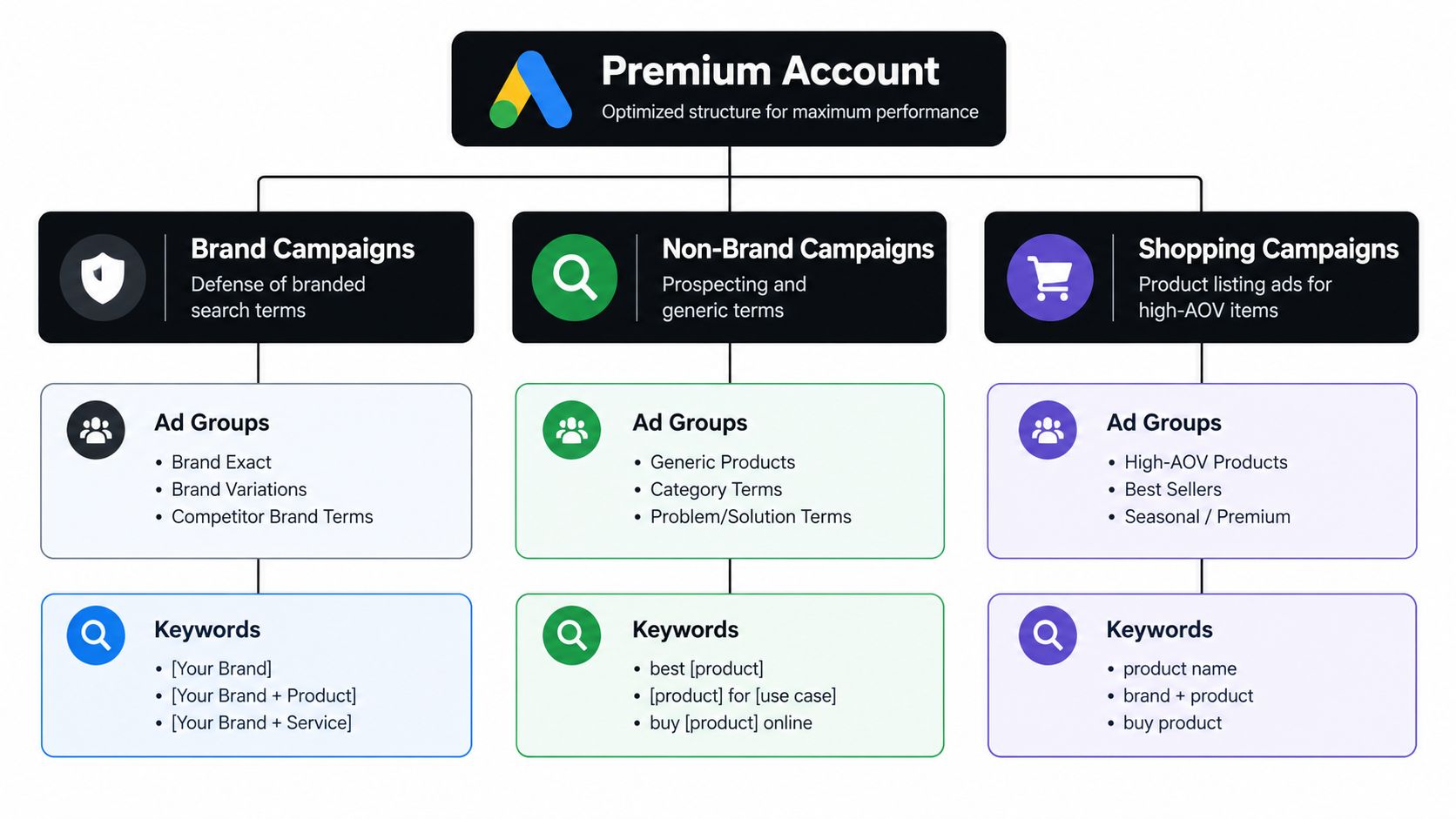
Premium accounts need clear campaign roles before they need more automation. Separate brand, nonbrand, and competitor intent, then assign budgets and bidding objectives based on the job each campaign must perform.
Brand Search protects branded demand and controls the message shown to people who already know the company. Nonbrand Search finds category and problem-aware demand. Competitor campaigns require their own risk tolerance because query context, landing-page quality, and lead quality differ from branded traffic.
Performance Max needs the same discipline. An asset group organizes images, logos, headlines, descriptions, videos, sitelinks, and audience signals around a meaningful theme or audience. It should not combine every product, promise, and landing page in one group and leave Google to sort out the commercial intent.
Build the skeleton before scaling
Use campaign role, not SKU count, as the primary organizing principle. A high-AOV catalog can contain many products, while the account still needs distinct paths for protecting existing demand, finding new demand, and presenting products to active shoppers.
| Campaign Type | Purpose | Recommended Bidding |
|---|---|---|
| Brand Search | Defend branded terms and control the brand message | Target CPA or value-based bidding after clean conversion data |
| Nonbrand Search | Capture category and problem-aware demand | Target CPA for stable lead actions, value-based bidding for revenue |
| Competitor Search | Test qualified demand around competing brands | Conservative budgets with separate conversion review |
| Shopping | Present high-AOV products to active shoppers | Target ROAS when purchase value is reliable |
| Performance Max | Expand across eligible Google inventory using themed assets | Target ROAS when value signals and landing pages are governed |
For high-AOV ecommerce, target ROAS, or tROAS, directs Google toward conversion value at a specified return. Use it only when purchase values are trustworthy and product economics are reasonably consistent. If margins, refunds, discounts, and product tiers vary materially, reported revenue is an incomplete signal. Import margin or another reliable value measure before allowing the system to prioritize the easiest revenue.
For lead generation, target CPA fits a consistent conversion such as a qualified consultation or booked procedure. It becomes misleading when every form submission counts equally despite different close rates. Set the primary conversion around qualified business outcomes, not the cheapest event to generate.
Broad match with Smart Bidding still requires negative keywords. It can find useful query variations, but premium accounts need regular query review, exclusions, and firm boundaries around irrelevant intent.
Treat URL expansion as governance
Google's Performance Max URL expansion can replace the final URL with another relevant page and generate a dynamic headline based on customer intent. That can support discovery on a tightly governed site. It can also send a high-value prospect to an editorial page, outdated offer, or collection page with weaker commercial intent.
Review eligible pages deliberately. Asset groups should lead to the conversion path you want, while webpage exclusions should block pages that should not receive paid traffic. Governance must be repeatable, with scheduled checks for new pages, changed offers, and landing-page quality.
For a closer look at how I manage Google Ads accounts, apply one operating standard: every campaign needs a job, every job needs an appropriate signal, and every signal must connect to business value.
Tracking First, The Technical Prerequisite for Bidding
Premium Google Ads accounts should be built around qualified outcomes before bidding automation is given control. If Google Ads receives duplicate purchases, weak leads, missing values, or incomplete offline outcomes, Smart Bidding can optimize confidently toward the wrong result.
Use this implementation order:
- Audit the measurement foundation. Check the Google tag, GA4, Google Tag Manager, consent behavior, transaction IDs, currency, and deduplication. A purchase that fires twice is not a minor reporting issue. It changes the data used for bidding.
- Enable Enhanced Conversions. Google describes Enhanced Conversions as a way to supplement existing tags with hashed first-party customer information, using SHA-256 hashing before transmission. Confirm that identifiers are collected with the required consent and that the setup meets the business's privacy obligations.
- Capture downstream identifiers. For calls, CRM records, and booked appointments, preserve the identifiers that connect the ad interaction with the eventual outcome.
- Import qualified outcomes. Send qualified leads, closed revenue, completed procedures, or other verified events back into Google Ads where the category and consent framework allow it.
- Change bidding only after validation. The primary conversion column should contain events that represent the value you want more of.
For ecommerce, reconcile purchase value with the backend, including refunds, discounts, tax, and currency treatment. For healthcare and B2B, a form submission may only begin the sales process. If only part of those submissions becomes profitable business, bidding toward every form trains the system for volume rather than economics.
Run this check today
Open Google Ads and compare reported purchases with the backend for a selected date range. Match records by date, transaction ID, and value. Look for duplicate IDs, missing transactions, unexplained value gaps, and purchases appearing in Ads that do not exist in the backend.
Fix reconciliation problems before changing tROAS, expanding match types, or raising budgets. This check often exposes the account problem faster than another round of campaign adjustments.
Google supports offline conversion imports for real-world outcomes such as qualified phone leads and in-office payments. Enhanced Conversions for Leads can use first-party information such as an email address or phone number to improve measurement, while call-conversion imports can connect sales calls to ads and keywords. The important distinction is between a click or form and the outcome that generates revenue.
Compliance limits the available options. Google's policy documentation addresses the collection and use of first-party data, disclosure and consent where legally required, and restrictions on enhanced conversions or store-sales uploads for conversions connected to sensitive categories. More data is not automatically better. A smaller, compliant dataset with clear definitions can outperform a larger dataset filled with weak microconversions.
Use Google Ads audit checklists to review these controls before scaling spend.
Audience, Creative, and Landing Pages That Protect Brand Equity
Premium performance leaks in three places: weak audience signals, generic creative, and a post-click experience that feels cheaper than the ad.
Audience signals can help Performance Max understand customer themes, but they aren't a substitute for strong conversion data. Customer Match, remarketing audiences, and relevant search intent can support discovery, yet I don't treat any audience list as a silver bullet. The account still needs a clear distinction between existing demand, active research, and new prospecting.
Research cycles change creative evaluation
A buyer may encounter a premium brand several times before acting. That makes early interactions easy to undervalue under last-click reporting. I evaluate prospecting with assisted conversions, qualified downstream outcomes, and incrementality where the account has enough volume and operational maturity to run a proper test.
Creative should be restrained and specific. A premium brand doesn't need a pile of interchangeable headlines. It needs assets that answer the buyer's current concern:
- Research stage: Explain materials, process, fit, clinical expertise, warranty, or other meaningful differentiation.
- Comparison stage: Resolve objections around quality, service, price, financing, delivery, or proof.
- Decision stage: Make the next step obvious without manufacturing urgency the offer can't support.
Performance Max asset groups should reflect these real themes. A product collection, a consultation offer, and an educational promise shouldn't share one message just because they live under the same domain.
Landing pages control the handoff
URL expansion makes landing-page governance part of campaign management. Product detail pages, collections, editorial content, and service pages send different intent signals. A page can be relevant to a keyword and still be wrong for the conversion path.
For high-consideration offers, the page must answer the questions that justify the purchase or appointment. It should also load cleanly, make the next step easy, and collect enough information to qualify without creating unnecessary friction. A premium experience doesn't mean hiding the action. It means making the action feel credible.
Seasonality needs the same judgment. Turn spend up when demand, inventory, staffing, and landing-page readiness support it. Reduce or pause campaigns when the business can't fulfill the promise or when the available audience is unlikely to produce profitable outcomes. Seasonal activation is not a calendar reminder. It is a decision about whether the entire conversion path is ready.
Why Last-Click Misreads Prospecting on Premium Offers
Platform-attributed ROAS is useful for reporting what Google Ads claimed credit for. It is not a complete answer to whether a campaign created incremental business.
Branded Search and remarketing often show the strongest attributed ROAS because they meet people close to a decision. Cutting nonbrand Search, Shopping, or Performance Max solely because those campaigns report lower ROAS can remove the activity that created the demand captured by branded campaigns later.
The right question is causal: what happened because the campaign ran that wouldn't have happened otherwise?
Test before reallocating
Google's Conversion Lift methodology compares people exposed to ads with a control group that isn't exposed. That controlled comparison can estimate incremental lift instead of relying only on attribution. Google also supports user-based and geography-based experiments, which can be useful when demand is geographically concentrated or user-level volume isn't sufficient.
Track the metrics that explain actual business impact:
- Incremental conversions: The additional outcomes caused by treatment.
- Incremental conversion value: The additional revenue or assigned value caused by treatment.
- Incremental cost per action: The cost of producing those additional outcomes.
- Incremental ROAS: The return from incremental value, not reported value alone.
- Incremental contribution margin: Value after product cost, fulfillment, discounts, and lead-to-sale rates.
The chart's example labels are illustrative, not a benchmark. Don't substitute a generic blended figure for your own test. A premium brand should judge the account against its own economics, customer quality, and payback period.
| Last-Click View | Incrementality View |
|---|---|
| Credits the final interaction | Compares treatment with a control |
| Favors branded Search and remarketing | Reveals whether exposure created additional outcomes |
| Measures reported conversion value | Measures incremental conversion value |
| Can reward demand harvesting | Supports budget decisions based on causal contribution |
| Often ignores offline quality | Can include verified offline outcomes when compliant |
The same principle applies outside ecommerce. For one ophthalmology practice, platform-reported results showed conversion rate moving from under 1% to 17% or more, cost per conversion falling 89%, from approximately $400 to approximately $44, and 190 additional patient calls per month. For an immigration medical exam clinic, platform-reported results over two years at approximately $13,000 per month showed cost per booked exam rising only 10% while market CPCs rose 54%, with conversion rate increasing from 11.5% to 15.9%.
Those examples are valuable because they focus on qualified outcomes, not because they prove that every account will produce the same result. Before changing a premium account's budget allocation, I want the business outcome defined, the signal validated, and the experiment designed around that outcome. A 30-day Google Ads Sprint is built around that kind of tracking and account work.
Brand Safety, Budgets, and the Next Step
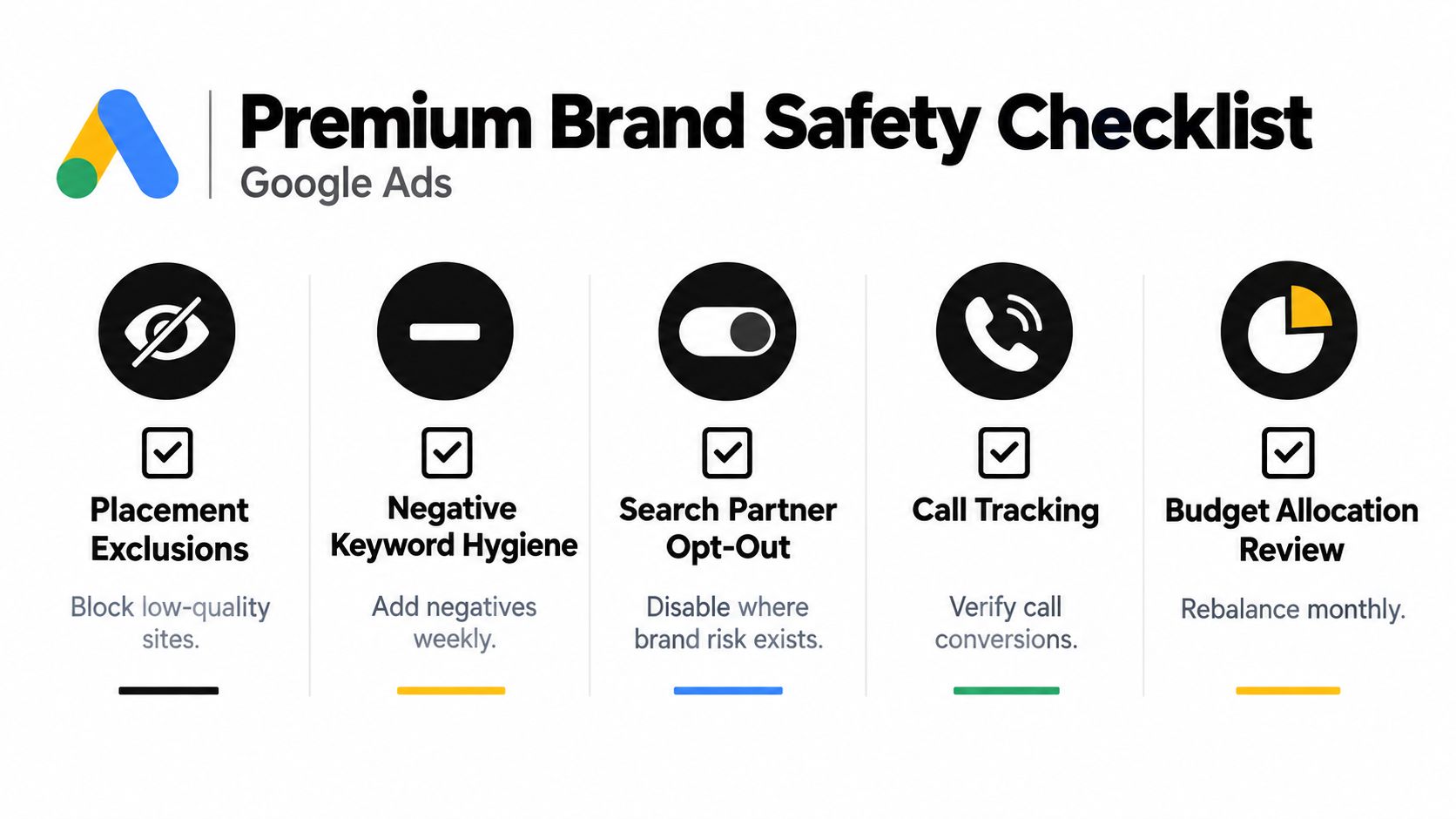
Premium brand management requires recurring QA, not a one-time account cleanup. I review placement exclusions, negative keyword hygiene, search-partner settings, call quality, and weekly spend pacing against qualified outcomes rather than raw clicks.
Use this operating checklist
- Placement exclusions: Remove low-quality or unsuitable inventory where the campaign's reach creates brand risk.
- Negative keyword hygiene: Review search terms regularly and add exclusions that protect budget and intent.
- Search partner settings: Opt out where the inventory or reporting doesn't meet the brand's tolerance.
- Call tracking: Listen to call quality and verify that reported calls represent real opportunities.
- Budget allocation: Rebalance around qualified outcomes, contribution margin, and tested incrementality.
Sensitive categories require additional restraint. Only signals that the business can legally and reliably send back to Google should influence bidding. A contaminated conversion dataset is worse than a smaller compliant one because it gives automation confidence in the wrong objective.
I run Come Together Media LLC as an independent consultancy, not an agency with account managers between you and the operator. The roster stays small by design, with a maximum of two to three new clients per quarter. My ongoing management minimum is $3,500 per month, and I also offer a $350 Office Hours session if you want to book an account review before making a larger commitment.
The main engagement is a $7,500 30-day Google Ads Sprint. Hire me for 30 days before you hire me forever. I fix the tracking first, then rebuild and optimize the account around qualified outcomes, brand protection, and the economics of your offer.
Come Together Media LLC provides tracking-first Google Ads management for premium ecommerce, healthcare, local, and lead-generation accounts where qualified outcomes matter more than cheap clicks. Visit Come Together Media LLC to start with the 30-day Sprint, review Office Hours, or preview the audit checklists.