


Most advice about hiring a freelance Google Ads expert starts with campaign structure, bid strategy, or a polished list of certifications. That's backwards. If Google Ads isn't receiving reliable information about qualified leads, booked appointments, calls, or sales, campaign management becomes organized guessing.
I'm Chase McGowan, a self-taught independent Google Ads and paid media operator. I work directly in accounts, keep a deliberately small roster, and don't put account managers or junior buyers between clients and the person making decisions. For businesses spending real money, the hiring question isn't “freelancer or agency?” It's who can connect ad clicks to actual business outcomes, then act on that evidence?
Table of Contents
- Why a Senior Freelance Operator Beats an Agency Team
- Define Your Goals Budget and What Success Looks Like
- Freelancer Consultant or Agency Which Model Fits Your Spend
- How to Vet Interview and Test a Freelance Google Ads Expert
- Onboarding Contracts and KPI Reporting That Keeps Performance Honest
- Making the Hire and Starting With a 30 Day Sprint
Why a Senior Freelance Operator Beats an Agency Team
An agency's larger headcount doesn't automatically create better execution. It often creates more handoffs. A strategist sells the engagement, an account manager runs communication, a junior specialist makes changes, and someone else assembles the report. The business owner still pays for senior judgment, but may rarely receive it directly.
I built my practice around the opposite model. The person clients speak with is the person working in Google Ads. My roster stays capped at two to three new clients per quarter maximum, because a small client list leaves nowhere to hide when tracking breaks, lead quality falls, or performance changes without an obvious explanation.

Senior execution starts before the bid change
The first question I ask inside an account isn't whether a campaign should use tROAS, or target return on ad spend, or tCPA, target cost per acquisition. I ask whether the conversions being used for optimization represent something valuable.
That means checking auto-tagging, preserving click identifiers, validating the relationship between Google Ads and GA4, and understanding whether the CRM stores the information needed to identify what happened after a form submission. For lead-generation businesses, a form fill may be only an early signal. The meaningful outcome could be a qualified lead, a booked appointment, a completed consultation, or a revenue event.
Google's offline conversion guidance describes this workflow directly. Advertisers need to preserve click IDs, store them with lead information, create offline conversion actions, and import those outcomes back into Google Ads. The platform also provides batching guidance and job-level diagnostics for troubleshooting offline conversion uploads.
An agency can do this well. So can a freelancer. The difference isn't the label. It's whether the person responsible has the authority, technical ability, and time to inspect the measurement layer before changing the campaign layer.
Practical rule: If a candidate starts with a bid recommendation before asking how your conversions are defined, keep interviewing.
Why direct access changes accountability
Direct access reduces interpretation loss. I can hear how a sales team describes a good lead, compare that language with search terms and landing pages, then decide whether the account should optimize toward volume, quality, or a later-stage event. There's no account-manager relay turning a specific business problem into a generic request for “better performance.”
You can see the working model in how I manage Google Ads accounts. It's not a promise that every account will improve on the same schedule. It's a commitment that decisions are made from the account's economics and measurement, not from a templated checklist.
Google Ads itself has changed substantially since AdWords launched on October 23, 2000, with 350 advertisers and a CPM-based buying model. By 2002, Google had shifted to a cost-per-click auction with quality-weighted ranking, a change that made performance advertising more measurable and scalable for specialists reviewing Google Ads history. The system is mature, automated, and complicated enough that senior judgment matters more than a long menu of services.
Define Your Goals Budget and What Success Looks Like
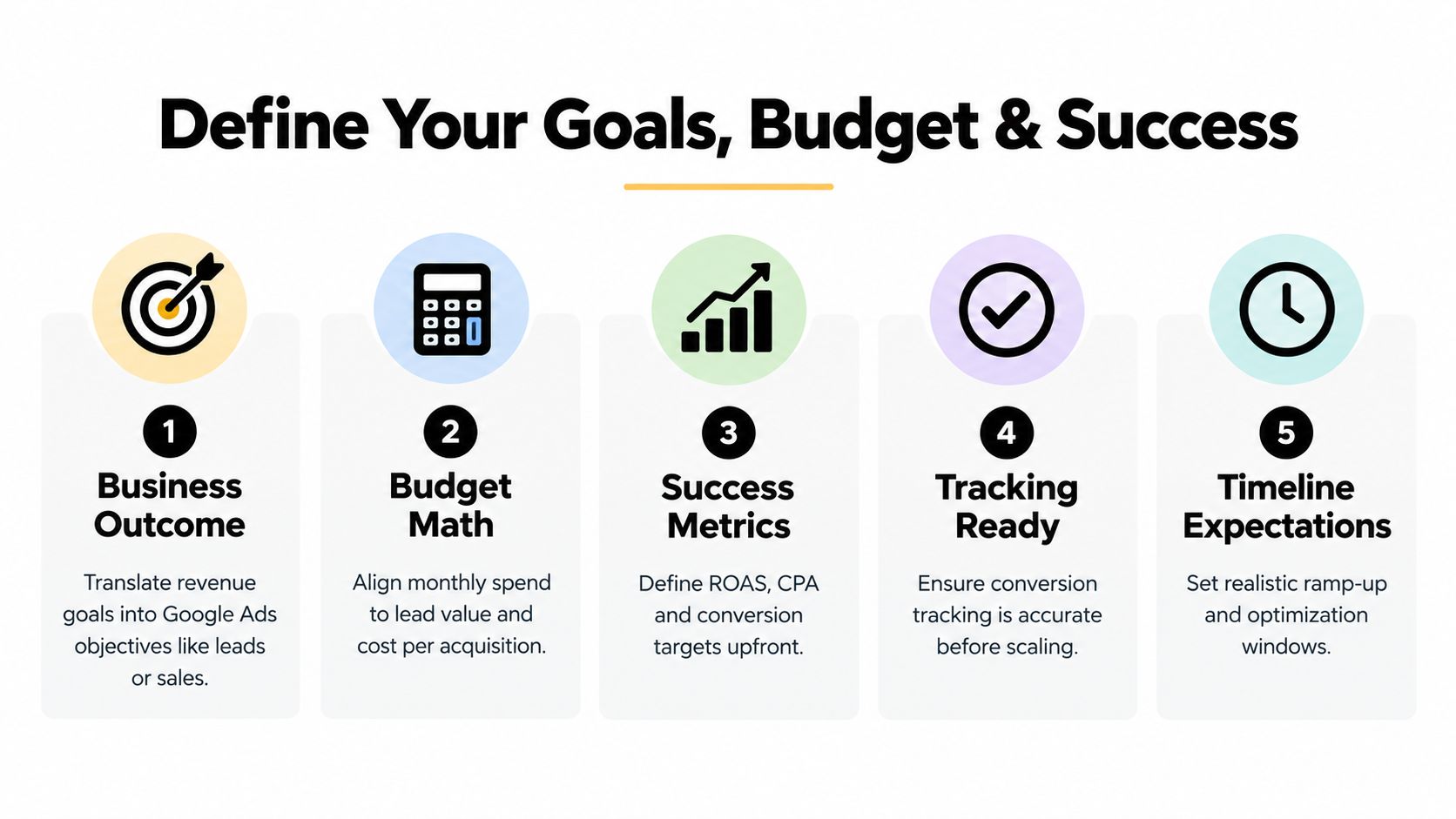
Before contacting a freelancer, write down what the business needs Google Ads to produce. “More conversions” is too vague. A local clinic may need qualified calls and booked appointments. An ecommerce company may care about profitable revenue and contribution margin. A B2B company may need sales-accepted opportunities rather than inexpensive form submissions.
The candidate should be able to work within that definition. They shouldn't replace it with click-through rate because clicks are easier to report.
Start with the outcome
Write a one-page brief containing:
- Primary business outcome: State whether you need sales, qualified leads, booked appointments, calls, or another concrete result.
- Economic boundary: Explain what an acceptable acquisition cost or return means to the business. If you use ROAS, define whether it's based on revenue or profit.
- Current account state: List active campaigns, conversion actions, bidding strategies, landing pages, and known tracking concerns.
- Decision authority: Identify who can approve changes to offers, pages, creative, CRM fields, and budgets.
- Hiring constraints: State whether you need hands-on management, strategic oversight, a technical tracking project, or a combination.
This brief prevents candidates from submitting interchangeable proposals. It also exposes weak thinking. A generic operator will answer with a package of campaign builds and reports. A senior operator will ask what a conversion means, where the value is recorded, and how quickly that information can return to Google Ads.
Benchmark the right comparison
Generic benchmarks can provide orientation, but they shouldn't become your target. Independent 2026 Google Ads benchmarks report an all-industry average of 6.64% click-through rate, $5.42 CPC, 8.18% conversion rate, and $66.69 cost per lead in the published benchmark data. The same source reports health and medical at a 3.36% conversion rate and $78.09 average CPA, which illustrates why vertical context matters.
Those figures don't tell you whether your account is healthy. A high-intent medical service, a long-cycle B2B offer, and a premium ecommerce product have different conversion paths. Ask candidates how they'll separate traffic quality from tracking quality, and how they'll establish a useful baseline without pretending that an industry average is a business forecast.
Take one audit step today
Open Google Ads and inspect every conversion action used in the account. Check the category, primary or secondary status, counting method, value settings, source, and recent activity. Then compare those actions with the events and conversions you see in GA4.
Look for obvious contradictions. If Google Ads is optimizing toward page views, duplicate thank-you events, unqualified form fills, or calls that never connect to a real conversation, record that before speaking with anyone. The Fre Vault Preview contains a free preview of vault audit checklists, which can help turn that inspection into a repeatable review.
Freelancer Consultant or Agency Which Model Fits Your Spend
The words freelancer, consultant, and agency describe different operating models, but the labels don't tell you who will touch the account. A solo specialist may provide deep execution. A consultant may focus on diagnosis and direction while your team implements changes. An agency may provide broader coverage, but often with multiple roles and layers.
The right choice depends on your need for hands-on work, internal capacity, technical measurement, and decision speed. A business spending heavily on ads can still be poorly served by an agency if the account needs one senior person to make connected decisions across tracking, offers, campaigns, and sales feedback.
| Model | Who Does Work | Access and Speed | Measurement Depth |
|---|---|---|---|
| Independent freelancer | One operator handles the agreed scope | Direct access, fast decisions, limited capacity by design | Can be deep when the specialist owns tracking and optimization |
| Independent consultant | Consultant diagnoses and advises, internal staff may implement | Strategic access, execution depends on the client team | Strong diagnosis, but implementation quality depends on internal resources |
| Agency | Work is distributed across strategists, managers, and specialists | Broader coverage, more handoffs and approval layers | Potentially broad, but depth depends on who is assigned and what scope includes |
The cost is more than the fee
Public marketplace listings show a wide pricing spread. U.S. salary data cited in the marketplace context places one hourly reference at about $47.71, while specialist marketplace rates commonly range from $60 to $225+ in the Upwork hiring overview. Those figures are not a quality guarantee. They show why buyers need to compare the work included, not just the hourly number.
A low-cost freelancer can be appropriate for a bounded task with clear instructions and clean measurement. That model becomes risky when the account needs conversion architecture, CRM integration, call tracking, offline imports, landing-page feedback, and ongoing decisions about qualified outcomes.
An agency can make sense when you need several disciplines operating at once, broad coverage across channels, or a team available for work outside paid search. It makes less sense when you're paying for senior thinking but receiving a junior contact who escalates every material decision.
For a more detailed view of PPC help for five-figure ad spend, compare the actual operator, scope, access, and accountability rather than the category printed on the proposal.
How to Vet Interview and Test a Freelance Google Ads Expert
A strong interview doesn't ask a candidate to predict your results. It asks them to show how they think when the data is incomplete, the tracking is messy, and the account contains competing signals.
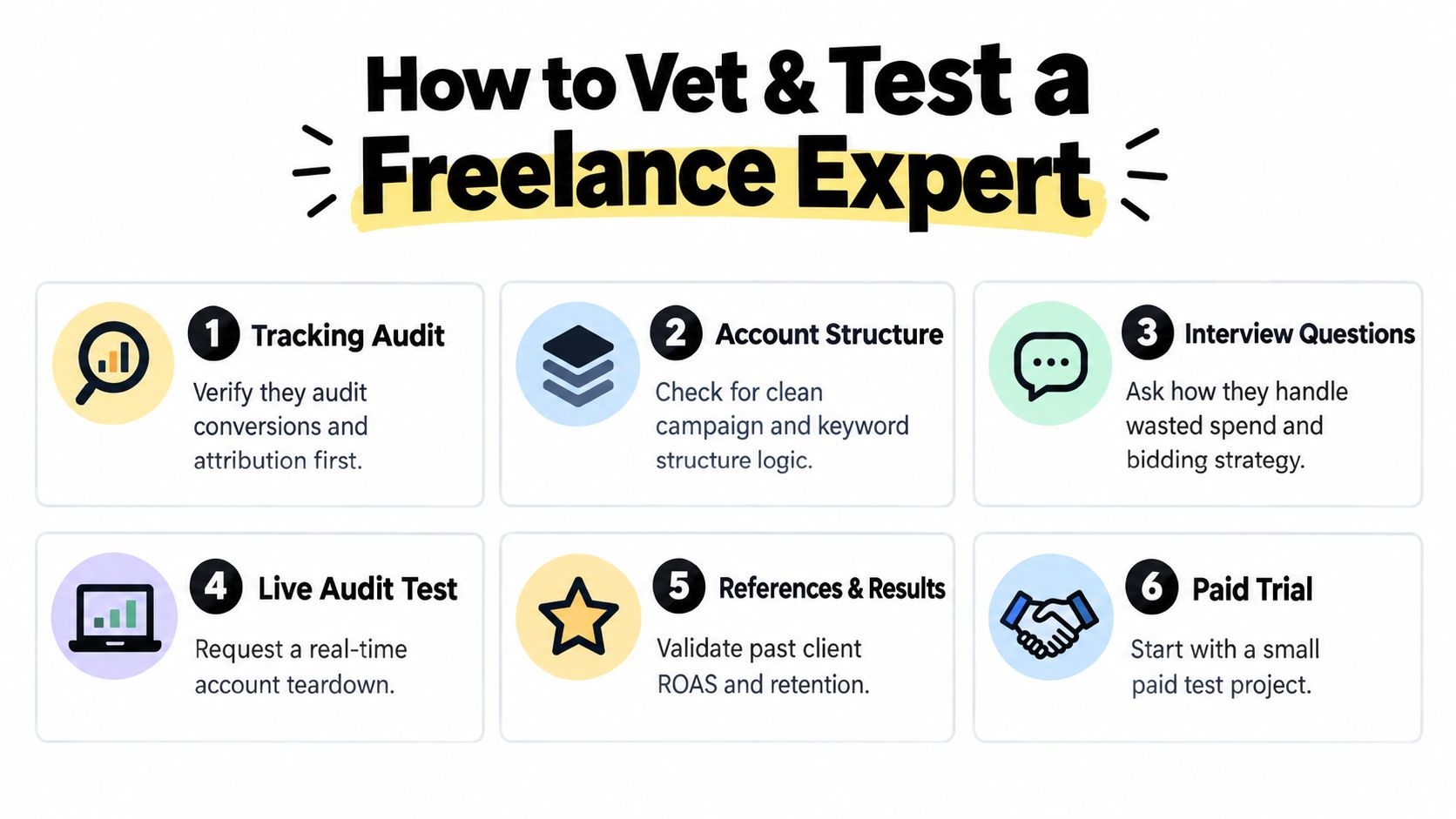
I use a tracking-first evaluation because campaign polish can hide measurement failure. Start by asking the candidate to explain what they'd inspect before making major changes. Then test whether they can turn that explanation into specific checks.
Ask questions that expose operating depth
Use questions such as:
- Which conversion actions should influence bidding, and why? A capable answer should distinguish primary actions used for optimization from secondary actions used for observation.
- How will you preserve and store the GCLID? Google's setup instructions require lead pages to pass the GCLID, or Google Click Identifier, and the lead-management system to store it with the prospect's information in the offline conversion setup guidance.
- How would you verify offline conversion import health? Look for discussion of upload status, diagnostics, conversion-action summaries, matched records, rejected records, and the relationship between CRM outcomes and Google Ads reporting.
- How do you measure calls? Google Ads can count calls that meet a specified duration as conversions, and it also supports importing call conversions from another system through its call conversion measurement options.
- When would you avoid changing the bidding strategy? A senior operator should understand that unstable or incomplete conversion data can make automation less useful, and that repeated resets can obscure what caused a change.
- How do you inspect Performance Max search themes? Search themes are added at the asset-group level, and Google allows up to 50 unique search themes in a campaign according to Google's search-theme documentation. A good answer should also recognize that overlapping terms can reach the same audience, so adding variants isn't automatically adding useful coverage.
Use a paid trial, not a theatrical audit
Give the candidate a limited paid task using a controlled account view or a defined audit package. Ask for a short written diagnosis containing:
- The first measurement risk they found.
- The conversion actions they would include or exclude from bidding.
- The evidence needed before restructuring campaigns.
- One wasted-spend hypothesis and how they'd test it.
- The business data they need from sales or the CRM.
- The changes they would not make yet.
The task should test reasoning, not invite unauthorized edits. Don't hand over broad access and ask someone to “fix what they see.” You're evaluating judgment, communication, and sequencing.
Red flag: A candidate guarantees a ROAS, CPA, or revenue outcome before seeing your tracking, economics, landing pages, and account history.
Verify proof without accepting theater
Ask for documented examples that match your business model. Platform-reported results can be useful when the operator clearly explains the starting conditions, the period, the spend context, and what the platform counted. Be wary of screenshots with cropped dates, unattributed improvements, or case studies that never explain the conversion definition.
The person should also state who will work in the account, how many active clients they carry, how often they review performance, and what happens if tracking fails. If the answers stay at the level of “AI optimization,” “full-funnel growth,” or “advanced targeting,” you still don't know what they'll do on Monday morning.
For a practical reference point, the audit checklists I use are built around account review and management checks rather than presentation language.
Onboarding Contracts and KPI Reporting That Keeps Performance Honest
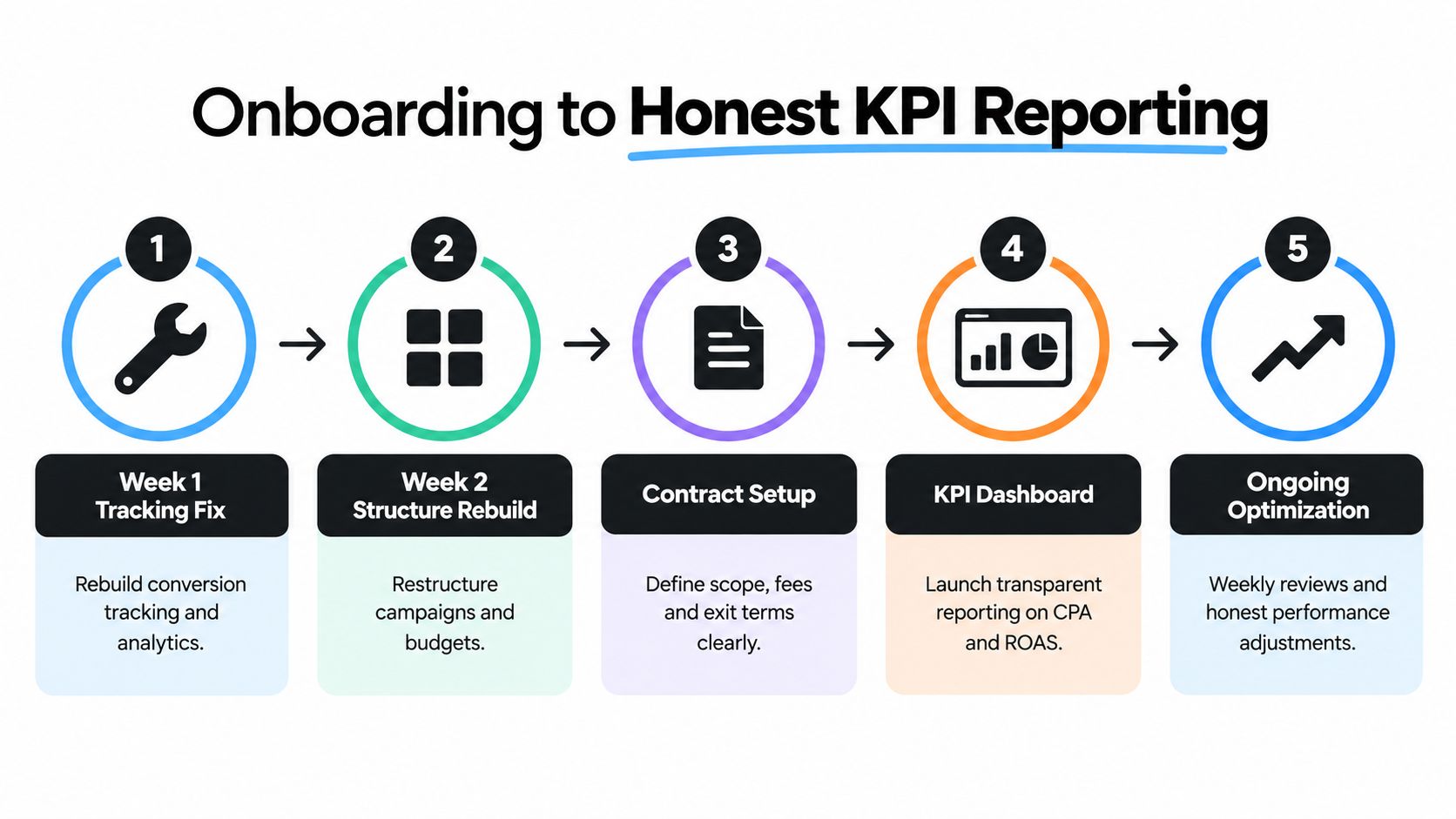
The first month should produce clarity, not a flood of unexplained changes. I structure onboarding around measurement, account understanding, and an agreed operating rhythm. Campaign edits matter, but they're downstream from knowing whether Google Ads is receiving the signals it needs.
A useful contract makes ownership and responsibility explicit. It should identify who owns the Google Ads account, GA4 property, conversion data, creative assets, landing pages, and CRM information. It should define the scope of management, communication channels, approval requirements, reporting cadence, and exit terms.
Build the first month around evidence
During the opening phase, I want to establish:
- Measurement integrity: Confirm auto-tagging, click-ID handling, GA4 event definitions, enhanced conversions, consent mode, call conversion rules, and offline conversion actions where relevant.
- Import reliability: Check whether CRM-qualified outcomes are arriving in Google Ads, whether records are accepted or rejected, and whether diagnostics identify missing or malformed data.
- Account logic: Review campaign goals, location settings, search terms, match types, budgets, asset groups, feeds, exclusions, and landing-page alignment.
- Business context: Learn which leads become revenue, which products carry margin, which calls matter, and which outcomes sales rejects.
- Change control: Record what changed, why it changed, and what evidence will determine whether the change stays.
Timing matters. Google says offline conversions uploaded more than 90 days after the associated last click won't be imported, while enhanced conversion leads uploaded more than 63 days after that last click also won't be imported in its conversion import requirements. A contractor who tells you to “send the CRM data later” may be creating an attribution problem that can't be repaired inside Google Ads.
Report the business signal, not just the interface
A useful report connects spend with outcomes the business recognizes. For ecommerce, that may include revenue, product-level performance, and return by campaign type. For lead generation, it should distinguish inquiries from qualified leads, booked appointments, connected calls, and later-stage outcomes when those can be imported.
GA4 can provide behavioral context, while Google Ads remains the place to inspect campaign delivery, bidding, search terms, conversion actions, and import diagnostics. The systems don't need to tell the same story in every column, but the differences should be explainable.
A report that celebrates clicks while ignoring rejected offline conversions is not transparent. Nor is a report that shows a favorable tROAS while branded demand, repeat customers, or conversion values remain undefined.
If you want a focused second opinion before committing to ongoing management, an Office Hours account review can be used to inspect the account and identify the most consequential questions.
Making the Hire and Starting With a 30 Day Sprint
The right hire is the operator who can explain the chain from click to commercial outcome, then show where that chain is weak in your account. You don't need the largest team if the work requires focused senior judgment. You need clear ownership, direct communication, and enough technical competence to ensure Google's automation learns from meaningful outcomes.
That's how I work at Come Together Media LLC. I'm the operator in the account, not a salesperson handing execution to someone else. I keep the roster intentionally small, and I use a defined engagement when a business wants to evaluate the method before making a longer commitment.
Use a bounded engagement to test fit
My $7,500 30-day Google Ads Sprint is designed as “hire me for 30 days before you hire me forever.” The work begins with tracking, including GA4, Google Tag Manager, call tracking, and server-side tagging where appropriate, then moves into account structure, campaign decisions, and optimization.
Ongoing management starts at $3,500 per month, month to month. For a narrower need, I offer a $350 Office Hours session for a focused account review. Those options let a buyer match the engagement to the problem instead of signing an open-ended agreement before either side understands the account.
Before contacting anyone, run one final check: open your conversion actions and identify which events Google Ads is currently allowed to use for bidding. Write down the business outcome each action represents. If you can't explain that mapping, make tracking the first hiring requirement.
The 30-day Google Ads Sprint is the right next step when you're spending enough that measurement errors are expensive, your agency relationship has too many layers, or you want senior execution before choosing ongoing management.
Come Together Media LLC offers tracking-first Google Ads management through direct access to Chase McGowan, with a capped roster and no account-manager layer. If your campaigns need qualified leads, booked appointments, calls, or revenue rather than surface-level reporting, visit Come Together Media LLC to choose the engagement that fits your account.
