Search Engine Marketing Basics: A Proven Guide to Profitable Growth
- Feb 1
- 13 min read
Picture this: you get to set up shop on the busiest street in the world, right at the exact moment a customer walks by looking for precisely what you sell. That’s the magic of Search Engine Marketing (SEM). It’s one of the most direct and powerful ways to connect with high-intent customers and drive real growth for your business.
What Is Search Engine Marketing and Why It Matters
Search Engine Marketing is simply the practice of using paid ads and organic optimization to get your website seen on search engine results pages (SERPs). Think of it as having two main tools in your belt:
Paid Search (PPC): This is where you pay for ads to show up for specific keywords. It delivers immediate visibility and gives you pinpoint control, making it perfect for generating leads and sales fast.
Search Engine Optimization (SEO): This is the long game. It’s the process of earning free, organic rankings by creating genuinely valuable content and building up your site’s authority over time.
While both are critical for a healthy strategy, this guide is focused on the immediate impact you can get from paid search.
The problem? So many business owners get burned their first time around. They sign a big contract with a bloated agency, only to see their budget wasted and their account handed off to a junior employee. Their questions are met with generic reports, and the strategy feels cookie-cutter and impersonal. It’s a story I hear constantly.
A Smarter Way to Approach SEM
Here's the truth: you don't need a massive, expensive agency to win at this game. In fact, a specialized, expert consultant offers a distinct advantage.
Instead of paying for an agency’s fancy office and layers of management, you invest directly in the expertise of a single, dedicated specialist whose only job is to make your business more profitable. This lean, agile approach cuts through the bureaucracy, allowing for faster optimizations and a strategy built entirely around your business goals, not an agency's revenue targets.
The sheer scale of opportunity in search is just staggering. Google still completely dominates the digital stage, processing an incredible 8.5 billion searches every single day. That works out to roughly 99,000 chances every second to connect with a potential customer. It’s a massive pie, and expert, specialized management is what lets you claim your slice.
To really get a handle on the SEM landscape, you need to understand related concepts like What Is SERP Tracking and How It Shapes Your SEO Strategy. Understanding all the moving parts is the first step toward building a campaign that doesn't just spend your money, but actively generates a profit.
You can dig deeper into how the paid side works by reading our guide on what search advertising is and how it works.
The Four Pillars of a Winning SEM Campaign
A successful paid search campaign isn't magic. It's a machine, and it's carefully built from four critical, interconnected parts. Get one wrong, and the whole thing sputters.
Too often, bloated agencies treat these components like a simple checklist, just going through the motions with junior staff. This is where a specialist’s focused, hands-on expertise creates a massive advantage—turning ad spend into predictable, scalable profit. Understanding these fundamentals is the first step in seeing the difference between just running ads and running them well.
This visual quickly shows where paid search fits into the bigger picture of Search Engine Marketing.
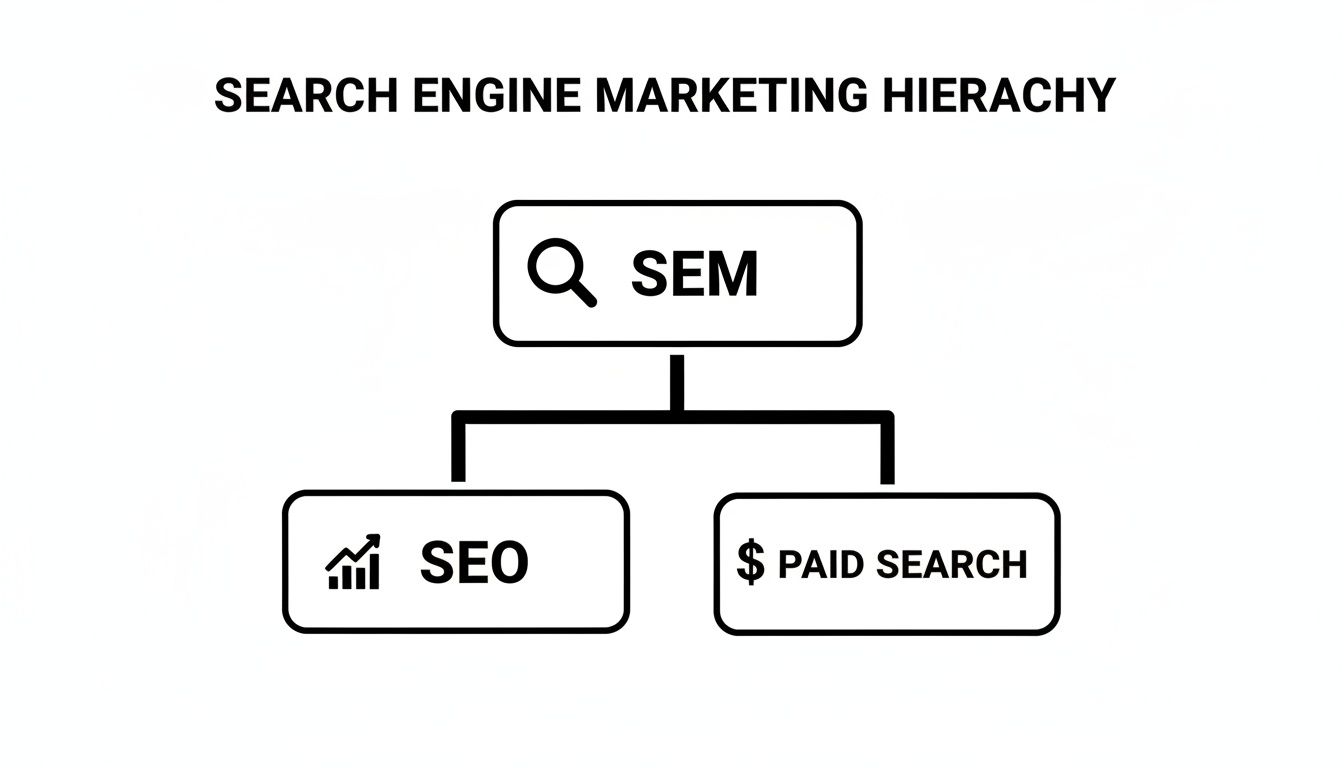
As you can see, SEM is the umbrella strategy. Paid search is the high-control, fast-acting component that delivers immediate visibility when you need it most.
Let's break down the four pillars that hold it all up.
Pillar 1: Keywords
Think of keywords as the exact language your customers use when they need a solution right now. A lazy agency might just grab a generic list of industry terms, which is a fantastic way to waste your budget on totally irrelevant clicks.
An expert consultant, on the other hand, acts more like a codebreaker, meticulously deciphering user intent.
Are they just browsing, or are they ready to buy? The keyword "running shoe reviews" signals someone is still in the research phase. But a search for "buy size 11 trail running shoes" shows a customer with their credit card practically out. As a specialist, I ruthlessly focus your budget on these high-intent searches, ensuring every single dollar works harder for you.
Pillar 2: Ad Copy
Your ad is your digital billboard. It’s a tiny, one-sentence sales pitch competing for a sliver of attention in a sea of results. Generic, uninspired ad copy—the kind churned out by overworked agency interns—gets ignored every time.
An expert crafts compelling, direct messages that speak to a user's specific pain point and offer an immediate, clear solution. This dramatically increases the odds they'll click your ad instead of a competitor's.
It’s the difference between a sign that says "Shoes for Sale" and one that promises, "Finally, the End of Foot Pain. Shop Our #1 Rated Running Shoes." One is just noise; the other is a magnet for the exact customer you want.
An agency often uses templated, bland ad copy across all its clients because it's efficient for them. A consultant creates copy that's ruthlessly efficient for you, using precise language that connects with your specific audience and drives real action.
Pillar 3: Bidding Strategy
Bidding is the real-time, high-stakes auction for ad space on platforms like Google Ads. But setting a bid isn’t just about offering the most money—far from it. It’s a strategic decision based on dozens of signals like the time of day, the user's device, their location, and past behavior.
Large agencies often default to automated, "set it and forget it" bidding that essentially lets Google’s algorithm spend your money with very little expert oversight. As a hands-on specialist, however, I actively manage your bidding strategy. I make constant manual adjustments and use smart bidding with tight controls to ensure you never, ever overpay for a click.
This active, expert oversight is one of the main ways I protect your budget and drive up your ROI.
Pillar 4: Landing Pages
Finally, we have the landing page. This is where the conversion actually happens—or doesn't. You can nail the keyword, the ad, and the bid, but if your landing page is confusing, slow, or irrelevant, you've just wasted every penny that got the user there.
A specialist ensures the message in your ad perfectly matches the promise of your landing page. This creates a seamless, logical, and trustworthy experience for the user from start to finish. This simple alignment, often overlooked by overworked agency teams juggling too many accounts, can be the single biggest factor in turning visitors into loyal, paying customers.
To tie it all together, here’s a quick-reference table summarizing how these four components work in tandem to build a powerful campaign.
SEM Campaign Components At A Glance
Component | What It Is | Why It Matters |
|---|---|---|
Keywords | The specific search terms people use on Google. | Connects your ads to the right audience based on their immediate intent. |
Ad Copy | The text of your ad that users see in the search results. | Grabs attention, communicates your value, and persuades users to click your link. |
Bidding | The process of telling Google how much you'll pay for a click. | Controls your ad spend, optimizes for conversions, and maximizes your budget's impact. |
Landing Pages | The specific webpage users "land" on after clicking your ad. | Fulfills the ad's promise and is where the final conversion (sale, lead, etc.) happens. |
Each pillar is essential. A great ad is useless if it targets the wrong keywords, and a perfect landing page won't convert anyone if the bidding strategy prevents people from ever seeing your ad in the first place. True SEM success comes from mastering how they all work together.
Why a Lean Expert Outperforms a Bloated Agency
So, you've decided to invest in paid search. Smart move. But now you face the single most important decision you'll make: who's going to manage your money?
This choice will make or break your return on investment. Too many businesses instinctively go for the big, impressive-sounding agency, assuming that bigger automatically means better. This is easily one of the costliest mistakes you can make.
The truth is, the traditional agency model is often fundamentally broken for small and medium-sized businesses. It’s a machine built for volume, not for individual client performance.
The Pitfalls of the Agency Model
The agency experience usually starts strong. You get a polished sales pitch from a senior strategist who really knows their stuff. But the moment that contract is signed, your account gets handed down the line.
Suddenly, you’re working with an overworked, under-experienced junior account manager. This person is likely juggling a dozen other clients and simply doesn't have the deep, specialized expertise to navigate the complex, fast-moving auction dynamics of Google Ads.
Need to make a quick strategy change? Good luck. Your urgent request to jump on a sudden market trend gets bogged down in internal meetings and layers of approval. By the time it’s implemented a week later, the opportunity is ancient history.
Agencies are structured to be efficient for themselves, not for their clients. Your budget is often just another number on a spreadsheet, managed through templates and one-size-fits-all strategies that protect their profit margins, not yours.
And what are you paying for, exactly? A huge slice of that hefty monthly retainer isn't going toward managing your ads. It's covering the agency’s massive overhead—the fancy downtown office, the bloated sales team, and the layers of administrative staff. That inflates your fees without adding a single dollar of value to your campaign performance.
The Specialist Advantage: Direct Expertise and Agility
Now, let's contrast that with the lean, expert consultant model.
When you hire a specialist like me, you're buying direct access to a seasoned pro with years of dedicated, in-the-trenches experience. There are no layers. I am your strategist and your account manager. Your success is my sole focus, which creates a powerful, aligned partnership from day one.
Because I’m not bogged down by bureaucracy, I can be incredibly nimble. I can spot a surge in searches for a competitor’s product at 9 AM and have a counter-campaign live by 10 AM. This agility allows me to capitalize on market shifts instantly, turning real-time data into immediate, profitable action. A large agency simply can't match that level of responsiveness.
A true expert finds the waste that bloated teams consistently miss. I don’t just run reports; I dive deep into the search query data. I uncover opportunities to slash costs by cutting out irrelevant clicks and reallocating that budget toward keywords that actually convert.
This hands-on, meticulous approach is the secret to a higher ROI. It’s about mastering the search engine marketing basics and turning your ad spend into a reliable engine for growth.
For a more detailed breakdown of this comparison, check out our article on why a specialist consultant wins over in-house vs agency marketing. Choosing the right partner isn't just about managing ads; it's about investing in a genuine partnership focused entirely on your profitability.
Launching Your First Google Ads Campaign Strategically
Jumping from theory to practice is where most businesses stumble. It’s a common story: thousands of dollars torched on preventable mistakes. Launching your first campaign isn’t about flipping a switch; it's about making smart, deliberate decisions from day one. This is how an expert helps you master search engine marketing basics and dodge the expensive pitfalls agencies often build right into their cookie-cutter setups.

Think of your initial setup as the foundation of a house. If you build on a weak foundation—rushed keyword research, default settings—it’s only a matter of time before the whole thing crumbles, taking your budget down with it. A strong, expert-built foundation, on the other hand, gives you a platform for profitable growth.
Defining a Single Clear Objective
Before you even touch a keyword, you need to answer one critical question: what is the single most important action you want someone to take? A classic agency mistake is chasing vague goals like "driving more traffic." An expert consultant forces you to get specific.
Are you trying to generate:
Qualified leads from a contact form?
Direct e-commerce sales for a specific product?
Inbound phone calls for your service business?
This one clear objective will be your North Star. It dictates every decision you make, from the ad copy you write to the landing page you build. Without this laser focus, your campaign will drift aimlessly, and your budget will be spread too thin across competing, fuzzy goals. A solid campaign architecture is non-negotiable for success; you can learn more about what a great Google Ads account structure in our detailed guide.
Setting a Budget for Data, Not Just Clicks
Your starting budget has one main job: buy enough data to make intelligent decisions later. Too many business owners set a budget that’s too low, get a trickle of inconclusive results, and then wrongly conclude that "Google Ads doesn't work."
An expert helps you set a realistic starting budget that actually allows you to gather meaningful data. You need to see which keywords, ads, and audiences are actually performing. This turns your ad spend into a strategic investment in market research, not just a gamble on random clicks.
"The costliest mistake in Google Ads is accepting the default settings. They are designed to make Google money, not you. An expert’s first job is to override these defaults and build a campaign structure that puts your profitability first."
This is where a specialist’s value is immediately obvious. I sidestep the budget-draining defaults that agencies often leave on autopilot, protecting your money from day one. As you structure your campaigns, you can also explore advanced dynamic keyword insertion techniques to make your ads even more relevant. By focusing on a solid, strategic launch, you create the bedrock for future optimization and long-term profitability.
How to Measure Success and Optimize for Profit
Getting your SEM campaign live is just the starting line. Honestly, that’s the easy part. The real work—the part that actually makes you money—begins the moment those ads are active.
This is where the difference between a hands-on expert consultant and a big, bloated agency becomes painfully obvious. Too many agencies just set it and forget it, letting campaigns coast on autopilot while a junior staffer glances at a dashboard once a week. That's a surefire way to burn cash.
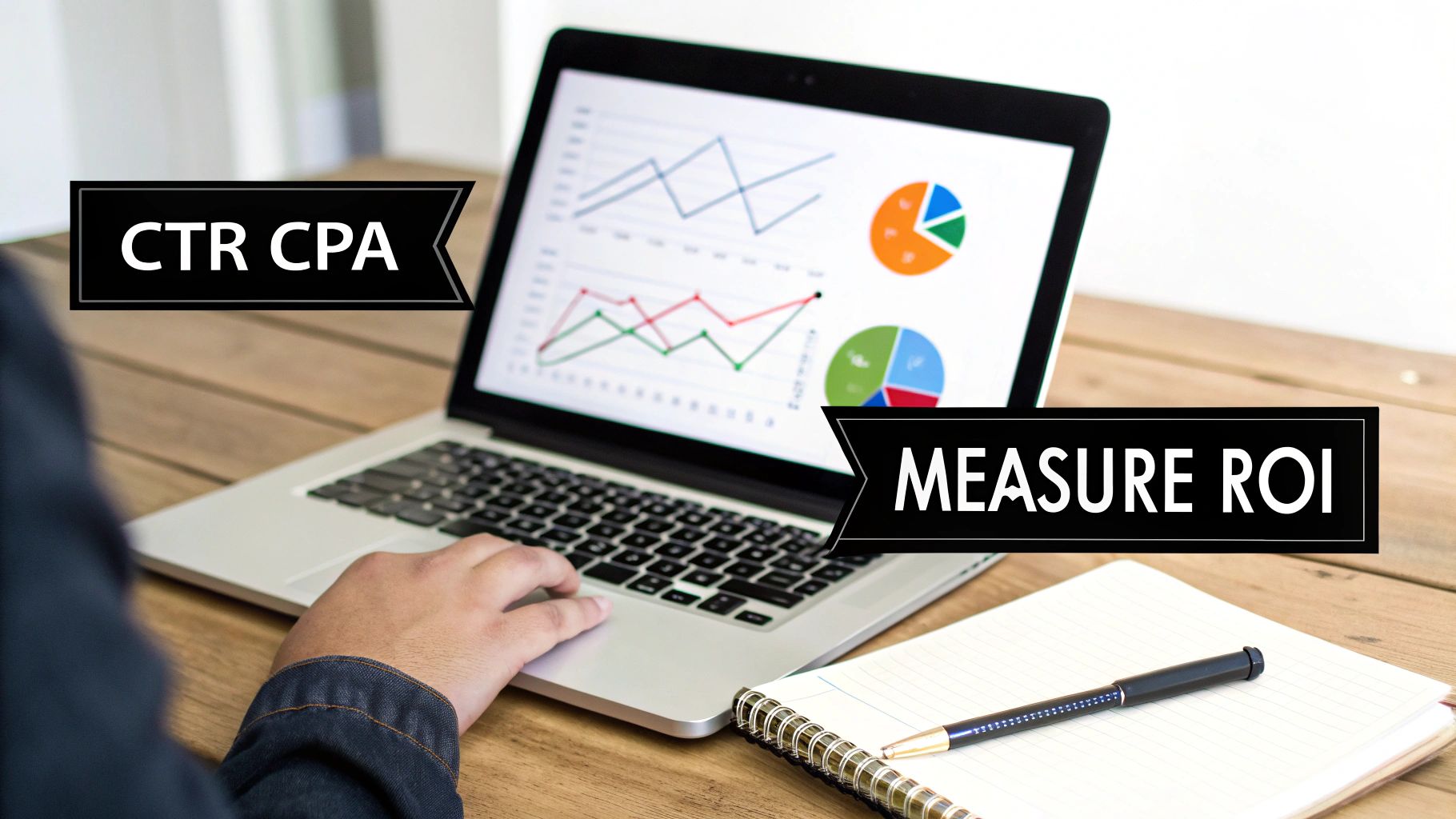
Think of it like flying a plane. An agency junior can probably keep it pointed in the right general direction. But an expert pilot—your dedicated consultant—is constantly making micro-adjustments, watching the instruments, managing fuel, and reacting to turbulence to make the flight as smooth and efficient as possible.
The numbers in your ad account are your instruments. They're telling you a story about what’s working and what's just wasting your budget.
Turning Data Into Dollars
You don't need to be a data scientist, but you absolutely need to get comfortable with a few key metrics. These aren't just buzzwords; they're the vital signs of your campaign's financial health.
Click-Through Rate (CTR): This is simple: out of everyone who saw your ad, what percentage actually clicked on it? If your CTR is low, it’s a big red flag that your message isn't connecting. As your consultant, I will immediately start testing new ad copy to fix that.
Cost Per Acquisition (CPA): How much are you spending, on average, to land one new customer or a qualified lead? The entire game is to push this number down as low as you can without killing the quality of the leads you're getting. This takes active, expert bid management and constant fine-tuning.
Return On Ad Spend (ROAS): This is the one that really matters. The bottom line. For every single dollar you put into your ads, how many dollars in pure revenue are you getting back? This should be the central obsession of anyone managing your account—and it is for me.
An agency might send you a pretty report that shows you got a ton of clicks. An expert consultant shows you exactly how those clicks turned into profitable customers, transforming your ad budget from an expense into a powerful, money-making machine.
This relentless focus on profitability is why paid search is still such a beast. In fact, paid search campaigns deliver an average $2 return for every $1 spent—that's double what you typically see from social media ads. Even better, businesses that zero in on high-intent keywords can see conversion rates 200% higher than with generic display ads. You can dig into more stats on search engine performance over at mettevo.com.
An expert lives and breathes this data. I’m constantly A/B testing ad copy, tweaking keyword bids, and poring over user behavior. It's these small, daily adjustments that compound over time to create huge wins in profitability—a level of detail and care that large, impersonal agencies just can't match.
Your Questions About Search Engine Marketing Answered
Even after getting the basics down, it’s totally normal to have questions. This is where we cut through the industry fluff and get right to the practical answers business owners need. My goal here is to show you the real value of expert management and smart investment so you can move forward with confidence.
How Much Should I Budget for SEM?
Honestly, there’s no magic number. The right budget hinges on how competitive your industry is, what you’re trying to achieve, and how aggressive you want to be. The better question to ask is, "How do I make whatever budget I have work smarter?"
This is where an expert’s value becomes crystal clear. Unlike a bloated agency that’s just trying to hit a spending quota, my number one goal as a specialist is to maximize your Return On Ad Spend (ROAS) from day one. Often, the first step is just finding and plugging the leaks—the wasted spend that’s almost always hiding in accounts run by junior agency staff.
A smart way to start is with a dedicated test budget for 90 days. This isn’t about instant profits; it's about buying data. Once we have proof of what works, we can scale your investment without just guessing.
How Quickly Can I Expect to See Results?
Paid search is the absolute fastest way to get your business in front of customers who are actively looking for what you sell. You can start seeing website traffic and collecting performance data within hours of launching a campaign. That immediate feedback loop is a massive advantage.
But let's talk about real business results—like a consistent, profitable flow of leads or sales. That usually starts to materialize within 30 to 90 days. This initial window is critical for testing, learning, and optimizing. An expert consultant uses this time to dial in the targeting, kill the ads that aren’t working, and double down on the keywords that are, building the momentum you need for long-term ROI.
Can I Just Do SEM Myself?
The platforms are designed to be self-service, sure. The real question is whether you should. Without deep expertise, it’s incredibly easy to burn through thousands of dollars on the wrong keywords, messy ad structures, or default settings that are built to help Google’s bottom line, not yours. It’s a painful and expensive way to learn.
Hiring a specialist isn’t an expense; it’s an investment in efficiency. You’re paying for my years of hands-on experience to sidestep costly mistakes, get results faster, and achieve a higher ROI than you ever could on your own.
What Is the Difference Between SEM and SEO?
Think of it like setting up shop in a new town.
SEO is like earning a great reputation and building a landmark store on Main Street. It’s incredibly valuable and creates lasting authority, but it takes time and consistent effort to get there.
Paid Search (a core part of SEM) is like buying the biggest, best billboard on the busiest highway leading into town. You get immediate, high-impact visibility the exact moment people need you.
A truly great marketing strategy uses both. But when you need speed, control, and predictable results to drive growth right now, paid search is the tool you can’t live without. An expert specialist just makes sure that billboard is in the perfect spot with the right message for the right people.
Ready to stop wasting money on bloated agencies and start getting a real return on your ad spend? At Come Together Media LLC, I provide the one-on-one Google Ads expertise you need to turn your campaigns into a predictable engine for growth. Schedule your free, no-obligation consultation today. Learn more at https://www.cometogether.media.


Comments