
In 2026, Google Ads management fees typically run from about $1,500 to $5,000 per month for mid-market accounts, while percentage-of-spend models commonly charge 10% to 20%. Complex tracking work often creates separate line items because fixing GA4, Google Tag Manager, call tracking, CRM imports, or feeds is a different job from monitoring spend.
The counterintuitive part is that the cheapest management fee can be the most expensive choice. If your conversion data is incomplete, an operator can optimize bids, search terms, and tROAS, or target return on ad spend, against numbers that don't represent qualified leads, booked procedures, or profitable orders.
I'm Chase McGowan, a self-taught independent Google Ads and paid media operator. I've run accounts throughout my career, I keep my client roster deliberately small, and I don't put account managers between clients and the person doing the work. The fee should pay for better decisions, cleaner measurement, and disciplined execution, not layers of overhead.
Table of Contents
- What Google Ads Management Fees Actually Cover
- The Three Main Fee Models and Their Incentives
- When Complexity Drives Fees Beyond Simple Spend Tiers
- Flat Retainers Versus Percentage Pricing by Spend Tier
- Why Tracking Infrastructure Changes Everything
- Questions to Ask Prospective Google Ads Managers
- How to Benchmark and Negotiate Your Management Fee
What Google Ads Management Fees Actually Cover
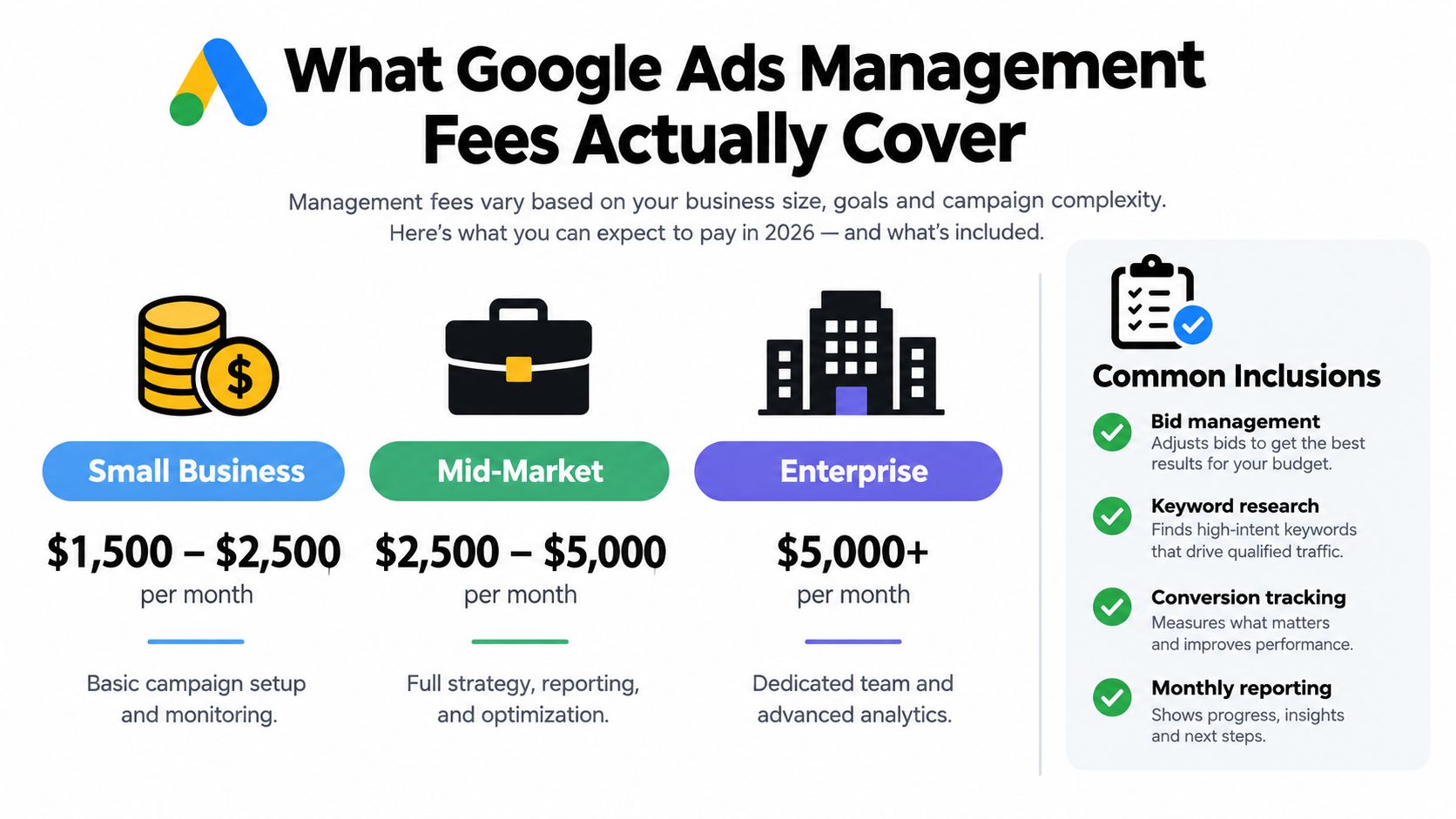
The 2026 market has a wide spread. Small-to-mid-sized businesses are commonly quoted about $1,500 to $5,000 monthly, while complex or enterprise accounts can reach $10,000 to $15,000 or more, according to published 2026 Google Ads agency pricing guidance. Those figures describe management, not the media budget paid to Google.
A quote becomes useful only when you separate its components. A real engagement may include:
- Account architecture: Campaign structure, ad groups, keyword themes, match types, audiences, exclusions, and budget allocation.
- Conversion measurement: GA4 events, Google Tag Manager configuration, call tracking, enhanced conversions, and consent mode.
- Ongoing optimization: Search-term review, bid adjustments, negative keywords, ad testing, landing-page feedback, and budget decisions.
- Commerce operations: Shopping feeds, product data, Performance Max asset groups, and revenue quality checks.
- Reporting: Clear views of Google Ads, GA4, and business outcomes, rather than a polished dashboard that hides attribution gaps.
The problem starts when a proposal uses “management” as a catch-all. One provider may include a tracking audit and account rebuild. Another may only adjust bids and send a monthly report, then charge separately for feed work, landing pages, CRM imports, or call tracking.
For context, a benchmark summary covering more than 16,000 campaigns reported an average search CPC of $5.26 and average CPL of $70.11 for data from April 2024 through March 2025, as described in this Google Ads cost guide. More expensive auctions increase the consequences of weak structure and bad measurement, but they don't automatically justify a higher fee.
Before signing, ask for a written scope with three columns: included, billed separately, and excluded. If you need creative production or short-form campaign education, an AI video generator for agencies can be a separate production resource, but it shouldn't be confused with conversion strategy or account management. You can also compare the hands-on scope with how I manage Google Ads accounts.
The Three Main Fee Models and Their Incentives
Every pricing model solves one budgeting problem and creates another. The right choice depends on whether your account needs routine oversight, technical work, or concentrated senior attention.
Percentage of spend
A percentage model is easy to understand. The manager charges a portion of the monthly media budget, commonly 10% to 20%, as documented in PPC pricing guidance from AgencyAnalytics. At $5,000 in ad spend, that range implies roughly $500 to $1,000 in management fees.
The attraction is scalability. A small account can avoid a large fixed retainer, and the provider's fee rises as the account grows. The incentive problem is equally clear: the manager earns more when you spend more, even when additional spend isn't efficient. A fee tied to budget can reward expansion of the auction rather than improvement in qualified conversion economics.
Percentage pricing works best when the scope expands with spend and the contract includes explicit efficiency guardrails. It works poorly when the manager's recommendation is always “increase budget” and nobody can explain what happens to marginal ROAS, qualified lead rate, or profit.
Flat retainers
A flat monthly retainer makes the management cost predictable and disconnects the fee from media volume. Specialist agencies often cluster around $1,500 to $5,000 monthly for mid-market accounts, according to the same PPC pricing benchmark.
This model is cleaner for accounts requiring intensive optimization because the manager isn't paid more just for moving more dollars. The trade-off is fit. A fixed retainer can be disproportionate for a low-spend account, while a flat fee that's too low for a large, technically demanding account may lead to shallow attention.
Hourly billing
Hourly work is appropriate for a defined audit, consultation, or implementation block. It gives you visibility into time, but not necessarily into value. A vague scope can turn every unresolved issue into another billable hour, while a highly efficient operator may appear expensive despite delivering the required outcome quickly.
Practical rule: If the proposal bills hourly, define the deliverable before discussing the hours. “Review conversion tracking and provide a prioritized repair plan” is a deliverable. “Work on the account” isn't.
Hybrid models combine a base fee with a percentage above a threshold. They can balance minimum coverage and scale, but they also make invoices harder to forecast. Ask exactly when the percentage begins, whether it applies to all spend or only incremental spend, and whether tracking or reporting sits outside the hybrid fee.
For anyone running PPC as a client business, the Freelancer Ops Pack Add-On is positioned as an account audit and management resource. It doesn't replace judgment about incentives, scope, or data quality.
When Complexity Drives Fees Beyond Simple Spend Tiers
Two accounts can spend the same amount and require completely different levels of work. A local lead-generation account with a small campaign structure may need straightforward search-term control and call measurement. An ecommerce account can involve Shopping feeds, product segmentation, Performance Max, revenue validation, and frequent merchandising changes.
Count the systems, not just the campaigns
Complexity rises when Google Ads depends on systems outside the interface. A tracking-first scope may involve:
- GA4 validation: Confirming that events reflect meaningful actions rather than duplicate or low-value interactions.
- Google Tag Manager work: Managing tags, triggers, and consent behavior so conversions fire correctly.
- Server-side tagging: Adding another implementation layer where the business needs more control over data collection.
- Call tracking: Connecting calls to campaigns, keywords, and outcomes instead of counting every call as equally valuable.
- Offline conversion imports: Sending qualified opportunities, booked appointments, or closed revenue back from the CRM.
- Feed maintenance: Keeping product data, availability, titles, pricing, and categories usable for Shopping campaigns.
Each system introduces failure points. A conversion can duplicate, a call can lose its source, a CRM status can fail to import, or a feed can reject products. The operator has to diagnose those issues before trusting automated bidding.
For technically complex accounts, market guidance places management commonly at $4,000 to $12,000 or more per month, with enterprise or multi-channel programs reaching $10,000 to $25,000 or more, as outlined by OuterBox's PPC management pricing guide. A lower-complexity local lead-generation account may fit within a $500 to $2,000 monthly band, depending on the provider and scope.
Read the quote as an operations document
Ask whether the fee covers implementation or only maintenance. A $30,000 monthly ecommerce account can be cheaper on a flat retainer than under a 15% spend model when the scope includes heavy measurement and feed operations. Conversely, a simple local account can become uneconomical if the provider applies an enterprise process to a narrow campaign set.
A 30-day Google Ads rebuild makes sense when the account needs a defined repair phase before ongoing management. For a practical starting point, the Fre Vault Preview provides a free preview of vault audit checklists.
Flat Retainers Versus Percentage Pricing by Spend Tier
The cleanest comparison is arithmetic, but arithmetic needs context. A percentage fee can be reasonable at lower spend when a flat minimum would consume too much of the budget. As spend rises, the same percentage can become a substantial management charge without proving that the work has expanded in proportion.
At $5,000 in monthly spend, a 10% to 15% fee equals $500 to $750. A flat fee around $1,500 would cost more in management, so percentage pricing may be more economical if the account doesn't need substantial technical work. The caveat is that many providers apply minimum fees, and 2026 pricing guidance from ALM Corp reports common minimum monthly spend requirements of $2,000 to $10,000, with management minimums often starting around $1,500 to $5,000 for mid-size and larger firms.
At $15,000 in spend, a percentage between 8% and 12% implies $1,200 to $1,800. A flat retainer around $2,500 costs more on the invoice, but may offer stronger incentives because the manager isn't rewarded for increasing spend.
At $30,000, a 5% to 10% fee equals $1,500 to $3,000, while a flat retainer around $4,000 is higher in this simplified comparison. The percentage isn't automatically the better deal if the flat fee includes tracking, CRM imports, feed maintenance, and strategic testing that the percentage provider bills separately.
At $50,000 or more, a flat retainer around $5,000 can be easier to budget than a percentage that changes with every budget decision. The broader market guidance also shows that at spend above roughly $25,000 monthly, percentage pricing can mathematically reach $4,000 to $12,000 in management charges alone, especially when add-ons are included.
The cheapest line on a proposal isn't the lowest cost if it buys optimization against incomplete conversion data.
Use a simple worksheet. Record monthly spend, fee formula, minimum, tracking inclusions, feed scope, reporting scope, and termination terms. Then compare the total cost of the work you need, not the headline fee.
Why Tracking Infrastructure Changes Everything
A manager can't optimize what the account can't measure. If Google Ads counts form starts as conversions while the business cares about booked procedures, the platform may pursue the wrong users with increasing confidence.
The measurement layer can include GA4, Google Tag Manager, server-side tagging, call tracking, enhanced conversions, and consent mode. These aren't decorative analytics tasks. They determine which signals feed bidding, which campaigns receive budget, and whether reported ROAS reflects revenue the business recognizes.
Sequence matters
My sequence is simple:
- Repair the measurement: Validate events, values, call sources, consent behavior, and CRM imports.
- Rebuild the account: Align campaigns, match types, negatives, ads, landing pages, feeds, and audiences with the actual customer journey.
- Optimize the bids: Use tROAS or other automated strategies only after the conversion signals are trustworthy.
- Review business quality: Compare platform-reported conversions with qualified leads, booked appointments, orders, and revenue.
That sequence is why a tracking-first engagement can cost more at the beginning and less over the life of the account. A manager who skips the first step may deliver clean-looking reports while making decisions from broken attribution.
The documented results support the method, not a promise for every account. For a premium ecommerce brand, platform-reported results show $6.65 million in additional revenue on $119,000 less spend over three years, with ROAS moving from 13x to 33x, average CPC falling 25%, AOV rising from $1,995 to $3,753, and Performance Max moving from 1.02x to 31.43x. Those figures are platform-reported, and the work involved measurement, structure, and optimization rather than just raising budgets.
An ophthalmology practice's platform-reported results show conversion rate moving from under 1% to 17% or more, cost per conversion falling 89%, from approximately $400 to approximately $44, and 190 additional patient calls per month. The useful lesson is the order of operations. A low fee that excludes measurement cleanup can leave you paying for optimization on an unreliable signal.
You can use Google Ads audit checklists to inspect the measurement layer before comparing management proposals. The audit should answer whether reported conversions match the actions your sales team values.
Questions to Ask Prospective Google Ads Managers
A pricing conversation should expose scope, incentives, and accountability. Ask these questions before comparing monthly fees.
Pricing transparency
- What exactly is included? A red flag is “full management” without a task list. A green flag is a written scope covering structure, optimization, reporting, and technical work.
- Is there a minimum spend or management fee? A vague answer makes small-budget economics impossible to assess. Ask for the fee at your current spend and at a higher spend.
- What changes the invoice? Confirm whether fees rise with media spend, campaign count, platforms, products, feed work, or additional reporting.
- Which items are add-ons? Setup, tracking, CRM imports, landing-page work, creative, and feed maintenance should be identified before the contract.
Tracking scope
Ask directly whether the manager will audit GA4, configure Google Tag Manager, validate call tracking, manage enhanced conversions and consent mode, or import offline conversions from the CRM. “Google Ads is tracking conversions” isn't enough. You need to know which conversions, how they're defined, and whether the business can verify them.
Reporting depth
Request reporting from Google Ads, GA4, and Meta where those platforms are part of the program. A polished third-party dashboard can make attribution gaps harder to see, so ask whether you can inspect the underlying platform data and the conversion definitions.
Optimization approach
Ask what changes happen weekly, what requires approval, and how tests are documented. A red flag is a manager who makes sweeping changes without preserving a baseline. A green flag is an operator who explains the hypothesis, the affected campaigns, the decision metric, and the next action.
Useful test: Ask the prospective manager to name the first three things they would verify before changing bids. If the answer starts with budget increases, they may be managing spend before measurement.
If you want a direct review rather than a long sales process, you can book an account review and use the same questions against your current setup.
How to Benchmark and Negotiate Your Management Fee
Collect three comparable quotes, then normalize them. Put each provider's fee, minimum, percentage trigger, setup work, tracking scope, reporting, feed responsibilities, and contract terms into one sheet. A cheaper quote often becomes less cheap when it excludes the work needed to make conversion data usable.
My published structure is straightforward. I charge $7,500 for a 30-day Google Ads Sprint, $3,500 per month minimum for ongoing management, and $350 for an Office Hours session. The Sprint is designed as “hire me for 30 days before you hire me forever.” It fixes tracking first, then rebuilds and optimizes the account. Ongoing work is month to month.
I work as an independent operator, not an agency. There are no account managers or junior layers, and the person clients speak with does the work. I deliberately take no more than 2 to 3 new clients per quarter, because a small roster protects the level of attention complex accounts require.
The comparison isn't “cheap freelancer versus expensive agency.” It's senior direct work versus a delivery model where the quoted fee may fund several layers before anyone changes the account. For more context on negotiating PPC management pricing, compare the fee against the measurement and decision-making scope, not just the percentage.
The documented ecommerce and ophthalmology results above are platform-reported outcomes, not guarantees. They show why the management fee should fund accurate signals and deliberate execution before it funds more spend.
Come Together Media LLC offers a tracking-first 30-day Google Ads Sprint, ongoing senior management, and focused Office Hours reviews for businesses that need accountable decisions instead of agency layers. Visit Come Together Media LLC to review the Sprint and choose the engagement that fits the current condition of your account.