Learning Search Engine marketing to Outsmart Your Competition
- Feb 4
- 18 min read
Learning search engine marketing gives you the power to steer your own ship. It’s about taking direct control of your company's growth, finally understanding those confusing reports from your overpriced agency, and stopping the cycle of wasted ad spend.
When you understand SEM, you can make smarter budget decisions and hold any marketing partner accountable. It’s the key to ensuring every single dollar you invest is actually working toward your bottom line, not just paying for a bloated agency's overhead.
Why Learning SEM Is Your Ultimate Business Advantage
I've talked to countless business owners who feel stuck. They're paying hefty monthly retainers to big, faceless agencies that deliver jargon-filled reports and, frankly, mediocre results. They feel like just another number in a massive client portfolio.
Often, the account manager you're assigned at a large agency is a junior employee juggling dozens of other clients. They apply a generic, cookie-cutter strategy to your unique business, and you're left wondering where the money went. This guide isn’t about turning you into a full-time Google Ads manager; it's about arming you with the strategic knowledge to see through the fluff and demand real results.
Once you understand the fundamentals, the whole game changes. You go from being a passive client to an active, informed stakeholder. You start asking the right questions, spotting the red flags in those agency reports, and steering the strategy toward what actually drives revenue for your business.
The Problem with Bloated Agencies
Many large agencies are built on a model that prioritizes their own operational efficiency over your specific success. It’s a volume game. Your account might get passed from one junior manager to the next, losing crucial context and momentum with every handoff.
Their focus can easily drift toward vanity metrics that look good on a PowerPoint slide—like impressions or clicks—but don't actually translate to profit. They’re not as invested in what truly matters: your conversions and your cost-per-acquisition.
The real issue is a profound lack of specialized attention. When you’re just one of a hundred clients, your campaign rarely gets the deep, strategic thinking it needs to dominate the competition. An expert consultant, on the other hand, lives and breathes your account's performance. Our success is directly tied to yours.
This is exactly why a solid grasp of SEM is so vital. It helps you see through the agency nonsense and demand a much higher standard of service, whether you decide to manage campaigns in-house or hire a true specialist who is personally invested in your growth.
Agency Model Vs Expert Consultant A Quick Comparison
When it comes to managing your Google Ads, understanding the difference between a large agency and a specialized consultant is key. It's not just about size; it's about the entire approach to getting you results. This table breaks down the stark contrast between the two models.
Attribute | Large Bloated Agency | Specialized Consultant (e.g., Come Together Media) |
|---|---|---|
Point of Contact | Junior account manager juggling 20+ clients | The actual expert doing the work |
Strategy | Templated, "one-size-fits-all" approach | 100% custom, based on your business goals |
Communication | Formal, scheduled calls with filtered reports | Direct, transparent, and frequent updates |
Agility | Slow to adapt due to internal bureaucracy | Quick to pivot and capitalize on opportunities |
Incentives | Focused on client retention and upselling services | Directly tied to your account's performance and ROI |
The contrast is pretty clear. While an agency might offer a broad suite of services, a consultant provides deep, focused expertise where it counts the most—driving profitable results for your business.
The Consultant Advantage A Clearer Path to ROI
Partnering with an individual Google Ads expert is a completely different world. Forget layers of bureaucracy—you get direct access to the person actually managing your campaigns. This one-on-one relationship fosters a much deeper understanding of your business goals, your customers, and the unique challenges you face in the market.
This direct partnership brings some serious benefits:
Deep Specialization: You're not hiring a jack-of-all-trades. You're working with a specialist who has spent years mastering the nuances of the Google Ads platform.
Total Transparency: Communication is refreshingly direct and clear. You’ll know exactly what’s happening with your budget and why certain strategic calls are being made, without the agency spin.
Agile Strategy: An independent consultant can pivot on a dime, adapting to market shifts or new opportunities without getting bogged down by internal agency approvals.
Aligned Incentives: A consultant's reputation and success are directly tied to your success. They thrive by delivering real, tangible results for a select group of clients, not by managing a massive portfolio.
Ultimately, learning the ropes of search engine marketing is your best defense against inefficient spending and your most powerful tool for profitable growth. That knowledge is what allows you to choose the right kind of partner—one who acts as a true extension of your team.
And it’s a channel worth mastering. Google still holds a staggering 89.66% of the global search market. With businesses earning an average of $2 for every $1 spent on PPC, the potential for a fantastic ROI is sitting right there. To dig deeper into the numbers, check out our guide on the PPC advantage versus SEO.
Grasping The Core Concepts Of SEM
Let's be honest, Search Engine Marketing can feel like a secret club, full of acronyms designed to keep business owners out. It's not. Once you connect the jargon to actual business results, you'll see it's surprisingly straightforward.
This isn't about memorizing a dictionary of terms. It's about building the confidence to look at a performance report and know what's working, what's not, and how to steer the ship. When you understand the numbers, you can instantly tell if your campaigns are printing money or just burning it.
The Metrics That Actually Matter
Forget the exhaustive list of every possible metric an agency might throw at you to look impressive. Let's zero in on the handful that directly impact your bank account. These are the pillars of any solid SEM campaign, and seeing how they connect is the first real step to mastering this stuff.
Let's say you run a dermatology practice in Denver. Your goal isn't just to get clicks; you need to get new patients booking appointments for high-value services like Botox. Here’s how the core concepts play out in a real-world scenario like that.
Pay-Per-Click (PPC): This is the basic model for platforms like Google Ads. You don’t pay a dime for your ad to just show up on the page. You only pay when someone is interested enough to actually click on it. It’s a direct, action-based cost.
Cost-Per-Click (CPC): This is the price tag on that single click. For your ad promoting "Botox specials in Denver," you might pay $8.50 every time a potential patient clicks through to your landing page.
Click-Through Rate (CTR): This tells you how compelling your ad is. If 100 people see your ad and 5 of them click, your CTR is 5%. A high CTR is a great sign that your message is hitting the mark with the right people.
Conversion Rate: This is the money metric. If 100 people click your ad but only 2 actually fill out your appointment form, your conversion rate is 2%. This number tells you if your website is closing the deal.
A bloated agency might send you a glossy report celebrating a huge number of clicks. But as a seasoned consultant, I'll tell you that the magic formula is a high CTR, a low CPC, and a strong conversion rate. That's the difference between looking busy and actually driving profit.
Connecting The Dots To Business Goals
These concepts aren't isolated islands. They form a logical chain that leads directly to a business outcome. A low CTR, for example, is a huge red flag. It means your ad copy isn't resonating, which forces you to pay more for fewer qualified leads.
The real skill is in understanding the relationship between these metrics. A low CPC is great, but it’s worthless if those cheap clicks never turn into paying customers. The goal is always to find that sweet spot—a sustainable price for clicks that reliably become profitable actions.
This is where a specialist truly shines. A big agency might slap a generic bidding strategy on all their clients. A dedicated consultant, on the other hand, digs into your specific conversion data to figure out the perfect CPC for your business, making sure every dollar spent is an investment with a measurable return.
As you get comfortable with these core SEM concepts, it's also smart to keep an eye on how AI-driven marketing is changing the game. This tech is becoming essential for optimizing bids and personalizing ad creative at a scale that was impossible just a few years ago.
From Jargon To Strategic Insight
Once you get these terms down, you move from being confused to being in control. When you can confidently talk about CPC, CTR, and conversion rates, you can have a completely different kind of conversation with any marketing partner you work with.
You start asking the right questions:
"Our CTR is solid, but the conversion rate is tanking. Is the problem with our ad targeting, or do we need to fix the landing page?"
"The CPC for this keyword group just doubled. What’s changed in the auction? Did a new competitor jump in?"
"Can we pull the budget from the campaigns with a high cost-per-conversion and push it into the ones that are actually performing?"
This level of insight is what separates a passive client from a strategic leader. It gives you the power to cut through the agency fluff, focus on what really drives revenue, and make sure your marketing budget is working as hard as you do.
Building Your First High-Impact Google Ads Campaign
Alright, let's get our hands dirty. This is where the theory ends and the real learning begins—inside the Google Ads platform itself. Building your first campaign is more than a technical exercise; it's about learning how to turn clicks into actual customers, and how to do it without lighting your budget on fire.
This is where so many businesses stumble right out of the gate. They get pulled in by Google's "smart" defaults, rush through the setup, and a week later wonder where all their money went. I've seen it a hundred times, especially with big, impersonal agencies that slap the same generic template on every client. A truly effective campaign is built on careful, deliberate choices before you ever spend a dime.
Structuring Your Account for Success
Think of your account structure like the foundation of a house. If it's a mess, everything you build on top of it will be unstable. The right structure gives you control over your budget, helps you serve up hyper-relevant ads, and, most importantly, gives you clean data to work with later.
The classic rookie mistake? Lumping everything into a single campaign and ad group. It's the fastest way to hemorrhage cash.
Instead, your account structure should be a clean mirror of your website. Let's go back to our artisanal coffee e-commerce store. Here’s how a pro would map it out:
Campaigns: These should be your main product categories. Think "Espresso Beans," "Coffee Subscriptions," and "Brewing Equipment." This lets you assign different budgets to your most important product lines.
Ad Groups: Get more specific within each campaign. Under "Espresso Beans," you’d create tightly themed ad groups like "Single-Origin Espresso," "Espresso Blends," and "Dark Roast Espresso."
Keywords & Ads: Now, for the magic. Each ad group gets a small, highly-focused list of keywords and ads that speak directly to that theme. The ad in your "Single-Origin Espresso" group should be talking about tasting notes from Ethiopia, not your monthly subscription deal.
This tight, granular approach is how you earn a high Quality Score. That's Google's rating of how relevant your keywords, ads, and landing page are to a user's search. A higher score means you pay less per click and get better ad positions. It’s a detail a hands-on consultant obsesses over, while an overloaded agency often just lets it slide. If you want to go deeper, our guide to Google Ads account structure really unpacks this.
The Art of High-Intent Keyword Research
Let’s be clear: keyword research isn't about finding every possible search term. It's about getting inside your customer's head and understanding their intent. This is easily the most critical skill in all of SEM. You have to learn to separate the buyers from the browsers.
A big agency might just target a broad term like "coffee" because the search volume is huge. Bad move. That just buys you a ton of expensive, junk clicks from people looking for a local cafe or the history of coffee. Profit lies in precision.
For our coffee store, we need to know the difference between these two keyword types:
Keyword Type | Example | User Intent | Action to Take |
|---|---|---|---|
High Commercial Intent | 'buy single-origin espresso beans' | This person has their wallet out, ready to go. | Bid aggressively. These are your money-makers. |
Informational/Research | 'how to brew coffee' | They're looking for an answer, not a product. | Avoid bidding on this for a sales campaign. |
This is where long-tail keywords (phrases of three or more words) become your best friend. Something like "buy organic dark roast espresso beans online" has way less search volume, but the person typing it knows exactly what they want. The conversion rate on these is through the roof. This is the strategic thinking that separates a profitable, consultant-led campaign from a wasteful one.
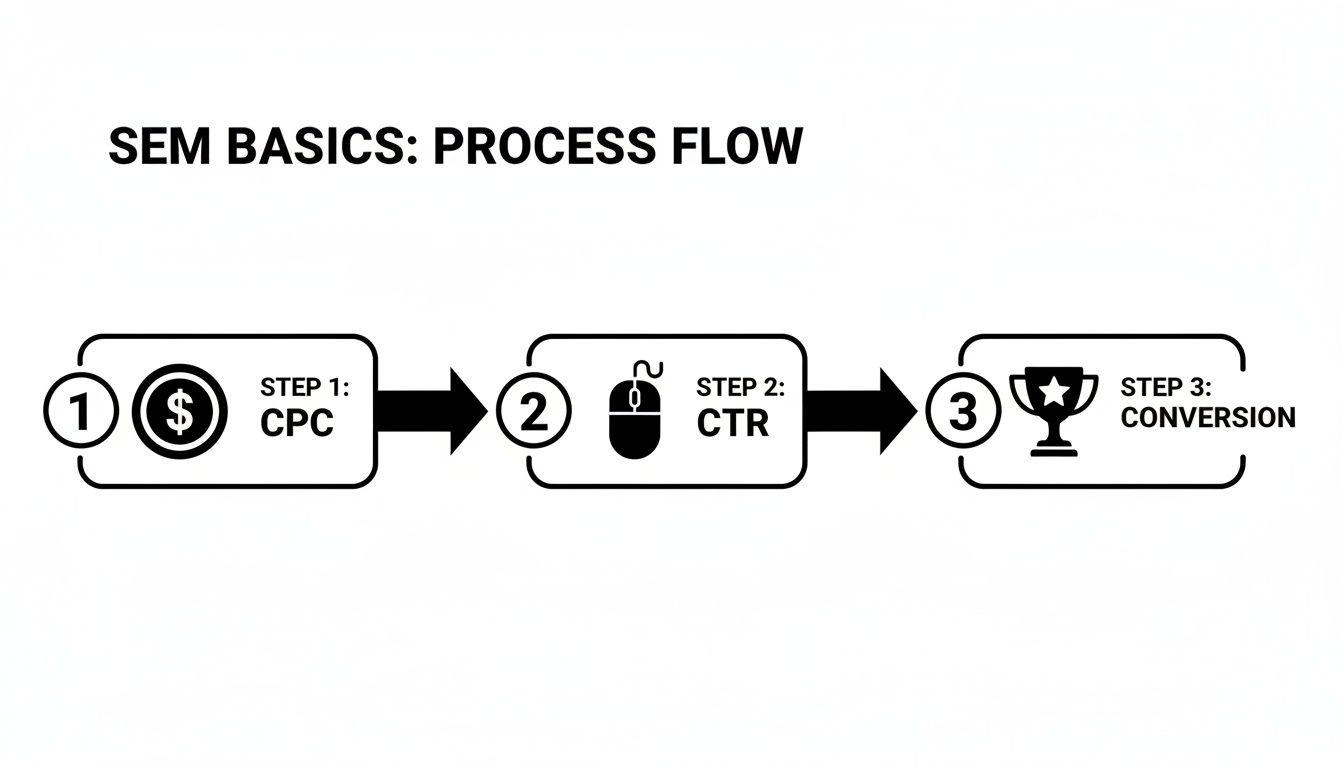
This simple flow is a great reminder that paying for the click (CPC) is just the first step. The real goal is to drive a conversion—a sale, a lead, a sign-up—that actually moves your business forward.
Nailing the Campaign Settings That Matter
When you spin up a new campaign, Google throws a ton of settings at you. Most can be ignored at first, but a few are absolutely non-negotiable. Get these right, and you'll sidestep the most common budget-draining traps.
The default settings in Google Ads are designed to make Google the most money, not you. A huge part of learning SEM is knowing which boxes to uncheck. This is a level of detail an agency account manager often misses, but a dedicated consultant lives by.
Here are the essentials to dial in immediately:
Campaign Goal: Be specific. If you want sales, choose the "Sales" goal. Don't pick something vague like "Website traffic."
Networks: This one is huge. For a new Search campaign, always uncheck the "Display Network" and "Search Partners" boxes. These are different, often lower-quality pools of traffic that will chew through your budget with little to show for it. An agency might leave these on to inflate click numbers, but a consultant focused on profit will cut them immediately.
Location Targeting: Get precise. If you only ship to the US, then only target the US. But don't stop there. Dig into the advanced settings and choose "Presence: People in or regularly in your targeted locations." The default setting includes people who are just interested in your location, which is way too broad.
Bidding: Start with Manual CPC (Cost-Per-Click). I know, I know—automated bidding sounds great. And it can be, eventually. But starting manually is like learning to drive a stick shift. It forces you to feel the road, understand the true cost of your keywords, and gives you maximum control from day one.
Focusing on these strategic choices builds a campaign for profitability right from the start. This isn't about finding secret hacks; it's about building a solid, intelligent foundation that turns Google Ads into a powerful engine for growth, not an intimidating black box.
Mastering Your Bidding Strategy And Budget
This is where the rubber meets the road. How you manage your bids and budget is the absolute core of search engine marketing. Get this right, and you have a profitable machine. Get it wrong, and you’ve got an expensive hobby.
Unfortunately, this is also where so many businesses get burned by big, impersonal agencies. They slap a generic, automated bidding strategy on every client account because it's easy for them. But "easy" for the agency is rarely the most profitable path for you.
Choosing Your Bidding Strategy
Your bidding strategy is your instruction manual to Google, telling it exactly how to spend your money to hit your goals. It’s a critical decision that demands nuance—something a junior account manager juggling 20 other clients simply doesn't have the bandwidth for.
Let's break down the two main philosophies here.
Manual Bidding (Manual CPC): Think of this as driving stick shift. You’re in complete control. You set a maximum cost-per-click for your keywords, giving you total command over what you're willing to pay for any single click. It's the perfect way to start, learn the ropes, and figure out the true cost of traffic in your specific market.
Automated Bidding: This is Google's "autopilot." Its Smart Bidding uses machine learning to chase conversions or conversion value. Strategies like Target CPA (Cost Per Acquisition) or Target ROAS (Return on Ad Spend) can be insanely powerful, but they have one non-negotiable requirement: a ton of clean, reliable conversion data to learn from.
The real expertise is knowing when to switch from manual to auto. A bloated agency might throw a brand-new account straight into automated bidding because it means less work for them. As a consultant, I can tell you that’s a recipe for disaster. You’re essentially letting an algorithm burn through your cash without any historical data to guide it.
An expert will almost always start a new account on Manual CPC. This deliberate approach lets us gather crucial baseline data, establish a profitable cost-per-click, and maintain absolute budget control before we even think about handing the reins over to automation.
Smart Bidding When The Time Is Right
Don't get me wrong: automated bidding is a game-changer when you use it correctly. Once your campaign has a steady stream of conversions coming in—a good rule of thumb is at least 30 conversions in the last 30 days—switching to a strategy like Target CPA can be a brilliant move to scale up efficiently.
The difference is all in the execution. A dedicated consultant partners with you to make that transition at the perfect moment, based on your account’s unique performance data. We don't follow a template; we follow your numbers.
Setting a Budget That Actually Works
Your daily budget is just as critical as your bidding strategy. A common and costly mistake I see all the time is setting a daily budget that's too low for the keyword volume you're targeting. This causes your ads to shut off by noon, completely missing out on all the valuable afternoon and evening traffic.
A much better approach is to start with a daily budget that can comfortably afford at least 10-20 clicks from your most important keywords. If your average cost-per-click is $5, a $25 daily budget just won't cut it. You have to give the campaign enough fuel to run all day and gather meaningful data.
This is another area where personalized attention pays for itself. An agency might spread your budget thin across dozens of generic keywords. A smart consultant, on the other hand, will help you focus your spend on a small, powerful group of high-intent keywords first. This ensures your budget makes the biggest possible impact right from day one.
How To Track Performance And Optimize For Profit
Launching a campaign is just the beginning. The real money in search engine marketing is made—or lost—in the daily, weekly, and monthly grind of optimization. This is where a hands-on, data-obsessed approach completely separates a dedicated consultant from a slow-moving, bloated agency.
Without solid tracking, you're just lighting your budget on fire.

Real success comes from knowing exactly which clicks turn into customers and why. Optimization isn’t a one-time fix. It’s a relentless cycle of analyzing what's happening, cutting the dead weight, and pouring fuel on the fire of what works. This is the very core of a transparent, one-on-one partnership.
Setting Up Non-Negotiable Conversion Tracking
Before you can optimize a single thing, you have to measure what actually matters. This is the absolute bedrock of a profitable campaign, yet it's where so many agencies fall flat, getting distracted by vanity metrics like clicks and impressions that don't pay the bills.
A conversion is the specific, valuable action you want a user to take after clicking your ad. Setting up conversion tracking is how you tell Google Ads what a "win" looks like for your business. It’s not optional. It’s the only way to know if you're making money or losing it.
Here’s what this looks like for different businesses:
For a Law Firm: A conversion is someone filling out your "Free Consultation" form.
For a Plumber: It's a phone call from a panicked customer with a burst pipe.
For an E-commerce Boutique: The main conversion is a completed sale in their online store.
Each of these actions can be tracked, sending a clear signal back to Google Ads that says, "This keyword and this ad just made me money." If you're struggling with the technical setup, getting this right is priority number one. Our guide on how to fix your Google Ads conversion tracking can get you on the right path.
The Optimization Loop: Analyze, Cut, And Amplify
With accurate tracking locked in, the real work begins. There's no secret formula here; it’s a logical, data-driven process that an expert consultant lives and breathes every single day. The goal is simple: make every dollar of your ad spend work harder.
This constant process is what separates profitable campaigns from money pits. An agency might check in once a month. A dedicated consultant is in your account constantly, hunting for opportunities. That agility is a massive advantage.
The core difference between a consultant and a large agency often boils down to this optimization loop. An agency might report on the numbers; a consultant relentlessly refines them. We are incentivized by your profit, not by sending a monthly report.
Understanding the financial impact of your campaigns is everything. That’s why learning how to calculate marketing ROI is a non-negotiable skill for anyone serious about using ad spend to drive real business results.
Cutting Waste With Negative Keywords
One of the fastest ways to boost profitability is to stop paying for clicks that will never, ever convert. This is where negative keywords become your most powerful tool. These are simply terms you tell your campaign to ignore, preventing your ads from showing up for irrelevant searches.
Let's say you're a plumber who specializes in emergency repairs, and you're bidding on the keyword "plumber."
Your ad might show for searches like "plumber training courses" or "plumber jobs."
These clicks cost you money but will never become a customer.
By adding "training," "courses," and "jobs" as negative keywords, you instantly stop wasting that budget.
An expert consultant obsessively scours search term reports for this kind of waste. It’s a simple but incredibly effective tactic that large agencies—often managing dozens of accounts with cookie-cutter strategies—frequently overlook.
Amplifying Wins By Refining Ad Copy
While you’re busy cutting waste, you also need to amplify what's working. Think of your ad copy as your digital storefront. Tiny changes can have a huge impact on your Click-Through Rate (CTR) and, more importantly, your Conversion Rate.
This is where a specialist approach really shines. A consultant will constantly test different headlines and descriptions to see what actually resonates with your ideal customer.
Example Ad Copy Test for a Law Firm
Ad Element | Version A | Version B (The Challenger) |
|---|---|---|
Headline 1 | Top-Rated Injury Lawyer | Get The Compensation You Deserve |
Headline 2 | Free Consultation Available | No Win, No Fee Guarantee |
Description | Our firm has 20 years of experience fighting for clients. | We've recovered over $50M for accident victims. Call us now. |
We run these versions against each other, see which one brings in more qualified leads at a lower cost, and then do it all over again. This constant refinement is what drives long-term, profitable growth—and it’s the hallmark of a personalized, expert-led search engine marketing strategy.
A Few Common Questions About Learning Search Engine Marketing
Diving into search engine marketing for your business always kicks up a few practical questions. As a business owner, you're rightfully wondering if the effort is worth the reward and how to best direct your energy. Should you manage campaigns yourself, or find the right partner to help you grow?
Let's get straight to it. The answers usually reveal the huge gap between a hands-on, specialist approach and the generic service you get from a big, bloated agency.
Should I Learn to Manage Google Ads Myself?
This is the big one. And the honest answer comes down to your most valuable asset: time.
Learning the fundamentals of SEM is non-negotiable. It’s a massive strategic advantage. It means you can understand performance reports, ask intelligent questions, and hold any agency or consultant you hire accountable. You need to know the basics.
But actively managing campaigns day-in and day-out? That's a serious time commitment. It demands constant monitoring, digging through data, and making smart optimizations.
The DIY Route: If you genuinely have the time and enjoy getting into the weeds with data, managing your own campaigns can be incredibly rewarding. No one will ever understand what drives your business better than you.
Hiring an Expert: If your time is better spent actually running your business, the goal isn't just to hire anyone. It's to find a true specialist. This is where an independent consultant's value really shines.
Think about it. At an agency, your account is often one of dozens managed by a junior employee. With a dedicated consultant, they become a focused extension of your own team. Our incentives are perfectly aligned: your profit is our only KPI.
How Much Should I Spend on Google Ads?
There's no magic number here, but your budget should never be a wild guess.
A smart starting point is a budget that can comfortably afford at least 10-20 clicks per day on your most important keywords. If your average cost-per-click is $6, a measly $25/day budget will likely cause your ads to shut off by noon, missing out on all the afternoon and evening traffic.
A bloated agency might pressure you to spend more right away, spreading that budget thinly across countless unproven keywords. It feels like a lot of action, but it's just burning cash inefficiently.
The consultant's approach is to start lean and focused. We'll pinpoint a small, potent group of high-intent, "money" keywords and concentrate your initial budget there. This lets us gather clean, meaningful data fast and prove ROI before we even think about scaling up responsibly.
How Do I Know If I Should Hire an Agency or a Consultant?
Choosing your partner is probably the most critical marketing decision you'll make. This is where you have to really understand the typical agency model versus the focused advantage of a specialized consultant.
Large agencies often woo you with their senior team, only to hand your account off to an overworked, under-experienced junior manager. Communication gets filtered, strategies become templated, and your actual business goals get lost in their internal chaos.
An individual consultant offers a completely different world.
You work directly with the expert. No layers, no middlemen, no games of telephone.
Your strategy is 100% custom. It’s built from the ground up for your specific business, not pulled from a one-size-fits-all playbook.
Communication is direct and refreshingly transparent. You get honest answers and nimble adjustments, not just a glossy monthly report that hides the details.
At the end of the day, if you value deep specialization, direct accountability, and a partner whose success is tied directly to your profitability, a dedicated expert consultant is the only logical choice.
Ready to stop guessing and start getting real results from your Google Ads? At Come Together Media LLC, I provide the one-on-one, expert guidance that bloated agencies simply can't match. Let's build a profitable strategy together. Schedule your free, no-commitment consultation today.


Comments