How to Find Low Competitive Keywords and Beat Bloated Agencies
- Feb 6
- 16 min read
Finding low-competition keywords is a game of strategy, not brute force. It's about pinpointing terms loaded with high searcher intent and facing manageable competition. As a specialized Google Ads consultant, this is my entire playbook. It’s how I help my clients sidestep the endless bidding wars big agencies start and get straight to customers who are ready to buy. It’s a simple shift in focus: from vanity metrics like search volume to what actually matters—your ROI.
Stop Overpaying for Hyper-Competitive Keywords

Let's be real—trying to outbid massive agencies with bottomless budgets is a surefire way to lose. As a specialized Google Ads consultant, I see it constantly: businesses burning through thousands on high-volume keywords because that’s the lazy advice they got from a big, bloated firm. It’s a simple strategy that looks great in a proposal but almost never delivers a positive return.
This guide is different. Think of it as an insider's playbook on 'smart competition'—a strategy I use to help my clients own the keyword spaces their bigger rivals completely ignore. We’re going to ditch the generic advice that keeps you trapped in expensive bidding wars.
Instead, we'll walk through a practical, repeatable workflow that gives you back control. You don’t need an enterprise-level budget or a team of generalists to win. What you need is a sharper, more focused approach from an expert who treats your budget like their own.
The Agency Trap vs. The Consultant's Edge
Most large agencies run on a volume model. They're juggling dozens of accounts and applying the same broad-stroke strategies to all of them. They hammer obvious, high-traffic keywords because it’s efficient for them, not necessarily for you. This one-size-fits-all method forces you into a head-to-head fight with industry giants, driving your ad spend through the roof for crumbs.
My approach as a dedicated consultant is the polar opposite. I don't have layers of account managers or redundant departments. It's just me, my expertise, and your business goals. That structure allows for a level of precision and agility that larger firms simply can't match.
We can pivot on a dime, test niche ideas, and uncover profitable pockets that are too small for a massive agency to even bother with.
The goal isn't just to find keywords; it's to find your keywords. These are the specific phrases that connect your unique solution to a customer's distinct problem—often in a space where your competitors aren't even looking.
This guide will show you exactly how to find and own these low-competition, high-intent keywords. When you do, you gain a massive competitive advantage that delivers:
Reduced Ad Spend: You stop overpaying for clicks by sidestepping the hyper-competitive auctions.
Increased ROI: You attract highly motivated buyers, which naturally leads to higher conversion rates.
A Genuine Competitive Edge: You build a solid foothold in profitable niches that everyone else has overlooked.
By the end of this article, you'll have a clear, actionable plan for how to find low-competitive keywords that will actually grow your business.
Building Your Foundation for Keyword Discovery
Before you even think about opening a keyword tool, we need to lay the strategic groundwork. This is the part that big, impersonal agencies almost always rush through—or skip entirely. They jump right to high-volume terms because it’s easy, but it ignores the most important part of the equation: your actual customer.
My process starts with you and your business, not a spreadsheet of generic keywords. We have to think like your best customer, not a marketer chasing a traffic quota. This means getting crystal clear on what success actually looks like for your specific business.
Define Your Unique Business Goals
What's the real objective here? It's almost never just "more traffic." A clear, specific goal sharpens your focus and stops you from chasing keywords that attract browsers instead of buyers.
Are you trying to:
Generate qualified leads? This means we’re hunting for keywords that signal someone is deep in the research phase, looking for a solution you provide.
Drive direct e-commerce sales? The focus shifts to product-specific, "buy now" keywords with undeniable commercial intent.
Increase local foot traffic? Here, we’ll zero in on geo-modified keywords and all those "near me" searches.
An overpriced agency might just lump all these together. But a specialist knows that a keyword strategy for lead gen is worlds apart from one built for immediate sales. We're not just finding keywords; we're mapping them directly to business outcomes.
Think Like Your Customer, Not a Marketer
Now, let's get inside your customer's head. The most valuable, low-competition keywords are almost always hiding in the natural language your customers use every single day. This is where my hands-on approach gives you a massive advantage over some detached agency account manager.
We'll brainstorm "seed keywords" by uncovering the real questions and pain points your audience has. It’s time to stop guessing and start listening. Where do you find this stuff?
Your Sales Team: Ask them for the top five questions prospects bring up on calls right before they sign on the dotted line.
Customer Support Tickets: What problems are your current customers trying to solve? Pay close attention to the exact phrasing they use in their emails or chats.
Online Forums (Reddit, Quora): Go search for your product or service category on these sites. How are real people describing their challenges? The raw, unfiltered language you'll find is a goldmine.
This isn't about finding keywords that sound good to you. It's about finding the exact phrases a frustrated or motivated person types into Google when they desperately need what you offer. That’s where the high-intent, low-competition magic happens.
I had a local MedSpa client who initially wanted to go all-in on "botox near me," a term completely dominated by huge clinics with bottomless budgets. After we dug into their client consultation notes, we found a recurring, very specific concern. So, we shifted our focus to a question-based keyword: "how to fix uneven smile after botox."
Sure, the search volume was just a fraction of the original term, but the competition was practically non-existent. More importantly, every single click came from a highly motivated person with a specific problem my client was uniquely qualified to solve. The result? A massive drop in their cost-per-acquisition and a surge in high-value patient bookings. This kind of nuanced strategy is born from a deep understanding of your business, not from a generic keyword report.
As you start building your foundation for keyword discovery, it's essential to understand the broader process of how to conduct keyword research like an expert. This groundwork is essential for a successful campaign. When you begin with this customer-centric approach, you build a powerful keyword list that aligns with real-world intent. For more insights on this initial phase, check out our guide on how to build a keyword list for SEO success.
Your Consultant's Toolkit for Uncovering Keyword Gems
You don't need the expensive, bloated tool stack big agencies use to win at keyword research. In fact, their reliance on overly complex software often makes them blind to the very opportunities we're hunting for.
My approach is different. As an independent consultant, I use a lean, powerful toolkit to find hidden keyword gems without a massive budget. The secret isn't having the most tools; it’s about having the right process. We'll start with free resources to build a solid foundation and then layer in precise data to sharpen our insights. This method keeps costs low and focus high—a huge advantage over agencies that just throw money at problems.
The whole process starts by aligning your goals with what your customers actually need, then finding a few "seed" keywords to kick things off.
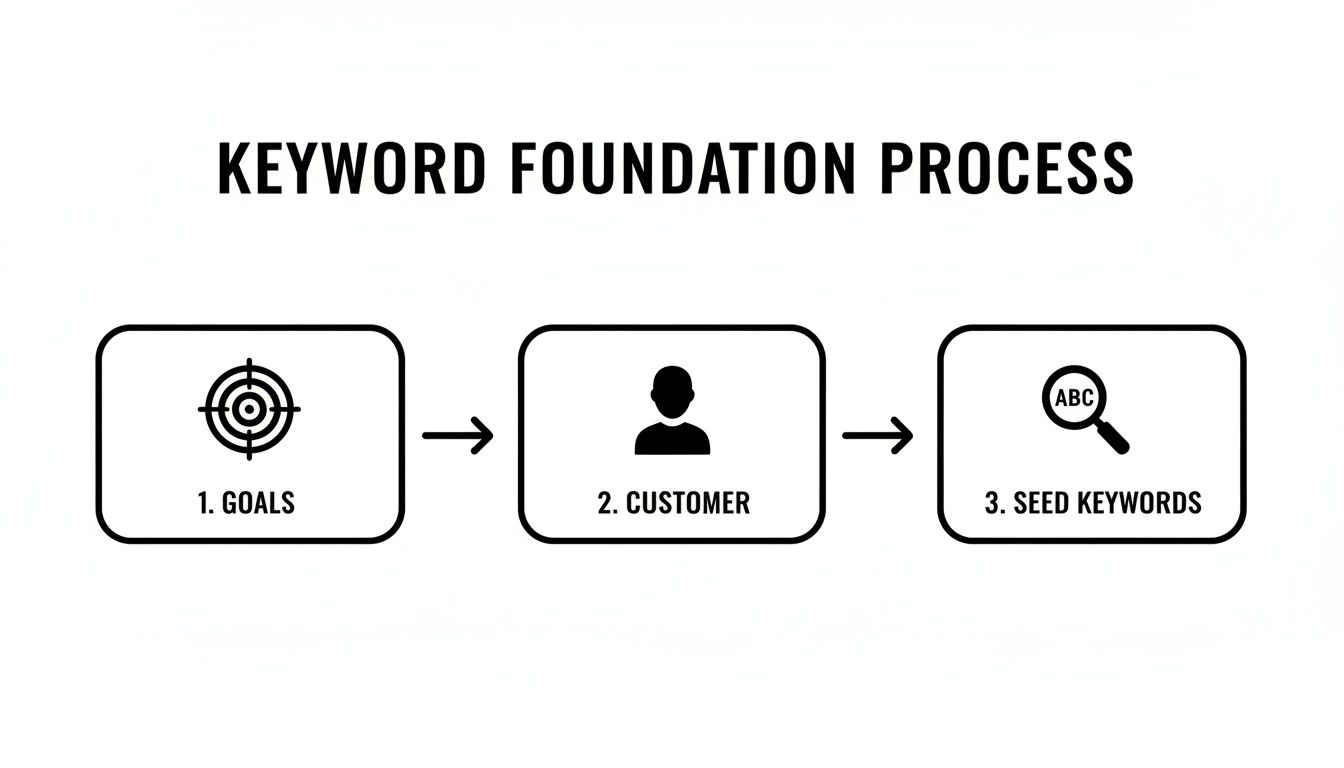
As you can see, a winning strategy always begins with clear business goals and a deep understanding of your customer—long before you ever type a keyword into a search bar.
Start with Google's Free Tools
Google Keyword Planner is the perfect place to start. It's built right into your Google Ads account, and while the search volume data is pretty broad without active campaigns, it’s fantastic for expanding your initial list. Think of it as a brainstorming partner that gives you directional data straight from the source.
Just enter one of your seed keywords, and it will spit out hundreds of related ideas. This first pass helps you map out the broader landscape and spot potential sub-topics you hadn't even considered. The goal here is a high volume of ideas, not perfect data.
Another incredible free resource? Google itself. Type a seed keyword into the search bar and watch the autocomplete suggestions. Those are real-time queries from actual users. Then, scroll to the bottom of the results page and check out the "Related searches." This is an absolute goldmine for understanding user intent and digging up long-tail variations.
Layering in Precision with Low-Cost Tools
Once you have a big, messy list of potential keywords, it's time to get more precise without breaking the bank. This is where you can lean on the free or low-cost tiers of powerful tools like Ahrefs or Semrush. You don't need a full-blown subscription that costs hundreds a month.
These platforms provide much more accurate Keyword Difficulty (KD) scores and search volume estimates. That KD metric is a crucial filter in our process. It gives us a simple score (usually 0-100) that estimates how hard it will be to rank on page one for a term. For a consultant working with small to medium-sized businesses, this is my North Star.
The core of my strategy is simple: filter ruthlessly. I immediately discard high-difficulty keywords, no matter how tempting their search volume looks. Big agencies chase volume; smart consultants chase profitability.
This is where the real work begins. I apply a series of filters to sift through the noise and isolate the high-potential, low-competition terms. My process zeros in on three key areas:
Low Keyword Difficulty: For a new or smaller website, I’ll set the maximum KD to 20 or below. This instantly cuts out the hyper-competitive terms that big brands are bleeding money on.
Long-Tail Phrases: I filter for keywords that are four or more words long. These longer phrases naturally have less competition and signal much stronger user intent.
Question-Based Queries: I specifically hunt for keywords starting with "who," "what," "where," "why," and "how." These signal a user is in the information-gathering stage, making them a prime audience. To really master this, check out these 9 tips for better SEO keyphrase research to refine your approach.
This methodical filtering is how you turn a massive list of maybes into a targeted list of winners. It’s a numbers game. Nearly 95% of all keywords get 10 or fewer searches per month. But more importantly, these long-tail keywords often deliver 2.5 times higher conversion rates compared to shorter head terms. They aren't just easier to win; they're more profitable.
For SMBs and consultants, choosing the right tool is about balancing power with cost. You don't need an enterprise-level suite to find these opportunities.
Lean Keyword Tool Comparison for SMBs
Tool | Best For | Key Feature for Low-Comp Keywords | Cost Level |
|---|---|---|---|
Google Keyword Planner | Initial idea generation & PPC data | "Refine keywords" feature to group ideas by brand, category, etc. | Free |
Ahrefs Webmaster Tools | Technical SEO & basic keyword data | Site Explorer for your own site shows keywords you almost rank for. | Free |
Semrush Free Account | Competitor analysis & keyword lists | Keyword Magic Tool (limited queries) provides excellent filtering. | Freemium |
Ubersuggest | All-in-one on a tight budget | Strong "Questions" and "Comparisons" keyword filters. | Low-Cost |
Ultimately, a lean toolkit forces you to be smarter and more strategic. It's not about the price tag of your software; it's about the process you apply.
By using this approach, you can build a powerful keyword strategy that rivals—and often surpasses—what a bloated agency can deliver. For a deeper dive into my preferred tools, check out our guide on the top PPC competitor analysis tools to outsmart bloated agencies.
How to Manually Vet Keyword Competition Like an Expert

This is where my approach as a consultant completely diverges from a bloated agency. Big firms live and die by their dashboards and automated reports. They’ll hand you a keyword list with a “difficulty” score and call it a day, but those metrics are just numbers—they don’t tell the whole story.
True low-competition opportunities are found by getting your hands dirty and manually dissecting the search results. This is the critical step that separates guesswork from a winning strategy. It's how you validate what the tools are telling you and spot the subtle weaknesses your competitors will never see.
I’ve built a rapid-fire checklist that lets me vet a keyword's real competitive landscape in under five minutes. It’s a process grounded in human observation, not just algorithms, giving you an immediate edge.
Analyzing the Organic SERP in Minutes
Your first move is a simple incognito Google search for your target keyword. The goal is to see what Google actually thinks is the best content for this query. Forget domain authority scores for a moment and look at the results with a critical eye.
Who’s really ranking on page one? Are you seeing massive, household-name brands in every single position? Or is it a mix of smaller blogs, niche forums, and maybe even a few outdated articles? That second scenario is a fantastic sign that the field is wide open.
Big agencies chase keywords dominated by behemoths, forcing you into an uphill battle you can't win. As a specialist, I look for keywords where the top results are good, but not unbeatable. That's the sweet spot where you can create something 10x better and realistically claim a top spot.
Here’s my personal checklist for quickly sizing up the organic competition:
Look for Weak Content: Click on the top 5-7 results. Are the articles thin, poorly written, or visibly outdated? If you see content from 2019 ranking on page one, that keyword is ripe for the taking with a fresh, more detailed piece.
Spot User-Generated Content (UGC): Are there Reddit threads, Quora answers, or niche forum discussions in the top 10? This is a massive green light. It means Google can't find enough authoritative, high-quality content and is resorting to UGC to fill the gap.
Check for Mismatched Formats: Do you see product pages, simple category pages, or directory listings ranking for an informational keyword? This signals a serious content gap. You can easily outrank them by creating a dedicated, in-depth blog post that directly serves the searcher's intent.
This manual review is what an overworked agency account manager simply doesn't have time for. They rely on their expensive tools, but you can get a better, more accurate picture of the competitive landscape for free, just by looking.
Interpreting PPC Competition and Ad Signals
A similar manual check is just as crucial for your Google Ads campaigns. The "top of page bid" estimates in Keyword Planner are a decent starting point, but they don't reveal the quality or intensity of the competition. For that, you need to look at the actual ads currently running.
Search for your keyword and analyze the ads at the top of the page. Are they sophisticated, compelling, and loaded with ad extensions like sitelinks and callouts? Or are they simple, lazy ads with generic headlines?
Weak ads are an opportunity. They show that competitors may be bidding, but they aren't putting much effort into their creative or messaging. A well-crafted ad from a focused specialist can easily steal clicks, even if you aren't the highest bidder. Getting a handle on the nuance between what users search for and what you bid on is key; you can sharpen your approach by understanding the crucial differences between search terms vs keywords for smarter Google Ads.
This hands-on analysis reveals the true commercial intent and competition level before you risk a single dollar of your ad budget.
Finding Achievable Ranking Targets
The entire point of this manual vetting is to find achievable targets. Big agencies often focus on dethroning the top three results, which is an incredibly expensive and difficult task. My strategy is to find keywords where the real opportunity lies just a little further down the page.
The most strategic targets are often keywords where competitors are currently ranking in positions 4-20. While the top three spots get most of the clicks, research shows the traffic difference between the first and fifth positions is 4x, highlighting a significant untapped opportunity. This creates a smarter path for smaller businesses: instead of fighting giants for the top spots, focus on terms where you can realistically break into the middle of the first page and climb from there.
By combining tool data with this expert manual review, you move beyond generic metrics. You start building a keyword strategy based on real-world opportunities.
Alright, you've got a killer list of low-competition keywords you've meticulously vetted. Now what?
Most big agencies would just throw your entire budget at the wall to see what sticks. They’ll start building campaigns for every keyword on the list, burning through cash in the name of "data collection." That's not my style. I take a much more methodical, surgical approach designed to get results from day one.
This is where having a seasoned consultant in your corner really pays off. We’re going to turn that raw list into a prioritized roadmap focused on tangible business outcomes—not just clicks and impressions. It’s all about being smart with every dollar and every hour you invest.
A Simple Framework for Smart Prioritization
To get from a long list to a focused plan, I walk clients through a simple but powerful scoring framework. We’re going to filter every single keyword through the lens of your actual business goals. No complex algorithms, just common sense.
We'll score each keyword on a 1-5 scale across three critical areas:
Business Relevance: How tightly does this keyword align with your most profitable products or services? A "5" is a direct match for a core offer. A "1" is more of a long shot.
Commercial Intent: Is the searcher window shopping, or do they have their credit card out? A query like "emergency plumber cost" is a solid "5" for intent, while "how does plumbing work" is a "1."
Realistic Opportunity: Based on our earlier SERP analysis, how confident are we that we can actually rank or compete for this keyword in a reasonable amount of time?
The keywords with the highest combined score shoot to the top of our list. This quick exercise immediately clarifies where to focus your energy and stops you from chasing keywords that, while tempting, won't actually move the needle.
The real goal isn't just finding low-competition keywords; it's finding the right low-competition keywords. An agency sees a dozen "easy" terms and attacks them all. A consultant helps you find the three that will actually generate sales this quarter.
Agile Testing: The Consultant's Edge
With our prioritized list in hand, we dive into the most important phase: agile testing. This is where we eliminate all the guesswork. Instead of launching a massive, high-stakes campaign based on assumptions, we run small, targeted tests to see what works in the real world.
This is exactly why a nimble consultant can run circles around a bloated agency. We can set up these tests fast, read the results without waiting for three layers of management approval, and pivot on a dime based on what the data is telling us.
How We Test Keywords for PPC Campaigns
For Google Ads, I build out small, hyper-focused ad groups for our top-priority keywords. I'm talking just 3-5 closely related keywords per ad group. This allows us to write ad copy that is incredibly relevant to the searcher's query—a detail big agencies often miss when they lump dozens of keywords into one generic ad group, killing their Quality Score.
We launch these micro-campaigns with a tightly controlled budget. Right now, the goal isn't profit; it's pure data. We need answers to a few key questions:
What's the real-world click-through rate (CTR)?
What's the actual cost per click (CPC)?
And the million-dollar question: what's our conversion rate and cost per acquisition (CPA)?
Within a week or two, we have our answers backed by hard data. The keywords that show a clear path to profitability get more budget. The ones that don't? We pause them. This constant feedback loop ensures your ad spend gets smarter and more efficient over time.
A Smart Plan for SEO Keyword Testing
For organic search, the testing process is similar, but the timeline is longer. We'll take a handful of our highest-priority keywords and build a focused content plan around them. This could mean creating one brand-new, definitive blog post for a specific term and optimizing an existing service page for another.
The key is to concentrate our fire. Instead of publishing 20 mediocre articles and hoping for the best, we create three outstanding pieces of content engineered to be the best possible resource for those specific queries.
Once that content goes live, we watch it like a hawk, tracking initial ranking signals and any new trickles of organic traffic. This targeted approach lets us prove a keyword's value before we commit to a massive content strategy, making sure every move we make is a strategic step forward.
Unpacking Your Low-Competition Keyword Questions
These are the questions I hear all the time from clients trying to find their footing. As an independent consultant, I’ll give you the straight-up answers you won’t get from a big, bureaucratic agency. My job is to give you clarity so you can move forward with confidence.
How Long Until I See Results?
This is the big one, and the honest answer is: it depends entirely on the channel.
With a PPC campaign in Google Ads, you get feedback almost instantly. Clicks and impressions start rolling in right away. But to get a real read on performance—like conversions and your actual cost-per-acquisition—you need to give it a few weeks to collect enough data. Think of it as a marathon, not a sprint.
SEO is a different beast entirely. You might see some movement for super low-competition terms in 4-6 weeks, but it really takes 3-6 months for a new piece of content to fully mature and hit its ranking stride. This is where patience is your greatest asset, building a lead-generating machine that works for you long after you stop paying for ads.
What’s a Good Keyword Difficulty Score to Aim For?
There's no single magic number. "Difficulty" is always relative to your own website's authority.
As a general rule, I tell new or smaller business sites to hunt for keywords with a difficulty score under 20 (using a tool like Ahrefs or Semrush). If your site is brand new, aiming for keywords under 10 is even better. But remember, this score is just a starting point. It’s a guide, not gospel.
A keyword difficulty score is just an estimate from a tool. It's a useful signal, but it should never replace the hands-on SERP analysis I walked you through earlier. I've seen KD 25 keywords that were a cakewalk to rank for because the top results were just plain weak, while some KD 15 keywords were a total slog.
This is exactly where a consultant’s real-world analysis gives you an edge over an agency just spitting out automated reports. I dig into the why behind the numbers.
Can This Strategy Actually Work in a Hyper-Competitive Niche?
Absolutely. In fact, this is where the strategy isn't just useful—it's essential. This is where my approach truly shines.
While you'll never outbid the national players for head terms like "personal injury lawyer," the long-tail keyword landscape is wide open. A big agency will tell you to bring a massive budget to the fight. I’ll show you how to sidestep the fight altogether.
Instead of battling over the same expensive keywords, we go after the highly specific, question-based searches your potential clients are typing into Google right now. Things like:
"what to do after a minor car accident with no injuries"
"how to calculate settlement for slip and fall"
"do I need a lawyer for a rear-end collision"
Sure, these have lower search volume. But the person searching has an urgent, specific problem. Their intent is sky-high. This approach brings in far better leads, crushes your cost-per-acquisition, and carves out a profitable space the big guys completely ignore. It's about working smarter, not just spending more.
Tired of overpaying for hyper-competitive keywords? Let Come Together Media LLC show you a smarter way to win on Google Ads. Book your free, no-obligation consultation today and discover the hidden opportunities in your niche.


Comments