


Are you pouring over $25,000 a month into PPC and still chasing predictable returns? You're not alone. I’ve seen it countless times. The real problem often isn't your ads, but a fundamental misunderstanding between SEO (building a long-term asset) and SEM (driving immediate, scalable results). This isn't just semantics; it's a strategic choice that bleeds your bottom line every single day.
After a decade deep in the trenches of Google Ads, I’ve seen this exact scenario play out with businesses just like yours. They burn cash by betting on the wrong horse or, worse, by trusting an overpriced agency that sticks a junior account manager on their file. You end up paying for their fancy office and getting a generic playbook in return—a broken model that serves their profits, not your ROI.
This guide cuts through that noise. It's a straightforward framework for fractional CMOs and entrepreneurs to decide which lever to pull and when. The end goal is sustainable, profitable growth, not vanity metrics and busy work. Getting this right is the first step toward building a marketing engine you can actually depend on.
The Core Conflict: Speed vs. Equity
The strategic tension boils down to this: SEM buys you speed, while SEO builds you equity.
With paid search, you can launch a campaign this morning and see leads roll in by the afternoon. It's an incredibly potent tool for instant traction and market testing. But the second you turn off the spend, the traffic vanishes. It's a tap you can turn on and off.
SEO, on the other hand, is like buying a piece of digital real estate. It's a slower, more deliberate game of building authority and earning Google's trust. The work you put in today—the content, the technical fixes, the backlinks—pays dividends for months and even years, generating traffic without a direct cost-per-click attached.
Actionable Takeaway: Pull up your marketing budget. If you see over 90% of your spend locked into either SEO or SEM exclusively, your strategy is dangerously imbalanced. A heavy SEM dependency means you're renting all your traffic, while a pure SEO focus means you're leaving immediate revenue on the table.
The question isn't about which one is "better." It's about which one serves your immediate needs and long-term vision. For a deeper dive into this, check out my guide on paid search vs SEO for smarter growth.
At a Glance: SEO vs. SEM Decision Matrix
Let's strip away the jargon and get straight to what matters for your P&L. Use this matrix as a quick reference to frame your strategic thinking and make smarter decisions, fast.
Decision Factor |
SEO (Search Engine Optimization) |
SEM (Search Engine Marketing) |
|---|---|---|
Primary Goal |
Build a long-term, sustainable digital asset and brand authority. |
Drive immediate, targeted traffic and generate leads or sales quickly. |
Time to Results |
6-12+ months for significant, competitive results. |
Immediate (results appear as soon as campaigns are live). |
Primary Cost |
Investment in expertise, content creation, and technical optimization (labor). |
Direct ad spend paid to search engines (e.g., Google) per click. |
Core Metric |
Organic traffic growth, keyword rankings, and organic conversion rate. |
Return on Ad Spend (ROAS), Cost Per Acquisition (CPA), and conversion volume. |
Ultimately, this isn't an either/or choice. The most sophisticated marketing engines run on a smart integration of both. The key is knowing which one to lean on at each stage of your growth. As a specialist, my job is to craft that integrated strategy, ensuring you’re not just spending money, but building a real business asset.
SEO vs. SEM: Defining the Battleground
Let's get one thing straight. People use SEO and SEM interchangeably all the time, and that simple mix-up is probably costing you a small fortune. Knowing the real difference isn't just semantics; it's the first step to building a strategy that actually drives profit instead of just burning through your marketing budget.
Think of it like this: Search Engine Marketing (SEM) is the whole game—every single tactic you use to get traffic from search engines. Search Engine Optimization (SEO) is a critical piece of that game, but it's the organic, unpaid part.
In the real world, though, most pros (myself included) use "SEM" as shorthand for the paid side of the street: Google Ads, also known as pay-per-click (PPC). For our purposes, that's how we'll talk about it.
SEO: The Long-Term Digital Asset
SEO is all about earning visibility—not buying it. It’s the slow-and-steady work of building a valuable asset that pays dividends for years. Think of it as buying prime real estate online. You're not just renting space for a month; you're building equity that generates traffic long after the initial work is done.
The whole point of SEO is to prove to search engines that your site is the most relevant, authoritative answer to a user's query. This work falls into two main buckets:
On-Page SEO: This is everything you control directly on your website. We're talking about optimizing service pages with the right keywords, publishing genuinely helpful blog posts, crafting clear title tags, and making sure your site loads lightning-fast. It's about making your site crystal clear for both people and search engine crawlers.
Off-Page SEO: This is all about building your site's reputation across the web. The big one here is earning backlinks—getting other credible websites to link to yours. Every quality backlink acts like a vote of confidence, telling Google your site is a trusted source.
It's also crucial to remember that SEO isn't static. Staying ahead means understanding how new challenges are changing the game, like mastering SEO for products in the AI era. If you’re not adapting, you’re falling behind.
SEM: Your High-Speed Lane to Visibility
Paid search, or SEM, is your express lane. It's like putting up a billboard on a digital superhighway—you pay the toll and get immediate, highly-targeted traffic for as long as your budget lasts. When you need leads or sales right now, this is the lever you pull.
As a PPC consultant, this is my world. I don't run a bloated agency that hands your account off to a junior analyst. I focus on the critical few activities that actually drive results from your ad spend.
A well-run paid search campaign isn't about getting the most clicks. It's about getting the right clicks from users ready to convert, and doing so at a cost that guarantees a positive Return on Ad Spend (ROAS). Anything else is just noise.
The key paid search activities I manage personally include:
Strategic Keyword Bidding: We don't just throw money at keywords. We hunt for high-intent phrases that signal a user is pulling out their wallet. This is how you outflank competitors who are just burning cash on vague, top-of-funnel terms.
Compelling Ad Copy Creation: Your ad is your digital handshake. It has to instantly connect with a user's problem and present your solution so clearly that they have no choice but to click your ad over the others on the page.
Landing Page Optimization: Getting the click is only half the job. Your landing page has to deliver on the ad's promise and make it ridiculously simple for a visitor to convert—whether that’s filling out a form or completing a purchase.
Ruthless Performance Analysis: This is a constant process of monitoring metrics that actually matter, like Conversion Rate and Cost Per Acquisition (CPA). We then reallocate budget away from what isn't working and double down on the winners.
This distinction is everything. SEO builds your long-term foundation; paid search drives your immediate revenue. Knowing when and how to use each is what separates the businesses that struggle from the ones that dominate their market.
Your Strategic Playbook: When to Deploy SEO vs. SEM
There’s no such thing as a one-size-fits-all marketing strategy. A B2B SaaS startup needs a completely different playbook than an established e-commerce brand. Stop listening to generic agency advice that ignores your business context.
The real work is making smart choices based on your goals, budget, and timeline. Are you building the long-term equity of SEO, capturing immediate demand with SEM, or blending both? It's about making the right trade-offs, without the agency bloat.
When to Go All-In on SEM (Paid Search)
You prioritize SEM when speed is everything. It’s the right move when you need immediate market feedback, a steady flow of leads, or a way to capitalize on a time-sensitive offer. If you’re not seeing traffic by the end of the day, something’s broken.
An aggressive, SEM-first approach makes sense when:
You're launching something new. You have zero brand recognition or organic traffic. SEM lets you instantly test your messaging, see if anyone actually wants what you're selling, and start generating revenue while SEO gets off the ground.
You have a high-ticket, high-intent offer. Think of emergency services like water damage restoration. When someone has an urgent, expensive problem, you must be at the top of the search results. Paying for a click is a tiny cost for a $10,000 job.
You're running a time-sensitive promotion. A Black Friday sale or a seasonal discount needs a massive, targeted traffic surge, right now. SEM lets you turn on the firehose for a specific window and shut it off the second the promotion ends.
When to Double-Down on SEO (Organic Search)
You prioritize SEO when you're building a defensible, long-term asset. This is the play for businesses that want to become the undisputed authority in their niche. SEO is all about compounding returns and systematically lowering your customer acquisition cost over time.
An SEO-heavy strategy is the right call when:
Your business relies on informational content. If your customers do a ton of research before they buy—like for financial planning or enterprise software—a deep library of genuinely helpful, optimized content is your most powerful sales tool. SEO makes you the expert they trust.
PPC costs in your market are insane. If the Cost-Per-Click (CPC) for your main keywords is prohibitively expensive, winning organically is the only way to survive long-term. A strong SEO presence becomes a huge competitive advantage and a moat around your business.
You want to maximize your company's value. A business that gets 50% of its leads from organic search is fundamentally more stable and valuable than one that’s 100% dependent on paid ads. SEO is an asset that shows up on your balance sheet.
This decision tree cuts through the noise. Are you playing the long game for sustainable growth, or do you need traffic and sales now?
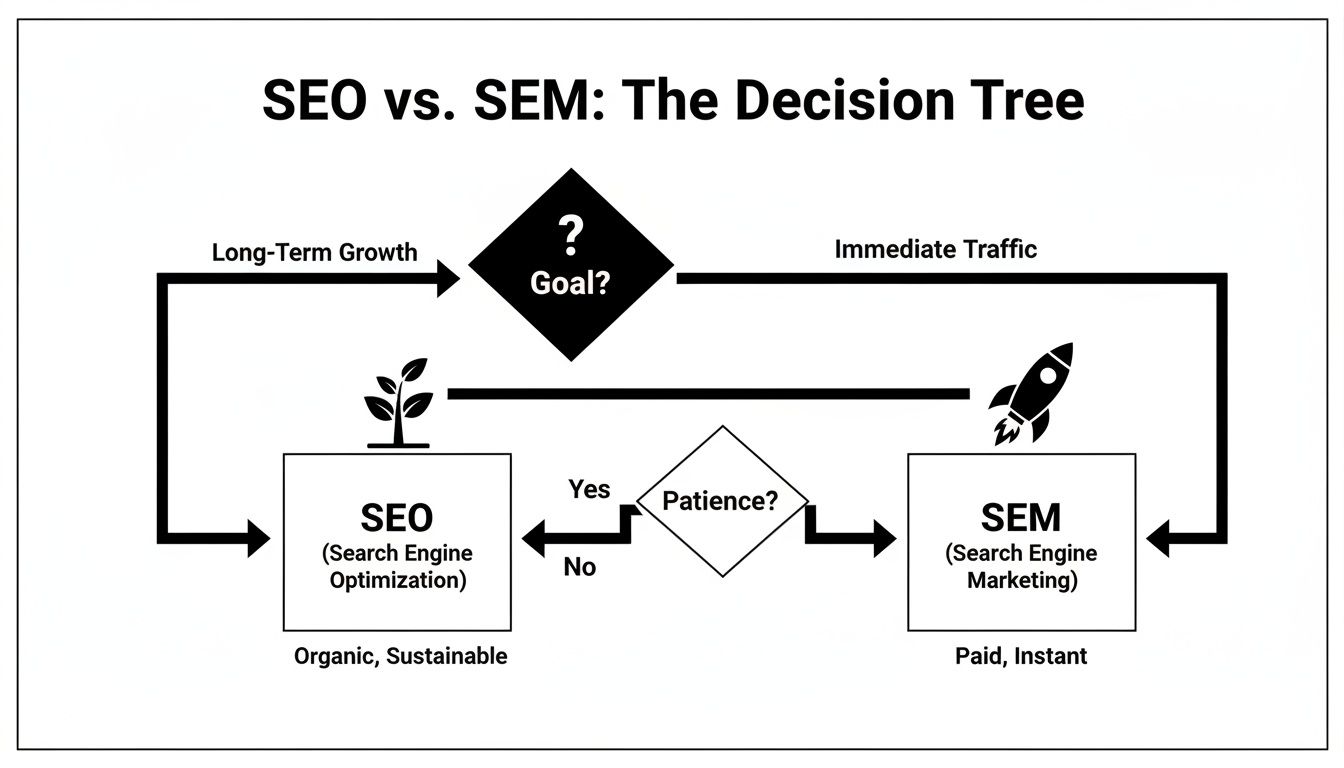
This forces you to declare your primary objective before you spend a single dollar.
The Hybrid Approach: The Ultimate Flywheel
The smartest operators know this isn't an "either/or" question. A hybrid strategy is how you truly dominate a market.
Think about a local law firm. They can run hyper-targeted SEM ads to capture immediate, high-intent leads for terms like 'car accident lawyer near me'. At the same time, they build long-term authority with SEO content like 'What to Do After a Minor Car Accident'. One feeds the other.
Actionable Takeaway: Use your SEM campaign data to de-risk your SEO strategy. Look at your Google Ads account. Which keywords and ad copy have the highest conversion rates? Those are proven winners. Use them to prioritize which pages and topics to build out for your SEO efforts. You get a data-backed roadmap to organic success.
This integration is where the magic happens. Your paid search data provides invaluable, real-time insights that you can pour directly into your long-term organic strategy. It's a synergy that most bloated, siloed agencies completely miss.
For a deeper look into this process, check out our guide on how to build a keyword list for SEO success.
Measuring What Matters: The KPIs That Drive Business Growth
Stop listening to agency-speak. Vanity metrics like impressions, clicks, and even a low Cost-Per-Click (CPC) are distractions, often used to make an account manager look busy. As a specialist who lives and dies by your P&L, I cut straight through that noise.
If a metric doesn't tie directly to revenue or profitable growth, it's irrelevant.
Your marketing partner should be obsessed with the numbers that actually move your business forward, not the ones that pad their monthly reports. This is all about accountability. When you zero in on the right Key Performance Indicators (KPIs), you can tell immediately if your investment in SEO and SEM services is paying off.
SEM KPIs That Directly Impact Your Bottom Line
For paid search, the conversation must start and end with profit. Any discussion that revolves solely around clicks or traffic is a major red flag. I’ve taken over countless accounts spending tens of thousands a month where the previous agency celebrated a low CPC while the client's Cost Per Acquisition was bleeding them dry.
These are the only SEM metrics that should command your attention:
Return on Ad Spend (ROAS): This is the ultimate benchmark for PPC success. For every dollar you put into ads, how many dollars in revenue are you getting back? If you spend $5,000 and generate $25,000 in sales, your ROAS is 5x. Anything less than a clear, profitable ROAS is simply unacceptable.
Cost Per Acquisition (CPA): How much does it cost you to land one new customer or qualified lead? Knowing your target CPA is non-negotiable. If your product has a $200 profit margin, a $250 CPA means you're literally paying to lose money on every single sale.
Conversion Rate: This metric tells you how effective your ads and landing pages are at turning clicks into customers. A low conversion rate often signals a disconnect between your ad's promise and the landing page experience—a fixable problem a true specialist will spot immediately.
From the Trenches: A B2B software client was burning $30,000/month and getting nowhere. Their agency kept reporting great "traffic growth," but sales were completely flat. We flipped the entire strategy to focus on hitting a target CPA of $400. By ruthlessly cutting low-intent keywords and overhauling their landing pages, we cut their lead volume by 30% but increased qualified sales demos by 70% within two months. They spent less to make significantly more.
SEO KPIs Beyond Basic Rankings
With SEO, the goal is to measure your progress toward becoming a dominant, traffic-generating asset for the business. While keyword rankings are a useful leading indicator, they don't tell the whole story. Ranking #1 for a term that drives zero qualified leads is a pointless vanity project.
Instead, we have to track the metrics that demonstrate tangible business impact:
Organic-to-Lead Conversion Rate: Are the visitors arriving from organic search actually turning into leads or customers? This is the SEO equivalent of CPA and the truest measure of your content's value.
Keyword Visibility for High-Intent Queries: It’s not about ranking for thousands of vague terms. It’s about owning the top spots for the commercial-intent keywords your ideal customers use right before they’re ready to buy.
Backlink Profile Authority: Are you earning links from respected, relevant sites in your industry? A growing number of high-quality backlinks is a direct measure of your site's authority and long-term ranking power. To dive deeper into this, you can learn about measuring your return on marketing investment in our practical guide.
The game is changing, too. With AI Overviews projected to appear in 60% of U.S. Google searches by November 2026 and ChatGPT fielding billions of queries, the very definition of "success" is evolving. This shift means a diversified SEO and SEM strategy is more critical than ever, as the rise of the Search Generative Experience (SGE) could significantly reduce clicks to traditional organic results.
Creating a Flywheel: How SEO and SEM Services Work Together
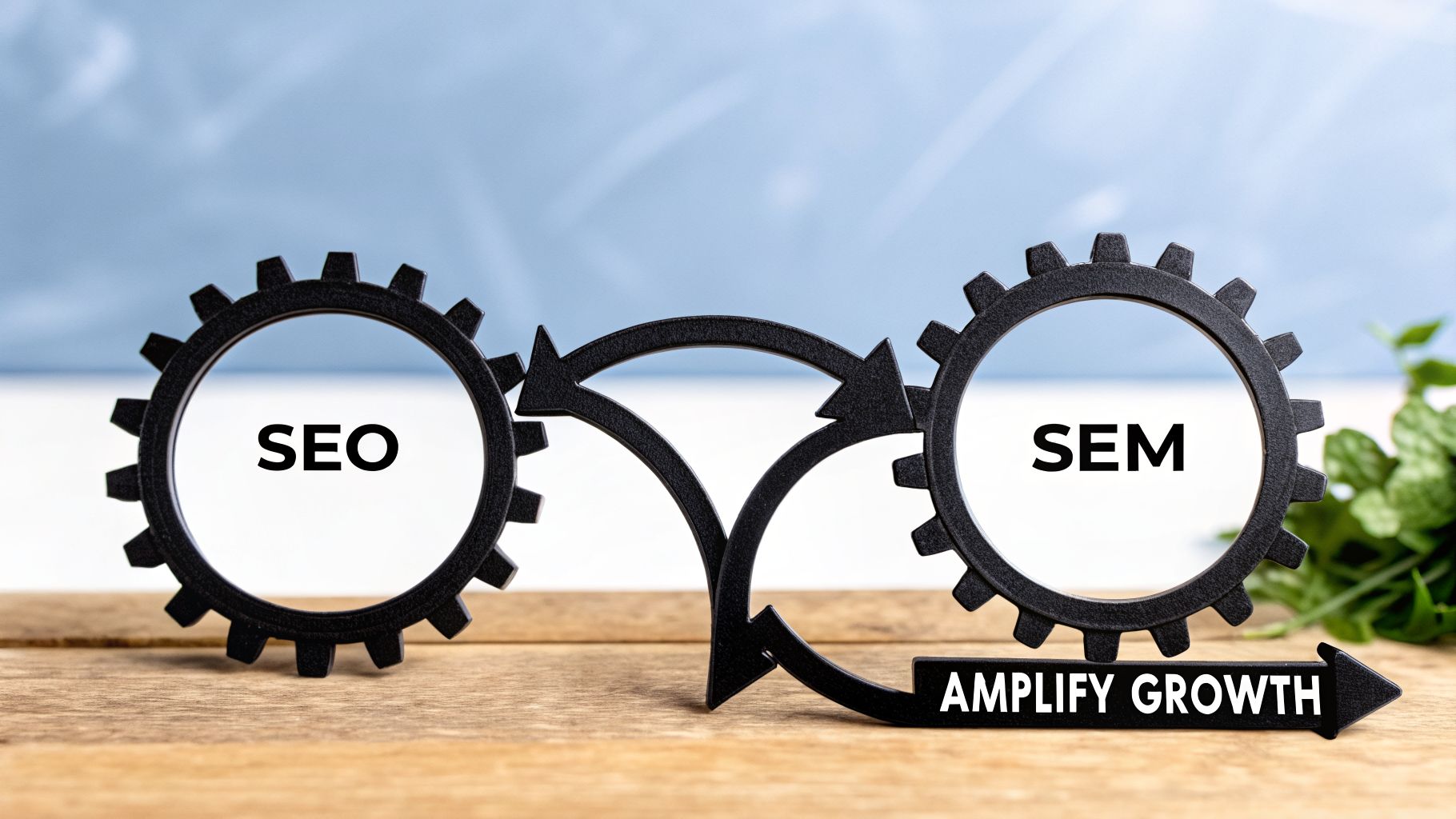
The whole "SEO vs. SEM" debate is a false choice. It's usually pushed by siloed agency teams who can't see the bigger picture. Choosing one over the other is like trying to row a boat with one oar—you'll just spin in circles. The sharpest marketers I know don't choose; they build a powerful flywheel where each discipline makes the other one stronger.
This isn't just about running two separate campaigns in parallel. It’s about building a system where paid and organic search feed each other, creating a force multiplier for your marketing budget. This is the strategic integration that high-growth companies nail, and the one that generalist agencies with their rigid departments almost always miss.
Use SEM to Fuel Your SEO Strategy
Think of paid search as the ultimate market research lab. Every dollar you spend on Google Ads buys you priceless, real-time data on what customers actually search for, what messaging makes them click, and which offers get them to convert.
Using this data to guide your SEO strategy isn't just a good idea; it's how you de-risk your entire long-term content investment. Stop guessing which keywords to target. Instead, mine your Google Ads reports for proven winners.
Find High-Converting Keywords: Pull your search terms report. Isolate the keywords driving actual sales and sign-ups—not just vanity clicks—and make them the top priority for your SEO content calendar.
Test Ad Copy for Meta Descriptions: Your best-performing ad copy is a battle-tested blueprint. Use it to write compelling meta titles and descriptions that you know will earn clicks in the organic results.
Uncover New Content Topics: Look for clusters of related search queries that signal a user's need for deeper information. These are perfect candidates for your next long-form blog post or in-depth resource page.
This approach strips the guesswork out of SEO. You're no longer throwing content against the wall to see what sticks; you're making calculated moves backed by hard data.
Let SEO Lower Your Paid Search Costs
The flywheel spins both ways. A strong organic presence, built through consistent SEO work, directly improves your paid search campaigns. The result? Better performance and a lower cost per acquisition.
A strong organic ranking for a given keyword signals to Google that your site is a relevant, authoritative result for that search. This directly boosts the Quality Score of your paid ads for that same keyword, which can dramatically lower your cost-per-click (CPC) and improve your ad position.
Basically, Google rewards you for delivering a great user experience. A higher Quality Score means you can outrank competitors, even when they’re bidding more than you.
By dominating both the paid and organic results for your most important terms, you build massive brand credibility and push your competitors further down the page. It's a two-pronged attack for owning your market. You can dive deeper into the mechanics of how to integrate SEO and paid search to maximize your ROI in our dedicated playbook.
The global SEO services market is set to explode from $81.46 billion in 2024 to $108.28 billion by 2026. That's a massive 32.9% jump. If you're already pouring money into PPC, ignoring the organic side of the equation is a costly mistake. As the latest SEO statistics show, a combined approach is the only reliable path to sustainable growth.
Finding a True Partner, Not Just Another Agency
If you’ve managed a decent ad budget, you know the feeling. You sign a steep retainer, get passed to a junior account manager with a playbook, and receive reports packed with vanity metrics.
The brutal truth? You’re not paying for expertise. You're funding their office snacks, their sales team's commission, and their bloated overhead.
You don't need another agency. You need a specialist. A true partner whose own reputation is on the line with your ROI. That’s the difference between hiring a faceless firm and working with an independent consultant—you get direct access, a custom strategy, and zero bureaucracy slowing things down.
Vetting a Specialist: The Questions That Cut Through the Noise
When you're vetting a potential partner for your SEO and SEM, you have to get past the sales pitch. Forget the glossy case studies and logos of past clients. Your only goal is to find out if they're a strategic thinker or just a button-pusher.
These are the questions that reveal the truth:
"How do you define success for a campaign like this?" The only acceptable answer involves ROAS, CPA, and your actual business goals. If they lead with clicks or impressions, they don't get it. End of conversation.
"Walk me through your exact process for the first 30 days." A real pro will talk about digging into your account history, running a competitive analysis, and locking down conversion tracking. A pretender will mumble something vague about "optimization" and "testing."
"Who, specifically, is doing the day-to-day work?" With a consultant, the answer is simple: "I am." At an agency, you have to push past the senior salesperson to see if you’re actually getting a seasoned expert or a recent grad.
A partnership thrives on direct communication and accountability. When the person who builds your strategy is also the one executing it, you eliminate the communication breakdowns and delays that plague the traditional agency model.
Red Flags That Scream "Run Away"
I've seen it all, and the warning signs are always the same. Spotting these early will save you a fortune in wasted ad spend and months of pure frustration.
Be wary of anyone who:
Guarantees results or #1 rankings. Nobody can guarantee rankings on Google. Period. Anyone who says they can is either lying or using black-hat tactics that will eventually get your site torched.
Is cagey about reporting or access. You must have 100% ownership and full admin access to your ad accounts. Vague reports or a "proprietary" dashboard are massive red flags. They're hiding poor performance.
Lacks a clear strategic viewpoint. If they can't give you a specific, data-backed reason for every recommendation, they’re just guessing with your money.
Actionable Takeaway: In your next meeting with an agency—current or potential—ask them to explain one recent change they made and tie it directly to your ROAS. If they can't connect their actions to your profit, it’s time to find someone who can.
Frequently Asked Questions
You’ve got questions. I’ve got answers forged from years managing high-stakes PPC accounts. Let's skip the agency song-and-dance and get straight to what you need to know.
Should I Pause SEO While Running an Aggressive SEM Campaign?
Absolutely not. I see this all the time, and it's a huge, costly mistake. Hitting pause on your SEO while you're spending on ads is like stopping construction on a house you own to go rent an expensive apartment. You’re sacrificing long-term equity for short-term visibility.
The smart money uses data from paid campaigns—like the exact keywords and ad copy that convert—to make your SEO strategy sharper and more effective. Plus, a strong organic ranking builds brand credibility, which in turn makes people more likely to trust and click your paid ads. They work together to own the search page, not compete with each other.
How Long Does It Realistically Take to See SEO Results?
Any consultant who gives you a fixed date without a deep-dive audit is selling you a pipe dream. Real SEO doesn't happen overnight.
That said, you should see leading indicators of progress within 3-6 months. This looks like better rankings for long-tail keywords and a clear lift in organic traffic. But for the big, business-moving wins—page-one rankings for your most competitive, high-value keywords—you're typically looking at a 6-12 month timeline of consistent, focused work. SEO is a marathon that builds a competitive moat; SEM is the sprint that gets you sales today.
SEO builds an asset. SEM rents an audience. Never sacrifice one entirely for the other. A balanced approach ensures you are building long-term value while capturing immediate revenue opportunities.
Is One Agency for Both SEO and SEM Better Than Separate Specialists?
The best setup is almost always dedicated specialists who actually talk to each other. It's incredibly rare for one agency to be truly elite at both SEO and SEM. One is usually their core service, and the other is a B-team add-on. When you're trying not to incinerate your marketing budget, finding the right ecommerce agency or solo expert is critical.
Hiring a dedicated PPC specialist and a separate SEO pro gets you top-tier talent for each discipline. The secret is making sure they collaborate. As a PPC consultant, I’m constantly syncing with my clients' SEO teams to share performance data and align our strategies. This "best of both worlds" approach consistently smokes a single, generalist agency every time.
Tired of the agency runaround and ready for a true PPC partner? I work directly with founders and CMOs to build and manage Google Ads campaigns that are ruthlessly focused on one thing: your return on ad spend. With Come Together Media LLC, you get a dedicated specialist, not another junior account manager.
Book a free, no-obligation strategy session today at https://www.cometogether.media.
