


Hiring a pay per click management company based on size is how advertisers end up paying for process instead of performance.
Big teams, channel sprawl, and polished decks look reassuring in a sales call. In the account, they often create something worse: slow approvals, blurred ownership, and junior execution hidden behind senior strategy talk. That gap is expensive for any SMB. In regulated healthcare, it also creates oversight risk. A missed policy issue, weak search query control, or bad conversion setup can waste budget and create compliance problems at the same time.
The problem is not PPC. The problem is who is steering the account, how often they are inside it, and whether anyone is checking for hidden waste before spend slips out through broad match, duplicate queries, stale ad copy, and broken lead tracking.

A serious buyer should care less about agency packaging and more about control points. Who adjusts bids and budgets each week? Who reviews search terms? Who catches tracking failures before a month of reporting becomes useless? Who understands healthcare restrictions well enough to prevent avoidable disapprovals and messy handoffs to legal or compliance teams?
That is why specialist-led management usually beats generalist agency layers. You get faster decisions, clearer accountability, and fewer blind spots between strategy, execution, and reporting. If you want a simple platform-level refresher on PPC marketing Google, review that first, then judge providers on whether they can apply it under real budget pressure. If you are weighing a consultant model against a larger shop, this guide to agency versus specialist PPC support gives useful context for what direct ownership should look like once spend is meaningful.
Introduction
The standard agency pitch is simple. More people, more resources, more channels, more value.
I don’t buy it.
A pay per click management company should be judged by account control, speed of optimization, reporting clarity, and commercial judgment. Not headcount. Not branding. Not how many services sit on a menu.
The real frustration behind agency churn
Most frustrated advertisers tell the same story.
The sales process feels senior. The ongoing work doesn’t. After onboarding, they get moved to an account manager who relays questions to a buyer, who relays questions to someone else. By the time changes happen, the auction has already moved.
That delay matters when you’re managing live spend.
Practical rule: If the person selling the strategy isn’t the person steering the account, ask who is making bid, budget, and query decisions every week.
The larger your budget gets, the less tolerance you should have for vague ownership. If you’re in healthcare, tolerance should be even lower. Policy mistakes, weak negative keyword control, and careless tracking setups can create waste and compliance headaches at the same time.
What a serious buyer should expect
You should expect a partner who can do four things without drama:
Audit fast and tell you where money is leaking.
Explain strategy plainly without hiding behind dashboards.
Own performance decisions instead of blaming platform volatility for everything.
Work inside constraints such as healthcare policies, CRM limitations, and internal approval cycles.
That’s the lens for the rest of this guide. If a provider can’t meet that standard, they’re not a fit. It doesn’t matter whether they call themselves a consultant, boutique firm, or pay per click management company.
Evaluating PPC Management Company Options
A bigger PPC market has created a bigger screening problem.
More firms now call themselves a pay per click management company. Plenty can launch campaigns. Far fewer can protect budget, catch tracking failures early, and make sound decisions inside regulated categories like healthcare. That gap is where SMBs lose money. Not only in wasted clicks, but in slow approvals, bad attribution, weak search term control, and compliance mistakes an agency rarely mentions in the pitch.
Agency model versus specialist model
You’re usually choosing between two operating models.
The first is the standard agency setup. Sales leads the pitch. Strategy gets summarized in a handoff. Day-to-day changes pass through layers. That structure looks organized, but it often adds delay right where speed matters most.
The second is the specialist model. One senior operator, or a small senior-led team, handles account strategy and execution directly. For SMBs and healthcare practices, that is usually the better bet. Read this comparison of specialist consultant vs in-house or agency marketing models if you want a blunt breakdown of the tradeoff.
I’d choose the specialist setup for most Google Ads accounts unless the account needs broad cross-channel production and multiple dedicated workstreams.
The reason is simple. PPC performance depends on judgment applied quickly. Search queries change, lead quality shifts, call tracking breaks, policies get flagged, and budget can drift before the weekly report even lands. A layered team reacts slower. You pay for that lag.
What to test before you hire anyone
Skip polished process talk. Test operational control.
Ask how they structure campaigns and why. A capable operator should explain how they separate intent, service lines, locations, device priorities, and conversion actions. Healthcare advertisers should push further. Ask how they split campaigns for branded queries, high-risk policy terms, and services that require tighter messaging review. If the answer is generic, the work will be generic too.
Ask who is inside the account every week. You need names and responsibilities, not job titles floating in a workflow chart. Who reviews search terms? Who changes bids and budgets? Who checks conversion tracking after site updates? Who handles disapprovals? If those answers are fuzzy, oversight is weak.
Ask how they handle lead quality, not just cost per lead. SMBs get trapped here all the time. The dashboard says performance improved while the sales team says leads are junk. A serious PPC operator has a method for reconciling ad platform conversions with CRM outcomes, call reviews, or intake feedback. Without that loop, optimization gets pointed at the wrong target.
Hidden costs agencies gloss over
In these situations, buyers get careless.
A proposal may show one management fee, but the complete cost sits in the gaps around execution. Slow response time during budget swings. No one checking search terms often enough. Conversion actions firing twice. Broad match expansion with weak negatives. Landing page edits stuck in another department. Healthcare copy getting disapproved because nobody accounted for policy nuance before launch.
Those are management failures, not platform problems.
For SMBs, the practical framework is straightforward. Judge the provider on four control points:
Decision speed: How fast can they make and publish meaningful changes without internal delays?
Visibility: Can they show spend, search terms, conversion paths, and lead quality clearly?
Constraint handling: Can they work within healthcare policies, CRM limitations, and approval bottlenecks?
Account ownership: Does your business control the ad account, tracking setup, and connected data sources?
If a firm is weak on any of those, expect waste.
Healthcare buyers need a stricter filter
Generalist agencies like to say they serve healthcare. That claim means very little.
A clinic, dental group, behavioral health provider, med spa, or specialty practice needs someone who understands policy review, restricted language, location targeting sensitivity, intake friction, and the limits of tracking in privacy-conscious environments. The wrong operator will apply ecommerce habits to a regulated account and call it modern strategy. That usually means loose match types, careless audience usage, aggressive copy, and reporting that hides what happened after the form fill.
You also need channel discipline. If you are comparing broader creative partners across paid media, this article on choosing a video ads agency makes a useful parallel point. More channels do not fix weak operator judgment.
Required checks before signing
Use this as a hard filter:
Full ownership of platforms and data: Your business should own Google Ads, GA4, Tag Manager, Merchant Center, call tracking, and CRM access.
Direct contact with the operator: You should be able to speak with the person making account changes.
Lead quality reporting: Reports should connect ad activity to qualified leads, booked appointments, revenue, or another real business outcome.
Search term and tracking discipline: They should explain how often they review queries, test conversion accuracy, and catch tracking breaks.
Healthcare-specific judgment when relevant: They should be able to discuss policy limitations, sensitive categories, and approval risk without guessing.
A pay per click management company becomes expensive when it hides the people, the process, and the account details that drive results. The right partner gives you control, fast decisions, and clear accountability.
Understanding Pricing Models for PPC Management
Cheap PPC management often costs more than expensive PPC management.
The reason is simple. Agencies rarely lose money when your account underperforms. You do. If the pricing model rewards activity, extra spend, or vague “optimization,” expect more motion than accountability. That gap gets worse for SMBs and regulated healthcare practices, where bad judgment carries added costs such as compliance risk, poor lead quality, and wasted front-desk time.
Pricing should answer one question first. What behavior does this fee structure encourage?
What the market actually sells
As noted earlier, PPC fees vary widely across the market. That range matters less than the incentives baked into the contract.
Most providers sell one of four models:
Flat monthly retainers
Percentage of ad spend
Performance-based pricing
Hybrid structures
These are not interchangeable. Each one pushes the operator toward a different set of decisions. If you run a local service business or healthcare practice, that difference shows up fast in lead quality, query control, and how aggressively the account gets scaled.
Comparison of PPC Management Pricing Models
Model |
Fee Structure |
Pros |
Cons |
|---|---|---|---|
Flat retainer |
Fixed monthly management fee |
Predictable billing, easier budgeting |
Weak accountability if scope and output are loosely defined |
Percentage of ad spend |
Fee rises as media spend rises |
Simple to calculate, common in agency proposals |
Encourages budget growth, even when efficiency should come first |
Performance-based |
Compensation tied to defined outcomes |
Better alignment if attribution is accurate |
Breaks down fast when lead quality or tracking is disputed |
Hybrid |
Base fee plus performance bonus |
Gives the operator stable coverage and a reason to improve results |
Requires precise definitions, reporting access, and dispute rules |
Percentage of spend is the agency-friendly default
This model survives because it is good for agencies, not because it is good for clients.
If your provider earns more as budget rises, they need strict constraints. Otherwise, every expansion looks justified. More campaign types. Broader keyword coverage. More testing. More spend. The account gets busier while profitability gets harder to read.
That is a serious oversight gap for SMBs. It is worse in healthcare. A clinic does not need more leads that fail intake, miss insurance criteria, or create policy review issues. It needs qualified appointments. Percentage pricing rarely puts enough pressure on that distinction.
Performance pricing only works when definitions are tight
“Pay us for results” sounds good on a sales call. It fails when nobody agrees on what a result is.
A form fill is not the same as a qualified lead. A phone call is not the same as a booked consult. For regulated practices, a lead that cannot be served is not performance. It is admin burden.
Use performance pricing only if you define the commercial terms before launch. That means:
Primary success metric Tie compensation to one business outcome. Use revenue, qualified leads, or booked appointments. Do not mix five goals into one bonus formula.
Source of truth Pick the system that settles disputes. CRM data usually beats ad platform reporting. GA4 can support analysis, but it should not become a loophole.
Qualification rules Spell out what makes a lead count. Geography, insurance fit, service eligibility, intake completion, and spam exclusions should be written into the agreement.
Ramp period New campaigns need time to stabilize. Set the timeline in advance so neither side argues over week-one noise.
Exclusions Broken forms, missed calls, scheduling bottlenecks, and sales follow-up failures should not inflate or suppress the PPC manager’s compensation.
Decision test: If the pricing model makes lead quality hard to verify, reject it.
What I recommend
For most SMBs, the best structure is a base fee plus a tightly defined bonus tied to qualified outcomes. That gives the specialist enough stable revenue to do real work, while still forcing performance accountability.
For healthcare advertisers, tighten it further. Use qualified consults, accepted patient leads, or another screened downstream metric. Do not use raw lead counts. They are easy to inflate and expensive to clean up.
If you want a useful reference point, this guide to PPC management pricing for real results explains how scope, accountability, and fees should line up.
One option in this category is Come Together Media LLC, which offers Google Ads consulting, audits, setup, and ongoing optimization for businesses that want direct specialist involvement rather than a layered agency structure.
Price matters. Incentives matter more. If the contract rewards spend growth and hides quality control, your PPC management company is billing for risk you still carry.
Building Your Audit Checklist
A PPC account can look busy and still be badly managed.
Plenty of campaigns have impressions, clicks, conversions, and polished dashboards while leaking budget through poor architecture, weak negatives, and bad tracking. That’s why audits matter. Not once a year. Routinely.
According to Improvado, agencies that enforce a structured audit cadence report 25 to 40% ROAS uplift versus reactive teams. That result comes from preventing quality score decline, auction pressure shocks, and avoidable waste.
Daily checks that stop waste early
This is often where most accounts fall down. Small problems get ignored because they don’t look dramatic at first.
Review these every day:
Bid movement: Watch for sudden changes in average CPC, impression loss, or unstable automated bidding behavior.
Search terms: Pull irrelevant queries fast. This matters even more if broad match is active.
Negative keyword updates: Don’t wait for the monthly report. Add exclusions as soon as patterns show up.
Budget pacing: Check whether strong campaigns are capped while weaker ones are still spending.
The goal isn’t more activity. It’s tighter control.
Weekly reviews that improve signal quality
Every week, look beyond raw spend and ask whether the account is still relevant to the traffic it’s buying.
Asset and ad performance
Review headlines, descriptions, image assets, and extensions. If one group of assets starts slipping while frequency rises, you may be seeing creative fatigue. Improvado notes that in high-frequency segments, CTR can drop 20 to 30% without an immediate spike in top-line CPA, which is exactly why lazy managers miss it.
Quality Score and relevance
Improvado also recommends aiming for Quality Score 7/10 or higher, noting that sub-5 scores can sharply increase costs. If your search ads are underperforming, don’t jump straight to bidding changes. Fix ad relevance, keyword grouping, and landing page alignment first.
Controlled testing
Keep testing disciplined. Improvado’s guidance includes A/B testing three creatives weekly and using automated alerts for 10% CTR variance. That’s a useful operational standard because it forces structured iteration instead of random edits.
Don’t “test” five things at once and call it optimization. Change one meaningful variable, learn from it, then move.
Monthly reviews that connect ads to business reality
Monthly analysis is where many agencies hide behind platform-reported conversions. Don’t let them.
Look at cross-channel attribution, CRM outcomes, and conversion lag. Improvado highlights conversion lag averaging 7 to 14 days in B2B cycles, which means same-week reporting often understates what certain campaigns are doing.
That’s also where you check for platform bias. Last-click reporting can make branded search look stronger than it really is if earlier touchpoints did the demand creation.
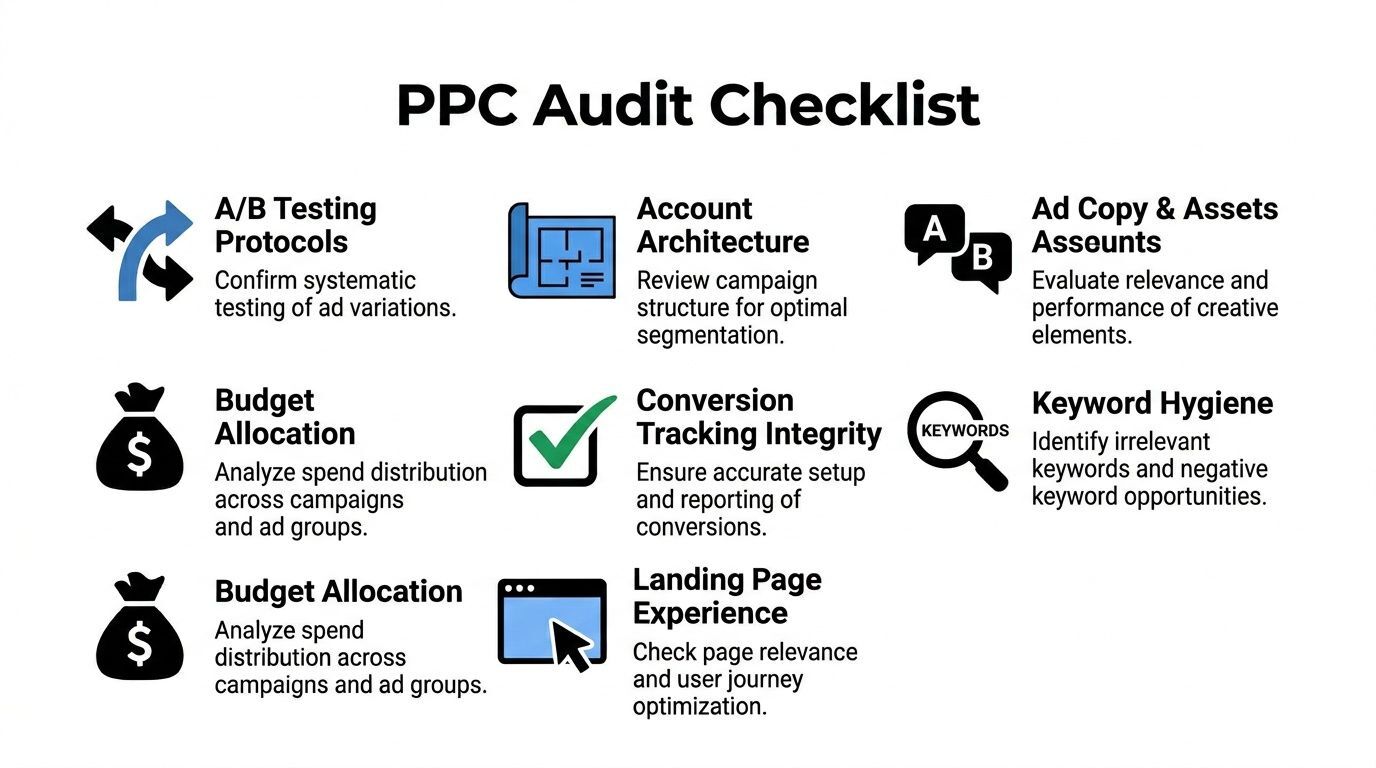
Core audit list
Use this checklist every month:
Account architecture Campaign naming, segmentation logic, geographic controls, and brand versus non-brand separation.
Keyword hygiene Match type discipline, query relevance, duplicate intent, and negative keyword depth.
Conversion tracking integrity GA4 events, enhanced conversions, CRM syncing, call tracking, and whether primary conversions reflect real value.
Ad and asset rotation Stale creative, missing extensions, weak calls to action, and message mismatch with landing pages.
Budget allocation Whether spend is concentrated in campaigns that contribute to revenue or qualified demand.
Landing page experience Message match, speed, form quality, mobile usability, and whether the page reflects the search intent.
Attribution review Lag, offline conversion imports, and differences between platform claims and actual sales data.
If you want a practical companion resource for reviewing your own account, use https://www.cometogether.media/blog/single-post/ppc-audit-checklist.
A good audit doesn’t just identify problems. It tells you which fixes matter first. Start with tracking, then query quality, then structure, then creative, then bidding. In that order.
Onboarding and Reporting Best Practices
Bad onboarding creates months of confusion.
The provider blames incomplete access. The client blames slow results. Reporting gets built on partial data, and everyone spends the quarter arguing over attribution instead of improving performance.
A competent onboarding process fixes that before the first optimization cycle starts.
Access first, opinions second
Before strategy decks, get control of the systems.
You need shared access to Google Ads, GA4, Tag Manager, Merchant Center if relevant, call tracking, CRM reporting, and landing page analytics. If any of that is missing, don’t pretend the account is ready.
For healthcare and other regulated categories, add one more layer. Make sure the PPC operator understands what cannot be tracked, what should not be passed through URLs or forms, and how consent impacts retargeting and audience strategy.
Minimum onboarding package
Every serious engagement should lock down these items:
Platform ownership: The advertiser owns the accounts and admin rights.
Conversion definitions: Primary and secondary conversions are documented in writing.
Revenue mapping: Ecommerce revenue, lead qualification status, or booked appointment status must be visible somewhere.
Approval workflow: Ad copy, landing page edits, and budget changes need a clear path.
Change log discipline: Major changes should be documented so performance shifts can be explained later.
Reporting that helps decisions
Most reports are too long and too weak.
They dump charts into a deck, summarize surface metrics, and bury the only questions that matter. Where is spend being wasted? Which campaigns deserve more budget? Which search queries are low quality? What changed this month that matters?
Good reporting should answer those directly.
What belongs on the dashboard
Use a dashboard that combines platform data and business outcome data. Keep vanity metrics in the background.
Your recurring report should show:
Spend by campaign and intent bucket
Conversion volume by primary business goal
Cost per acquisition or cost per qualified lead
ROAS where revenue data exists
Search term quality notes
Budget shifts and why they happened
Conversion lag observations
Tests run, tests paused, and tests promoted
That last line matters. If nobody can tell you what was tested and learned, you’re not looking at active management.
A strong PPC report should create an obvious next move. If it only explains the past, it’s incomplete.
Cadence matters more than presentation
The communication rhythm should match the speed of the account.
For active spend, I prefer a simple cadence:
Weekly check-in for changes, blockers, and budget notes
Monthly deep dive for performance and structural recommendations
Quarterly strategy review for bigger shifts in goals, channel mix, and attribution logic
That pattern keeps the account moving without wasting time on performative meetings.
What to watch during the first month
The first month tells you whether the relationship will work.
Look for these signs:
They ask hard questions about lead quality, close rates, and sales feedback.
They challenge broken tracking instead of working around it.
They make focused changes, not random account-wide edits.
They explain why some optimizations must wait for enough signal.
They document decisions clearly.
If instead you get vague reassurance, broad recommendations with no prioritization, or reports loaded with top-line metrics, you probably hired presentation instead of expertise.
Onboarding should reduce uncertainty. Reporting should reduce noise. If either one adds confusion, the pay per click management company is not doing its job.
Identifying Red Flags and Case Study Outcomes
Most bad PPC relationships don’t collapse all at once. They decay.
The warning signs show up early. Slow follow-up. Thin reporting. Broad match sprawl. No real search term discipline. Weak answers when policy issues appear. By the time the client gets frustrated enough to switch, the account has usually been drifting for months.
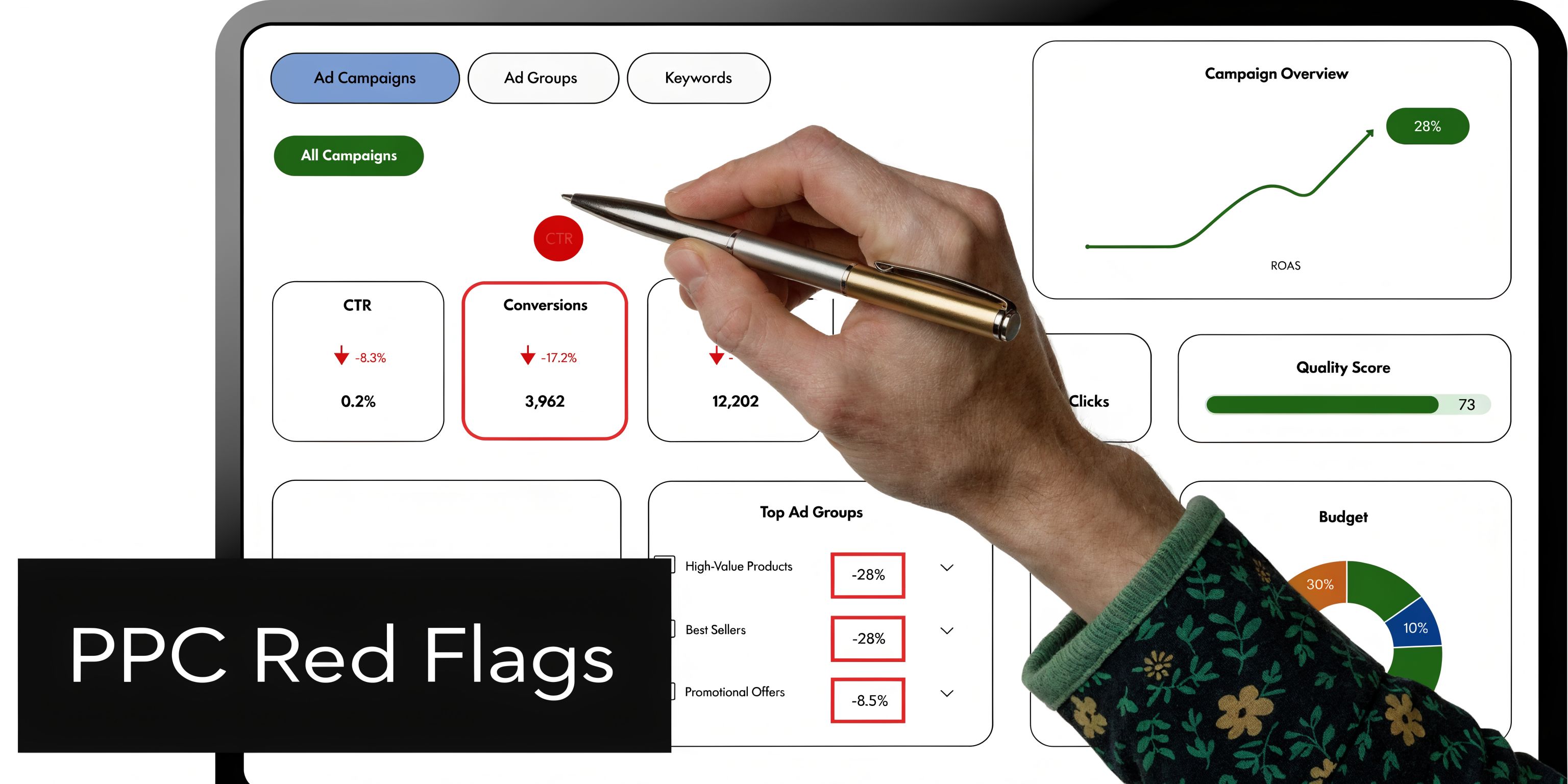
Healthcare advertisers feel this faster than most. According to Disruptive Advertising, healthcare CPCs rose 18% year over year in major markets, and 40% of healthcare campaigns were flagged for automated broad match errors without custom negative lists. If your manager is loose with query control in that environment, they’re not just wasting spend. They’re making the account harder to stabilize.
Red flags that should trigger an immediate review
Some issues are annoying. Others are disqualifying.
Strategic red flags
No clear keyword philosophy: They can’t explain when they use broad, phrase, or exact match.
Platform-first reporting: They celebrate conversion volume without reconciling lead quality or revenue.
No testing discipline: Ad copy changes happen, but nobody can tell you what hypothesis was tested.
Generic healthcare handling: Sensitive categories get the same structure as retail or home services.
Operational red flags
Delayed optimization: Search terms and negatives are reviewed too slowly.
Restricted access: The provider controls the account logins or limits visibility.
Template onboarding: You get a standard checklist with no adaptation to your business model.
Junior-only communication: The person on calls can’t answer tactical questions without “checking with the team.”
The fastest way to spot weak PPC management is simple. Ask what changed in the account last week, why it changed, and what the result was.
Two realistic outcomes specialists create
I’m not going to invent glossy case studies. The pattern is enough.
Ecommerce account with bloated campaign structure
An ecommerce brand often arrives with too many campaigns, duplicated intent, weak negatives, and budget spread across assets no one has reviewed carefully. A specialist typically starts by tightening architecture, cutting overlap, rebuilding negative lists, and simplifying reporting around actual product margin or revenue contribution.
The result isn’t magic. It’s clarity. The account becomes easier to manage, easier to test, and harder to waste money in.
That’s the sort of account where broad agency process often gets in the way. Too many approvals. Too much channel sprawl. Not enough ownership.
Plastic surgery or dermatology practice with compliance issues
A healthcare practice usually has a different problem set. Ads get rejected. Search queries drift into irrelevant or risky territory. Remarketing is handled too cautiously or too carelessly. Tracking gets set up in a way that creates blind spots.
In that situation, a specialist should tighten negative keyword lists, review policy-sensitive language, separate treatments cleanly by intent, and build a reporting system that respects privacy limits while still showing business value.
For healthcare buyers, this isn’t optional. Query hygiene and policy literacy are part of performance.
Here’s a short explainer that’s relevant if you’re trying to spot these issues in account reviews:
What a good specialist does differently
A strong specialist usually brings three advantages that agencies underplay.
Faster diagnosis
They don’t need internal handoffs to decide whether branded search is distorting reported ROAS, whether Performance Max is cannibalizing demand, or whether broad match has drifted too far.
Better accountability
You know who made the decision. You know why they made it. You know what they’re watching next.
Better fit for regulated industries
Healthcare accounts need policy-aware structure, careful exclusions, and realistic tracking expectations. Specialists who work in that environment usually know what to avoid before the platform teaches them the hard way.
If your current provider responds to every performance issue by expanding keywords, refreshing creative without a testing plan, or asking for more budget, you don’t have a strategy partner. You have a spend manager.
Conclusion
The common assumption is that a larger pay per click management company gives you better coverage and safer execution.
Usually, it gives you more layers.
That’s the wrong trade if you care about speed, control, and accountability. The better choice is often a dedicated PPC specialist who owns strategy, touches the account directly, and reports on business outcomes instead of platform theater.
If you’re spending heavily and still dealing with vague answers, stale optimizations, or reporting that doesn’t connect to revenue, don’t wait for another quarterly review. Audit the account now. Check access. Review search terms. Revisit your pricing model. Ask who is making weekly decisions.
A strong PPC partner won’t need a complicated pitch. They’ll show you clear thinking, clean tracking logic, disciplined optimization, and a willingness to cut waste even when it’s inconvenient.
That’s what turns Google Ads from an expensive line item into a reliable growth channel.
If you want a direct, specialist-led review of your Google Ads account, Come Together Media LLC offers one-on-one PPC consulting, audits, setup, and ongoing optimization for businesses that need sharper execution and clearer accountability than a typical agency model provides.
