


You are probably doing what most smart operators do when growth stalls. You keep adding services.
A little SEO. Some paid social. A content retainer. Email automation. Maybe a redesign. Maybe a reporting dashboard that makes everyone feel busy. Your budget grows, your vendor list grows, and clarity disappears.
That is the trap.
Most small business internet marketing services are packaged to be easy to sell, not easy to measure. Generalist agencies love complexity because complexity hides weak execution. If you spend serious money on PPC, that matters. Your best opportunities usually do not come from adding more channels. They come from tightening strategy, fixing waste, and putting more of the budget behind the channels that already show buying intent.
Stop Wasting Money on the Wrong Marketing Services
If your marketing stack feels bloated, your instincts are probably right.

A lot of small businesses are active online. That does not mean they are confident in the results. 73% of small businesses are not sure their current marketing strategy is working, and companies with more than ten marketing staff members report 75% confidence in ROI, compared with 6% confidence for companies without dedicated marketing personnel, according to these small business online marketing statistics.
That gap tells you something important. The problem is rarely effort alone. The problem is execution, measurement, and channel selection.
What usually goes wrong
I see the same pattern in audits:
Too many services at once. Businesses spread budget across search, social, display, SEO, content, and email before any one channel is under control.
No clear acquisition priority. Everything is called “important,” so nothing gets the focus it needs.
Agency upsells disguised as strategy. More deliverables, more meetings, more decks. Not more profit.
Weak tracking. If conversion tracking is sloppy, every report after that is decoration.
The fix is not complicated. It is disciplined.
A better way to judge marketing services
Rank every service by three questions:
Does it capture existing demand or create future demand?
Can you measure revenue impact clearly?
Does it fit your timeline?
If you need pipeline this quarter, some services belong at the center and some belong in support. If you want a practical framework for that kind of budget discipline, this guide on marketing spend optimization for ROI is worth reviewing.
If a service cannot tell you what job it does, how success is measured, and when results should realistically show up, do not fund it at a premium.
That alone will cut out a lot of bad proposals.
Your Digital Marketing Toolkit Demystified
Think of internet marketing like a mechanic’s toolbox. A good mechanic does not dump every tool onto the engine. A good marketer should not dump every service into your plan.
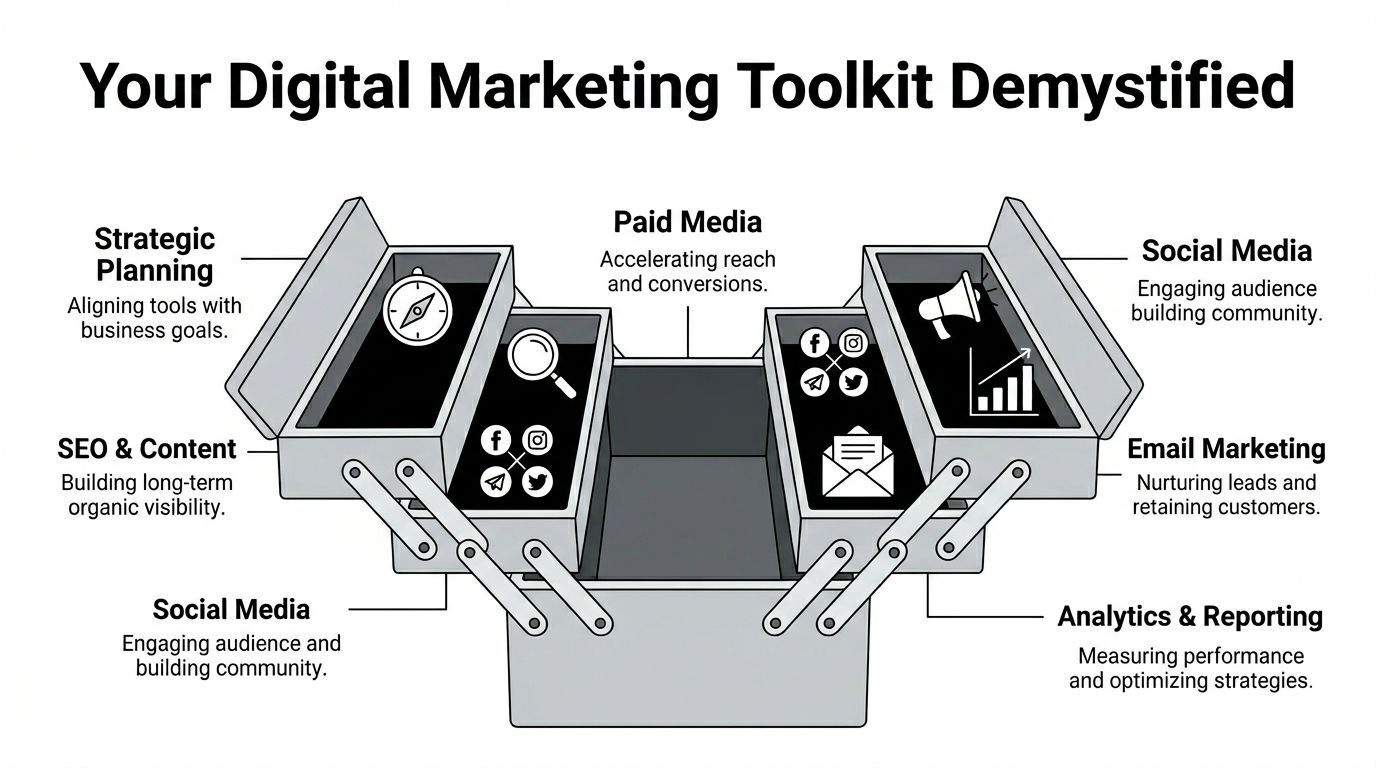
Each tool has one main job
SEO helps your site earn visibility in search over time. It is a long-term asset play.
Content marketing gives SEO something to rank and gives buyers something useful to consume before they trust you.
PPC or search ads capture active demand. This is the fastest route to measurable lead flow when the account is built correctly.
Display and remarketing keep you visible after someone visits your site. They work best as support, not as your primary acquisition engine.
Social media ads interrupt attention. They can work well for certain offers, but they are usually weaker than search when someone already knows what they want.
Organic social helps with credibility, audience touchpoints, and staying visible. It is rarely the main driver of direct-response revenue for most smaller firms.
Email marketing converts more of the traffic and leads you already paid to acquire. It is follow-through, not a magic traffic source.
Internet Marketing Services Comparison
Service |
Primary Goal |
Time to ROI |
Typical Pricing Model |
Key KPIs |
|---|---|---|---|---|
SEO |
Increase organic visibility |
Slow |
Retainer or project-based |
Non-branded rankings, organic traffic, qualified leads |
Content Marketing |
Educate buyers and support SEO |
Slow |
Retainer, per asset, or project-based |
Content engagement, assisted conversions, qualified traffic |
PPC Search Ads |
Capture high-intent demand |
Fast |
Management fee, retainer, or spend-based fee |
CPA, ROAS, conversion volume, impression share |
Display and Remarketing |
Re-engage visitors and support conversion |
Medium |
Spend-based fee or retainer |
View-through impact, assisted conversions, return visitor conversions |
Social Media Ads |
Generate awareness and demand |
Medium |
Spend-based fee or retainer |
Cost per lead, CTR, conversion rate, audience quality |
Organic Social |
Build trust and community |
Slow |
Retainer or in-house management |
Engagement quality, referral traffic, branded search lift |
Email Marketing |
Nurture leads and retain customers |
Medium |
Platform fee plus setup or retainer |
Open quality, click quality, conversion rate, repeat purchase activity |
Where businesses overpay
The biggest waste comes from buying these services as a bundle without a hierarchy.
A business that needs immediate lead volume should not treat organic social the same way it treats search ads. A business with strong branded demand but weak site performance should not spend aggressively on top-of-funnel campaigns before fixing landing pages and tracking.
Here is the blunt version:
Use PPC when you need speed and clear attribution.
Use SEO and content when search behavior in your niche supports a long-term play.
Use email to squeeze more value out of the traffic you already bought.
Use social and display carefully. They are support channels until proven otherwise.
Good small business internet marketing services are not about channel variety. They are about using the right tool for the right job, in the right order.
The Foundation SEO and Content Marketing
SEO and content are the slab under the house. Important, expensive, and slow to build.

If an agency tells you SEO will solve a short-term pipeline problem, push back. SEO is not a rescue tactic. It is a compounding asset when your market has meaningful search demand and your site can compete.
What SEO is supposed to do
A competent SEO program handles three jobs.
First, it fixes technical barriers. Search engines need to crawl the site cleanly, understand page purpose, and load the experience quickly.
Second, it improves relevance. That means pages align to real search intent, not vanity keywords.
Third, it builds authority. That comes from strong content and credible links, not from publishing thin articles no one wants.
Technical work matters more than many businesses realize. Technical SEO audits focused on Core Web Vitals, including reducing Largest Contentful Paint to under 2.5 seconds, can improve Google rankings by 10 to 20 positions and drive 15 to 25% organic traffic growth, according to this technical SEO reference from Semrush’s agency listing content.
What a real SEO program includes
A serious SEO engagement usually includes:
Technical auditing with tools like Screaming Frog, Lighthouse, and Google Search Console
On-page optimization for title tags, internal linking, page structure, and search intent alignment
Content planning tied to buyer questions, not random keyword exports
Structured data work such as JSON-LD schema where relevant
Link acquisition that focuses on relevance and quality, not volume for the sake of volume
If you run both paid and organic search, this guide on how to integrate SEO and paid search to maximize your ROI is a useful framework.
When SEO deserves real budget
SEO makes sense when:
You sell into a category with strong research behavior
Buyers compare providers before contacting sales
Your margins justify a long payback window
You can commit to consistent content and technical improvements
It is a weaker fit when you need immediate leads, your market has low search volume, or your website is so poor that paid traffic will struggle too.
This video gives a useful visual overview of the broader SEO mindset.
How to hold SEO providers accountable
Do not let an agency hide behind vague language like “authority building” or “visibility improvements.”
Ask direct questions:
What to ask |
What a strong answer sounds like |
|---|---|
What technical issues are suppressing performance right now? |
Specific issues tied to crawlability, speed, indexing, or page structure |
Which pages target non-branded demand? |
A page-level map tied to search intent |
How are you measuring progress? |
Rankings for relevant terms, qualified organic traffic, leads, and assisted conversions |
What content is being created and why? |
Content tied to commercial or informational intent, not filler publishing |
SEO is valuable when it builds an owned traffic asset. It is wasteful when it turns into a publishing treadmill with no commercial logic.
Content follows the same rule. One strong page built around a real buyer question is worth more than a calendar full of generic posts.
The Growth Accelerator Paid Media Management
Most high-spend businesses should get serious here first.
Paid media, especially Google Ads, is the fastest lever for lead generation and revenue when buyers are already searching. It is also the easiest channel to waste money in when no adult is supervising the account.

I have audited enough accounts to say this plainly. Most underperformance is not caused by competition. It is caused by lazy structure, weak exclusions, bad data, and generic management.
Why paid media deserves priority
SEO builds over time. Email monetizes existing traffic. Social can support demand creation.
PPC captures intent right now.
When someone searches with commercial intent, your campaign can answer that demand immediately. That is why paid search should usually be the center of the plan for firms spending heavily and expecting accountability.
What good PPC management looks like
A healthy Google Ads account is not just “running.” It is organized to make decisions easier and performance more reliable.
That includes:
Clean campaign structure so budgets, search terms, and intent groups are not mixed together
Accurate conversion tracking so bidding systems optimize toward actual business outcomes
Keyword control with match types, negatives, and search term review
Landing page alignment so the click lands on a page built to convert
Bid strategy discipline using the right automation for the data available
If you want a strong overview of the fundamentals, this guide to PPC for small business and expert growth strategy is a good companion read.
The expensive mistakes I keep finding
The same issues show up over and over.
Broad match abuse is one of the worst. Businesses let Google expand aggressively without enough negatives or segmentation. That is how budgets leak into irrelevant traffic.
Unclear conversion goals are another. If the account counts weak actions as conversions, automated bidding learns the wrong lesson.
Performance Max without control is common too. It gets launched because it is easy to sell, not because the account is ready for it.
And then there is the agency staffing problem. The person who sold you the account is usually not the person managing it. Your budget funds layers of account management, not hands-on expertise.
Audience segmentation is not optional
Specialist work pays off quickly here.
Targeted audience segmentation using Google Ads Customer Match and Remarketing Lists for Search Ads can reduce CPA by 20 to 30%, and expert-led audits often find up to 40% of spend wasted on broad match keywords without proper negative keyword lists, according to this small business PPC agency roundup.
That aligns with what experienced auditors see in the field. The account often does not need more budget first. It needs better control.
The PPC terms that matter
Quality Score
Quality Score is Google’s estimate of keyword, ad, and landing page relevance. It is not the only metric that matters, but low scores often point to real structural issues. If relevance is weak, your costs usually rise and impression quality suffers.
ROAS
ROAS, or return on ad spend, measures revenue generated relative to spend. It is useful for ecommerce and some lead generation models with strong revenue tracking. If your attribution is weak, reported ROAS can mislead you.
CPA
CPA, or cost per acquisition, tells you what you pay for a lead or sale. It only matters if the acquisition definition is meaningful. A cheap junk lead is still expensive.
Conversion tracking
This is the control system. If form fills are duplicated, calls are missing, offline sales are ignored, or low-value actions are treated like wins, the entire account gets distorted.
Before you touch bids, check tracking. Before you expand campaigns, check search terms. Before you increase budget, check landing pages.
Search, display, remarketing, and Performance Max
These are not interchangeable.
Channel |
Best use |
Common mistake |
|---|---|---|
Search |
Capture active buying intent |
Sending traffic to generic pages |
Display |
Support awareness and remarketing |
Expecting cold display to carry direct-response performance |
Remarketing |
Re-engage visitors and cart abandoners |
Letting lists get too broad and message get stale |
Performance Max |
Expand inventory with strong data inputs |
Launching it before conversion tracking and creative inputs are ready |
Search usually earns the most trust because intent is explicit. Display and remarketing work best as support systems. Performance Max can be useful, but only when the account already has clean data, strong creative, and disciplined goals.
Why independent specialists beat bloated agencies
This is not an anti-agency rant. It is an operating reality.
A specialist has fewer layers, fewer handoffs, and fewer incentives to bury the account in deliverables. You get direct communication. Changes happen faster. Strategy stays connected to execution.
The agency model often breaks because:
Senior people sell, junior people manage
Reporting gets polished while search term quality gets ignored
Meetings replace actual optimization
Your account competes internally for attention
A specialist lives or dies on account performance and trust. That is a healthier incentive structure for businesses that care about efficiency.
A practical audit checklist you can use today
Open your account and look for these issues right now:
Search terms. Are irrelevant queries spending real money?
Negatives. Is there an active negative keyword process?
Conversion actions. Are the primary actions tied to real business value?
Campaign intent. Are branded, non-branded, competitor, and remarketing campaigns separated cleanly?
Landing page match. Does each ad group point to a page that answers the exact promise of the ad?
Bid strategy fit. Is the strategy aligned with the amount and quality of conversion data available?
If those basics are shaky, no amount of “advanced strategy” will save the account.
Where I would invest first
If you spend heavily on Google Ads and want a lean stack, I would usually prioritize:
Search campaign structure and query control
Conversion tracking cleanup
Audience layering with Customer Match and remarketing
Landing page relevance
Selective expansion into remarketing and Performance Max after the account earns it
That is how paid media becomes a growth engine instead of a budget furnace.
Maximizing ROI with Email Marketing
Email is where a lot of expensive traffic finally gets monetized.
Most businesses treat email like a newsletter tool. That is too shallow. Email should recover abandoned intent, nurture hesitant leads, and bring buyers back after the first conversion.
What email is supposed to do
For service businesses, email keeps a lead warm after the first click or inquiry. People compare, delay, and forget. A simple nurture sequence gives them reasons to come back.
For ecommerce, email retains customers and recovers revenue that your ads almost produced but did not quite close.
The automations every business should have
You do not need a huge flowchart. Start with a few sequences that matter.
Welcome sequence. Introduce the brand, set expectations, and move the subscriber toward a clear next step.
Lead nurture series. Answer objections, show proof, and guide a prospect toward consultation, demo, or purchase.
Abandoned cart or abandoned browse. Bring back visitors who showed intent but left.
Re-engagement campaign. Wake up stale subscribers before your list quality decays.
How email makes PPC more profitable
Paid traffic gets expensive when too many visitors bounce after one session. Email gives you another shot.
A strong email system helps you:
Extend the value of each click
Shorten the delay between first visit and purchase
Improve retention after acquisition
Reduce dependence on constant front-end ad spend
If you are paying for traffic and not building a usable email follow-up system, you are leaving value behind after the click.
The best email programs are simple, relevant, and timed around buyer behavior. Fancy templates do not fix weak messaging. Clear offers and useful follow-up do.
How to Choose Your Marketing Partner A Checklist
Choosing the wrong partner costs more than choosing the wrong channel.
You can survive a weak campaign. You will struggle to survive a weak operator managing a large budget for months while feeding you polished reports.
Why the agency model often underdelivers
The small business market is often underserved by traditional providers because the market is fragmented and buyers expect more customized support. A Salesforce survey found 82% of business buyers expect consumer-like personalized experiences, creating an opening for one-on-one consultants to provide more customized guidance, according to Bain’s analysis of the untapped small business market.
That tracks with what buyers feel. They want specificity. They get process.
Large agencies tend to standardize everything because standardization protects margin. The problem is that your account is not standard. Your buying cycle, economics, tracking setup, and sales process all shape what “good performance” means.
Specialist versus agency
Question |
Independent specialist |
Full-service agency |
|---|---|---|
Who works on the account? |
Usually the person you hired |
Often a layered team with junior day-to-day management |
Communication |
Direct and fast |
Filtered through account managers |
Strategy |
Built around fewer accounts and more depth |
Often templated for operational scale |
Incentives |
Retention through performance and trust |
Retention through contracts, process, and cross-sells |
Adaptability |
Faster changes and tighter feedback loop |
More meetings, more approvals, slower execution |
This does not mean every agency is bad. It means you should assume nothing.
If you are evaluating options, this article on how to choose a digital marketing agency that delivers results gives a useful baseline for due diligence.
The questions you should ask before signing anything
Use this checklist in every vetting call.
Who will manage the account? Ask for the specific person, not the department.
How often do you review search terms and negatives? If the answer is vague, that is a problem.
What counts as a conversion in your reporting? Force precision.
How do you separate strategy from reporting? Many firms do reporting very well and optimization poorly.
How do you handle landing page feedback? Paid media performance is tied to the page, not just the ad.
What happens in the first thirty days? You want an audit-and-priority plan, not generic onboarding language.
What channels do you think we should not invest in right now? Good partners disqualify work.
Red flags that should end the conversation
Some signals are enough on their own.
They promise every channel
They avoid account access questions
They cannot explain attribution clearly
They lead with dashboards instead of diagnosis
They never challenge your budget mix
They talk about impressions more than pipeline quality
A strong partner is willing to tell you where not to spend. Weak partners sell activity.
That matters a lot in small business internet marketing services, where too many providers still push packages instead of judgment.
Your Next Step Toward Profitable Growth
The channel mix matters. The order matters more.
If you already spend heavily on acquisition, your most impactful move is usually not another trendy service. It is a sharper paid media operation with cleaner tracking, tighter segmentation, stronger landing pages, and a realistic support system around it.
SEO and content can build long-term value. Email can convert more of the traffic you already paid for. AI tools are becoming useful support systems too. An emerging trend is the use of AI marketing tools to improve optimization, and some small businesses have seen 40% organic traffic growth by using AI to identify underserved content topics, according to this review of AI marketing tools for small businesses. Used correctly, AI supports strategy. It does not replace judgment.
The immediate move is simpler.
Get your Google Ads account audited by someone who is not trying to bury you in a service bundle. Look for wasted spend, weak search term control, bad conversion setup, audience gaps, and campaign structure problems. Those issues usually show up fast, and fixing them usually matters more than adding another channel.
If your account is already spending at scale, you do not need more fluff. You need a hard look at what is leaking.
If you want that kind of direct, specialist review, Come Together Media LLC offers one-on-one Google Ads consulting and PPC audits focused on wasted spend, conversion tracking, campaign structure, and practical opportunities to improve ROI. No agency layers. No generic playbook. Just clear findings and actionable next steps.
