A Smarter Way of Managing Pay Per Click: Why an Expert Consultant Beats an Agency
- Feb 12
- 16 min read
If managing your PPC campaigns feels like you're just throwing money into a black box and hoping for the best, you're not just imagining it. The truth is, effective PPC requires a real, hands-on partnership—not a generic, templated service from an overpriced, bloated agency. Real success comes from dedicated, individual expertise that’s laser-focused on your specific business goals, making sure every single dollar you spend brings back a measurable return.
Why Your Agency Approach to PPC Is Holding You Back
So many businesses sign on with a big PPC agency expecting world-class results, only to get stuck in a frustrating loop. The classic agency model often means your account gets passed down to a junior manager who's trying to juggle dozens of other clients. What you end up with is slow communication, one-size-fits-all strategies, and reports packed with vanity metrics that don’t actually connect to your bottom line.
This is a massive problem. The global pay-per-click market is on track to hit $142.63 billion in 2025 and an unbelievable $299.88 billion by 2032. When the average cost-per-click is hovering around $2.69, a passive, cookie-cutter agency approach isn't just ineffective; it's a direct leak in your budget.
The Pitfalls of the Bloated Agency Model
Large agencies are fundamentally built on volume and high overhead, not individual specialization. Their entire structure creates built-in disadvantages for the small and medium-sized businesses they're supposed to be helping.
I see the same issues time and time again:
Lack of Specialization: Your account is handled by a generalist, not a dedicated expert. You're paying premium rates for junior-level work, and your unique industry nuances are completely ignored.
Layered Communication: Trying to get a straight answer is a nightmare. You have to go through layers of account coordinators just to talk to the person actually doing the work, wasting your valuable time.
Cookie-Cutter Strategies: Agencies love to apply the same campaign structures to all their clients because it's efficient for them—not because it's what's best for your business. You get a templated solution, not a custom strategy.
This table breaks down the key differences in strategy, communication, and results you can expect when working with me, an individual expert consultant, versus a large agency.
Expert Consultant vs Traditional Agency: A Head-to-Head Comparison
Feature | Expert Consultant | Traditional PPC Agency |
|---|---|---|
Strategy | Custom-built from scratch based on your specific goals, market, and data. | Often relies on pre-built templates and "best practices" applied across all clients. |
Communication | Direct, one-on-one access to the senior expert managing your account. No middlemen. | Filtered through account managers and junior staff, leading to delays and miscommunication. |
Expertise | Deep, specialized knowledge in PPC. The person you hire is the person doing the work. | Managed by generalists juggling multiple marketing channels and dozens of clients. |
Accountability | My success is directly tied to your performance and ROI. I win when you win. | Focused on client retention and hitting internal agency metrics, which may not align with your business goals. |
Flexibility | Agile and able to pivot strategy quickly based on real-time data and market changes. | Slower to react due to rigid internal processes, high staff turnover, and layered approval chains. |
The takeaway is simple: the agency model is built for its own scale; my model is built for your performance.
A More Effective Path Forward
In sharp contrast, working with me means the expert you hired is the one actually managing your account. You get someone with years of specialized, in-the-trenches experience right from the start. This direct relationship cuts through all the agency noise and focuses on what really moves the needle. You get personalized attention, proactive optimizations, and a strategy built from the ground up to hit your targets. This is a point I dive into deeper when comparing in-house vs. agency marketing options.
This is about turning your ad spend into a predictable engine for growth, not just another expense line item for an underperforming agency. It's about forging a true partnership focused on driving a higher return on ad spend (ROAS) and lower acquisition costs, giving you the control and clarity you've been missing.
Building a Strategic Foundation with a PPC Audit
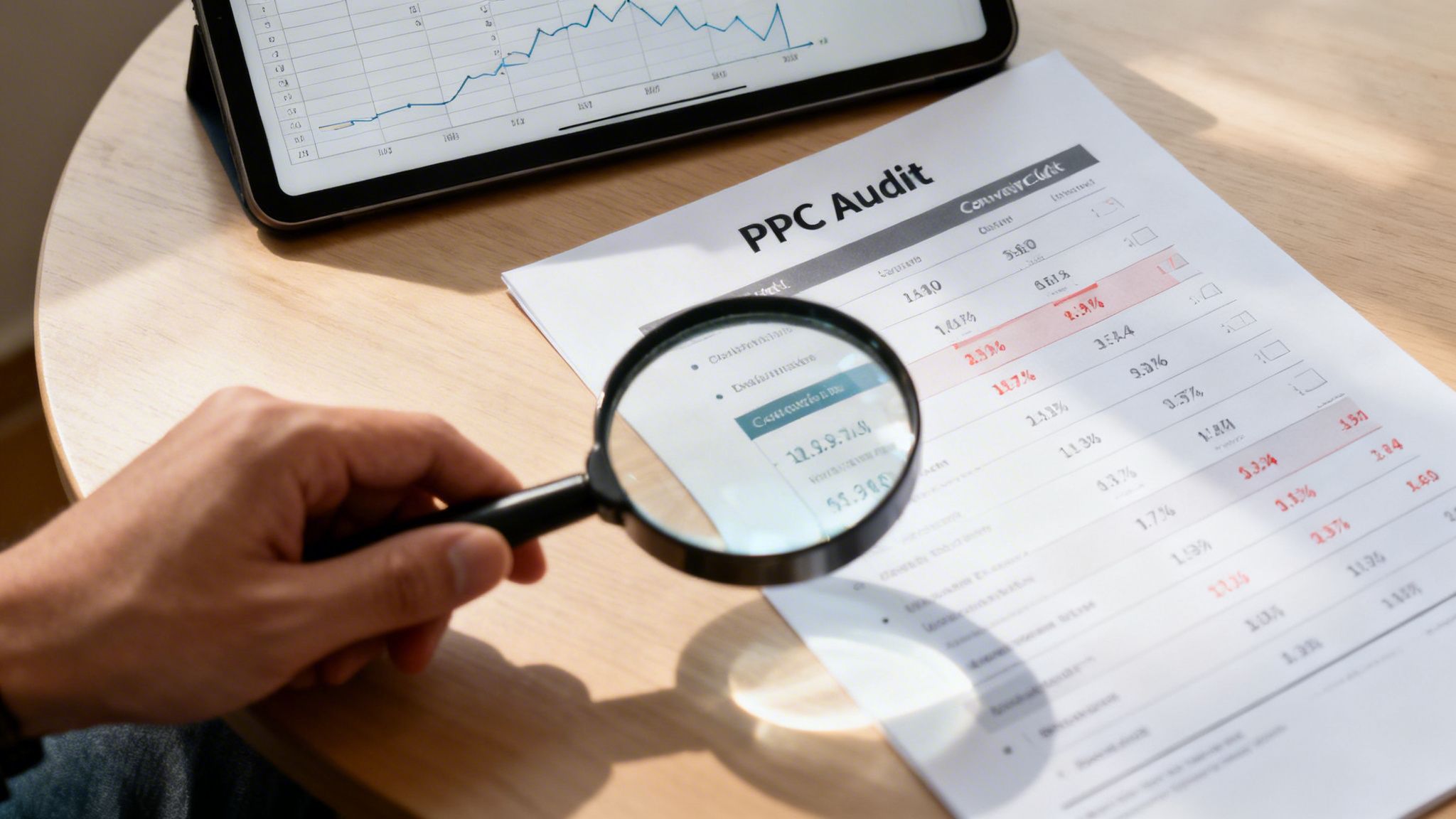
Before you spend another dollar on ads, you need an honest look under the hood. It’s the only way to get a clear, unbiased diagnosis of your account’s health.
Too often, agencies jump right in, launching campaigns with the same tired templates they use for every other client. This cookie-cutter approach completely ignores the unique history, data, and hidden potential already sitting inside your account.
Real success in PPC management starts with my meticulous audit, not a generic playbook from a faceless firm. Think of it like a master mechanic running a full diagnostic on a car before grabbing a wrench. You wouldn't just start replacing parts randomly, and you shouldn't manage your ad spend that way either. A deep-dive audit is where my value as a dedicated consultant becomes immediately obvious.
Uncovering Hidden Waste and Opportunity
The whole point of my PPC audit is to systematically identify two things: what’s bleeding your budget dry, and where the untapped opportunities for growth are hiding.
Unlike a junior account manager at a big firm who might just glance at surface-level metrics, I look for the subtle patterns that reveal major insights. This means a granular review of every component, from high-level campaign settings down to individual keyword match types. It's a forensic investigation designed to build a profitable strategy on a foundation of evidence, not assumptions.
Key areas I always focus on include:
Account Structure and Hierarchy: Is the account logically organized? A messy structure—all too common in agency-neglected accounts—is a direct path to poor Quality Scores and inflated CPCs.
Campaign Setting Leaks: Are you losing money to incorrect location targeting, ad scheduling, or device bid adjustments? These "small" settings can easily waste 10-20% of an ad budget if ignored.
Conversion Tracking Integrity: Is your tracking even accurate? So many accounts are making decisions based on faulty data because no one at the agency bothered to properly set up or verify conversion actions.
Keyword and Search Term Analysis: This is a big one. My audit differentiates between the keywords you’re bidding on and what users are actually searching for. This is where I almost always find massive amounts of wasted spend.
The Problem with Most Agency "Audits"
Here's a hard truth: most agency-led audits are just a veiled sales pitch. They run a quick automated report that spits out generic recommendations, all designed to get you to sign a long-term contract, not to provide genuine strategic value.
The process is superficial because their business model isn't built on deep, individual analysis—it's built on client volume.
A proper audit isn't a quick software scan. It's a hands-on, strategic analysis that requires my expertise to interpret the data correctly and transform those insights into a profitable action plan.
As an independent consultant, my audit process is the bedrock of our entire partnership. I dig into your historical data to see exactly what has and hasn’t worked. I reverse-engineer what your top competitors are doing to find gaps you can exploit. This isn't about fitting you into an agency's pre-made box; it's about building a custom blueprint for your success. To see what this looks like in practice, check out my guide on a better pay per click audit that saves you money.
From Diagnosis to Actionable Strategy
The final output of my audit is not a list of problems—it’s a clear, prioritized roadmap for fixing them. This becomes the strategic foundation for every single thing we do moving forward.
A thorough audit gives us actionable steps for immediate improvement:
Restructure for Profitability: I'll build a logical campaign hierarchy with tightly themed, granular ad groups that boost relevance and Quality Score.
Eliminate Wasted Spend: The first thing I'll do is build an extensive negative keyword list based on all the irrelevant search terms I uncovered.
Refine Audience Targeting: We can identify high-performing demographic, in-market, and affinity audiences to layer onto campaigns for much better precision.
Verify Data Accuracy: I'll test and confirm that all your conversion actions are firing correctly, so we know every decision is based on solid data.
This foundational work prevents the costly setup mistakes that plague so many accounts managed by bloated, inattentive agencies. It sets the stage for a nimble, data-driven approach that drives real business results from day one.
Crafting Ad Campaigns That Actually Drive Conversions
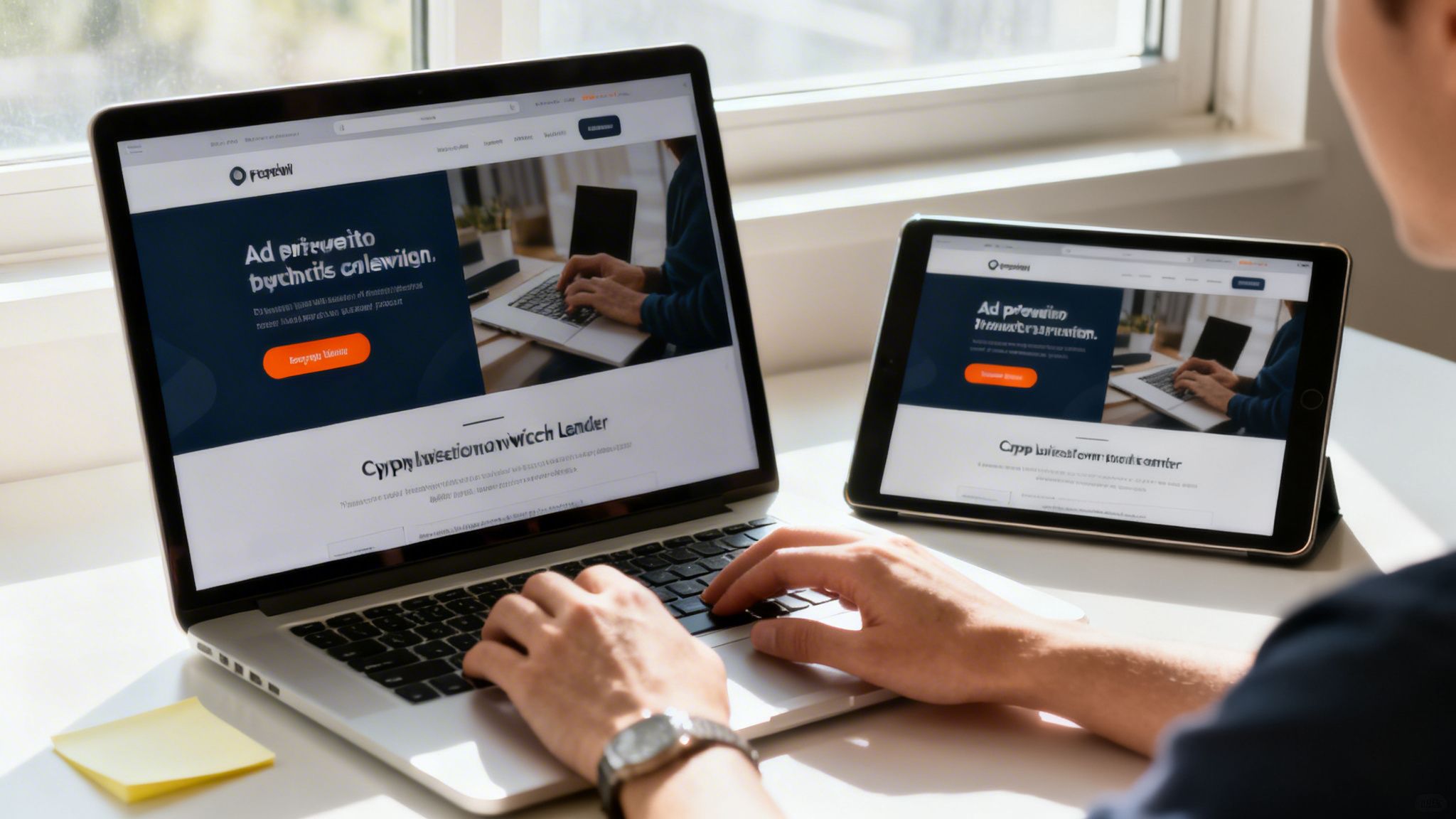
A solid audit is just the launchpad. The real work—and the real profit—comes from my day-to-day execution. This is where we move from a strong foundation to campaigns that actively turn clicks into customers.
It’s also where my specialized, hands-on expertise leaves the bloated, formulaic agency model in the dust. The difference is in the details: finding the high-intent keywords your competition has missed and writing ad copy that connects with a customer's actual problem. This is what separates a stagnant campaign from a revenue-generating machine.
Uncovering Keywords That Your Competitors Ignore
Most agencies stop at the obvious keywords. They target the high-volume, high-competition terms everyone else is bidding on, and call it a day. While those terms have their place, the real gold is in the long-tail keywords—the longer, more specific phrases that signal someone is ready to buy.
My process involves digging much, much deeper. I comb through customer reviews, forum discussions, and sales team feedback to find the exact language your ideal clients are using.
For instance, a generic agency might target "emergency plumber." I’ll hunt for phrases like:
"24/7 plumber for leaking water heater"
"cost to fix burst pipe under sink"
"local plumber with same day service"
These keywords have lower search volume, but the user's intent is crystal clear. That specificity leads to higher click-through rates, better Quality Scores, and, most importantly, leads that are actually qualified. It’s a level of detail a junior account manager juggling 30 clients simply doesn't have time for.
Writing Ad Copy That Demands a Click
Once you’ve got the right keywords, your ad copy is your frontline sales pitch. Generic, boring agency ads are invisible. My goal is to speak directly to the searcher's pain point and frame your business as the immediate, obvious solution.
This is where I lean on proven psychological triggers to write compelling ads:
Urgency: "Limited Spots Available for March" or "Offer Ends Friday."
Social Proof: "Join 500+ Happy Customers" or "Rated 5-Stars in Boston."
Specificity: "Get Your Free Quote in 60 Seconds" instead of the tired "Contact Us."
This is also where my deep understanding of your business pays off. An agency might write one generic ad for a plastic surgeon. I’ll create separate, targeted ads for "mommy makeover consultation" versus "non-surgical facelift options," each speaking to the unique motivations of that specific audience. If you want to dive deeper into this, you can learn more about how to write ad copy that actually converts on our blog.
The best ad copy isn't about clever taglines. It's about creating a powerful message match between the search query, your ad, and your landing page. This seamless experience is what drives conversions.
Perfecting the Landing Page Experience
This is the single biggest fumble I see from large agencies. They drive perfectly good traffic to a generic homepage or a clunky service page and wonder why nothing converts. It's a massive waste of your ad spend. The landing page is arguably the most critical piece of the entire campaign.
For a deeper dive, there are some great landing page optimization best practices that can turn visitors into customers.
My focus here boils down to a few key things:
Flawless Message Match: If your ad says "50% Off Your First Visit," that better be the first thing a user sees on the page. The headline on your landing page must mirror the ad's promise.
Laser-Focused Call-to-Action (CTA): The page needs one clear goal. I won't confuse visitors with a dozen different links and options. I guide them to the single action you want them to take.
Blazing-Fast Page Speed: Slow pages kill conversions, period. I make sure landing pages are optimized for speed, especially on mobile, where most of your customers are searching.
Getting this right has huge stakes. Across industries, Google Ads sees an average conversion rate of 7.52%, with the average cost-per-lead (CPL) at $70.11. Small, expert-led tweaks to ad copy and landing pages can dramatically lower those costs. This meticulous, hands-on optimization is where I provide real value, ensuring not a single dollar of your ad spend is wasted on a poor user experience.
Getting Smart with Bids and Budgets
Your budget is the lifeblood of your Google Ads campaigns. How you manage it—and the bids you place—is what separates a money pit from a money-making machine. This is where I see the biggest difference between my hands-on management and the passive, automated approach many agencies take. Every dollar needs to work for you.
Managing bids and budgets isn’t a task you can just "set and forget." It's a daily ritual of checking in, analyzing what's working, and moving money around to double down on the winners. While some agencies will plug your account into software and send a report once a month, I’m in the trenches daily, making the small, smart adjustments that stop wasted spend cold.
Automated Bidding vs. Manual Control
Look, Google’s automated bidding strategies like Target CPA and Target ROAS are incredibly powerful. They use machine learning to get you conversions or revenue, and they definitely have a place in a healthy account.
But just flipping them on and hoping for the best? That's a classic agency mistake. These systems need good, clean data, and a real pro knows when to let the machine drive and when to grab the wheel.
Target CPA: Your go-to for lead generation. You tell Google what you're willing to pay for a new lead.
Target ROAS: Perfect for e-commerce. You tell Google the return you need for every ad dollar spent.
Manual CPC: Absolutely essential for new campaigns. When you have zero data, I need to be in the driver's seat, controlling what you pay for every single click.
My secret is a hybrid approach. I almost always start new campaigns on Manual or Enhanced CPC to gather data fast while keeping a tight leash on costs. Once a campaign is consistently bringing in at least 15-20 conversions a month, then we can start testing an automated strategy, while keeping other parts of the account under my direct control.
The real skill here isn't just picking a bid strategy from a dropdown. It's knowing when to switch and how to feed the algorithm the clean data it needs to do its job. Agencies often let automation run wild; I actively manage the machine.
A Smarter Way to Allocate Your Budget
One of the most common mistakes I see is a budget spread way too thin across too many campaigns. Or even worse, everything gets dumped into one giant agency-made mess. A much better way is to split up your budget based on user intent. This ensures your best audiences get the lion's share of the investment.
Here’s a simple framework I use to get started:
Campaign Type | Budget Allocation | The "Why" Behind It |
|---|---|---|
Brand Search | 10-15% | Pure defense. I protect your brand name from competitors and scoop up the cheapest, highest-intent traffic from people who already know you. |
High-Intent Non-Brand | 50-60% | This is your engine for growth. We're targeting keywords that scream "I'm ready to buy!" This is where the bulk of your investment should go. |
Remarketing | 10-15% | Going after people who visited your site but didn't convert. It's a second chance, and it's often the campaign with the highest ROAS. |
Performance Max/Testing | 10-20% | This is our lab. We'll explore new audiences, test out Google's newer campaign types, or go after broader reach—all with a controlled, sandboxed budget. |
This isn’t just about spending money; it’s about investing it where you know you’ll get the best bang for your buck. And it's not set in stone. If remarketing is crushing it one month, we’ll pour more fuel on that fire. This kind of active, dynamic budget management is something you just don't get from a bloated, slow-moving agency. It’s how we make sure every single dollar is accounted for and every win is scaled up, fast.
Finding Your Rhythm: Ongoing Optimization and Reporting
Getting a PPC account set up is just the start. The real results come from the consistent, hands-on process of refinement. This is where a great strategy meets the messy reality of the market, and where an experienced consultant separates a high-performing account from one that just burns cash.
Frankly, this is where most bloated agencies fail. They lean on automated reports and barely touch the account, letting your budget slowly bleed out from a thousand tiny cuts.
As a dedicated consultant, I live and breathe your account data. I build a sustainable rhythm of daily, weekly, and monthly optimizations, turning raw numbers into decisive action. This constant attention is what keeps your campaigns adapting, improving, and pulling ahead of the competition.
The Weekly Management Checklist
Think of your weekly PPC routine as essential maintenance. These are the high-impact checks that keep the engine humming and stop small issues from spiraling into budget-draining disasters. This is where I spend a huge chunk of my time, zeroing in on immediate chances to boost efficiency.
An agency might give a high-level dashboard a quick look once a week. I’m deep in the trenches, focused on what matters:
Mining the Search Term Report: This is non-negotiable. I dig into the exact queries people typed to trigger your ads. Any irrelevant searches get added straight to the negative keyword list. This one task alone is a masterclass in stopping budget waste.
Reviewing Bid Adjustments: I’m constantly checking performance across devices, locations, and audiences. Is mobile crushing it? I’ll adjust the bids to lean into what's working right now.
Monitoring Budget Pacing: Are we on track? I make small, daily tweaks to ensure our top campaigns have the fuel they need without blowing the budget in the first two weeks.
Checking Key Metrics: I’m watching for any sudden swings in Click-Through Rate (CTR), Cost Per Click (CPC), and Conversion Rate. A sudden drop in CTR could signal a new competitor, and requires immediate action.
Monthly and Quarterly Strategic Reviews
While the weekly tasks are tactical, our monthly and quarterly check-ins are all about strategy. This is when we pull back from the day-to-day and analyze the bigger picture to plan our next moves. It takes my experience to read these tea leaves correctly—something a junior account manager just can’t replicate.
Each month, the focus is on bigger wins. We’re A/B testing ad copy, digging into Quality Score trends, and reviewing landing page data. We figure out what worked, what flopped, and build a concrete plan to double down on success for the next 30 days.
Quarterly reviews are for the major strategic pivots. We’ll measure performance against your core business goals, scout opportunities for expansion, and lock in the budget and key performance indicators (KPIs) for the coming quarter.
As your consultant, I don’t just ‘manage’ your account; I become a strategic partner. Our reviews and reports connect every dollar of ad spend directly to your business growth, giving you the clarity that big agencies often hide behind jargon.
Reporting That Actually Tells You Something
Forget those glossy, 20-page agency reports filled with vanity metrics like impressions and clicks. They’re designed to look impressive while obscuring a total lack of meaningful results. My approach is the complete opposite: simple, transparent, and focused only on the numbers that hit your bottom line.
We track the KPIs that actually matter:
Cost Per Acquisition (CPA): What’s the real cost to land a new customer?
Conversion Rate: What percentage of clicks are actually turning into leads or sales?
Return On Ad Spend (ROAS): For every dollar you put in, how many are you getting back out?
This entire process of managing bids to hit these goals comes down to a simple, powerful loop: allocate budget, adjust based on what the data says, and analyze the results to do it all over again, but smarter.
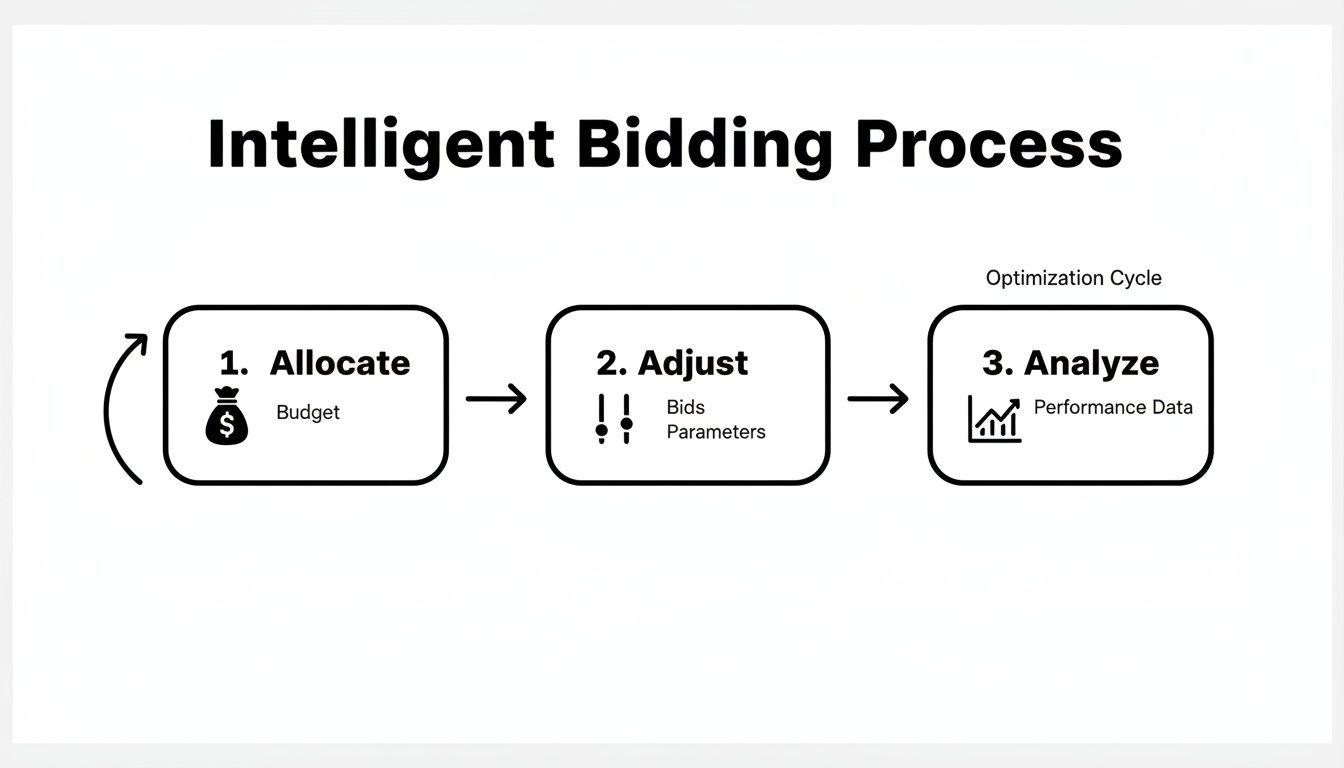
This constant cycle is the heart of intelligent bidding. It ensures your money is always working as hard as it possibly can.
And today, you can’t talk about optimization without talking about mobile. By 2025, mobile ad spend is projected to account for a massive 66% of all digital ad dollars. With Google dominating the market and CPCs steadily climbing, ignoring mobile performance is a critical, costly mistake. My hands-on optimization makes sure your ads are perfectly tuned for the small screen—where most of your customers are. Learn more about the key PPC statistics every marketer should know.
This disciplined, data-first rhythm is what separates an unpredictable ad account from a reliable engine for growth.
Common Questions I Get About PPC Management
Running a business and trying to navigate the world of PPC can feel like drinking from a firehose. You’re bound to have questions. Here are the most common ones that come up in my conversations with business owners, along with some straight answers from the trenches.
How Can I Tell If My Current PPC Agency Is Doing a Bad Job?
This is a big one. It usually boils down to a few unmistakable red flags that signal you're getting a cookie-cutter service from a bloated firm, not a real strategy from a specialist.
First, who are you talking to? If your main point of contact is a junior account manager who constantly has to "check with the team," that's a problem. It’s a classic symptom of the agency model where you’re paying for expertise you never actually get access to. With me, you talk directly to the expert every time.
Next, look at your reports. Are they a sea of vanity metrics like clicks and impressions? Or do they tell you exactly what your Cost-Per-Acquisition (CPA) and Return On Ad Spend (ROAS) are? If they can't draw a straight line from their work to your bank account, something is very wrong. I live and die by the metrics that matter to your business.
Finally, are they proactive? I am always bringing you new ideas for tests and optimizations. If you’re the one constantly pushing for improvements while your agency just coasts, they're not managing your account—they're just collecting a check.
What’s a Realistic PPC Budget for a Small Business?
There’s no magic number here, but for most small or local businesses, a starting ad spend of $1,500 to $3,000 per month is a solid place to begin. It's enough to get the data we need to make smart decisions without betting the farm.
But honestly, the budget itself is less important than the strategy behind it. I’ve seen small, surgically precise budgets run circles around massive, unfocused agency-managed ones. A tight campaign targeting high-intent keywords in a specific service area will almost always win.
The real key is to start with a test budget you can stomach, prove the model by hitting a positive ROAS, and then scale up with confidence.
The goal isn't just to spend money; it's to make every dollar accountable. As your expert consultant, I'll help you set a smart starting budget and then obsess over making that investment pay off.
Should I Be Using Google Ads or Social Media PPC?
This really depends on your business and where your customers are in their journey. The two platforms do very different jobs.
Google Ads (Search): This is all about capturing existing demand. Someone is literally typing "plumber near me" into a search bar. They have a problem right now. This intent-based marketing is almost always the best place to start for leads and sales.
Social Media Ads (Facebook/Instagram): This is about creating demand. You're showing up in someone's feed to introduce them to your brand. It’s powerful for building awareness, but it’s typically higher up in the sales funnel.
The best strategies often use both, but in the right order. As your consultant, I would typically advise starting where the buying intent is hottest (usually Google) and expanding from there, ensuring we get the foundational lead-generation engine running first.
How Long Until I See Results from PPC?
You’ll see traffic almost instantly, but don’t mistake activity for results. To get to a place of stable, optimized performance, you need to give it about 90 days. Be very skeptical of any agency that promises you the moon overnight.
Here’s how our partnership would break down:
Month 1 is for data collection. We’re learning what works and what doesn’t—which keywords convert, which ads resonate, and which audiences are duds.
Month 2 is for initial optimization. We take what we learned and start making moves—doubling down on the winners and cutting the losers loose.
By Month 3, things should be humming. The account is running efficiently, and we have a clear, reliable picture of your core metrics like CPA and ROAS.
PPC management is a marathon of steady, calculated improvements, not a mad dash to the finish line.
Ready to stop guessing and get a personalized, expert-led strategy for your Google Ads? Come Together Media LLC offers one-on-one consulting to help your business build a predictable growth engine.
Schedule your free, no-commitment consultation today and let's talk about what's possible.


Comments