What Is Good Advertising Copy? A Consultant’s Guide for SMBs
- Feb 10
- 16 min read
Good advertising copy is so much more than just a few clever words. It’s the engine that connects your business directly to a customer's real needs, compelling them to take action. For small and medium-sized businesses, it’s what turns a casual scroll into a determined click, making sure every single dollar you spend on ads is pulling its weight.
The Hidden Power of Expert Ad Copy

If you're a business owner burning through your Google Ads budget with nothing to show for it, you're not alone. The problem usually isn't your service or your spending—it's your message. The internet is a crowded place. Just showing up isn't enough; you have to show up with a message that actually persuades.
Many businesses make the mistake of hiring over-priced, bloated agencies, thinking that a massive headcount guarantees results. But what often happens? Your account gets handed off to a junior staffer who relies on the same tired, one-size-fits-all templates for every client. Your unique business gets crammed into a generic box, leaving you with ad copy that feels cold, impersonal, and completely misses the mark with your ideal customer. It’s an assembly-line approach that almost guarantees wasted money.
The Consultant Advantage: Bespoke Strategy Over Bloat
An individual, expert Google Ads consultant works completely differently. Think of it like buying a suit. The big agency sells you one off the rack—it sort of fits, but it’s baggy in some places and tight in others. As a specialist consultant, I am the master tailor who crafts a suit that fits you perfectly. I take the time to learn the unique fabric of your business, your industry, and what truly motivates your audience.
This focused, hands-on approach delivers key advantages you just won't get from a typical agency:
Deep Specialization: You're not working with a generalist trying to manage clients in a dozen different industries. You get a dedicated expert who lives and breathes Google Ads. That depth of knowledge leads to smarter, more creative strategies.
Personalized Strategy: Your campaigns are built from scratch. They’re based on your specific goals and customer data, not just pulled from some dusty agency playbook.
Direct Accountability: You speak directly with the person managing your money and getting you results. No account managers, no layers of bureaucracy, no waiting days for an answer.
Good advertising copy isn't created in a vacuum. It's the direct result of a strategic partnership where an expert takes the time to translate your business's core value into words that resonate and convert.
This guide is designed to go way beyond the generic tips you’ve already read. We’re going to give you a clear, actionable framework to completely overhaul your ad performance. You'll see exactly why the high-volume, bloated agency model so often fails and how my specialized expertise in crafting good advertising copy can turn your campaigns from a money pit into your most powerful engine for growth.
Why Generic Agency Advice Fails Your Campaigns

There’s a massive difference between hiring a big, impersonal agency and partnering with a dedicated consultant. Most large agencies are volume machines. They lean on junior staff and automated tools to churn out templated ad copy, and this assembly-line approach always misses the unique heartbeat of your business.
Think of it like buying a suit. You can get a mass-produced, off-the-rack suit that’s designed to almost fit everyone, but it never truly fits anyone perfectly. As an expert consultant, I'm your master tailor for Google Ads.
This isn’t just about tweaking a few headlines. It’s about taking the time to deeply understand your industry, your ideal customers, and what truly makes you different. It’s a custom, data-backed strategy that finds hidden opportunities and dodges the costly mistakes baked into those one-size-fits-all agency models.
The Problem With Assembly-Line Ad Copy
For big, bloated agencies, ad copy is often just another item on a checklist. Their entire model is built on efficiency at scale, which means your campaigns get crammed into pre-existing formulas. A junior account manager, likely juggling dozens of other clients, will slap on the same generic headlines they used for the last five businesses in your industry.
This method completely ignores the nuances that give your business an edge. It fails to capture your brand’s voice, your customers’ real pain points, or the competitive dogfight you’re in every single day. The result is what they call "good advertising copy" in a textbook, but in the real world, it just doesn't work.
Your ads end up sounding like everyone else’s, getting lost in a sea of sameness. This leads directly to wasted ad spend, dismal click-through rates, and a frustrating lack of real results for your business.
Why Nuance Is Your Greatest Advantage
As an individual consultant, my biggest weapon is the ability to go deep. I don’t just scratch the surface; I live and breathe your business to craft messaging that actually connects with people. This means doing the hard work:
Real Customer Empathy: I dig through customer reviews, stalk your competitors, and learn to speak your customers' language. The goal is to reflect their actual needs and wants, not just guess at them.
Strategic Positioning: I pinpoint what makes you the best choice and translate that value into ad copy that answers the searcher’s most important question: "Why you?"
Data-Driven Creativity: I don't just follow so-called "best practices." I use hard performance data to guide creative decisions, relentlessly testing different angles until we find what truly drives conversions.
This detailed, hands-on process is something a bloated agency structure simply can’t support. Their model is built for speed and volume, not the specialized attention required to build campaigns that actually win.
A dedicated consultant's value isn't just in managing your ads; it's in becoming a strategic partner who understands your business as deeply as you do. This partnership is the foundation of ad copy that doesn't just get clicks—it builds your business.
Imagine lighting your marketing budget on fire because your ad copy just doesn't connect. It happens all the time. Historical data from market-mix modeling shows a staggering truth: for the same exact brand, the sales impact between the best and worst-performing ads can vary by as much as 4:1. This isn't a fluke; it's the norm. You can't just throw more money at weak copy and expect better results. It's the quality of the message that gives you the most leverage, a fact you can dig into by reviewing copy testing research from Ipsos.
This all points to one fundamental truth: the person writing your ads matters. An expert who is personally invested in your success will always outperform a faceless agency that sees you as just another account number on a spreadsheet.
Core Principles of High-Converting Ad Copy
Writing good advertising copy that actually converts isn't about finding a magic formula. It’s a craft built on proven psychological principles. While big agencies love to name-drop classic frameworks, they usually just treat them like fill-in-the-blank templates. The result? The same generic, forgettable ads you scroll past every day.
As a specialist consultant, I approach these frameworks like a master chef uses a recipe—not as a rigid checklist, but as a foundation to create something special. It's about knowing exactly which emotional triggers to pull for your specific audience. That's the skill that separates a campaign that just spends money from one that actually makes it.
The AIDA Framework: A Masterclass in Persuasion
The AIDA model is the bedrock of persuasive writing. It maps out the four stages a potential customer goes through before making a decision: Attention, Interest, Desire, and Action. A generic agency just checks the boxes. A specialist wields each stage with surgical precision.
Attention: Your first job is to stop the scroll. An agency might toss in a lazy, clickbait headline. A consultant digs into your customer data to unearth a shocking statistic or ask a bold question that hits their biggest pain point head-on.
Interest: Once you've got their eye, you have to hold it. Agencies will drone on with dry product features. A specialist tells a story or presents a fascinating insight that makes the reader think, "That's exactly my problem. Tell me more."
Desire: This is where you shift their thinking from "that's interesting" to "I need that." It’s not about what your service does; it’s about what it does for them. An agency says, "Our software has a new dashboard." A consultant says, "Finally see your business's vital signs in 60 seconds."
Action: You must tell them exactly what to do next. Your call-to-action (CTA) needs to be crystal clear, compelling, and feel urgent.
The real difference between a bland ad and a brilliant one is how these principles are applied. An agency sees AIDA as a formula; an expert sees it as a conversation. That shift in perspective changes everything.
This tailored application makes all the difference. An agency might slap the same "Shop Now" CTA on every e-commerce ad. A consultant, however, knows that a high-ticket service needs a "Get Your Custom Quote" CTA, while a new consumer good might convert better with "Claim Your Free Sample." It's about matching the action to the customer's mindset. This is how you really start improving click-through rates in Google Ads—by tailoring every single element.
Moving from Generic to Granular
My edge as a consultant is most obvious when you look at how these frameworks are actually put into practice. It’s the difference between a surface-level tactic and a deeply strategic execution. An agency’s workflow is built for volume; mine is built for impact.
This table breaks down the stark difference between a generic agency's approach and the tailored strategy of an expert consultant.
| Persuasive Frameworks Agency vs Consultant Approach | | :--- | :--- | | Framework Element | Typical Agency Approach (Generic) | Expert Consultant Approach (Tailored) | | Unique Value Proposition (UVP) | Uses industry buzzwords like "innovative solutions" or "trusted provider." | Pinpoints the one specific, measurable benefit the customer gets that competitors can't offer. For example, "The only CRM that integrates directly with your accounting software." | | Problem-Agitate-Solve (PAS) | Describes a common, surface-level problem like "Tired of slow software?" | Digs into the emotional consequence of the problem: "Wasting another Saturday catching up on paperwork because your software is failing you?" | | Call-to-Action (CTA) | Relies on standard, low-commitment phrases like "Learn More." | Crafts a CTA that promises immediate value and reduces friction, such as "See a 5-Minute Demo Now." |
The contrast is clear. The agency approach is forgettable and just adds to the noise. The consultant's approach is specific, emotional, and memorable—it creates good advertising copy that feels less like an ad and more like a solution.
To develop truly high-converting copy, you also have to understand the nuances of each platform. For example, applying proven LinkedIn article best practices can dramatically increase views because the strategy is built for that specific environment. This focus on platform-specific messaging is a hallmark of an expert-level strategy.
Let's Debunk Some Common Google Ads Copy Myths
In the world of Google Ads, it’s dangerously easy to get lost chasing metrics that feel important but do absolutely nothing for your bottom line. I’ve seen countless businesses and even bloated agencies fall into the trap of blindly following whatever the platform suggests, treating automated scores as the holy grail of success. This path almost always leads to wasted ad spend and missed opportunities—especially for small and medium-sized businesses where every single dollar has a job to do.
This is exactly where a seasoned, independent consultant brings a critical edge over a process-driven agency. An agency might be obsessed with getting every ad to a "Good" or "Excellent" Ad Strength score just so their reports look green. As an expert, I know success is measured in leads and sales, not vanity metrics. My focus is always on actual business results, making data-driven decisions that automated tools and junior agency staff simply can't in their quest for assembly-line efficiency.
Why Ad Strength Is Not Your North Star
One of the most damaging myths in Google Ads is that a higher Ad Strength score automatically leads to better performance. Google's own system pushes this narrative hard, rewarding advertisers for filling every available asset slot and clicking "apply" on every automated recommendation. But the real-world data tells a much different, and frankly, more profitable story.
Chasing a perfect score often forces you into writing diluted, generic copy that pleases an algorithm but fails to connect with a human being. It's a classic case of choosing platform compliance over customer persuasion. A consultant’s real value is knowing when to ignore the machine and focus on what actually drives someone to click, call, or buy.
An expert doesn’t work for the algorithm; they make the algorithm work for you. A sharp, persuasive message built on customer intent will always outperform a generic ad with an "Excellent" score.
You'd think the Ad Strength metric would be a reliable guide, but a massive study of over 1 million ads blew that assumption out of the water. It found that ads with an "Average" Ad Strength often crush those rated "Good" or "Excellent" on the metrics that actually matter: CPA, conversion rate, and ROAS. This is especially true for Responsive Search Ads (RSAs), where ROAS can literally drop off a cliff when moving from "Average" to "Good." You can dive into the nitty-gritty and explore the full study on ad copy tactics from Search Engine Journal.
Time to Question "Best Practices"
Beyond the Ad Strength myth, a lot of other conventional wisdom deserves a second look. Bloated agencies love to stick to a rigid playbook of "best practices" because it's efficient for them, not because it's effective for you. As an expert, I am constantly testing and challenging these assumptions to find out what really moves the needle for your specific business.
Here are a few common agency "rules" that an expert knows when to break:
Myth 1: Longer Headlines Are Always Better. Google practically begs you to use the full character count, but sometimes a short, punchy headline cuts through the noise like a hot knife through butter. A concise message often delivers the clarity and impact that a longer, watered-down headline just can't.
Myth 2: Always Use Title Case Capitalization. Sure, Title Case is standard, but Sentence case can feel more natural and less like a slick sales pitch. I've seen this simple test lead to surprising lifts in click-through rates just because the ad felt more authentic and approachable.
Myth 3: Fill Every Possible Asset. Jamming every possible asset into an ad can dilute your core message. An expert focuses on quality over quantity, strategically picking the assets that actually support the main call-to-action instead of just checking all the boxes.
The key takeaway here is that crafting good advertising copy requires a human touch and a healthy dose of critical thinking. Google's recommendations are just that—recommendations. A dedicated consultant uses experience to read the data, test relentlessly, and make decisions that serve your business goals, not some automated scoring system. That strategic, results-first mindset is the fundamental difference between an expert partner and a generic agency.
A Practical Workflow for Testing and Optimizing Ad Copy
Here’s a truth that separates the pros from the amateurs: exceptional ad copy isn't born from a single moment of creative genius. It's forged, piece by piece, through relentless, methodical testing. While big, bloated agencies often don't have the time to obsess over a single campaign, a dedicated consultant lives and breathes this iterative process. It's how I turn good copy into great copy.
This isn’t about throwing ideas at the wall and hoping something sticks. It’s a structured workflow built to deliver incremental, data-backed improvements. This cycle is what demystifies "optimization" and highlights a key advantage of working with a focused expert: the hands-on attention required for real growth—something an agency juggling a massive client list just can't offer.
Make no mistake, this structured approach is what separates professional campaign management from pure guesswork. Research shows that rigorous copy testing can hit 59% accuracy in predicting sales success, which is often better than an expert’s gut feeling. Just look at PepsiCo—they boosted creative effectiveness by nearly a third across their entire ad portfolio simply by committing to this kind of disciplined testing. You can discover more research on the power of copy testing to see how data consistently beats intuition.
Step 1: Formulate a Clear Hypothesis
Every good test starts with a question, not a random change. A hypothesis is just an educated guess about what will improve performance. Without one, you’re flying blind, and you'll never understand why something worked—or why it failed.
A weak hypothesis is vague. It sounds like, "I think a different headline will work better." A strong one is specific and measurable.
Weak Hypothesis: “Let’s try a new CTA.”
Strong Hypothesis: “Changing the CTA from ‘Learn More’ to ‘Get Your Free Quote’ will increase the conversion rate because it offers a more specific, high-value outcome for our service-based audience.”
This small shift in framing is everything. It forces you to connect every change back to a business goal and your customer's mindset. An agency might just swap assets to make Google's Ad Strength metric happy, but a consultant builds tests around hypotheses designed to make you more money.
Step 2: Design and Run Controlled A/B Tests
With a solid hypothesis in hand, it's time to set up a clean A/B test (or split test) to see if you're right. The key is to isolate a single variable. If you change too many things at once, you'll have no idea what actually caused the results to change.
Start by testing the elements that have the biggest impact. Here’s a good list to work from:
Headlines: Test different emotional hooks. Does a headline that pokes at a pain point (e.g., "Stop Wasting Money on Ads") beat one that highlights a benefit (e.g., "Double Your Leads in 30 Days")?
Descriptions: Try out different forms of proof. Does a description with a hard statistic ("Trusted by 10,000+ Businesses") outperform one with a customer quote ("'The best service we've ever used!'")?
Calls-to-Action (CTAs): Test different levels of commitment. A low-friction CTA like "Download the Free Guide" might get more clicks, but a high-intent CTA like "Schedule a Demo" will almost always attract more qualified leads.
The secret to good advertising copy isn't finding one perfect ad. It's building a system of continuous, disciplined testing that turns your campaigns into a learning engine, constantly adapting and improving over time.
To really dig in, it helps to understand how these tests work within different ad formats. It’s especially powerful when you learn more about optimizing Responsive Search Ads, where this methodology is built right in.
Step 3: Measure What Truly Matters
This is where so many agencies drop the ball. They'll send you reports full of vanity metrics—clicks and impressions—because they're easy to track and usually look good. But clicks and impressions don't pay the bills.
A consultant focused on your growth zeroes in on the metrics that actually reflect ROI.
Cost Per Acquisition (CPA): How much does it cost you to get a new customer or a qualified lead? A winning ad variant has to lower this number.
Conversion Rate: What percentage of people who click the ad actually do the thing you want them to do? This is the ultimate test of how persuasive your copy is.
Conversion Value: For e-commerce, are your new ads driving bigger purchases?
Return on Ad Spend (ROAS): This is the big one. For every dollar you put in, how many are you getting back out?
When you focus on these bottom-line metrics, every optimization becomes a business decision, not just a technical one. This commitment to real-world impact is the defining difference between an expert-led approach and a volume-based agency model.
Your Next Step Towards Winning Ad Copy
By now, you should have a solid grasp of what separates generic ads from campaigns that actually drive profit. Crafting good advertising copy isn't just a creative exercise; it's a powerful blend of psychology, sharp data analysis, and relentless optimization.
Frankly, it's a process most bloated, over-priced agencies aren't built for.
Their one-size-fits-all templates are a fast track to wasted ad spend and missed opportunities. The real path to maximizing your ROI starts with a specialized strategy built around your business goals—not an agency's monthly retainer.
This is where a dedicated consultant makes all the difference. You get a partner who's just as invested in your bottom line as you are, focusing on a data-first methodology that gets results.
Moving from Theory to Action
Alright, enough learning—it's time to start doing. The principles behind testing and optimizing your ads are actually pretty straightforward when you have a system.
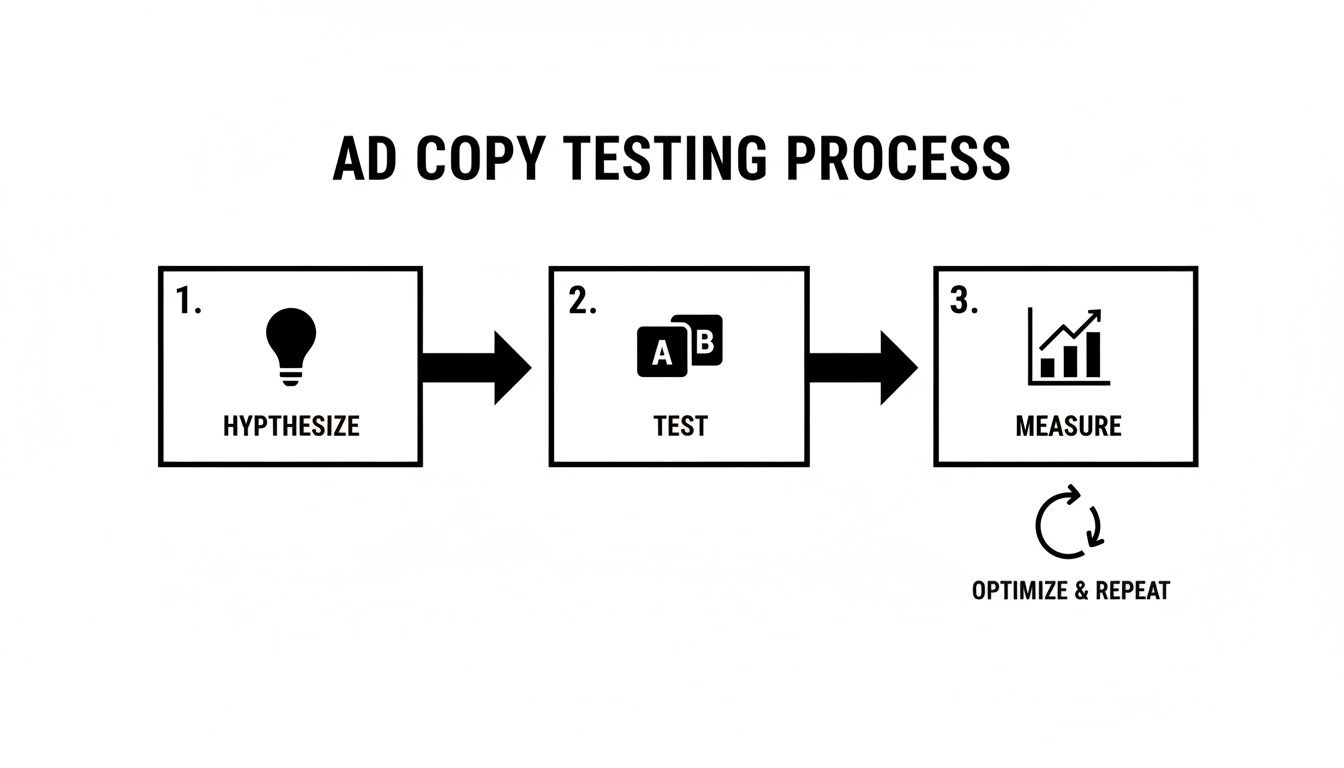
This simple loop—hypothesize, test, measure, and repeat—is the engine of every successful ad account. Winning copy isn't born from a single flash of brilliance; it’s forged in a continuous cycle of data-driven refinement.
Once you have a testing workflow in place, you can dig deeper into the metrics that matter. This guide to improving Click Through Rates is a great resource for fine-tuning your copy to get more people to click.
The biggest breakthroughs in your Google Ads performance won't come from just reading about theory. They'll come from implementing a disciplined, expert-guided optimization process.
The best place to begin is with a clear-eyed analysis of your current ads. A focused audit can immediately spot costly mistakes and highlight quick wins, giving you an immediate, tangible first step. Better yet, the insights from a strong ad strategy often ripple out, improving other critical assets like your landing pages. That’s why we also focus on landing page design best practices.
I invite you to book a complimentary consultation. Let's get a no-obligation analysis of your campaigns on the calendar and start working together to achieve the results you deserve.
Frequently Asked Questions
Jumping into Google Ads can feel like you're trying to solve a puzzle with a thousand moving pieces. It's totally normal to have questions, especially when your hard-earned money is on the line. Here are some of the most common ones I hear from business owners just like you.
Why Is My Ad Copy Not Converting?
This is the big one. More often than not, ad copy fails because it’s not connecting with a real human problem. It’s a classic mistake: you list all the cool features of your service, but you forget to tell people why it actually matters to them. You're talking about the what, but your customers only care about the why.
Another common trap is using a generic, one-size-fits-all message. A big, bloated agency might just plug your business name into a tired template they've used a dozen times. As an expert consultant, I take the time to find what makes you different and craft a message that actually resonates and stands out from the noise.
How Much Should I Spend on Google Ads?
There's no single magic number here. Your budget really depends on your industry, how competitive it is, and what you’re trying to achieve. But honestly, the more important question is how efficiently that money is being spent.
I’ve seen it time and again: $500 spent on sharp, expertly written ads can absolutely crush a $5,000 budget wasted on generic copy managed by a faceless, over-priced agency.
The goal isn’t to throw more money at the problem. It’s to get a bigger return on every single dollar you invest. An expert’s job is to maximize your Return on Ad Spend (ROAS) and make your budget work smarter, not just harder.
What Makes an Expert Consultant Different from a Large Agency?
It all comes down to two things: specialized focus and personal attention. When you sign with a large agency, your account often gets handed off to a junior employee who’s juggling way too many clients to give yours the focus it deserves. A dedicated consultant is a different game entirely.
You get direct access: You're talking to the person actually managing your campaigns, not an account manager who acts as a go-between.
Strategies are built for you: I build your strategy from the ground up, based on your specific goals and customers—no generic playbooks allowed.
The focus is on results that matter: We’re tracking leads and sales, not just vanity metrics like clicks and impressions that don't pay the bills.
At the end of the day, a consultant provides the hands-on, strategic partnership needed to drive real growth. That’s something the high-volume, assembly-line model of a big, bloated agency just can't replicate.
Ready to stop guessing and start seeing ads that actually work? At Come Together Media LLC, I bring a personalized, data-driven approach to Google Ads that’s built for real-world results. Let's build a winning strategy together.


Comments